Optimization
This original textbook reading covers part of the AP topic. Follow the AP course outline for complete topic instruction and practice.
The most practical use of a derivative
Consider that you are an engineer hired by a multi-billion dollar soda company. The company is holding a contest for manufacturing a new design for their cylindrical aluminum cans with a prize of $1 000 000. Since aluminum is a relatively expensive metal, your job is to minimize the use of this metal in manufacturing a can no larger than 20 cm high and no wider than 10 cm in diameter. Assume the can must hold 250 cm3 of soda, and the cost of aluminum is $0.001 per cm2, what should be the height and diameter for your award-winning aluminum can that would minimize the design costs?
People face problems like that every day. While those poor folks who did not learn calculus will most likely give up when they encounter a real-life problem like that, those of us who have mastered derivatives can find an optimum solution that will give us the right answer.
Optimization involves finding conditions under which a variable is either at its minimum or maximum. Hm... minimum... maximum... we already know how to do that! This should be easy. Optimization is used every day in large corporations as well as smaller businesses, as well as by you! It is used by doctors in deciding whether to put patients on pills or give them surgery, and by students to decide how much sleep they should get before studying for their exam.
Example Problem 6.2.1
You really want to win that contest! So you decide to start working on the highly efficient can that holds 250 of soda using the least amount of aluminum.
a) Find the dimensions of the cylindrical can.
b) What is the cost to manufacture one can, assuming a sheet of aluminum costs $0.001 per cm2?
c) Is this design realistic? If not, what should the dimensions be, given that the radius can’t be wider than 10 cm and the height no longer than 20 cm?
Interactive 6.2.1 Aluminum can
Loading the original 3D model…
Original preview and model
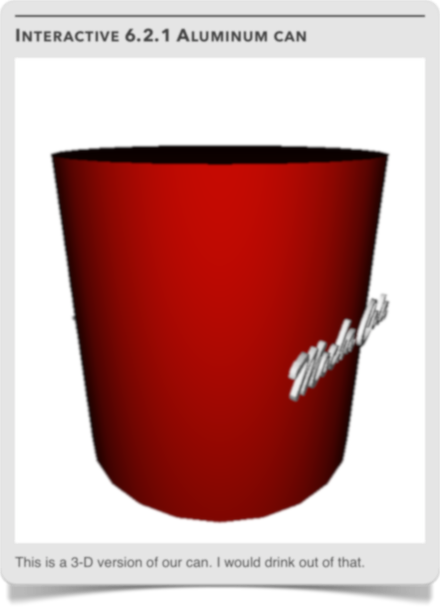
This viewer rotates the original source mesh. Lighting and controls are a web adaptation.
Download original COLLADA modelGlossary and deeper reading · 2 refreshers
These editorial refreshers supplement the reading. Definitions and examples are added guidance; original source wording and recorded answers remain in their original context.
-
Derivative
A derivative gives the instantaneous rate of change of a function with respect to its input. At a point, it is the finite limit of the difference quotient when that limit exists. For example, the derivative of x² is 2x, so the tangent slope at x=3 is 6. A derivative function collects those rates across the inputs where the function is differentiable.
-
Optimization
Optimization finds the greatest or least value of an objective while satisfying the problem’s constraints. Express the objective in suitable variables, determine the allowed domain, and compare all relevant candidates. For example, among rectangles with a fixed perimeter, writing area in terms of one side reduces the search to a one-variable problem. Endpoint and feasibility checks are part of the argument, not optional final details.