Chapter 3 Source Answers and Examples
Chapter problems → · Original reading →
Reviewed solution to Problem 5
New reviewed response for this exact prompt.
Mass=0.0300×44.01=1.3203g; density=1.3203/7.00=0.1886gL⁻¹. Pressure=nRT/V=(0.0300)(0.082057)(300)/7.00=0.1055atm. This ideal calculation explicitly replaces the unvalidated3M real-gas premise; real-gas accuracy requires appropriate conditions/data.
Reviewed solution to Problem 6
New reviewed response for this exact prompt.
R=PV/(nT)=22.414/273.15≈0.08206L atm mol⁻¹K⁻¹. The inputs must be independent measurements to test the value; a volume calculated from an assumedR cannot independently verify that sameR. Experimental uncertainty and gas nonideality limit the test.
Reviewed solution to Problem 7
New reviewed response for this exact prompt.
Each gas hasPi=niRT/V=(0.250)(0.082057)(273.15)/6.00=0.934atm. The total is1.868atm≈1.87atm. Dalton’s law sums the partial pressures; the amounts are explicitly specified.
Worked examples and reviewed revisions
Example Problem 3.1.1
Worked example
AP edition reviewed replacement.
A fixed amount of idealized gas has initial volume 100 mL. Its pressure doubles while temperature remains constant. What is its final volume?
New independently computed worked answer.
At fixed temperature and amount, Boyle’s law gives P₁V₁=P₂V₂. With P₂=2P₁, V₂=V₁/2=50 mL. This relation would not hold unchanged if the gas amount or temperature changed.
Example Problem 3.1.2
Original example and steps
Example Problem 3.1.2
Calculate the pressure of 1.5 M compressed oxygen gas at 25ºC. Find the same for compressed nitrogen gas with a density of 1.165 kg/m3.
a) It seems there is not enough information to calculate pressure, but if you recall - M, or molarity is defined at moles per liter.
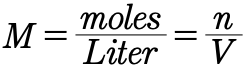
Connections like these are vital and will help further the understanding of what you are learning. Once we have this relation, we can easily rearrange the ideal gas equation and solve for pressure.

- Similarly, it looks like there is not information, but:
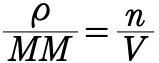
This relation is not as obvious, but works because the units of denisty and molecular weight cancel out the same way the units of number of moles and volume do. Let us calculate the molecular weight, but recall that nitrogen gas is diatomic, so its value of MM = 28.0 g/mol:

Example Problem 3.1.3
Original example and steps
Example Problem 3.1.3
What is the pressure (in atm) of 0.652 moles of oxygen gas in a 10.0 L cylinder at 30º C?
We are looking for the resulting pressure given number of moles of gas, volume, and temperature.
The ideal gas equation can be used for the calculation.
P = ?
V = 10.0 L
n = 0.652 moles
R = 0.0821
T = 30º C + 273 = 303 K
The conversion from ºC to K is: ºC + 273
0.0821 is used for R since we are dealing with L and atm
An easy manipulation of the equation and substituting its values gives:

Example Problem 3.2.1
Original example and steps
Example Problem 3.2.1
If 87.0 g of hydrogen gas that is 95% pure is reacted with excess nitrogen gas at STP, how many liters of ammonia will be produced?
The chemical equation is not given, so it is very important to write that out first and balance if necessary. Recall that both hydrogen and nitrogen gas are diatomic.
H2 (g) + N2 (g) → NH3 (g)
Then balance:
3H2 (g) + N2 (g) → 2NH3 (g)
Now we calculate using dimensional analysis:

G OF HYDROGEN → 95% PURITY → G/MOL CONVERSION

MOL/MOL CONVERSION → L OF GAS @ STP → L OF NH3
Example Problem 3.2.2
Original example and steps
Example Problem 3.2.2
A 10.0 L flask contains 4.5 g of methane gas (CH4) and 0.500 moles of hydrogen gas at 25ºC. What is the pressure inside the flask?
There are two gases inside the flask, so we have to take into account total number of moles in the same way that the Law of Partial Pressures works. It makes sense to manipulate the ideal gas law this way:
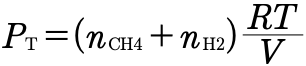
We are already given moles of hydrogen gas, so let us calculate moles of methane gas:

Calculating for total pressure:

Example Problem 3.2.3
Worked example
AP edition reviewed replacement.
Use a hypothetical sealed-vessel ideal-gas combustion model with fixed temperature and volume and all product water remaining gaseous. Initially there is 1.00 mol octane and 50.0% excess O₂. For C₈H₁₈+(25/2)O₂→8CO₂+9H₂O, find the final-to-initial pressure ratio after complete octane reaction.
New independently computed worked answer.
One mole octane requires 12.50 mol O₂; 50.0% excess gives 18.75 mol O₂ initially. Initial total gas amount is 1.00+18.75=19.75 mol. Products are 8.00 mol CO₂, 9.00 mol H₂O(g), and 18.75−12.50=6.25 mol unreacted O₂. Final total is 23.25 mol. At fixed T and V, Pfinal/Pinitial=23.25/19.75=1.177215, a 17.7% rise. Real engines involve temperature, volume and phase changes, so this is a stated model.
Example Problem 3.3.1
Worked example
AP edition reviewed replacement.
Reviewed ideal-gas replacement: estimate the pressure of CO₂ at 298.15 K with measured density 1.98 g L⁻¹. Use M=44.00 g mol⁻¹ and R=0.082057 L atm mol⁻¹ K⁻¹. This explicitly replaces the defective real-gas table calculation.
New independently computed worked answer.
Vm=M/ρ=44.00/1.98=22.2222 L mol⁻¹. In the reviewed ideal model, P=RT/Vm=(0.082057)(298.15)/22.2222=1.100959255 atm≈1.10 atm. The old 48 g mol⁻¹, raster molar-volume formula and 12.33 atm result are superseded. This estimate does not certify real-gas accuracy.
Example Problem 3.4.1
Worked example
AP edition reviewed replacement.
In a 100 cm tube, NH₃ and HCl travel from opposite ends. For a supplied ideal relative-speed ratio of 1.47, estimate where the NH₄Cl ring appears, measured from the NH₃ end.
New independently computed worked answer.
If x is the NH₃ distance, HCl travels 100−x. The supplied model gives x/(100−x)=1.47, so x=147/2.47=59.514 cm≈59.5 cm from the NH₃ end. NH₃(g)+HCl(g)→NH₄Cl(s). Real counter-diffusion and the reaction front can depart from a simple Graham-law model; Graham’s law directly describes ideal effusion.
Example Problem 3.4.2
Original example and steps
Example Problem 3.4.2
Atmospheric CO2 concentrations have increased from 280 ppmv in 1750 to 391 ppmv in 2012. What is the corresponding increase in the mass of atmospheric carbon? Assume CO2 to behave ideally. (ppmv = parts per million by volume)
We will introduce an equation just for the purpose of this problem:
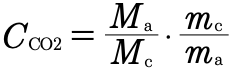
This is called the mixing ratio. It is used to calculate the mixing of one gas (carbon dioxide in this case) with air specifically.
- C is the mixing ratio
- M is the molar mass (in kilograms, kg)
- m is the total mass in atmosphere
Molar mass of air = 29 x 10-3 kg/mol
Molar mass of carbon = 12 x 10-3 kg/mol
Atmospheric mass of air = 5.2 x 10¹⁸ kg
We are given the past and current mixing ratios of CO2, and we are calculating for change in mc.
Two equations can be setup and the difference can be taken to accomplish the above, or it can be manipulated into one change equation.
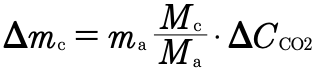

= 2.4 x 10¹⁴ kg = 530 billion tons
Of change in CO2 pollutant in the atmosphere