Diffusion and Atmospheric Chemistry
Supporting original reading. Follow the AP topic pathway for reviewed scope, worked reasoning and targeted practice.
Chemistry I · original Chapter 3 · combined Chapter 3
The final gas law we will be investigating is that of Graham’s Law. It explains rates at which gases diffuse or effuse.
- Diffusion: mixing of two substances through movement
- Effusion: molecules escaping through an orifice (hole)
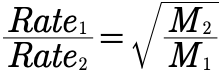
Rate is the rate of effusion for gas 1 and gas 2
M is the molar mass for gas 1 and gas 2
The same equation is used for both diffusion and effusion, and requires two gases, of which one can be air. In cases of effusion, the unknown rate of escape or effusion through a hole is compared with a known value for another gas.
Recall that air is a mixture of various gases.
Analyzing these two rates may not seem very important at first but actually have very important uses. Effusion, for example, is taken into account when creating sensors that find gas leaks. Diffusion has been used, and is still used, to purify uranium and was a crucial step in the creation of the first atomic bomb.
Example Problem 3.4.1
The ammonia/hydrogen chloride tube illustrates diffusion: gases mix through many molecular collisions. Effusion is escape through a very small opening, where the Graham-law speed comparison has a more direct model. We can use a square-root molar-mass ratio as a simplified estimate for the tube, but it is not a precise prediction of the observed ring position under every experimental condition.
The question has a lot of information, but if we look closely, we have everything we need. It is good practice to always write the reaction taking place if not given:
NH3 (g) + HCl (g) → NH4Cl (s)
Use the following idealized model: both gas fronts travel for the same time, and their speeds have ratio √(M(HCl)/M(NH₃)). The actual experiment is diffusion with collisions, so the result is an estimate. It does not mean that each gas separately travels its ratio times half the tube.
MM of NH3 = 17.0 g/mol
MM of HCl = 36.4 g/mol
Plugging into the Graham’s Law equation gives:
With the supplied rounded molar masses, v(NH₃)/v(HCl)=√(36.4/17.0)=1.463. The commonly rounded ratio 1.47 gives nearly the same estimate. This replaces the source raster formula with a readable reviewed calculation.
The lighter NH₃ front travels farther in the simplified equal-time model. When the fronts meet, NH₃(g)+HCl(g)→NH₄Cl(s) gives a visible solid ring. If the speeds were equal the meeting point would be halfway; when their speeds differ, the sum of their distances still has to equal 100 cm.
Let x be the distance in centimeters from the ammonia end. The HCl front travels 100−x. Equal travel time gives x/(100−x)=1.47, so x=147/2.47. This relation, rather than 50×1.47, divides the total tube length between the two fronts.
x=147/2.47=59.51 cm from the ammonia end, and 100−x=40.49 cm from the hydrogen chloride end. Using the less-rounded mass ratio gives about 59.4 cm. Either result is a simplified Graham-law estimate, not a guaranteed actual diffusion-ring position.
Which gas traveled further?
Gallery 1.4.1 Earth’s Atmosphere
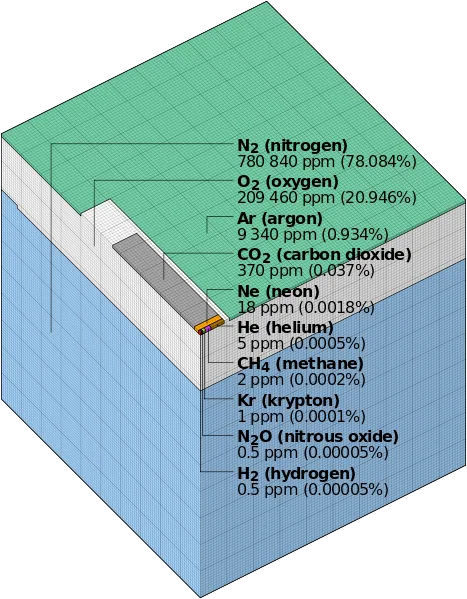
Visualization of composition by volume of Earth's atmosphere, by CMG Lee. Data is from NASA Langley.
Read all original image captions
Image 1
Visualization of composition by volume of Earth's atmosphere, by CMG Lee. Data is from NASA Langley.
Apart from problems like the one above, questions tend to be easier. Unknown gases can be identified using molar mass by their individual rates of effusion. These will appear in the end-of-section problems, but just remember that Graham’s Law equates two ratios, and molar mass can be calculated easily using inventory.
Atmospheric Chemistry
The study of the Earth’s atmosphere and its composition is called atmospheric chemistry. It is also applied to the study of the atmosphere of other planets. Often, it is applied in the environmental sciences to investigate ozone depletion, pollution, and global warming.
The following problem will introduce just one application, the increase of carbon dioxide pollutant in the atmosphere over many years.
Example Problem 3.4.2
Atmospheric CO2 concentrations have increased from 280 ppmv in 1750 to 391 ppmv in 2012. What is the corresponding increase in the mass of atmospheric carbon? Assume CO2 to behave ideally. (ppmv = parts per million by volume)
We will introduce an equation just for the purpose of this problem:
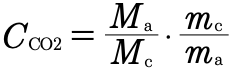
This is called the mixing ratio. It is used to calculate the mixing of one gas (carbon dioxide in this case) with air specifically.
- C is the mixing ratio
- M is the molar mass (in kilograms, kg)
- m is the total mass in atmosphere
Molar mass of air = 29 x 10-3 kg/mol
Molar mass of carbon = 12 x 10-3 kg/mol
Atmospheric mass of air = 5.2 x 10¹⁸ kg
We are given the past and current mixing ratios of CO2, and we are calculating for change in mc.
Two equations can be setup and the difference can be taken to accomplish the above, or it can be manipulated into one change equation.
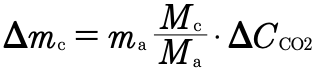

= 2.4 x 10¹⁴ kg = 530 billion tons
Of change in CO2 pollutant in the atmosphere
Chapter Problems
1. At STP, which of the following occupies the greatest volume? 44.8 L of H2 or 32.0 g of CH4.
2. If the volume of a gas at 30.0ºC and 10.0 L is reduced to 9.0 L under constant pressure. How much did the temperature decrease by?
3. A 375 mL sample of gas at 27.0ºC exerts a pressure of 1.75 atm. What pressure (in torr) would it exert if the volume is decreased to 105 mL at a constant temperature?
4. At 100ºC and a pressure of 4.865 atm, what volume (in L) would be occupied by 1.50 mole of He?
Reviewed density replacement: a sealed gas sample contains0.0300mol CO₂ in7.00L at300K. Use M(CO₂)=44.01g mol⁻¹ and the ideal model. Calculate its mass density and pressure. Mass=1.3203g, soρ=0.1886g L⁻¹; P=nRT/V=0.1055atm usingR=0.082057L atm mol⁻¹ K⁻¹. This dilute replacement does not use the source’s invalid van der Waals table or its3M loading.
Reviewed model check: an independently measured1.000mol idealized gas sample hasP=1.000atm,T=273.15K andV=22.414L. EstimateR=PV/(nT)=0.08206L atm mol⁻¹ K⁻¹, then explain why using an assumed molar volume derived from a chosenR would be circular. Experimental uncertainty and nonideality limit a real-gas determination.
Reviewed mixture replacement: a6.00L flask at273.15K contains0.250mol H₂ and0.250mol He. In the ideal-mixture model, determine each partial pressure and total pressure. Each gas givesPᵢ=nᵢRT/V=0.934atm; Ptotal=1.868atm. The amounts are explicitly specified rather than leaving0.50mol of hydrogen and helium ambiguous.
8. If a 300 L gas tank at 25.0ºC contains nitrogen, helium, and argon (partial pressures are 1.23 atm, 2.46 atm, and 3.69 atm). How many moles of each gas are present?
9. Under identical conditions, calculate the ratio of effusion of helium compared to carbon dioxide.
10. If chlorine gas effuses at a rate of 700 mL/min and an unknown gases effuses at a rate of 957 mL/min through the same orifice, what is the molar mass of the unknown gas?
Glossary and deeper reading · 4 refreshers
These editorial refreshers supplement the reading. Definitions and examples are added guidance; original source wording and recorded answers remain in their original context.
-
Diffusion
Diffusion is the net spreading of particles associated with random motion and concentration differences. Individual particles move in many directions even as the overall distribution becomes more uniform. For example, a gas initially concentrated in one part of a container spreads throughout the available space.
-
Effusion
Effusion is the escape of gas particles through an opening small enough that particle–particle collisions within the opening are negligible. Under comparable conditions, lighter gases effuse faster on average than heavier gases. For example, helium effuses faster than argon at the same temperature in the ideal model.
-
Molar mass
Molar mass is the mass of one mole of a specified substance. It is commonly expressed in grams per mole and connects a sample's mass to its amount of substance. For example, water has a molar mass of approximately 18.02 grams per mole.
-
Mixture
A mixture contains two or more substances whose proportions can vary. Its components retain their chemical identities until a chemical reaction changes them. For example, water and ethanol can form mixtures with many different compositions.