Gas Stoichiometry and Partial Pressures
Supporting original reading. Follow the AP topic pathway for reviewed scope, worked reasoning and targeted practice.
Chemistry I · original Chapter 3 · combined Chapter 3
Section 2
Gas Stoichiometry and
Partial Pressures
Gallery 1.2.1 Combining Volumes
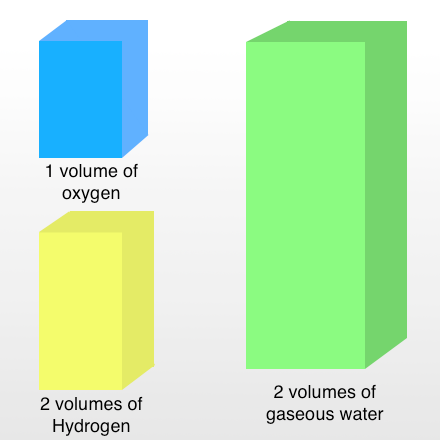
The blue ‘box’ represents 1 volume or 1 molecule of oxygen gas.
Read all original image captions
Image 1
The blue ‘box’ represents 1 volume or 1 molecule of oxygen gas.
Image 2
The yellow represents 2 volumes of hydrogen. When reacted, a whole number (2 volumes) of H2O results.
An additional relationship to note is that of Guy-Lussac’s Law. It states that, at constant temperature and pressure, the ratio between gaseous reactants and products can be expressed in whole numbers. Does it sound a bit confusing? It is actually very simple, and is sometimes referred to as the law of combining volumes.
We will use three tools in addition to those we have previously used when solving stoichiometry problems:
- Law of Combining Volumes (Guy-Lussac’s Law)
- Volume of gas at STP
- Ideal gas equation
It was noted before, but is extremely important to remember:
1 mol of gas at STP takes up 22.4 L
This applies to any gas, and 22.4 L refers to the volume the gas takes up. Also remember the ideal gas equation, pV=nRT.
Example Problem 3.2.1
If 87.0 g of hydrogen gas that is 95% pure is reacted with excess nitrogen gas at STP, how many liters of ammonia will be produced?
The chemical equation is not given, so it is very important to write that out first and balance if necessary. Recall that both hydrogen and nitrogen gas are diatomic.
H2 (g) + N2 (g) → NH3 (g)
Then balance:
3H2 (g) + N2 (g) → 2NH3 (g)
Now we calculate using dimensional analysis:

G OF HYDROGEN → 95% PURITY → G/MOL CONVERSION

MOL/MOL CONVERSION → L OF GAS @ STP → L OF NH3
The end-of-section problems will cover everything learned about gases so far, and includes a lot of the skills used when tackling stoichiometry problems in the past chapters. Use Figure 1.2.2 as a guide to move from unit to unit when finding the answer.
Dalton’s Law of Partial Pressures
The pressure of a mixture of gases is equal to the pressures of the individual gases. This should be easy to understand, and comes from the fact that there is always conservation of “stuff” and gases take up the volume of whatever container it is in.
Figure 1.2.1 Conversions including gases
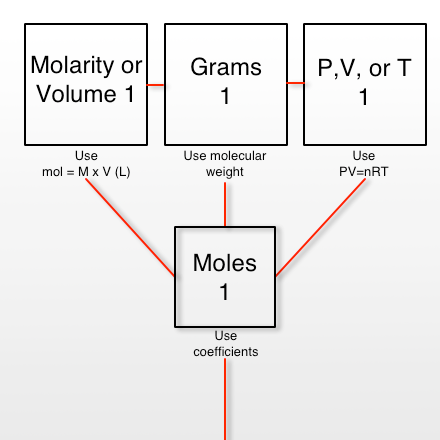
A similar flowchart like shown before, this shows the basic steps to remember when doing conversions involving gases.
Read all original image captions
Image 1
A similar flowchart like shown before, this shows the basic steps to remember when doing conversions involving gases.
TOTAL PRESSURE = PRESSURE OF GAS A + PRESSURE OF GAS B
It makes sense: if we put two gases into a container with different pressures, and they cannot escape, then the total pressure inside the container should be the same as the two pressures added up. Very important to note, partial pressure is directly proportional to moles of gas inside the container.
Total pressure is the sum of the partial pressures even if there are more than two gases.
Example Problem 3.2.2
A 10.0 L flask contains 4.5 g of methane gas (CH4) and 0.500 moles of hydrogen gas at 25ºC. What is the pressure inside the flask?
There are two gases inside the flask, so we have to take into account total number of moles in the same way that the Law of Partial Pressures works. It makes sense to manipulate the ideal gas law this way:
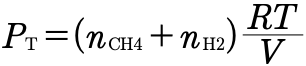
We are already given moles of hydrogen gas, so let us calculate moles of methane gas:

Calculating for total pressure:

Example Problem 3.2.3
Reviewed ideal-gas model: at fixed volume and fixed temperature, 1.00 mol octane vapor reacts completely with 50.0% excess oxygen. Use C₈H₁₈(g)+12.5 O₂(g)→8 CO₂(g)+9 H₂O(g) and assume all water remains gas. Initially there are 1.00+18.75=19.75 mol gas; afterward there are 8+9+6.25=23.25 mol. Because T and V are fixed, P is proportional to total n. The pressure increases by (23.25/19.75−1)×100%=17.72%. A real combustion in a car cylinder changes temperature and volume, so this is an explicit calculation model.
First, we write the reaction taking place to better understand what is happening:
C8H18 + O2 → H2O + CO2
Recall, this is how every combustion reaction looks like. Hydrocarbon + oxygen gas goes to water and carbon dioxide. Now, we must balance:
2C8H18 + 25O2 → 18H2O + 16CO2
If we apply the law of partial pressures, and we know that we initially have 50% excess oxygen, we can come to this result:

For the reviewed fixed-temperature, fixed-volume model, compare total gas moles: ninitial=19.75 mol and nfinal=23.25 mol. Thus Pfinal/Pinitial=23.25/19.75=1.1772. The increase is 17.72%. The relation would not describe an uncontrolled hot piston simply from these mole counts.
We are looking for change in pressure. This initial amount is before reaction, and we know we have excess (too much, leftover) oxygen. So the following can be calculated:

This takes int account the amount of oxygen actually used and takes into account moles of products after the reaction has completed, 18 moles of water and 16 moles of carbon dioxide.
To find percentage increase, we use the following equation:

Glossary and deeper reading · 3 refreshers
These editorial refreshers supplement the reading. Definitions and examples are added guidance; original source wording and recorded answers remain in their original context.
-
Stoichiometry
Stoichiometry uses a balanced chemical equation to relate amounts of reactants and products. Equation coefficients provide mole ratios rather than direct mass ratios. For example, forming water from hydrogen and oxygen consumes two moles of hydrogen molecules per mole of oxygen molecules.
-
Partial pressure
A gas's partial pressure is the pressure it would exert alone in the mixture's volume at the same temperature. In an ideal mixture, the component partial pressures add to the total pressure. For example, a component with mole fraction 0.20 contributes 0.20 of the total ideal pressure.
-
Ideal gas law
The ideal gas law relates pressure, volume, amount, and absolute temperature in an idealized gas model. It treats particles as having negligible volume and no intermolecular attractions. For example, at fixed amount and temperature, doubling the container volume halves the ideal gas pressure.