Real Gas Law
Supporting original reading. Follow the AP topic pathway for reviewed scope, worked reasoning and targeted practice.
Chemistry I · original Chapter 3 · combined Chapter 3
Section 3
Real Gas Law
The ideal gas law is a model, not a claim that particle motion is predictable rather than random. It treats particles as having negligible volume and neglects intermolecular attractions. At low density and sufficiently high temperature those assumptions often work well. At high pressure or near condensation, molecular size and attractions can produce measurable deviations.
Real gases still have random molecular motion. We can refine an ideal model when measurements show its limits. The van der Waals equation is one historical example, with corrections for attractions and excluded volume. AP Chemistry requires interpreting those effects qualitatively; the detailed equation calculations here are enrichment.

Although more complex, it should seem familiar - PV = nRT. Let us define the individual variables:
- R: ideal gas constant (the same as in Section 1)
- T: temperature
- Vm: the molar volume
- a, b: variables that are calculated for each gas
So why use this instead of the simpler ideal gas law? It allows closer approximations during calculations - neither law estimates perfectly. There are actually more complex models of the same real gas law, but the one shown above is called the Van der Waals Model.
Created by Johannes Diderik van der Waals in 1873, a Van der Waals force explains that there are secondary bonds known as intermolecular forces. These forces are not chemical but can be seen more as a physical type of attraction. An example is that of gecko feet - their feet do not create any kind of chemical bond when climbing a wall, yet they are able to scale extremely smooth surfaces and stick to it. Why? Forces between the microscopic pads of the feet and the surface itself experience secondary bonds.
Figure 1.3.1 Secondary Bonding

Much like a magnet, polar attractions form at an atomic level. They are not as strong as ionic or covalent bonds however, and are called ‘secondary bonds’.
Read all original image captions
Image 1
Much like a magnet, polar attractions form at an atomic level. They are not as strong as ionic or covalent bonds however, and are called ‘secondary bonds’.
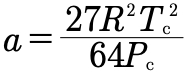
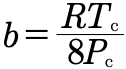
The following original parameter table is superseded for calculation: it lacks units and contains invalid negative excluded-volume values. Do not use it to certify a real-gas answer. The reviewed example below is an explicitly ideal-gas density calculation. For AP reasoning, explain attraction and particle-volume deviations using their effects on measured pressure.
Example Problem 3.3.1
Reviewed example: estimate the pressure of CO₂ at 25 °C from density 1.98 kg m⁻³ using an ideal-gas model. Use M(CO₂)=44.0 g mol⁻¹ and R=0.08206 L atm mol⁻¹ K⁻¹. Then explain why an experimental real-gas pressure may differ. This revised prompt does not use the invalid original van der Waals table.
For the reviewed ideal-density calculation, use T=298.15 K and R=0.08206 L atm mol⁻¹ K⁻¹. The stated density is 1.98 kg m⁻³=1.98 g L⁻¹. This computation is not a real-gas value obtained from the source table.
Pressure is being calculated, but how do we find molar volume, Vm?
The molar volume is Vm=M/ρ. Equivalently, n/V=ρ/M. These expressions keep units visible: (g mol⁻¹)/(g L⁻¹)=L mol⁻¹.
M is molar mass (which we have calculated easily in the past by taking inventory) and the Greek letter ‘rho’ (ρ) stands for density. To find the molar mass:
Taking inventory correctly: one carbon contributes 12.0 g mol⁻¹ and two oxygen atoms contribute 32.0 g mol⁻¹. Therefore M(CO₂)=12.0+32.0=44.0 g mol⁻¹. A single molecule has a mass in grams or u; g mol⁻¹ is a molar mass.
Molar volume is:
Vm=44.0/1.98=22.22 L mol⁻¹. Do not use the original raster’s inconsistent molar-mass value.
Finally, pressure will be:
For the reviewed ideal model, P=ρRT/M=(1.98×0.08206×298.15)/44.0=1.10096 atm≈1.10 atm. Real-gas attractions and volume effects can shift the measured value; this answer follows only from the stated ideal approximation.
Glossary and deeper reading · 5 refreshers
These editorial refreshers supplement the reading. Definitions and examples are added guidance; original source wording and recorded answers remain in their original context.
-
Real-gas behavior
Real-gas behavior includes effects of particle attractions and particle volume that the ideal gas law neglects. Those effects compete, so actual pressure can fall below or rise above the ideal prediction under different conditions. For example, attraction can lower pressure while excluded particle volume can raise it under strong compression.
-
Ideal gas law
The ideal gas law relates pressure, volume, amount, and absolute temperature in an idealized gas model. It treats particles as having negligible volume and no intermolecular attractions. For example, at fixed amount and temperature, doubling the container volume halves the ideal gas pressure.
-
Condensation
Condensation is a phase change from gas to liquid. It releases energy to the surroundings as particles form more closely associated liquid arrangements. For example, water vapor condensing on a cooler surface forms liquid droplets.
-
Intermolecular force
Intermolecular forces are interactions between molecules. They affect properties such as boiling point and solubility and are distinct from the bonds within each molecule. For example, vaporizing water separates molecules while largely preserving their O–H bonds.
-
Mole
A mole is an amount of substance containing exactly 6.02214076 × 10²³ specified entities. The entities can be atoms, molecules, ions, or formula units, so the counted entity must be named. For example, one mole of oxygen molecules contains two moles of oxygen atoms.