Gas Laws
Supporting original reading. Follow the AP topic pathway for reviewed scope, worked reasoning and targeted practice.
Chemistry I · original Chapter 3 · combined Chapter 3
Section 1
Gas Laws
Certain substances, both elements and compounds, exist as gases in standard laboratory conditions. This should not be confused with STP (standard temperature and pressure), since a laboratory usually operates at room temperature (25º C) and pressure at sea level (760 torr or 1 atm).
Some common substances that exist as gases include hydrogen H2, oxygen O2, nitrogen N2, and carbon dioxide CO2 to name a few. As mentioned before when studying phases of matter, gases exhibit certain properties:
- Gases can be compressed into smaller volumes. If too much pressure is applied, it can change into a liquid or solid.
- They have no definite shape or volume and will fit whatever container it is in.
- Can expand with no limit and completely fills the volume of its container.
- Can mix (or diffuse) into each other.
- Have low densities.
Amounts of gases can be quantified using temperature, pressure, volume, and number of moles of gas present. Temperature is measured in Kelvin (K), volume is measured in liters (L), and number of moles is denoted with the letter n.
Pressure is defined as force per unit area. There are various common units of pressure:
1.00 atm = 760 torr = 760 mmHg = 1.01 x 10⁵ Pa = 1.01 bar
atmosphere - Torr - millimeters of Mercury - Pascals - bar
Gallery 1.1.1 Barometer
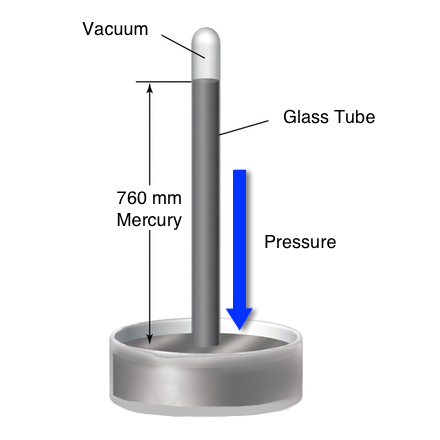
A barometer works by having a glass tube in vacuum with liquid mercury at its base. When pressure changes, the mercury climbs up the tube. The distance it travels at standard atmosphere (1 atm) is 760 mm.
Read all original image captions
Image 1
A barometer works by having a glass tube in vacuum with liquid mercury at its base. When pressure changes, the mercury climbs up the tube. The distance it travels at standard atmosphere (1 atm) is 760 mm.
The following three gas laws provide relationships and proportionalities between the different variables that affect gases - temperature, pressure, volume, and moles of gas.
Boyle’s Law
Volume is inversely proportional to pressure. If volume increases, pressure decreases.

Charles’ Law
Volume is proportional to temperature. Either increases if the other increases.

Avogadro’s Law
Volume is proportional to number of moles of gas. Either increases if the other increases.

Whatever variable not mentioned in each law is considered to be held constant.
Example Problem 3.1.1
If the pressure of a gas is doubled, what will happen to its volume?
Boyle’s law compares a fixed amount of gas at constant temperature. Under its ideal model, doubling pressure halves volume: P₁V₁=P₂V₂. Temperature and amount are not disregarded; they are controlled. If either changes, use the appropriate full gas-law relation instead.
A more often used law was created using the previous laws, and is called the ideal gas equation.
PV = nRT
The only new variable introduced in this equation is the gas constant, R. There are many values of R depending on units, but the following table includes the most commonly used.
| Values of R | Units |
|---|---|
| 0.0821 | L•atm/mole•K |
| 62.4 | L•torr/mole•K |
| 8.314 | J/mole•K |
Choose a value of R that matches every unit in your calculation. With pressure in atm, volume in L, amount in mol and temperature in K, R≈0.08206 L atm mol⁻¹ K⁻¹. With pressure in Pa and volume in m³, R≈8.314 J mol⁻¹ K⁻¹. An atmosphere, abbreviated atm, is a pressure unit; it is not an atom count. Convert Celsius to kelvin before using the gas law.
In the convention used here, STP means 0 °C (273.15 K) and 1 atm. One mole of an ideal gas then occupies about 22.4 L. Specify the convention: some references use 1 bar instead, and a different temperature or pressure gives a different molar volume. “One mole occupies 22.4 L” is not a general rule for all conditions.
Example Problem 3.1.2
Calculate the pressure of 1.5 M compressed oxygen gas at 25ºC. Find the same for compressed nitrogen gas with a density of 1.165 kg/m3.
a) It seems there is not enough information to calculate pressure, but if you recall - M, or molarity is defined at moles per liter.
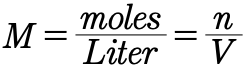
Connections like these are vital and will help further the understanding of what you are learning. Once we have this relation, we can easily rearrange the ideal gas equation and solve for pressure.

- Similarly, it looks like there is not information, but:
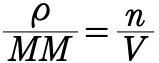
This relation is not as obvious, but works because the units of denisty and molecular weight cancel out the same way the units of number of moles and volume do. Let us calculate the molecular weight, but recall that nitrogen gas is diatomic, so its value of MM = 28.0 g/mol:

Example Problem 3.1.3
What is the pressure (in atm) of 0.652 moles of oxygen gas in a 10.0 L cylinder at 30º C?
We are looking for the resulting pressure given number of moles of gas, volume, and temperature.
The ideal gas equation can be used for the calculation.
P = ?
V = 10.0 L
n = 0.652 moles
R = 0.0821
T = 30º C + 273 = 303 K
The conversion from ºC to K is: ºC + 273
0.0821 is used for R since we are dealing with L and atm
An easy manipulation of the equation and substituting its values gives:

Glossary and deeper reading · 2 refreshers
These editorial refreshers supplement the reading. Definitions and examples are added guidance; original source wording and recorded answers remain in their original context.
-
Diffusion
Diffusion is the net spreading of particles associated with random motion and concentration differences. Individual particles move in many directions even as the overall distribution becomes more uniform. For example, a gas initially concentrated in one part of a container spreads throughout the available space.
-
Mole
A mole is an amount of substance containing exactly 6.02214076 × 10²³ specified entities. The entities can be atoms, molecules, ions, or formula units, so the counted entity must be named. For example, one mole of oxygen molecules contains two moles of oxygen atoms.