Chapter 1 Source Answers and Examples
Chapter problems → · Original reading →
This chapter has no answer key. Its worked examples follow.
Worked examples and reviewed revisions
Example Problem 1.1.1
Worked example
Example Problem 1.1.1
What would a substance consisting of both sodium and chloride atoms be classified as?
Sodium and chlorine are elements; chloride is the name of the negatively charged chlorine ion, Cl⁻. In sodium chloride, Na⁺ and Cl⁻ ions are chemically combined in a fixed 1:1 ratio in an ionic lattice. This compound is table salt. Simply placing different elements together does not necessarily make a compound: a mixture can have variable proportions without new chemical bonds forming.
Example Problem 1.1.2
Original short answer
Example Problem 1.1.2
What is the smallest component of any given substance?
The atom, but we have established there are smaller subatomic particles (and more beyond the scope of chemistry)
Example Problem 1.2.1
Original short answer
Example Problem 1.2.1
Water vapor is put into a flask. Explain how it behaves inside in its physical state.
Water vapor is a gas, that means it takes the shape and volume of its container. If the flask measured 100 mL, then the volume of the gas would also be 100 mL.
Example Problem 1.2.2
Original example and steps
How could you change molten steel into a solid steel bar?
Molten steel is a liquid, so to change it into a solid, it must be cooled down. This is a well-known process for many metals called metal casting.
Example Problem 1.3.1
Original short answer
Example Problem 1.3.1
What group, period, and if applicable, title apply to Xenon (Xe)?
Xenon can be found in Group VIIIA (8A), Period 5, and is one of the noble gases.
Example Problem 1.3.2
Original short answer
Example Problem 1.3.2
What can you say about the element Sodium (Na) with respect to its group name, period, and properties?
Sodium can be found in Group IA and Period 3. It is a metal (is hard and ductile), exists normally as a solid and is one of the alkali metals.
Gallery 1.3.2 How to count the valence/outermost electrons of an element
Original example and steps
Gallery 1.3.2 How to count the valence/outermost electrons of an element
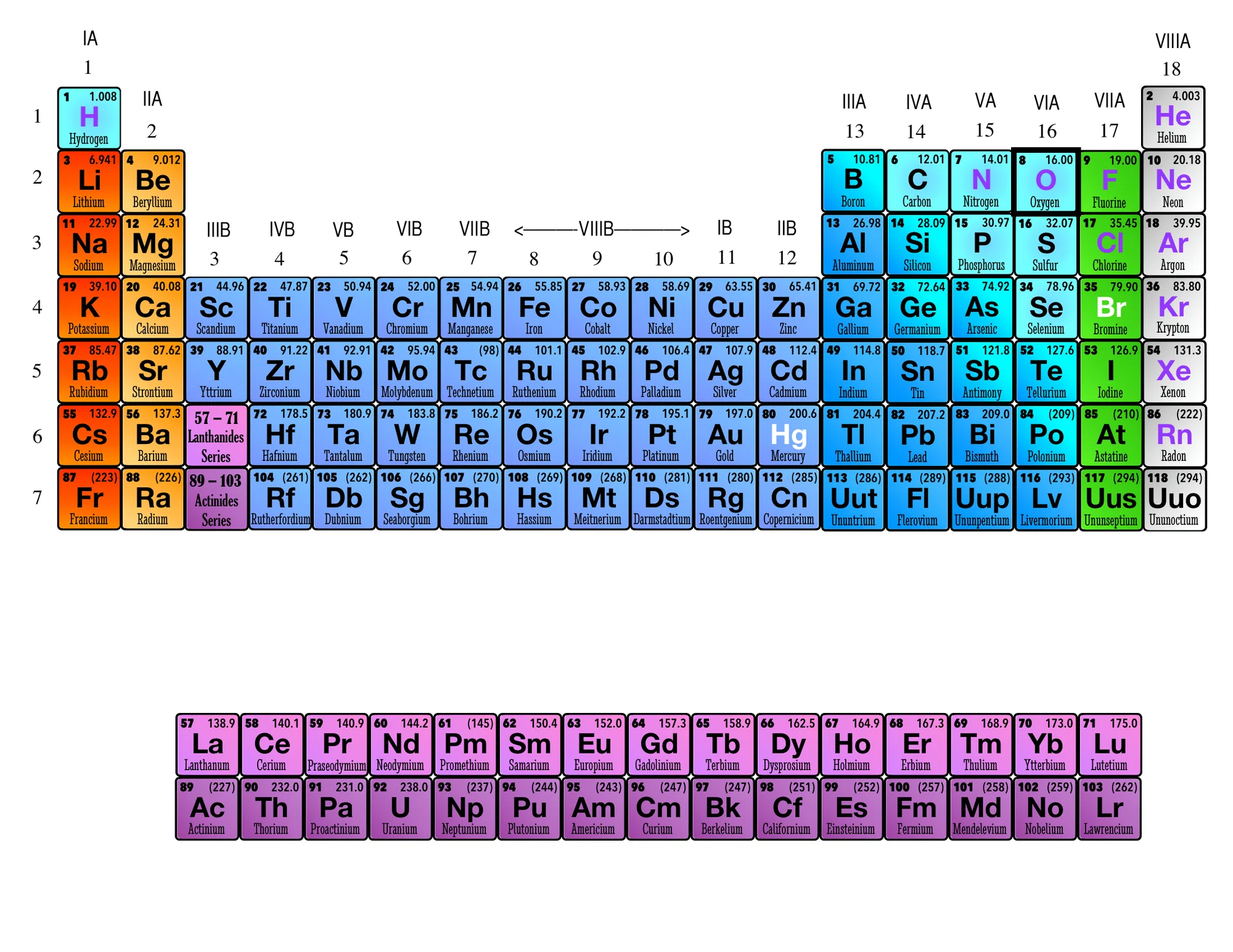
Suppose we want to know, how many valence electrons does Oxygen have?
Read all original image captions
Image 1
Suppose we want to know, how many valence electrons does Oxygen have?
Image 2
We start counting from the left from its row/period, and keep going until we get to the element of interest.
Image 3
Now suppose we wanted to know, how many valence electrons does Iodine have?
Image 4
When counting for Iodine, we have to skip over the d-block elements because the d-electrons are “shielded” by the p orbitals.
Example Problem 1.4.1
Worked example
Example Problem 1.4.1
What would be the compound formed if we reacted Magnesium metal with Oxygen gas? Write its chemical formula.
Magnesium is a Group 2 element and commonly forms Mg²⁺; oxygen forms the oxide ion O²⁻ in magnesium oxide. One Mg²⁺ and one O²⁻ balance to zero net charge: (+2) + (−2) = 0. The simplest whole-number ion ratio is 1:1, so the formula is MgO, magnesium oxide. This formula describes an extended ionic solid, not a discrete MgO molecule. Adding the valence-electron counts of two neutral atoms does not establish the ion ratio. The balanced reaction is 2Mg(s) + O₂(g) → 2MgO(s).
Example Problem 1.4.2
Original short answer
Example Problem 1.4.2
What compound is formed when Calcium is reacted with Chlorine gas? Write its molecular formula and name the compound.
Calcium has 2 valence electrons and Chlorine has 7. Calcium has one more electron than what Chlorine needs, so two chlorine atoms will react with Calcium to form CaCl2. This compound is called Calcium Chloride.
Example Problem 1.4.3
Original example and steps
Example Problem 1.4.3
What compound is formed when Aluminum is reacted with Oxygen? Write its molecular formula and name the compound.
Aluminum has 3 valence electron. Oxygen needs 2.
-Two Oxygen atoms won’t work, because they will need 4 electrons and Aluminum only has 3.
-Say we bring in another Aluminum atom, so now we have 6 electrons to give. 3 Oxygen atoms will happily take these 6.
-The final compound ends up being Al2O3. Each Al atom gives 3 electrons and each O atom accepts 2. Win-win!
Example Problem 1.4.4
Original short answer
Example Problem 1.4.4
What would be the compound name for water? (H2O)?
There are two hydrogen and one oxygen atoms. The name would be dihydrogen monoxide.
Example Problem 1.4.5
Original short answer
Example Problem 1.4.5
Name the compound: (NH4)2SO4.
NH4+is the polyatomic ion, ammonium. SO42- is the oxyanion, sulfate. The compound name would be: ammonium sulfate. Note: