Predicting and naming compounds
Supporting original reading. Follow the AP topic pathway for reviewed scope, worked reasoning and targeted practice.
Chemistry I · original Chapter 1 · combined Chapter 1
Section 4
Predicting and naming compounds
We were introduced to valence electrons in the previous section, and now we are going to try to predict reactions based on the number of valence electrons present. First, let’s get some definitions out of the way.
A compound is formed when different elements are combined, and there are two different types:
Covalent compound: The elements that react are non-metals. (H2O, CO2, NO3)
Ionic compound: Ionic compounds usually occur when a metal reacts with a non-metal. (NaCl, Fe2S3, CsF)
We should now become more familiar with what a chemical formula looks like. This tells us what a substance is composed of, and in what ratio it occurs. If there are any subscripts (numbers below and to the right of an element), they tell us how many atoms of that element are present.
An ionic solid is an extended arrangement of positive and negative ions, rather than a collection of separate molecules. We use a formula unit to state the smallest whole-number ion ratio. NaCl means one Na⁺ for every Cl⁻; Al₂O₃ means two Al³⁺ for every three O²⁻. In each case the total positive and negative charge balances.
Example Problem 1.4.1
What would be the compound formed if we reacted Magnesium metal with Oxygen gas? Write its chemical formula.
Magnesium is a Group 2 element and commonly forms Mg²⁺; oxygen forms the oxide ion O²⁻ in magnesium oxide. One Mg²⁺ and one O²⁻ balance to zero net charge: (+2) + (−2) = 0. The simplest whole-number ion ratio is 1:1, so the formula is MgO, magnesium oxide. This formula describes an extended ionic solid, not a discrete MgO molecule. Adding the valence-electron counts of two neutral atoms does not establish the ion ratio. The balanced reaction is 2Mg(s) + O₂(g) → 2MgO(s).
Example Problem 1.4.2
What compound is formed when Calcium is reacted with Chlorine gas? Write its molecular formula and name the compound.
Calcium has 2 valence electrons and Chlorine has 7. Calcium has one more electron than what Chlorine needs, so two chlorine atoms will react with Calcium to form CaCl2. This compound is called Calcium Chloride.
Example Problem 1.4.3
What compound is formed when Aluminum is reacted with Oxygen? Write its molecular formula and name the compound.
Aluminum has 3 valence electron. Oxygen needs 2.
-Two Oxygen atoms won’t work, because they will need 4 electrons and Aluminum only has 3.
-Say we bring in another Aluminum atom, so now we have 6 electrons to give. 3 Oxygen atoms will happily take these 6.
-The final compound ends up being Al2O3. Each Al atom gives 3 electrons and each O atom accepts 2. Win-win!
| Prefix | Number |
|---|---|
| Mono- | 1 |
| Di- | 2 |
| Tri- | 3 |
| Tetra- | 4 |
| Penta- | 5 |
| Hexa- | 6 |
| Hepta- | 7 |
| Octa- | 8 |
| Nona- | 9 |
| Deca- | 10 |
Use the numerical prefixes for binary molecular compounds, but omit mono- from the first element when there is just one atom of it. The second element takes its numerical prefix and an -ide ending: CO is carbon monoxide, and CO₂ is carbon dioxide. Conventional vowel contractions give names such as monoxide and tetroxide. We change the name, not the formula or the atom counts.
Example Problem 1.4.4
What would be the compound name for water? (H2O)?
There are also very common compounds that very often found in nature, for that reason they were given their own names. These polyatomic ions cannot be named using the prefixes, so they have to be memorized.
There are two hydrogen and one oxygen atoms. The name would be dihydrogen monoxide.
NH4+ | ammonium | O22- | peroxide |
OH- | hydroxide* | C2H3O2- | acetate |
CN- | cyanide | C2O42- | oxalate |
SCN- | thiocyanate | CrO42- | chromate |
MnO4- | permanganate | Cr2O72- | dichromate |
HCO3- | bicarbonate | ClO4- | perchlorate |
NO2- | nitrite | ClO2- | chlorite |
SO32- | sulfite | SO22- | hyposulfite |
Polyatomic ions have a charge for the whole bonded group. Their formulas combine in ratios that make an ionic compound electrically neutral. For example, NH₄⁺ and NO₃⁻ form NH₄NO₃, ammonium nitrate, while two NH₄⁺ ions balance one SO₄²⁻ ion in (NH₄)₂SO₄. The parentheses show that the entire ammonium group occurs twice. An aqueous ammonia solution is often informally called ammonium hydroxide, but NH₄OH is not a good example of a separate strong-electrolyte salt.
One trick to help remember the names is the prefixes and suffixes. Anything ending in -ate usually has 3 or 4 Oxygens, and a charge of -2 or -3. Once you memorize how many oxygens and charge the -ate molecule has, the rest is easy hypo- < -ite < -ate < per- . This lists the prefixes and suffixes according to an increasing number of Oxygen atoms in the polyatomic ion.
A formula can suggest a familiar acid or base, but the presence of H or OH alone does not establish acid/base behavior. In a Brønsted–Lowry reaction an acid donates a proton and a base accepts one. HCl in water behaves as an acid, NaOH supplies hydroxide as a base, and CH₃OH contains an OH group without behaving as a strong hydroxide base. Always consider the species and reaction.
The label (aq) means aqueous: dissolved in water. It is different from (l), which labels a pure liquid phase. HCl(g) is hydrogen chloride gas; HCl(aq) is its aqueous acid solution, called hydrochloric acid. The phase label changes the chemical context even though the formula looks familiar.
| Pure Gas | Aqueous Solution |
| HF (g) - hydrogen fluoride | HF (aq) - hydrofluoric acid |
| HCl (g) - hydrogen chloride | HCl (aq) - hydrochloric acid |
H2S (g) - hydrogen sulfide | H2S (aq) - hydrosulfuric acid |
| HI (g) - hydrogen iodide | HI (aq) - hydroiodic acid |
(g) denotes gas phase and (aq) denotes aqueous phase.
Example Problem 1.4.5
Name the compound: (NH4)2SO4.
Gallery 1.4.1 Oxyanions
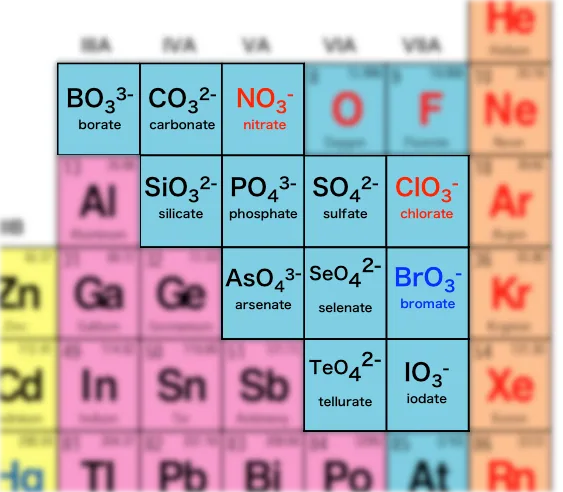
Edited to include oxyanion formulas and names.
Read all original image captions
Image 1
Edited to include oxyanion formulas and names.
NH4+is the polyatomic ion, ammonium. SO42- is the oxyanion, sulfate. The compound name would be: ammonium sulfate. Note:
One final addition to our list of compound name is that of oxyanions. An oxyanion is simply a polyatomic anion (Section 1: an ion with a negative charge) that contain oxygen and a non-metal.
Chapter Problems
- What type of a mixture is milk? If colloid, name the specific type of colloid.
- What percent of the total electrons in Br are valence electrons?
- You can change from physical states using __ and __.
- The phase transition in which I2 (s) is converted into I2 (g) is called ____. In order to have this change, the I2 (s) must be ____.
- Which elements naturally exist as diatomic molecules?
- What is the symbol of the element containing 21 protons and 20 electrons?
- How many protons, electrons, and neutrons are present in 48Ti2+?
- The name for P4S7 is:
- The name for H2S (g) is:
- Which element has a greater ability to attract a shared pair of electrons, F or Br
Glossary and deeper reading · 3 refreshers
These editorial refreshers supplement the reading. Definitions and examples are added guidance; original source wording and recorded answers remain in their original context.
-
Valence electron
Valence electrons are the electrons most directly involved in an atom's bonding and chemical behavior. For main-group atoms, they occupy the highest occupied principal shell. For example, neutral chlorine has seven valence electrons, helping explain its tendency to form a chloride ion.
-
Ion
An ion is an atom or group of atoms with a net electric charge. Ordinary ion formation changes electron count without changing the element's proton count. For example, a sodium atom losing one electron becomes a sodium ion with charge +1.
-
Formula unit
A formula unit specifies the simplest whole-number ratio of ions in an ionic compound. It is a counting unit for an extended solid rather than an isolated molecule. For example, one calcium chloride formula unit represents one calcium ion and two chloride ions.