Matter
Supporting original reading. Follow the AP topic pathway for reviewed scope, worked reasoning and targeted practice.
Chemistry I · original Chapter 1 · combined Chapter 1
Section 1
Matter
Interactive 1.1.1 Classification of Matter
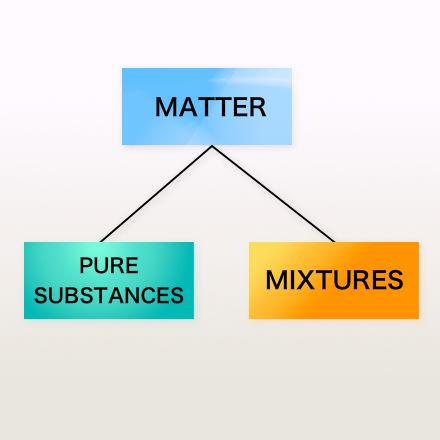
Read all original figure notes
Pure Substances
Pure Substances can be further classified into elements (listed on the Periodic Table) or compounds, such as salt, chalk, etc.
Mixtures
Mixtures are usually a combination of pure substances. Mixtures that are the same throughout are homogeneous. If there is some kind of separation, it is called heterogeneous.
(Sugar water vs. oil and water)
An atom is the smallest unit that retains the identity of an element. Different substances are made from different kinds of particles: an oxygen molecule has two oxygen atoms, while sodium chloride is an extended arrangement of ions. Inside an atom, a tiny positive nucleus contains protons and, except for the most common hydrogen isotope, neutrons. Electrons occupy quantum states around the nucleus. We describe their likely locations with orbitals, rather than little planetary paths.
Interactive 1.1.2 Gold Foil Experiment
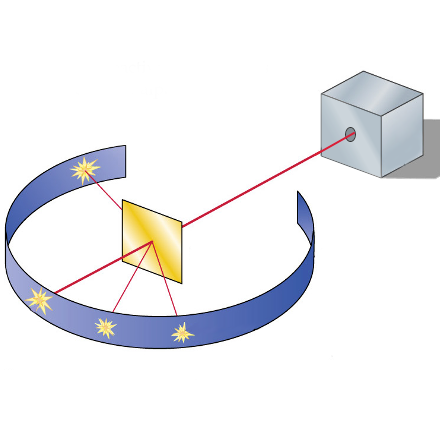
Read all original figure notes
Deflected particles
Some of the heavy alpha particles were deflected. From calculations, it was found there was a heavy central area in the gold foil, the nucleus. Additionally, since it could deflect beta particles, it was positively charged.
Thin Gold Foil
A very thin sample of gold foil, with a thickness of only a few atomic radii. This thinness of the foil allowed most of the particles to pass right through.
Alpha Particle Beam
Beam of alpha particles - heavy radioactive particles about 8,000 times heavier than an electron. They carry a positive charge.
Rutherford and Bohr together made the Rutherford-Bohr atomic model, which is still used today.
During the experiment, some alpha particles were reflected right back at the observer, leading Rutherford to comment on the shocking nature of the experimental results, that “it was like shooting a bullet at a piece of tissue paper, and the bullet bounced back and hit you.”
The Four States of Matter
All forms of matter, whether compounds, elements, or mixtures, exist in a state of being either solids, liquids, gases, or plasma.
Solids are rigid, have a fixed shape, and fixed volume.
Liquids have a fixed volume, but no fixed shape. They assume the shape of the container they are placed in.
Gases have neither a fixed shape nor a fixed volume. They can expand or contract depending on the pressure and volume, and follow their own set of rules, discussed in Chapter 3.
There is also a state called plasma. A plasma contains enough mobile electrons and ions to respond strongly to electric and magnetic fields. It may be only partly ionized; not every electron has to be stripped from every atom. Although it contains charged particles, a large plasma can be approximately neutral overall because positive and negative charges balance. Lightning and many stars give us examples.
Pure Substances and Mixtures
As discussed earlier, pure substances can be either elements or compounds. Chlorine gas is an example of an element. Table salt is an example of a compound. Both of them are pure substances.
This is because no matter how hard we try to break the salt, it will always stay NaCl. Sugar is also a pure substance.
Is Iron a pure substance? What about steel?
As opposed to pure substances, mixtures are a combination of two or more pure substances that do not react with each other. In our everyday life, most substances we encounter are mixtures. Depending on which state of matter these substances are in, each mixture can have a different name.
A solution is a homogeneous mixture: at the scale of a representative sample, its composition is uniform. The solvent is the medium in which solutes are dispersed. Water with dissolved salt is familiar, but solutions can also be gases or solids. Air is a gas mixture, and some alloys are solid solutions. A gas such as carbon dioxide can be a solute in liquid water. Do not use the word solution as a synonym for liquid.
| Term | Definition |
|---|---|
| Element | A pure substance made up of a single type of atom |
| Compound | A pure substance made up of two or more elements |
| Solution | A homogeneous mixture made of a solute and a solvent |
| Solute | The compound or element being dissolved |
| Solvent | The substance that the solute is dissolved in |
| Alloy | A solution of two or more metals |
Interactive 1.1.3 An Atom
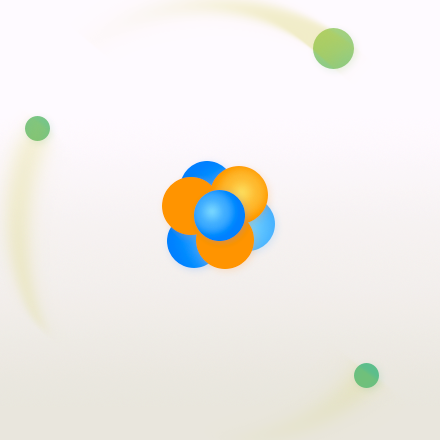
Read all original figure notes
The Electron
A negatively charged particle, it surrounds the nucleus in what is known as an “electron cloud”
The Nucleus
Composed of protons and neutrons, it makes up most of the mass of the atom.
The Proton and
Neutron
The positive and
neutrally charged
particles.
Term Definition Suspension A heterogeneous mixture where setting can occur over time (ex: sand in water) Emulsion A suspension (usually liquid in liquid) with distinctly different phases (ex: oil in water) Colloid A heterogeneous mixture that is so fine that it almost looks homogeneous (ex: milk, paint)
Different types of colloids
Colloids can be further subdivided based on their bulk material’s phase and suspended material’s phase.
| Bulk phase | Suspended phase | Name |
|---|---|---|
| Gas | Liquid | Aerosol (ex: fog) |
| Gas | Solid | Aerosol (ex: dust) |
| Liquid | Gas | Foam (ex: shaving foam) |
| Liquid | Liquid | Emulsion (ex: salad dressing) |
| Liquid | Solid | Sol (ex: blood) |
| Solid | Gas | Foam (ex: styrofoam) |
| Solid | Liquid | Gel (ex: cheese) |
| Solid | Solid | Sol (ex: glass) |
Note: Some of the names are repeated (Sol, foam, and aerosol), so in order to distinguish the different types, they are often referred to by their distinguishing phase (solid or liquid).
Example Problem 1.1.1
What would a substance consisting of both sodium and chloride atoms be classified as?
Sodium and chlorine are elements; chloride is the name of the negatively charged chlorine ion, Cl⁻. In sodium chloride, Na⁺ and Cl⁻ ions are chemically combined in a fixed 1:1 ratio in an ionic lattice. This compound is table salt. Simply placing different elements together does not necessarily make a compound: a mixture can have variable proportions without new chemical bonds forming.
Elements usually exist as a single atom. Simply put, they are all the “flavors” that atoms come in, and as far as we know, the ones that have been found are the only ones that exist in the universe. They each have their individual configurations and typically hold a neutral net charge. That means that there is an equal number of protons compared to electrons. However, there are cases where they are not equal. Atoms that experience this are called ions.
Let us suppose we have an atom that has 1 electron and 1 proton (for now we disregard the neutron because it would not affect the net charge). Think of it like this, -1 + 1 = 0, therefore no charge. If this atom lost that 1 electron, it would become positively charged - a cation. Similarly, if the original atom gained an electron, it would become negatively charged - an anion.
When an atom loses electrons, it becomes more positive.
Example Problem 1.1.2
What is the smallest component of any given substance?
The atom, but we have established there are smaller subatomic particles (and more beyond the scope of chemistry)
This mystery atom, however, is that of hydrogen. It is an element that is found everywhere, and is theorized to make up 75% of the universe. It is in your body, it is in water, it is in the sun and is one of the most important ingredients in keeping it burning.
The negatively charged hydrogen ion is denoted as H-, also known as hydride. The positively charged hydrogen is similarly written as H+. We will review element naming when the periodic table is introduced, but the concept of writing the charge above the element symbol is easy to grasp. For example, an atom of chromium that lost 3 electrons is written as Cr+3.
Apart from ions, an element might also exist with a neutral charge (equal number of protons and electrons), but a differing number of neutrons. This will result in an isotope. These isotopes exhibit different properties, different uses, and have different masses.
We will later revisit the idea of ions, isotopes, and atomic particles (neutrons, protons, and electrons) and see that they control many properties of whatever piece of matter they are a part of.
Pop Quiz 1.1.1
Question 1 of 5 · 0 correct
Organize the following types of matter:
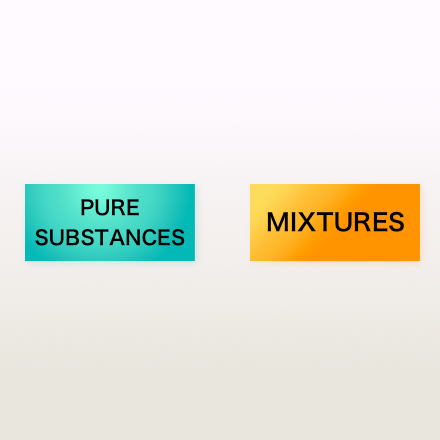 1234
Glossary and deeper reading · 6 refreshers
These editorial refreshers supplement the reading. Definitions and examples are added guidance; original source wording and recorded answers remain in their original context.
-
Ion
An ion is an atom or group of atoms with a net electric charge. Ordinary ion formation changes electron count without changing the element's proton count. For example, a sodium atom losing one electron becomes a sodium ion with charge +1.
-
Isotope
Isotopes are atoms of the same element with different numbers of neutrons. They have the same proton number but different masses. For example, carbon-12 and carbon-13 each have six protons but have six and seven neutrons, respectively.
-
Mixture
A mixture contains two or more substances whose proportions can vary. Its components retain their chemical identities until a chemical reaction changes them. For example, water and ethanol can form mixtures with many different compositions.
-
Pure substance
A pure substance has one chemical identity and a fixed composition. It may be an element or a compound, so containing more than one element does not make it a mixture. For example, pure water contains hydrogen and oxygen in a fixed ratio.
-
Solvent
A solvent is the component used as the dissolving medium in a solution. It is often present in the greater amount, though the designation also depends on the mixture's context. For example, water is the solvent in a dilute aqueous sugar solution.
-
Solute
A solute is a component dispersed in a solvent to form a solution. It need not be a solid, and a solution need not be liquid. For example, carbon dioxide is a gaseous solute in carbonated water.