States of matter
Supporting original reading. Follow the AP topic pathway for reviewed scope, worked reasoning and targeted practice.
Chemistry I · original Chapter 1 · combined Chapter 1
Section 2
States of matter
Interactive 1.2.1 Arrangement of atoms

Atoms in a solid are closely packed and organized, not
allowing for much movement. A solid has a fixed shape and a fixed volume.
Read all original image captions
Image 1
Atoms in a solid are closely packed and organized, not
allowing for much movement. A solid has a fixed shape and a fixed volume.
Image 2
Atoms in a liquid have more energy and freedom to move around. A liquid usually has a fixed volume but no fixed shape. It adopts the shape of its container.
Image 3
Atoms in a gas are very energetic and move around very freely, they take up the space of whatever its in. A gas has neither a fixed shape nor a fixed volume.
Gallery 1.2.1 Phase Transitions
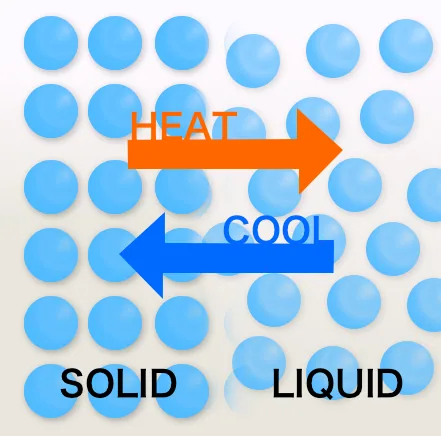
To change from solid to liquid, temperature change is needed.
Read all original image captions
Image 1
To change from solid to liquid, temperature change is needed.
Image 2
Change from liquid to gas can either be through temperature or pressure changes.
Image 3
Terms for common phase transitions.
Temperature and pressure both affect state changes. At high temperatures, molecules have more energy and thus more freedom to move around. At high pressures, molecules are more constrained.
For example, the conditions for these changes in water are well known. When water reaches its melting point, 0°C, it changes from solid to liquid. When it reaches its boiling point of 100°C, it changes from liquid to gas.
Some characteristics of each state include:
Solid: is rigid and does not take either the shape or volume of container it is in.
Liquid: flows and takes up the shape, but not the volume, of that container it is in.
Gas: expands and takes up both the shape and the volume of the container it is in.
Example Problem 1.2.1
Water vapor is a gas, that means it takes the shape and volume of its container. If the flask measured 100 mL, then the volume of the gas would also be 100 mL.
As mentioned before, temperature and pressure greatly influence phase transitions, or the change from one phase (physical state) to another.
It should become clearer through the images that: lowering energy moves matter to a more ordered state (i.e. solid). Adding heat is giving energy to a system, whereas cooling a system takes away energy. A highly pressurized system is usually more ordered than a low pressurized system because the molecules are held more tightly together. These concepts are reinforced in Chapter 8 (Thermodynamics) but it is good to have a conceptual understanding.
Gallery 1.2.2 Pressure Transitions

Imagine you had a piston-like container filled with gas.
Read all original image captions
Image 1
Imagine you had a piston-like container filled with gas.
Image 2
As you press down (adding a lot of pressure) the gas will condense into a liquid.
Image 3
As you increase the pressure even more by pushing the piston down, the liquid will be forced into a solid.
How could you change molten steel into a solid steel bar?
Molten steel is a liquid, so to change it into a solid, it must be cooled down. This is a well-known process for many metals called metal casting.
The Fourth State of Matter
A fourth state of matter that was understood only recently is known as plasma. It is the most common fundamental state of matter found in the universe (though not on Earth). A gas becomes a plasma when it is heated so much that its electrons stop being restricted to a specific electron cloud and just start flying around everywhere!
This gives plasmas a property that regular gases don’t have: the ability to carry and conduct charge. Plasma is found in stars, lightning, and many other structures in the universe, such as nebulas (where stars are born).