The Periodic Table
Supporting original reading. Follow the AP topic pathway for reviewed scope, worked reasoning and targeted practice.
Chemistry I · original Chapter 1 · combined Chapter 1
Section 3
The Periodic Table
Interactive 1.3.1 The Periodic Table
Read all original figure notes
Periods
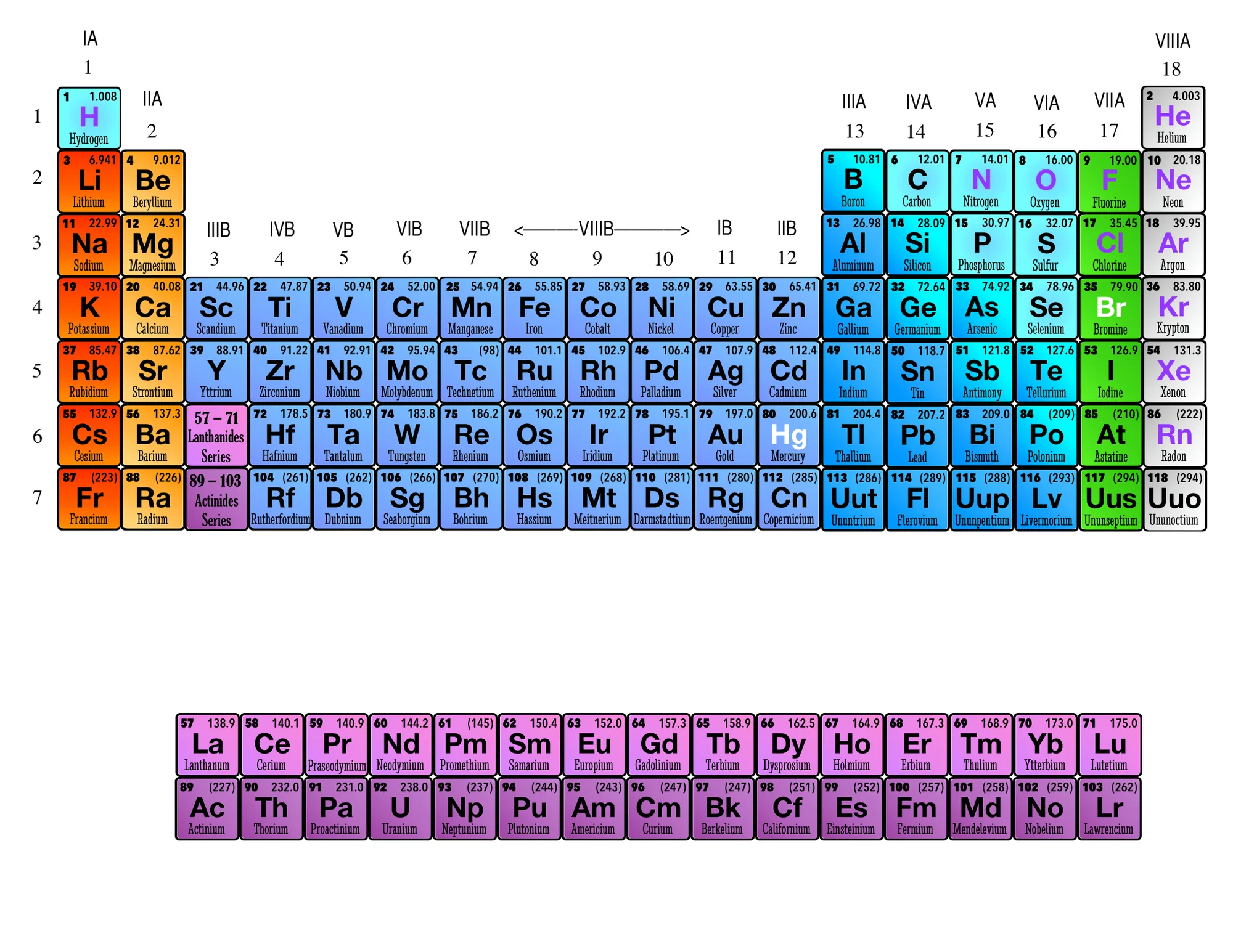
Periods run horizontally. They represent the energy level of electrons present in the element. This will be covered in more depth later.
Groups
Groups run vertically and have roman numerals. You may see them being numbered by the new system as well, which is numbered from 1 to 18
It is important to note that the periodic table is a very good visualization of all the elements, but is not perfect because the elements themselves are not. In later sections, you will see that sometimes there are exceptions to what you would expect from the way things are organized.
Interactive 1.3.2 Metallicity
Read all original figure notes
“Staircase”
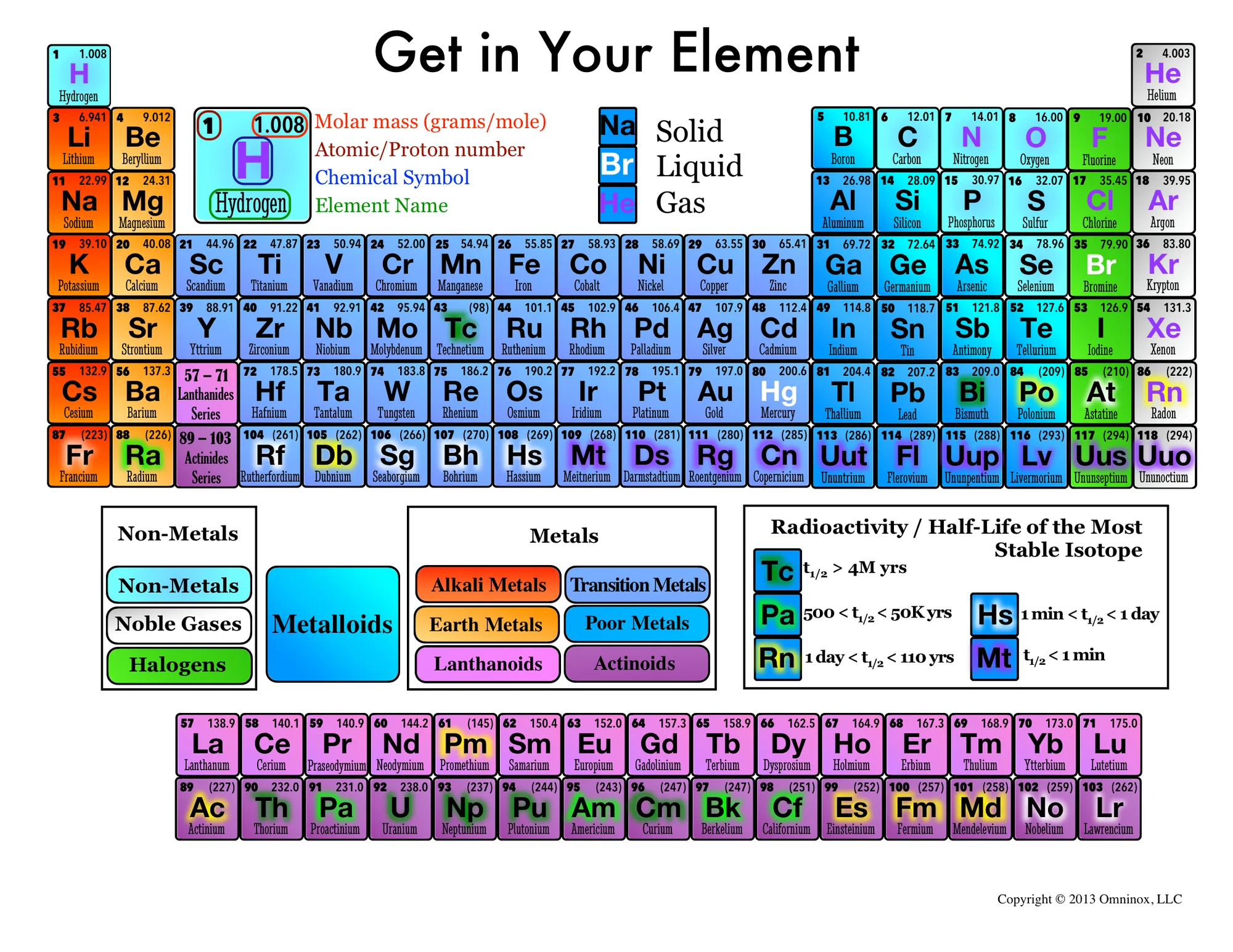
The shading of the background represents whether an element is a metal, metalloid, or non-metal. You can see that the metalloids (represented by the gradient) form a “staircase” shape. The only element excluded from this staircase shape is Aluminum, which is very much a metal.
Group IA: Alkali Metals
Group IIA: Alkaline Earth Metals
Group VIA: Chalcogens
Group VIIA: Halogens
Group VIIIA: Noble (Inert) Gases
*1st Bottom Row: Lanthanoids
*2nd Bottom Row: Actinoids
Example Problem 1.3.1
What group, period, and if applicable, title apply to Xenon (Xe)?
Xenon can be found in Group VIIIA (8A), Period 5, and is one of the noble gases.
Noble gases have filled valence shells in their ground-state atoms and are relatively unreactive under many ordinary conditions. Relatively is the key word: xenon and some other noble gases can form compounds under suitable conditions. A filled shell helps explain their low reactivity; it is not a rule that they can never react.
Although Hydrogen (H) sometimes appears at the top right and left of the table, it is neither an alkali metal nor a halogen.
Apart from these titles, there are more overall divisions in the table. Representative elements are the elements in any Group A (left and right of the table). Transition metals lie in any Group B (center of the table), and the inner transition metals are the bottom two rows that are separated from the rest of the table.
The bold “staircase” shape divides the table into three broader categories. Any element to the left is known as a metal. Any element to the right is a non-metal, and any element touching the line is known as a metalloid. From previous experience, you might know that a metal is hard, has luster, most are malleable (can be formed or hammered into shape), ductile (can be drawn into a wire), and conduct electricity. A non-metal has none of these properties, and a metalloid may exhibit some but not all of them (metalloid means metal-like).
Interactive 1.3.3 The polyatomic elements
Read all original figure notes
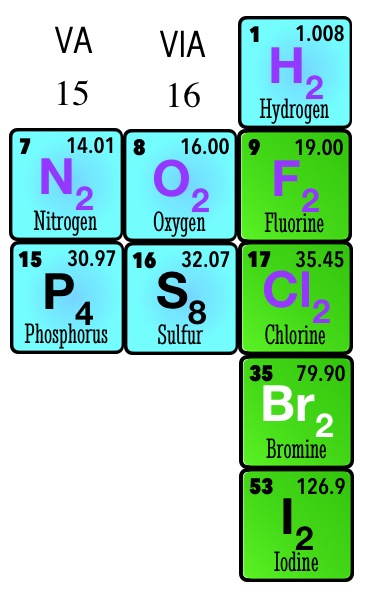
The non-metal square
Many of the other non-metals also exist as bonded pairs, because they are more stable this way.
Halogens
Most of the halogens are diatomic, and exist as two loosely bonded gas molecules.
The periodic table used in this book includes colors: Black elements naturally exist as a solid, purple as a gas, and white as a liquid. However, not all tables are conveniently colored. The following figure will also more clearly define the existence of polyatomic elements, elements that exist naturally as two or more atoms loosely bonded to themselves in a molecular configuration:
With all this information, we can classify just one element into many different categories and start inferring a lot from just what is available from the periodic table.
Example Problem 1.3.2
What can you say about the element Sodium (Na) with respect to its group name, period, and properties?
Sodium can be found in Group IA and Period 3. It is a metal (is hard and ductile), exists normally as a solid and is one of the alkali metals.
The easiest way to learn the element names is to simply study the periodic table. Some are more obvious (Oxygen is O) and some are not as easy to guess (Gold is Au).
Apart from naming and separating groups of elements, the periodic table has many more uses that are not clear at first. These are called periodic trends. Most of these work by traveling across the groups and/or periods. Some will be described below:
Electronegativity: this is the ability to gain or attract a shared pair of electrons. This plays a greater role in bonding. It generally increases as you go right and up on the table.
Ionization energy: energy required to remove an electron from a neutral atom. This increases as you go right and up on the table.
Gallery 1.3.1 Periodic trends
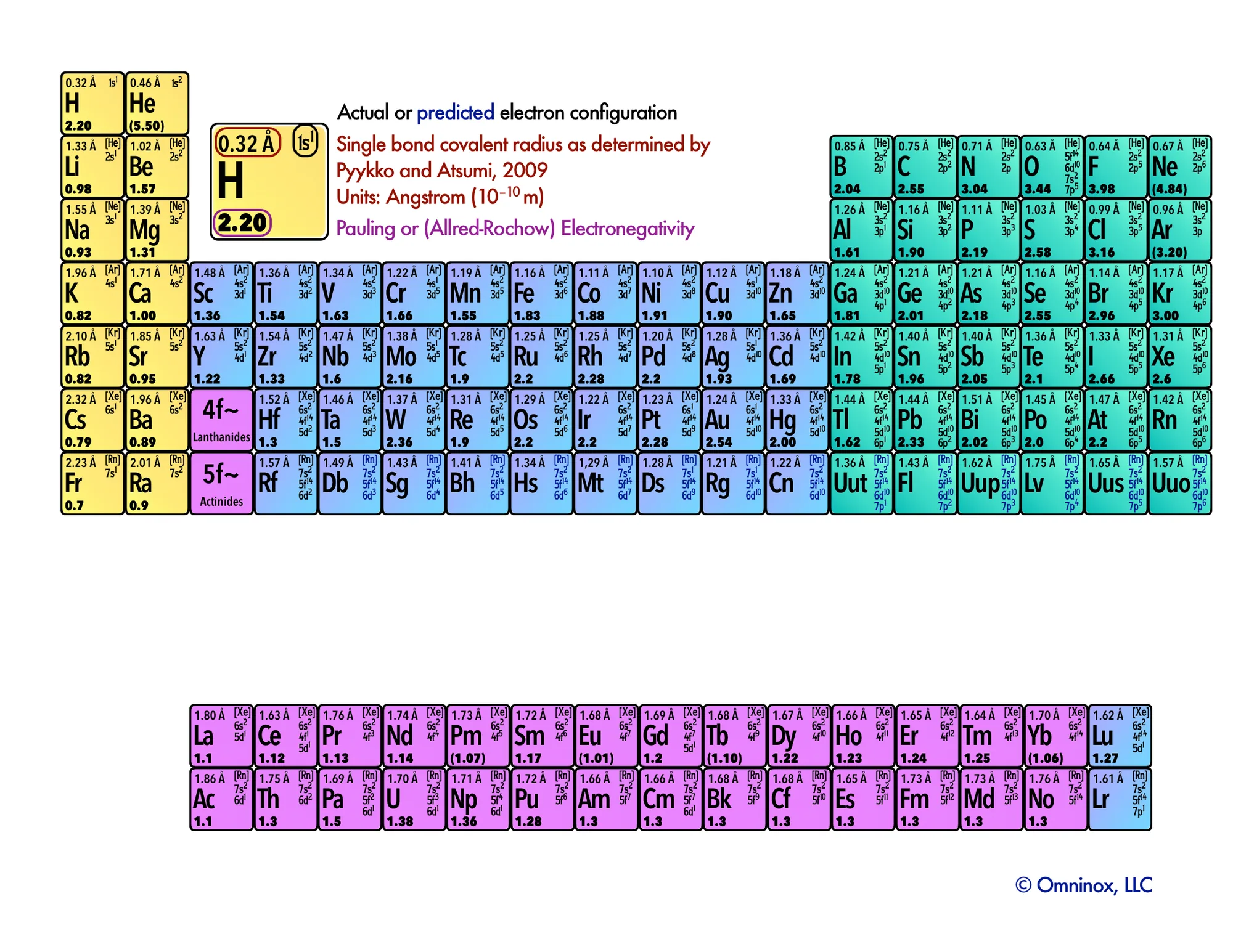
The periodic table above shows two trends: electronegativity and atomic radius. What do they do?
Read all original image captions
Image 1
The periodic table above shows two trends: electronegativity and atomic radius. What do they do?
Image 2
The periodic table above shows metallicity. Pay attention to the staircase. How does metallicity change with direction?
Electron affinity: This is the ability of an atom to attract any electron. It increases as you go right and up on the table.
Metallicity: Metals are compounds or elements that are good conductors of heat and electricity. This trend also decreases as you go right and up on the periodic table.
Gallery 1.3.2 How to count the valence/outermost electrons of an element
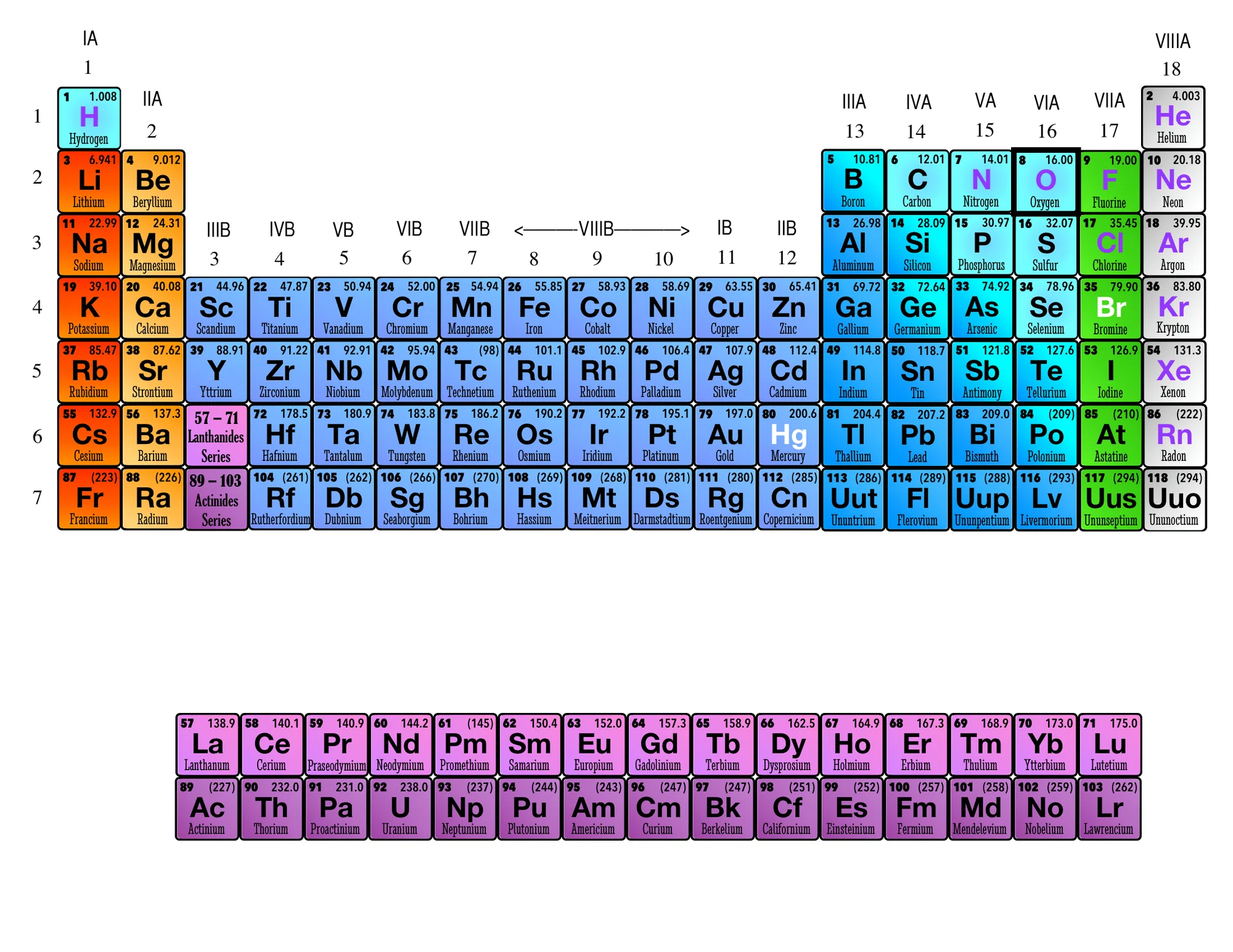
Suppose we want to know, how many valence electrons does Oxygen have?
Read all original image captions
Image 1
Suppose we want to know, how many valence electrons does Oxygen have?
Image 2
We start counting from the left from its row/period, and keep going until we get to the element of interest.
Image 3
Now suppose we wanted to know, how many valence electrons does Iodine have?
Image 4
When counting for Iodine, we have to skip over the d-block elements because the d-electrons are “shielded” by the p orbitals.
Electron shells, orbitals, and valence electrons
Think of occupied electron shells as layers of an onion, with a limit to the analogy: electrons do not sit on a solid shell. Hydrogen and helium use only the first shell in their ground states; larger atoms occupy additional shells. For main-group atoms, the outer occupied shell contains the valence electrons most directly involved in bonding. Their behavior depends on attraction to the nucleus, shielding and configuration, not simply on being the outermost layer.
Reactions occur most often because the outermost, or valence, shell of an atom still has some room for more electrons in order to achieve a “stable” configuration, similar to that of a noble gas. Atoms can achieve this by either “giving away” valence electrons or “accepting” electrons enough to fill their valence (outermost) shell.
Why are valence electrons important?
Here is the shielding picture in the right direction. Core electrons reduce the full nuclear attraction felt by valence electrons. The positive nucleus still attracts the outer electrons, but intervening electron density partly screens that charge. Across a period the nuclear charge generally increases while core shielding changes much less; down a group, occupied shells and distance increase. Use these ideas together when explaining radius or ionization energy.
A filled outer shell is a useful main-group pattern. Many atoms form ions or bonds that produce an octet, and helium has a filled first shell with two electrons. There are important exceptions, including electron-deficient molecules, odd-electron species and expanded valence-shell structures. Treat the octet as a model that helps us predict common formulas, rather than an absolute requirement that every stable species has zero or eight valence electrons.
“Donating” and “accepting” electrons
Recall that we said Oxygen has 6 valence electrons. Oxygen wants to reach the magic number 8. Do you think Oxygen is more likely to donate 6 of its electrons or accept 2 more electrons? Obviously it is much easier to accept 2 than to give away 6.
Let’s go to the other end, of the periodic table and look at Na, which has 1 valence electron. Do you think that Na will be more likely to give away its one electron or try and accept 7 more electrons...? Clearly it would be much easier for Na to lose its 1 valence electron than try to gain 7 more electrons.
This is why we often find the alkali metals reacting frequently with halogens, because it is easy for an alkali metal such as Na to lose an electron, and a halogen such as Cl to gain one electron. Now what’s the chemical formula for salt again...?
Metallicity and its role
Incidentally, whether an element is a metal or non-metal is strongly correlated with how it will react. Metals usually like to react with non-metals because metals have electrons to give, and non-metals need just a few electrons to reach their magic number of 8 valence electrons and become more “noble.”
Glossary and deeper reading · 2 refreshers
These editorial refreshers supplement the reading. Definitions and examples are added guidance; original source wording and recorded answers remain in their original context.
-
Electron configuration
An electron configuration describes how an atom's or ion's electrons occupy shells and subshells. A ground-state configuration places electrons in the lowest-energy arrangement consistent with the electron-filling rules. For example, neutral helium has two electrons in its 1s subshell.
-
Electronegativity
Electronegativity describes an atom's tendency to attract shared electron density in a bond. It helps predict bond polarity but is not the same as ionization energy or electron affinity. For example, oxygen attracts shared electrons more strongly than hydrogen in an O–H bond.