Connecting Linear and Rotational Motion
Connect angular motion with arc length, tangential speed, and acceleration.
Same turn, different trips
Place two stickers on a rotating disk, one near the axle and one near the edge. They complete each revolution together, but the outside sticker travels a longer path. A rigid disk gives every point the same angular velocity ω and angular acceleration α, while linear motion depends on distance from the axis.
For a point at perpendicular distance r from a fixed axis, the arc length is s = rΔθ, with Δθ in radians. If the rotation does not reverse, the traveled distance is r|Δθ|. With a reversal, add r|Δθ| for each leg instead: the magnitude of the net angular displacement would undercount the path. A half-turn makes an arc πr. This is the curved path length, not the straight-line displacement between endpoints. After a full turn the point returns to its start, so its vector displacement is zero while its path length is 2πr.
Dividing arc length by time gives v_t = r|ω| for tangential speed. Dividing the change in tangential velocity component by time gives a_t = rα in a consistently signed tangential direction. Their units work because radians are dimensionless ratios; keeping “rad” in angle and angular-rate labels still helps identify what you measured.
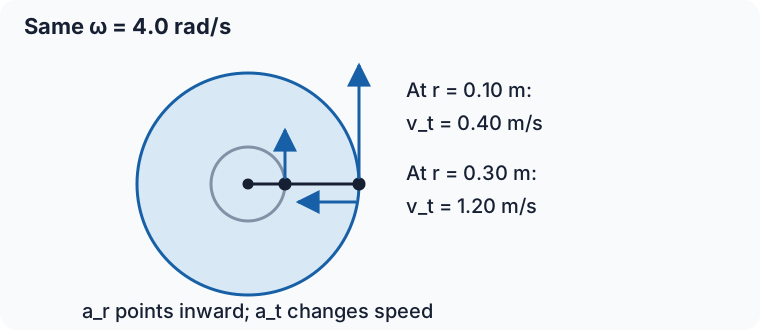
Worked example: two spots on a turntable
A turntable has ω = +4.0 rad/s and α = +3.0 rad/s². Sticker A is at r_A = 0.10 m and sticker B is at r_B = 0.30 m. Their angular quantities match: ω_A = ω_B and α_A = α_B.
Their speeds are different: v_A = 0.10(4.0) = 0.40 m/s and v_B = 0.30(4.0) = 1.20 m/s. Their tangential acceleration magnitudes are a_t,A = 0.10(3.0) = 0.30 m/s² and a_t,B = 0.30(3.0) = 0.90 m/s². Tripling the radius triples both quantities for the same angular motion.
If the disk turns through 2.0 rad, the stickers travel arcs of 0.20 m and 0.60 m. A useful check is the ratio s_B/s_A = r_B/r_A = 3. The ratio does not depend on how quickly the disk turns through that angle.
There are two acceleration components
Tangential acceleration changes speed. Radial, or centripetal, acceleration changes the direction of velocity. Even if α = 0, a point on a turning disk has inward acceleration a_r = v²/r = rω². The two components are perpendicular.
For sticker B in the example, a_r = 0.30(4.0²) = 4.8 m/s² inward. Its total acceleration magnitude is √(4.8² + 0.90²) ≈ 4.88 m/s². The acceleration is neither entirely inward nor entirely tangential while the disk speeds up. At the exact instant when ω = 0 but α is nonzero, radial acceleration is zero and tangential acceleration can still be nonzero.
A point at the axis has r = 0. Its linear speed and linear acceleration due to rotation are zero, although we still describe the whole disk with its angular velocity. This is why measuring the center’s travel cannot by itself tell you how fast a wheel spins.
Build a graph that separates the quantities
At one instant, a speed-versus-radius graph for points on a rigid disk is a straight line through the origin. Its slope is |ω|, with units s⁻¹ or rad/s. A tangential-acceleration-versus-radius graph has slope |α| when plotting magnitudes. An angular-velocity-versus-radius graph is horizontal: ω is shared by all points.
Suppose a string unwinds from an axle without slipping. The string’s speed equals the surface’s tangential speed at the contact radius, so v_string = r_axle|ω|. If the string wraps around a smaller axle on the same wheel, it moves more slowly for the same wheel rotation. Use the radius where the constraint actually acts, not automatically the wheel’s outside radius.
Instructional example (guided activity):
Make a measurement: Film two marks at known radii on a disk turning steadily. Measure how far each travels over the same angle and time. Plot v_t versus r with axes and units, then infer ω from the slope. Explain why a camera centered along the axis reduces perspective error. This is a direct check of the proportionality instead of two unrelated substitutions.
Worked example — Equal angular acceleration, unequal linear acceleration
Two marks fixed on a rigid disk lie at radii 0.10 m and 0.30 m. Over 2.0 s the disk’s angular velocity changes from +2.0 to +8.0 rad/s with constant α = +3.0 rad/s². Both marks have that same ω at each instant and that same α throughout: their relative angular separation cannot change while the disk stays rigid. At the final instant their tangential speeds are 0.80 and 2.40 m/s, and their tangential acceleration magnitudes are 0.30 and 0.90 m/s². The outer mark’s larger linear values come from its radius, not a larger angular acceleration.
Keep angular and linear ideas apart
Pause & try it
Let's see what stuck.
Choose an answer, then check the reasoning. Try the written problems below before opening their solutions.
0 of 3 checked · 0 correct
Assigned practice: an unwinding string
A string unwinds without slipping from a 0.040 m-radius axle. It moves 0.60 m while the wheel turns. Find the angular displacement magnitude. If the string then has acceleration 0.20 m/s², find the angular acceleration magnitude.
Open the separate worked solution.
Assigned practice: check two measurements against rigidity
Two marks are fixed to a rigid disk at radii 0.10 m and 0.30 m. During the same steady-rotation interval, a student reports tangential speeds 0.40 m/s and 0.90 m/s. Each speed has a possible error of at most 0.03 m/s; take the radii as exact for this task. Are the measurements consistent with one angular speed? Show a comparison that decides, then propose a specific measurement check before claiming that the outer mark really has a different angular speed.
Open the separate worked solution.
Return to the original Angular Forces and Circular Motion for the linear/rotational comparisons and centripetal-force quizzes. A centripetal force is the inward net-force requirement, not an extra force added to the force diagram.
Sources and scope: College Board CED, with edition-specific coverage verified against the supplied file. Supplied College Board CED, printed p. 95, 5.2.A. OpenStax: Relating Angular and Translational Quantities verifies the arc, tangential, and radial relationships. AP direction descriptions use clockwise and counterclockwise about a stated axis.
Explain and apply the model
Try these problems before opening the solutions. State your assumptions, show the diagram or calculation, and explain what makes your answer follow.
Compare both angular rates on a rigid disk
Two marks are fixed to the same rigid disk at radii 0.10 m and 0.30 m. During the same 2.0 s interval the disk’s angular velocity rises from +1.0 to +5.0 rad/s at constant rate.
(a) Which complete comparison correctly gives both marks’ final angular velocity, angular acceleration and tangential acceleration magnitudes?
Glossary and deeper reading · 9 refreshers
These editorial refreshers supplement the reading. Definitions and examples are added guidance; original source wording and recorded answers remain in their original context.
-
Angular acceleration
Angular acceleration is the rate of change of angular velocity. For a fixed axis its sign follows the chosen positive rotation direction, and its units are radians per second squared. For example, a fan speeding up has angular acceleration, whereas one turning steadily does not.
-
Radian
A radian is an angle measure defined by arc length divided by radius. One complete turn is two pi radians, and angle formulas connecting linear and rotational motion use this measure. For example, an arc whose length equals the circle’s radius subtends one radian at the center.
-
Magnitude
Magnitude is the nonnegative size of a vector quantity. It does not specify direction, and it differs from a signed component. For example, a westward velocity can have a negative x component while its speed, the velocity magnitude, stays positive.
-
Velocity
Velocity describes how position changes with time and includes direction. Instantaneous velocity describes one moment, while average velocity is displacement divided by elapsed time. For example, a car turning a corner can change velocity while maintaining the same speed.
-
Acceleration
Acceleration is the vector rate of change of velocity with time. It can change an object’s speed, direction, or both, and it is measured in meters per second squared. For example, a satellite moving at constant speed in a circular orbit accelerates toward the center.
-
Vector component
A vector component describes the part of a vector along a chosen axis. Its signed value changes when the axes change, even though the physical vector remains the same. For example, a diagonal launch velocity can be resolved into horizontal and vertical components that share the same elapsed time.
-
Centripetal acceleration
Centripetal acceleration is the inward acceleration component that changes the direction of motion along a curved path. For circular motion its magnitude is speed squared divided by the circle’s radius. For example, a car moving at constant speed around a bend still has centripetal acceleration.
-
Angular displacement
Angular displacement is the change in an object’s rotation angle about a specified axis. Its sign follows the chosen rotation convention, and it is commonly measured in radians. For example, a wheel can return to the same orientation after one turn while having an angular displacement of two pi radians.
-
Centripetal force
Centripetal force names the inward net-force component required for motion along a circular path. It is supplied by actual interactions such as tension, friction, gravity, or normal forces rather than being an additional type of force. For example, gravity supplies the centripetal force on a satellite in a circular orbit.