Emission and Absorption Spectra
Read occupied energy levels, match photon transitions, and distinguish electron from nuclear binding energy.
AP Physics 2 Topic 15.3 · College Board CED printed p. 140, 141 / PDF p. 147, 148 · See this topic in the course outline
An energy-level arrow is an energy-accounting statement. Its length determines the photon energy, and its direction tells whether the atom absorbs or emits.
Before you start
- Photon energy
- Bohr energy levels
- Systems and interaction energy
The atom is the electron–nucleus system
Model the atom as the electron and nucleus together. Absorbing a photon transfers its energy into the atom; emitting a photon transfers energy out. A bound-to-bound transition requires photon energy equal to the energy-level difference: . Absorption goes upward; spontaneous emission from an excited state goes downward. The system's energy changes because the electron–nucleus interaction and electron motion change, not because the electron keeps an arbitrary leftover part of a mismatched bound-transition photon.
Each pair of levels determines one photon frequency and wavelength. A photon whose energy lies between allowed gaps is not absorbed for those bound-to-bound transitions. If its energy reaches the ionization threshold, however, it can remove an electron and any excess can become kinetic energy; the strict gap-matching rule describes transitions between bound states, not all possible photon interactions.
Read emission and absorption fingerprints
An element's allowed energy levels create a characteristic set of line frequencies. A hot, excited dilute gas can produce bright emission lines when atoms drop to lower levels. A cooler gas in front of a continuous source can remove selected frequencies, making dark absorption lines. Compare several lines with a known spectrum to infer which elements are present; a single coincident line is weak evidence. Occupancy, source brightness, and instrument response affect which lines are visible.
| Level | Energy (eV) | Diagram location |
|---|---|---|
| Separated electron | 0 | ionization limit at top |
| 3 | −1.0 | highest bound horizontal line |
| 2 | −3.0 | middle line |
| 1 | −8.0 | ground-state line at bottom |
Draw the horizontal lines on an energy axis with their actual uneven spacings. Upward arrows from level 1 to levels 2 or 3 represent absorption of 5.0 or 7.0 eV; downward arrows represent emission of the corresponding photon energies. A 3→2 emission gives 2.0 eV, another line. AP energy-level diagrams here are for single-electron atoms; the hypothetical values are provided, not a claim about a particular element.
| Transition | Photon energy (eV) | Vacuum wavelength (nm) |
|---|---|---|
| 1→2 | 5 | 248.0 |
| 1→3 | 7 | 177.1 |
Levels from bottom to top: -8 eV, -3 eV, -1 eV. The free-electron reference is 0 eV. The green dot marks level 1 as the starting occupied state. Only arrows leaving that occupied ground state are possible in the stated bound-transition model.
Electron binding energy reaches the zero level
Electron binding energy is the energy needed to remove the electron from its atom. With the free-electron reference at E = 0, an electron in a level E < 0 needs at least to become free with zero kinetic energy. The ground state is lowest and therefore needs the most removal energy. An excited atom is less tightly bound and needs less.
For the table above, binding energies are 8.0, 3.0, and 1.0 eV for levels 1, 2, and 3. A 10 eV photon can ionize the ground-state atom, leaving about 2 eV for the products' kinetic energy in an approximation that neglects recoil. This electron binding energy is distinct from nuclear binding energy, which separates nucleons and typically uses a much larger MeV scale.
A downward arrow fixes a wavelength
A supplied single-electron atom has levels −8.0, −3.0, and −1.0 eV. It emits in a transition from −1.0 to −3.0 eV. Find photon wavelength and the binding energy of the final state. Use hc = 1240 eV·nm.
Eγ = (−1.0) − (−3.0) = 2.0 eV.
Why this step? Emission carries away the positive loss of atomic energy.
λ = 1240/2.0 = 620 nm.
Why this step? The photon energy, not the absolute level energy, sets the wavelength.
The final level is 3.0 eV below zero, so its ionization binding energy is 3.0 eV.
Why this step? Removal to zero is distinct from the 2.0 eV transition.
Answer and check
620 nm photon; final-state electron binding energy 3.0 eV.
| Transition | Photon energy (eV) | Vacuum wavelength (nm) |
|---|---|---|
| 3→2 | 2 | 620.0 |
Levels from bottom to top: -8 eV, -3 eV, -1 eV. The free-electron reference is 0 eV. The green dot marks level 3 as the starting occupied state.
Use the missing light as evidence
An emission spectrum tells which frequencies a source adds to the light. An absorption spectrum tells which frequencies a material removes from a continuous beam passing through it. Both originate in differences between allowed atomic energy levels, but the emitting source and the absorbing material need not be the same element.
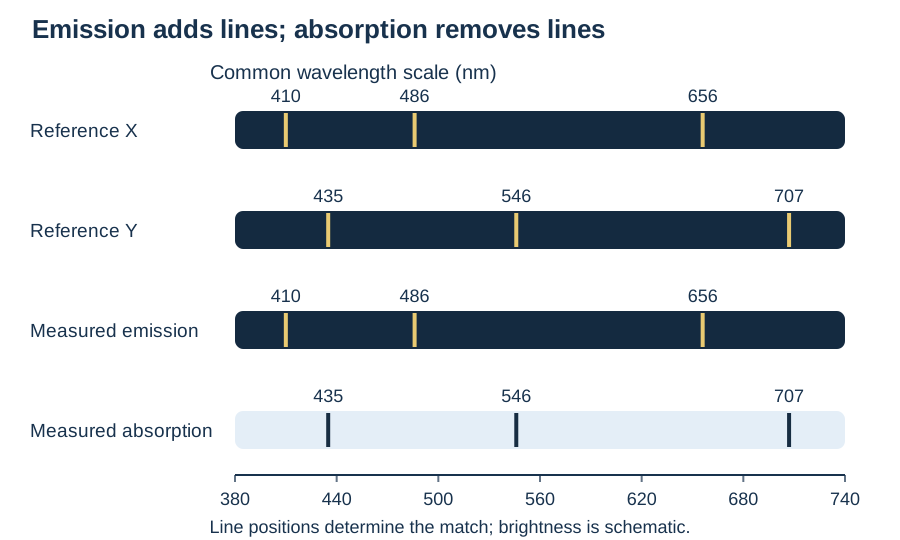
Compare measured wavelengths with reference line sets on one common wavelength scale, allowing for the stated measurement uncertainty. Several matching lines give a stronger identification than one shared line. In the example, bright lines at 410, 486, and 656 nm match reference X. Dark lines at 435, 546, and 707 nm instead match reference Y, so the continuous beam has passed through Y. The absence of X’s absorption lines does not establish that no X exists anywhere: occupancy, weak lines, instrument response, and resolution can limit what is observed.
Each bound transition selects a photon energy hf equal to the level gap. Atomic structure creates characteristic line positions; changing source brightness can change line strength without changing the ideal gap’s wavelength. Thermal radiation from the continuous lamp supplies the broad background, while the gas removes selected frequencies.
Inspect diagram labels
The diagram keeps its full size here. Focus the view and use the arrow keys, or scroll across it, to inspect every label.
An emitting source and an absorbing gas differ
Reference X has strong lines at 410, 486, and 656 nm; reference Y has strong lines at 435, 546, and 707 nm. A source emits at 411, 485, and 657 nm. A separate continuous lamp viewed through a cool gas has dark lines at 434, 547, and 706 nm. Each measured wavelength has uncertainty ±2 nm; compare only with these supplied candidates.
Inspect diagram labels
The diagram keeps its full size here. Focus the view and use the arrow keys, or scroll across it, to inspect every label.
- The source measurements differ from X by +1, −1, and +1 nm, all within ±2 nm. They do not match Y’s supplied line set, so X is the better source identification.
- The dark-line measurements differ from Y by −1, +1, and −1 nm. All three agree within ±2 nm, so Y is the better identification for the absorbing gas.
- The absorbed photons raise atoms to higher allowed levels when the matching lower states are populated. The emitted photons in the first setup come from downward transitions in excited atoms.
- A single match would be weak evidence because different candidates can share a line and measurements have uncertainty. The three-line agreement supports these identifications among the stated reference candidates; it is not proof that the samples contain no unlisted component.
Answer and check
The emitting source is best matched by X and the absorber by Y. Bright and dark lines answer different composition questions; use several resolved positions with their uncertainty.
Try it from memory
Write your answer and reason before opening the worked answer. Your self-assessment is a study decision; it is not an automatically graded score.
Question 1
An atom at −8.0 eV has available levels −3.0 and −1.0 eV. Can it absorb a 6.0 eV photon in a bound-to-bound transition?
Worked answer and reason
No. The available gaps are 5.0 and 7.0 eV, and 6.0 eV is also below the 8.0 eV ionization threshold.
Bound transitions require a matching gap rather than any energy above the smaller gap.
Question 2
Why can a cool gas in front of a continuous lamp produce dark spectral lines at wavelengths that the same excited gas can emit?
Worked answer and reason
The same level differences set absorbed and emitted photon energies. The cooler gas removes selected incident wavelengths by upward transitions, while downward transitions in excited gas produce bright lines.
Transition direction changes energy flow but not the paired energy gap.
JavaScript enables saved drafts and self-assessment. You can always work on paper.
Catch the tempting mistake
- A −3 eV energy level emits a 3 eV photon whenever an electron occupies it.
- Emission needs a downward transition; its photon energy is the difference between two levels.
Put it to work
Give the physical reason as well as the calculation. The worked solutions are on a separate page.
- Problem 5 · graphical
- Problem 6 · mixed
- Problem 17 · mixed
Explain and apply the model
Try these problems before opening the solutions. Show the physical model, your calculation or sketch, and the reason your conclusion follows.
Which material emits, and which absorbs?
Reference X has resolved strong lines at 410, 486, and 656 nm. Reference Y has resolved strong lines at 435, 546, and 707 nm. Source A shows bright lines at 409, 487, and 655 nm. In a separate setup, a continuous lamp is viewed through cool gas B and dark lines occur at 436, 545, and 708 nm. Each measurement has uncertainty ±2 nm. Use only these supplied candidate references; no other component is ruled out by this dataset.
(a) Identify the best supplied reference for source A and for gas B, using all measured line positions and their uncertainty. Explain why the two setups can identify different materials and why a single coincident line would be weaker evidence.
(b) Draw aligned qualitative emission and absorption spectra with a common wavelength axis from 380 to 740 nm. Mark the measured line positions, distinguish bright lines from dark lines on a continuous background, and explain the atomic energy-transfer direction in each setup.
(c) A separate hypothetical single-electron atom has levels −8.0, −3.0, and −1.0 eV. A photon corresponding to the −3.0→−1.0 eV gap passes through gas whose atoms are all in the −8.0 eV ground state. Must that line be absorbed? Explain using its energy, the occupied starting level, and the ground-state ionization threshold. Compare the removal energies from all three levels and explain why the ground state requires the greatest removal energy.
Written working workspace
Drawing is temporarily unavailable. Work on paper if needed, then record your reasoning here.
Saving written working requires JavaScript. Keep your work on paper or in your own notes; the source problem above remains available.
Worked solution and rubric →Revisit the explanation →Revisit the explanation →
Scientific calculator workspace
Keep intermediate precision and report units. This calculator supports arithmetic and elementary functions.
Scientific calculator
This calculator requires JavaScript. Use the physics formula sheets and show your working manually.
+ − * / ^ ! · pi · e · sqrt · sin, cos, tan · asin, acos, atan · atan2(y,x) · ln, log · abs · exp · hypot(x,y). Use * between factors. Keep units in your written working.
For the teacher
- Ask which levels are occupied before listing absorption lines. Do not allow “any photon greater than a transition energy works” for a bound-to-bound transition.
Source objectives and scope
- 15.3.A — Describe the emission or absorption of photons by atoms.
In AP Physics 2, only energy level diagrams of single-electron atoms will be considered.
Suggested skills are teaching guidance. The course applies all science practices across its objectives.
Science references for this teaching
- AP Physics 2 Course and Exam Description, official Unit 15 — Official topic/LO/EK scope and boundaries; local pinned pages 143–158, equations and relevant clauses visually checked on 143–144,146,149–150,152–158.
- AP Physics 2 Course and Exam Description Clarifications, effective Fall 2026 — 15.7.B.1 current definition includes decay to a lower energy level of the same nucleus.
- OpenStax University Physics 3, Blackbody Radiation — Verification of Wien peak and integrated spectral intensity versus Stefan–Boltzmann total power.
- OpenStax University Physics 3, Photoelectric Effect — Verification of threshold, maximum kinetic energy, intensity distinctions, and retarding-potential experiment.
- OpenStax University Physics 3, The Compton Effect — Verification of positive electron-at-rest shift and photon energy/momentum accounting.
- OpenStax University Physics 3, Nuclear Binding Energy — Verification of all-nucleon mass defect and atomic-mass convention.
- OpenStax University Physics 3, Radioactive Decay — Verification of exponential survival, half-life, and nuclear transformation balances.
- OpenStax University Physics, Volume 3: 6.1 Blackbody Radiation — Primary textbook verification of the wavelength-based blackbody spectral shape, the distinction between peak height and complete spectrum area, Wien’s displacement law, and Stefan–Boltzmann emitted intensity and power.
Glossary and deeper reading · 12 refreshers
These editorial refreshers supplement the reading. Definitions and examples are added guidance; original source wording and recorded answers remain in their original context.
-
Photon
A photon is a quantum of electromagnetic radiation with energy proportional to its frequency. It has zero rest mass and no electric charge but carries energy and momentum. For example, increasing light’s frequency increases the energy of each photon, while increasing the number of same-frequency photons increases the total energy.
-
Energy level
An energy level is an allowed energy of a quantum system. Bound systems have discrete levels, and a transition between them requires an energy transfer equal to the level difference. For example, an atom emitting a photon drops to a lower energy level and transfers the difference to that photon.
-
Excited state
An excited state is an allowed state with energy above the system’s ground state. It can release energy through a transition to a lower state when an allowed process occurs. For example, an excited atom can emit a photon whose energy equals the difference between two levels.
-
Frequency
Frequency is the number of complete repeating cycles per unit time. It is measured in hertz, meaning cycles per second, and is the reciprocal of the period. For example, a vibrating string with a higher frequency produces more cycles each second.
-
Wavelength
Wavelength is the spatial distance between neighboring points at the same phase of a periodic wave. It connects propagation speed and frequency through speed equal to frequency times wavelength. For example, neighboring crests of a sinusoidal water wave are separated by one wavelength.
-
Emission spectrum
An emission spectrum shows the frequencies or wavelengths of radiation emitted by a source. An excited dilute gas produces characteristic bright lines associated with allowed energy-level transitions. For example, comparing several observed lines with known element spectra can help identify which atoms are present.
-
Absorption spectrum
An absorption spectrum shows radiation removed from a source spectrum as it passes through matter. Atomic absorption lines correspond to photon energies that can promote atoms between allowed levels. For example, a cooler gas in front of a continuous light source can produce dark lines at selected wavelengths.
-
Electronvolt
An electronvolt is an energy unit equal to the elementary-charge magnitude multiplied by one volt. It is approximately 1.60 × 10⁻¹⁹ joule and is not a unit of voltage. For example, atomic transition energies are often more conveniently expressed in electronvolts than in very small fractions of a joule.
-
Electron binding energy
Electron binding energy is the energy required to remove an electron from its bound atomic state to the specified free-electron reference. With a free electron at zero energy, a negative bound-state energy has a binding-energy magnitude equal to its distance below zero. For example, an excited hydrogen atom requires less additional energy to ionize than the same atom in its ground state.
-
Kinetic energy
Kinetic energy is energy associated with motion relative to a chosen reference frame. For a nonrelativistic translating object it is one half of its mass times speed squared. For example, doubling a cart’s speed quadruples its translational kinetic energy when its mass stays fixed.
-
Thermal radiation
Thermal radiation is electromagnetic energy emitted by matter because of its temperature. It can transfer energy through a vacuum, and net radiative transfer between ordinary bodies is from hotter to cooler. For example, sunlight warming a surface does not need air to carry the energy across space.
-
Ground state
The ground state is the lowest-energy state available to the specified quantum system. Its energy need not be zero because the energy reference is chosen separately. For example, a hydrogen atom in its ground state is more tightly bound than the same atom in an excited state.