Power
Interpret power as an energy-transfer rate and distinguish constant-force from constant-power motion.
Same job, different time
Carry a box to a shelf slowly or lift it quickly. If its mass and height change are the same, its gravitational energy gain is the same. The faster lift transfers that energy at a greater rate. Power tells us how quickly energy changes, whether it’s transferred into or out of a system or converted between forms inside it.
Average power over an interval is P_avg = ΔE/Δt for the specified transfer or conversion. For work done by a force, P_avg = W/Δt. The SI unit is the watt: 1 W = 1 J/s. Power isn’t another name for energy. A large energy transfer can happen at low power if it takes a long time.
Power can have a sign when we describe energy entering or leaving a chosen system. Positive power means transfer in; negative means transfer out under that convention. A motor’s quoted output rating is usually a positive magnitude, so state what the sign means when you use it in an energy balance.
Example 3.5.1 — Lifting to a shelf
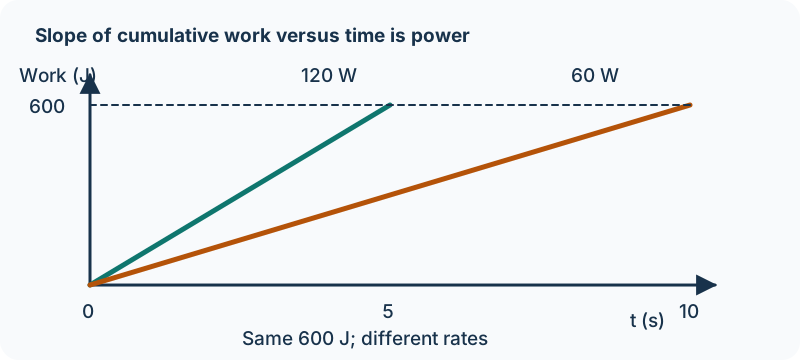
A hoist raises a 20 kg crate 3 m in 5 s at constant speed. Using g = 10 m/s², the crate–Earth system gains mgh = 600 J. The hoist’s average mechanical output is 600/5 = 120 W. Doing the same lift in 10 s takes the same 600 J but an average of only 60 W.
Constant speed lets us neglect the crate’s kinetic-energy change. If it starts and ends at different speeds, the hoist may also change kinetic energy. If there are dissipative losses, its input energy can exceed useful output. Don’t treat a motor rating as proof that every joule becomes gravitational energy.
Instantaneous power includes direction
During a short interval, displacement along a force is velocity along that force times time. Dividing W = F_parallelΔx by Δt gives P = F_parallel v = Fv cos θ for the instantaneous rate. A force perpendicular to velocity delivers zero instantaneous power to a particle; an opposing force has negative power.
For a constant-speed lift, force is mg and speed is h/Δt. Their product gives P = mg(h/Δt), agreeing with mgh/Δt. If force or speed changes, instantaneous power may change even though a full-interval average has one value.
A 30 N force along a cart’s velocity delivers 60 W when speed is 2 m/s and 150 W when speed is 5 m/s. Constant force doesn’t mean constant power. Conversely, an ideal constant-power drive with force along velocity has F = P/v. It supplies a smaller force at larger speed.
That expression cannot describe a real drive starting from exactly zero speed with finite power and unbounded force. The constant-power approximation applies over a stated operating range; real motors have force or torque limits. Name that limit rather than interpreting division by zero as a physical prediction.
Example 3.5.2 — A steady power input
An ideal 2 kg cart starts with K_i = 4 J. A drive supplies a constant mechanical power of 6 W for 2 s, with losses neglected. Energy input is PΔt = 12 J, so K_f = 16 J and v_f = √(2·16/2) = 4 m/s.
The speed doesn’t grow linearly with time. Since K = ½mv², constant power gives v² = v_i² + 2Pt/m. A v²-versus-time graph is linear, while v-versus-time grows with a decreasing slope. This connects a power model to a measurable motion prediction without a variable-acceleration calculation.
Read a slope, design a measurement
On a cumulative-work-versus-time graph, secant slope gives average power and tangent slope gives instantaneous power. A straight line means constant power over that interval. Area under a power–time graph gives transferred energy; check the units W·s = J.
To measure average lifting power, use a known mass, a measured vertical rise, and elapsed time. Time several repeatable lifts, specify whether acceleration periods are included, and use starts and ends at the same speed if you want ΔK = 0. Plot work versus time for a hoist running at a fixed operating condition. The best-fit slope estimates output power. A measured speed and supporting force provide an independent Fv comparison. Report how timing multiple lifts reduces random reaction-time error, while measuring the actual vertical rise avoids a systematic geometry error.
Check what you know
Pause & try it
Let's see what stuck.
Choose an answer, then check the reasoning. Try the written problems below before opening their solutions.
0 of 3 checked · 0 correct
Give it a try
Practice 1
A 10 kg object rises 2 m at constant speed in 4 s. Find work, average power, and instantaneous power if the speed is constant throughout, using g = 10 m/s².
Practice 2
A cart has 20 J of kinetic energy. A constant 5 W input lasts 6 s with 8 J dissipated. Find the final kinetic energy and identify why input power alone doesn’t give the kinetic-energy increase.
Practice 3
Derive the slope of v² versus time for a mass m driven at constant power P with no losses. Explain how an experiment could use that slope to infer P.
Keep exploring
The original FFR — Power retains its examples and quizzes. The preserved energy problems 24–26 include constant-power and energy-graph practice with separate solutions.
Course scope and standards: the supplied AP Physics 1 CED, printed pages 73; Topic 3.5 and its exact learning objectives. The official College Board CED is the public source; the project audit records the supplied edition.
Supporting physics references: OpenStax: power. These lessons, diagrams, examples, and practice questions were written for this book.
Glossary and deeper reading · 8 refreshers
These editorial refreshers supplement the reading. Definitions and examples are added guidance; original source wording and recorded answers remain in their original context.
-
Gravitational potential energy
Gravitational potential energy is energy associated with the relative positions of attracting masses. Near Earth, changes can be approximated by mass times gravitational field strength times height change when that field is nearly constant. For example, lifting a book increases the gravitational potential energy of the book–Earth system.
-
Power
Power is the rate at which energy is transferred or converted. It is measured in watts, with one watt equal to one joule per second. For example, two motors can lift the same load through the same height but have different average powers if they take different times.
-
Mechanical work
Mechanical work is energy transferred by a force through displacement of its point of application. For a constant force on a particle, it depends on the force component along the particle’s displacement, and it can be positive, negative, or zero. For example, a magnetic force perpendicular to a particle’s displacement does zero work on that particle.
-
Displacement
Displacement is the vector change in position from the start of an interval to its end. It depends on those endpoints rather than the length or shape of the path traveled. For example, walking around a closed track and returning to the start gives zero displacement but a nonzero distance traveled.
-
Velocity
Velocity describes how position changes with time and includes direction. Instantaneous velocity describes one moment, while average velocity is displacement divided by elapsed time. For example, a car turning a corner can change velocity while maintaining the same speed.
-
Force
A force describes an interaction that can change an object’s momentum. It is a vector measured in newtons, so both size and direction matter when forces are added. For example, a rope can pull a cart while the floor exerts friction in another direction.
-
Torque
Torque describes a force’s turning effect about a chosen axis or point. Its magnitude is force times the perpendicular lever arm, and its direction or sign describes the rotation tendency. For example, pushing near the handle of a door produces more torque than the same perpendicular push near the hinge.
-
Acceleration
Acceleration is the vector rate of change of velocity with time. It can change an object’s speed, direction, or both, and it is measured in meters per second squared. For example, a satellite moving at constant speed in a circular orbit accelerates toward the center.