Potential Energy
Choose an energy reference and describe spring and gravitational configuration energy.
The energy belongs to the arrangement
Say you hold a tennis ball above the floor. It isn’t moving, so its kinetic energy is zero. Let go and it gains kinetic energy while falling. That gain comes from a change in the ball–Earth system’s gravitational potential energy. The useful energy is associated with their arrangement, not a property of the isolated ball alone.
Potential energy is a scalar associated with the positions of interacting parts of a system. For conservative interactions, a change in configuration gives a potential-energy change, with W_conservative = −ΔU. If a force is nonconservative, don’t invent a friction potential energy to account for its path-dependent work.
We choose where U = 0 to simplify the question. That choice changes energy values but not energy changes or predicted motion. Saying “this point has zero potential energy” means you’ve chosen a reference; it doesn’t mean the system has no interaction there.
Gravity near the surface
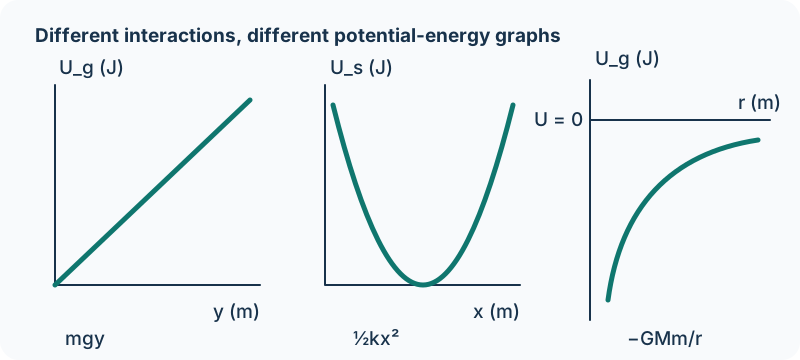
When g is nearly constant, ΔU_g = mgΔy, with y positive upward. If we choose U = 0 at y = 0, then U_g = mgy. Raising an object increases the ball–Earth system’s gravitational energy; lowering it decreases that energy. The force of gravity does the opposite amount of work on the object.
Example 3.3.1 — Move the zero, keep the result
Lift a 2 kg object from y = 1 m to y = 4 m using g = 10 m/s². With ground zero, initial U is 20 J and final U is 80 J. The change is +60 J. If we instead choose zero at the starting height, initial U is 0 and final U is 60 J. The change is still +60 J.
A negative potential-energy value is allowed. If ground is zero, a location below it can have negative mgy. Only the difference enters the work or energy balance. Unlike kinetic energy in this model, potential energy doesn’t have to be nonnegative.
Gravity over large distances
For approximately spherical masses outside one another, with zero at infinite separation, U_g = −GMm/r. The minus sign means the system at finite separation has less gravitational potential energy than it would infinitely far apart. Pulling the masses farther apart makes U less negative and requires a positive energy input.
The corresponding force varies as 1/r², while potential energy varies as −1/r. Don’t interchange those powers. Near the surface, the change of −GMm/r over a small height interval is approximated by mgΔy. For a large altitude change, use the general difference ΔU = GMm(1/r_i − 1/r_f).
If a system includes three or more masses, its total gravitational potential energy is the sum over distinct pairs. For three masses, count pairs AB, AC, and BC once each. Adding both AB and BA would double-count the same interaction. This pairwise viewpoint also reinforces why potential energy belongs to a system.
A spring stores energy in either deformation direction
For an ideal spring, U_s = ½kx², where x is deformation from the relaxed length. The spring is a system with internal interactions; stretching or compressing it changes its configuration. Both deformations store positive elastic energy when relaxed length is the zero. Double the deformation magnitude and stored energy quadruples.
You can see the equation from the external holding-force graph. A slow stretch has F_hold = kx, so work to stretch from zero to x is the triangular area ½x(kx) = ½kx². The work done by the spring is negative during the stretch and positive as it returns toward relaxed length.
For a vertical hanging mass, gravity shifts the equilibrium extension. The spring’s elastic energy still uses deformation from relaxed length, even when a force equation uses displacement from the gravity-shifted equilibrium. Include both gravity and spring energy when that system changes height.
Use a graph to compare models
Sketch U_g versus y near Earth as a straight line with slope mg. Sketch U_s versus signed x as a symmetric upward parabola. Sketch general U_g versus r as a negative curve approaching zero from below. The shapes tell different stories: constant gravitational force, increasing spring-force magnitude, and decreasing distant gravitational force. Measure spring holding force versus deformation and use the graph area to estimate energy; compare loading and unloading areas to see whether real elastic behavior is approximately conservative.
Worked example — A scalar belongs to an interacting pair
Two approximately spherical objects interact only through gravity. Their masses are 2.0 kg and 3.0 kg, their center separation is 0.40 m, and G = 6.67 × 10⁻¹¹ N·m²/kg². With zero at infinite separation, the two-object system has U = −Gm₁m₂/r = −1.00 × 10⁻⁹ J. At 0.80 m, U = −5.00 × 10⁻¹⁰ J, so ΔU = +5.00 × 10⁻¹⁰ J. Gravity is conservative, so this energy depends on configuration, not the route used to increase separation.
Potential energy is a scalar associated with the positions of interacting objects. The negative sign specifies the chosen reference-relative energy, not a direction. Rotate the entire pair in space without changing separation and U stays the same, though the force directions rotate. A system with conservative interactions can store configuration energy; the two masses, rather than either isolated structureless mass, supply the gravitational pair. Adding a nonconservative drag interaction would not erase gravitational potential energy; it would add a path-dependent energy transfer alongside this conservative storage.
Check what you know
Pause & try it
Let's see what stuck.
Choose an answer, then check the reasoning. Try the written problems below before opening their solutions.
0 of 3 checked · 0 correct
Give it a try
Practice 1
A 300 N/m spring is stretched 0.10 m from relaxed length. Find its energy and the energy after doubling that stretch.
Practice 2
Three equal masses m occupy the corners of an equilateral triangle of side r. Write the total gravitational potential energy with zero at infinite separation. Explain the number of terms.
Practice 3
An object moves from center distance R to 2R from a planet. Find ΔU symbolically and describe how the general U–r graph represents that change.
Keep exploring
The original Potential Energy retains its tennis-ball explanation, worked examples, and quizzes. The reference zero, pair counting, and general gravitational form here complete the updated scope.
Course scope and standards: the supplied AP Physics 1 CED, printed pages 69, 70; Topic 3.3 and its exact learning objectives. The official College Board CED is the public source; the project audit records the supplied edition.
Supporting physics references: OpenStax: gravitational potential energy; OpenStax: conservative forces and elastic energy; OpenStax: gravitational potential energy over large distances. These lessons, diagrams, examples, and practice questions were written for this book.
Explain and apply the model
Try these problems before opening the solutions. State your assumptions, show the diagram or calculation, and explain what makes your answer follow.
Identify a configuration potential
Two approximately spherical masses m₁ = 3.0 kg and m₂ = 4.0 kg interact only through gravity. They change center separation from 0.50 m to 1.0 m. Use G = 6.67 × 10⁻¹¹ N·m²/kg² and choose U = 0 at infinity.
(a) Name the system and conservative interaction that can store potential energy. Calculate both endpoint potential energies and ΔU, and explain which configuration has the larger U.
(b) State whether potential energy is a scalar or vector. If the pair is rotated in space at unchanged separation, predict the change in U and explain why force direction and the sign of U do not supply an energy direction. Then explain whether adding air resistance would erase the system’s gravitational potential energy.
Your written working
Drawing is temporarily unavailable. Work on paper if needed, then record your reasoning here.
Saving written working requires JavaScript. The problem remains available above; keep your work on paper or in your own notes.
Glossary and deeper reading · 13 refreshers
These editorial refreshers supplement the reading. Definitions and examples are added guidance; original source wording and recorded answers remain in their original context.
-
Kinetic energy
Kinetic energy is energy associated with motion relative to a chosen reference frame. For a nonrelativistic translating object it is one half of its mass times speed squared. For example, doubling a cart’s speed quadruples its translational kinetic energy when its mass stays fixed.
-
Gravitational potential energy
Gravitational potential energy is energy associated with the relative positions of attracting masses. Near Earth, changes can be approximated by mass times gravitational field strength times height change when that field is nearly constant. For example, lifting a book increases the gravitational potential energy of the book–Earth system.
-
Scalar
A scalar is a quantity described by a value and unit without a spatial direction. A scalar can have a sign when its definition or reference permits one; scalar does not mean always positive. For example, mass is a scalar, whereas the velocity of that mass also needs a direction.
-
Conservative force
A conservative force does work that depends only on the starting and ending configurations. A potential-energy function can describe it, and its work around a closed path is zero. For example, near-Earth gravity does the same work between two heights whether a ball follows a vertical or a curved path.
-
Force
A force describes an interaction that can change an object’s momentum. It is a vector measured in newtons, so both size and direction matter when forces are added. For example, a rope can pull a cart while the floor exerts friction in another direction.
-
Gravity
Gravity is the attractive interaction between masses in the Newtonian model. For spherical bodies or point-mass approximations, its strength decreases with the square of the separation between their centers. For example, Earth’s gravity provides the inward force that keeps a satellite in orbit.
-
Power
Power is the rate at which energy is transferred or converted. It is measured in watts, with one watt equal to one joule per second. For example, two motors can lift the same load through the same height but have different average powers if they take different times.
-
Mechanical work
Mechanical work is energy transferred by a force through displacement of its point of application. For a constant force on a particle, it depends on the force component along the particle’s displacement, and it can be positive, negative, or zero. For example, a magnetic force perpendicular to a particle’s displacement does zero work on that particle.
-
Mechanical equilibrium
Mechanical equilibrium means there is no translational or angular acceleration for the system being considered. For a rigid body, both the net external force and the net external torque must vanish. For example, a stationary ladder supported against a wall requires both force balance and torque balance.
-
Displacement
Displacement is the vector change in position from the start of an interval to its end. It depends on those endpoints rather than the length or shape of the path traveled. For example, walking around a closed track and returning to the start gives zero displacement but a nonzero distance traveled.
-
Magnitude
Magnitude is the nonnegative size of a vector quantity. It does not specify direction, and it differs from a signed component. For example, a westward velocity can have a negative x component while its speed, the velocity magnitude, stays positive.
-
Vector
A vector is a quantity with a magnitude and a direction, represented by an arrow or by components along chosen axes. Vectors add by adding corresponding components rather than simply adding their magnitudes. For example, an eastward displacement followed by a northward displacement produces a resultant pointing northeast. The zero vector has zero magnitude and no unique direction.
-
Drag
Drag is a force from a fluid that opposes an object’s motion relative to that fluid. Its dependence on speed, shape, and fluid properties varies with the physical regime. For example, a parachute increases air drag by presenting a large area to the moving air.