The Bohr Model of Atomic Structure
Distinguish element, isotope, and ion, then use the limited single-electron Bohr model for energy states.
AP Physics 2 Topic 15.2 · College Board CED printed p. 138, 139 / PDF p. 145, 146 · See this topic in the course outline
An element is fixed by its protons. Isotopes change neutrons; ions change electrons. The Bohr model then gives a limited, useful way to connect attraction with allowed energy states.
Before you start
- Coulomb force
- Circular motion
- de Broglie wavelength
Read nuclear notation and ion charge
An atom has a small positively charged nucleus containing protons and neutrons, surrounded by negatively charged electrons. In , Z is proton number and A is total nucleon number, so neutron number is A − Z. The nucleus carries charge +Ze. A neutral atom has Z electrons; an ion has a nonzero net charge because its electron count differs.
| Species | Protons | Neutrons | Electrons | Net charge |
|---|---|---|---|---|
| ¹²₆C neutral | 6 | 6 | 6 | 0 |
| ¹³₆C neutral | 6 | 7 | 6 | 0 |
| ¹²₆C²⁺ | 6 | 6 | 4 | +2e |
Changing Z changes the element; changing A at fixed Z changes the isotope; removing electrons changes ion charge. Electron numbers and arrangements strongly affect chemical interactions. Atomic mass is dominated by protons and neutrons: an electron has about 1/1836 of a proton's mass. “Dominated by” is not “exactly the sum”: binding energy and electrons matter in precise mass bookkeeping.
Combine electric attraction with allowed standing waves
In the Bohr model of hydrogen, the electric force supplies the centripetal net force for a circular electron orbit: . This gives . Charge, mass, radius, and attraction constrain the orbit; it is not a gravitational planetary system.
Classical circular motion alone permits a continuous set of radii and energies and does not explain stable line spectra. Add the standing-wave condition , so the electron wave fits an integer number of wavelengths. This produces discrete allowed radii/energies; for hydrogen a useful provided model is . Zero energy is a separated electron and nucleus at rest; negative energy means bound.
The Bohr model combines classical force reasoning with quantization; it is historically useful and best for single-electron systems. AP electron-structure analysis is limited to energy levels. Orbital shapes and probability functions are outside this scope; do not portray the circular model as a complete description of all atoms.
Count an ion before analyzing its orbit
A helium-4 ion has one electron. State its particle counts and net charge; then write the force condition for the electron in a Bohr circular orbit of radius r.
Z = 2, A = 4 gives 2 protons and 2 neutrons. One electron leaves net charge +e.
Why this step? Nuclear notation fixes nucleons, while electron count fixes ion charge.
. The attraction supplies the inward net force.
Why this step? Use the nucleus’s actual charge rather than copying the hydrogen force.
The standing-wave condition remains .
Why this step? The circumference must fit an integer number of matter wavelengths.
Answer and check
2 protons, 2 neutrons, 1 electron; charge +e. Electric centripetal force and standing-wave fit constrain the allowed orbit.
Charge is concentrated in different regions
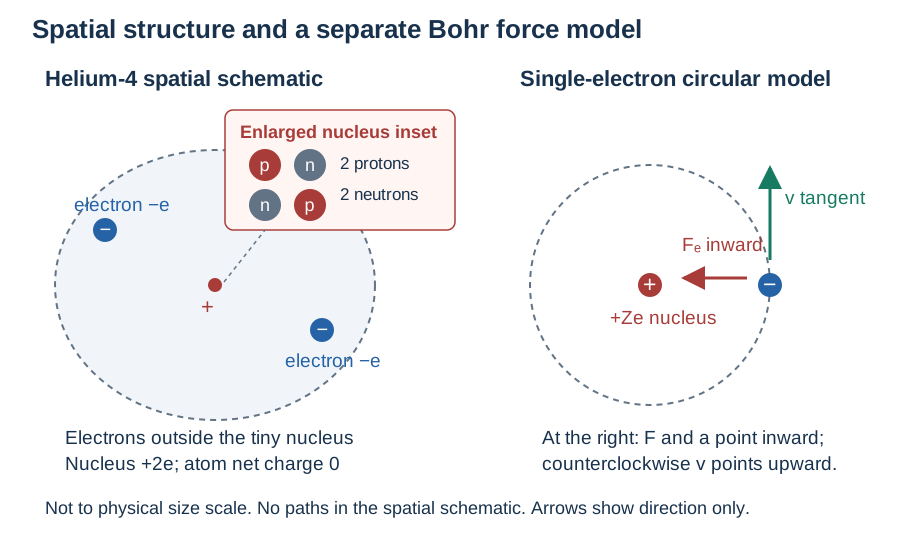
An atom has a small positive nucleus in its central region and one or more negative electrons surrounding it. The nucleus contains protons and neutrons; neutrons add mass and nucleon number without adding electric charge. The electrons are outside the tiny nuclear region. A schematic that puts electrons inside the nucleus or spreads positive charge throughout the atom misses this spatial structure, even if its total particle counts are correct.
For scale, an atomic radius of about 10⁻¹⁰ m is roughly 100,000 times a nuclear radius of about 10⁻¹⁵ m. A drawing large enough to label the nucleus must enlarge it relative to the atom, so state that the schematic is not to scale. A neutral helium-4 atom has two protons and two neutrons in the nucleus and two electrons outside it: nucleus charge +2e, total electron charge −2e, total atom charge zero. Removing one electron leaves the same nucleus and produces an ion of charge +e.
Surrounding does not require a literal circular electron path. We use spatial charge regions and energy levels here; the separate Bohr diagram is a historical model with circular paths. The electron-structure description in this course stays at energy levels.
Inspect diagram labels
The diagram keeps its full size here. Focus the view and use the arrow keys, or scroll across it, to inspect every label.
Inward attraction changes direction
In a single-electron Bohr model, place a positive nucleus at the center and an electron at the right-hand point of a circular orbit. The electron’s instantaneous velocity points tangent to the circle; for counterclockwise motion it points upward there. The electric force points left toward the nucleus. Force is not along the velocity: its inward direction supplies centripetal acceleration and continually changes the direction of motion.
For nuclear charge +Ze, the force magnitude is F = kZe²/r². Equate that inward electric force to mv²/r to obtain v² = kZe²/(mr). A more highly charged nucleus has stronger attraction at the same radius. This classical force balance alone does not select allowed orbits: the additional integer matter-wave fit 2πr = nh/(mv) restricts the states. The Bohr model helped explain hydrogen’s discrete energies; it remains a limited historical representation.
Inspect diagram labels
The diagram keeps its full size here. Focus the view and use the arrow keys, or scroll across it, to inspect every label.
One electron around a charge +2e nucleus
A helium-4 ion has one electron. In a supplied Bohr model its orbit radius is 2.65 × 10⁻¹¹ m. Use k = 8.99 × 10⁹ N·m²/C², e = 1.60 × 10⁻¹⁹ C, m = 9.11 × 10⁻³¹ kg, and h = 6.63 × 10⁻³⁴ J·s.
Inspect diagram labels
The diagram keeps its full size here. Focus the view and use the arrow keys, or scroll across it, to inspect every label.
- The tiny central nucleus has two protons and two neutrons and charge +2e. The one negative electron is outside it; the complete ion has net charge +e. This inventory does not require orbital shapes.
- The attraction has magnitude F = k(2e)e/r² = 6.55 × 10⁻⁷ N and points toward the nucleus. From F = mv²/r, v = √(Fr/m) = 4.37 × 10⁶ m/s.
- The de Broglie wavelength is λ = h/(mv) = 1.67 × 10⁻¹⁰ m. The circumference 2πr = 1.67 × 10⁻¹⁰ m fits approximately one wavelength with the rounded constants.
- At the right of the nucleus, draw the force left and the velocity up for counterclockwise motion. The force is perpendicular to that instantaneous velocity; it supplies inward acceleration.
Answer and check
The one-electron ion has a small +2e nucleus surrounded by its −e electron and net charge +e. The model gives v ≈ 4.37 × 10⁶ m/s and an approximately one-wavelength circular fit; it does not claim this orbit picture describes every atom.
Try it from memory
Write your answer and reason before opening the worked answer. Your self-assessment is a study decision; it is not an automatically graded score.
Question 1
Compared with neutral ¹⁶₈O, which counts change in neutral ¹⁸₈O and in ¹⁶₈O²⁻?
Worked answer and reason
¹⁸O has two more neutrons, the same 8 protons and 8 electrons. O²⁻ has two more electrons, giving 10, while its nucleus stays 8 protons and 8 neutrons.
An isotope change and an ion change affect different parts of the atom.
Question 2
Can a Bohr ring circumference equal 2.5 de Broglie wavelengths? What is missing from classical force balance alone?
Worked answer and reason
Not in the allowed standing-wave model: the wave does not match after one circuit. Force balance alone allows continuous radii and does not impose quantized energy states.
The boundary condition supplies the integer requirement.
JavaScript enables saved drafts and self-assessment. You can always work on paper.
Catch the tempting mistake
- The number written above the element is the number of neutrons.
- A is the total nucleon number. Subtract Z to find neutrons.
Put it to work
Give the physical reason as well as the calculation. The worked solutions are on a separate page.
- Problem 3 · mixed
- Problem 4 · mixed
- Problem 19 · experimental
Explain and apply the model
Try these problems before opening the solutions. Show the physical model, your calculation or sketch, and the reason your conclusion follows.
Locate the charge, then draw its force
Consider a neutral hydrogen atom with one proton and one electron. Use illustrative atomic and nuclear radii 1.0 × 10⁻¹⁰ m and 1.0 × 10⁻¹⁵ m. In a separate historical Bohr model, put the nucleus at the origin and the electron at x = +r, with r = 2.12 × 10⁻¹⁰ m and counterclockwise circular motion. Use k = 8.99 × 10⁹ N·m²/C², e = 1.60 × 10⁻¹⁹ C, m = 9.11 × 10⁻³¹ kg, and h = 6.63 × 10⁻³⁴ J·s.
(a) Draw a labeled spatial schematic of the neutral atom showing the signs of charge, the small nuclear region, and the electron outside it. Calculate the nuclear-to-atomic radius ratio and explain why a readable nucleus inset is not to scale. Evaluate a diagram that places negative electrons inside the positive nucleus while retaining the same particle counts.
(b) For the separate Bohr model, draw the instantaneous velocity, electric force, and acceleration directions at x = +r. Calculate the force magnitude and speed by equating electric attraction to centripetal force. Explain why the force is not along the velocity.
(c) Calculate the electron’s de Broglie wavelength and the approximate number of wavelengths around this Bohr circumference. Explain why force balance alone does not select allowed energy states, and give the historical model’s useful scope.
Written working workspace
Drawing is temporarily unavailable. Work on paper if needed, then record your reasoning here.
Saving written working requires JavaScript. Keep your work on paper or in your own notes; the source problem above remains available.
Worked solution and rubric →Revisit the explanation →Revisit the explanation →Revisit the explanation →
Scientific calculator workspace
Keep intermediate precision and report units. This calculator supports arithmetic and elementary functions.
Scientific calculator
This calculator requires JavaScript. Use the physics formula sheets and show your working manually.
+ − * / ^ ! · pi · e · sqrt · sin, cos, tan · asin, acos, atan · atan2(y,x) · ln, log · abs · exp · hypot(x,y). Use * between factors. Keep units in your written working.
For the teacher
- Ask students to keep separate counts of protons, neutrons, and electrons. Explain that circular Bohr orbits are a model, not a required modern picture of literal electron paths.
Source objectives and scope
- 15.2.A — Describe the properties of an atom.
The analysis and description of electron structure is limited to energy levels and will not include such advanced descriptions as orbitals, orbital shapes, or probability functions.
Suggested skills are teaching guidance. The course applies all science practices across its objectives.
Science references for this teaching
- AP Physics 2 Course and Exam Description, official Unit 15 — Official topic/LO/EK scope and boundaries; local pinned pages 143–158, equations and relevant clauses visually checked on 143–144,146,149–150,152–158.
- AP Physics 2 Course and Exam Description Clarifications, effective Fall 2026 — 15.7.B.1 current definition includes decay to a lower energy level of the same nucleus.
- OpenStax University Physics 3, Blackbody Radiation — Verification of Wien peak and integrated spectral intensity versus Stefan–Boltzmann total power.
- OpenStax University Physics 3, Photoelectric Effect — Verification of threshold, maximum kinetic energy, intensity distinctions, and retarding-potential experiment.
- OpenStax University Physics 3, The Compton Effect — Verification of positive electron-at-rest shift and photon energy/momentum accounting.
- OpenStax University Physics 3, Nuclear Binding Energy — Verification of all-nucleon mass defect and atomic-mass convention.
- OpenStax University Physics 3, Radioactive Decay — Verification of exponential survival, half-life, and nuclear transformation balances.
- OpenStax University Physics, Volume 3: 6.1 Blackbody Radiation — Primary textbook verification of the wavelength-based blackbody spectral shape, the distinction between peak height and complete spectrum area, Wien’s displacement law, and Stefan–Boltzmann emitted intensity and power.
Glossary and deeper reading · 17 refreshers
These editorial refreshers supplement the reading. Definitions and examples are added guidance; original source wording and recorded answers remain in their original context.
-
Isotope
Isotopes are atoms of the same element with different numbers of neutrons. They share an atomic number but have different mass numbers and can differ in nuclear stability. For example, carbon-12 and carbon-14 are isotopes because both have six protons but different neutron counts.
-
Ion
An ion is an atom or group of atoms with a nonzero net electric charge. For an atomic ion, the electron count differs from the proton count while the element remains fixed by its protons. For example, removing an electron from a neutral atom makes a positive ion.
-
De Broglie wavelength
De Broglie wavelength is the wavelength associated with a particle’s momentum in a quantum description. It is Planck’s constant divided by momentum magnitude, so greater momentum corresponds to shorter wavelength. For example, electron diffraction is noticeable when the experimental structure has a length scale comparable to the electrons’ de Broglie wavelength.
-
Atomic number
Atomic number is the number of protons in an atomic nucleus. It identifies the element and does not change merely when electrons are gained or lost. For example, every carbon isotope has the same atomic number even though their neutron counts can differ.
-
Mass number
Mass number is the total number of protons and neutrons in a nucleus. It is a count rather than the atom’s measured mass in kilograms or atomic mass units. For example, subtracting atomic number from mass number gives the neutron count of an isotope.
-
Electric charge
Electric charge is a conserved property that determines electric interactions. It can be positive or negative and is measured in coulombs; ordinary net charges arise from an imbalance of charged particles. For example, transferring electrons between initially neutral objects leaves one negatively charged and the other positively charged.
-
Electric force
Electric force is the interaction of an electric field with a charged object. For point charges at rest, like signs repel and opposite signs attract, with direction along their separation. For example, an electron and proton exert equal-magnitude opposite forces on one another despite having different masses.
-
Net force
Net force is the vector sum of all forces acting on the object or system under consideration. For constant mass in an inertial frame, it equals mass times acceleration. For example, equal upward and downward forces give zero net force even though neither force is zero.
-
Wave
A wave is a propagating disturbance that can transfer energy without transporting the medium as a whole. Mechanical waves require a material medium, while electromagnetic waves can propagate through vacuum. For example, a pulse travels along a rope while individual rope segments move locally around their equilibrium positions.
-
Wavelength
Wavelength is the spatial distance between neighboring points at the same phase of a periodic wave. It connects propagation speed and frequency through speed equal to frequency times wavelength. For example, neighboring crests of a sinusoidal water wave are separated by one wavelength.
-
Quantization
Quantization means a quantity can take only certain allowed values in the stated quantum system. Bound-state boundary conditions can restrict energy to discrete levels rather than a continuous range. For example, an electron bound in a hydrogen atom cannot have an arbitrary energy between its allowed levels.
-
Energy level
An energy level is an allowed energy of a quantum system. Bound systems have discrete levels, and a transition between them requires an energy transfer equal to the level difference. For example, an atom emitting a photon drops to a lower energy level and transfers the difference to that photon.
-
Instantaneous velocity
Instantaneous velocity is the rate of change of position at a particular moment. On a position-versus-time graph, its component is the slope of the tangent at that time. For example, the velocity just before a ball lands differs from the average velocity of its entire flight.
-
Force
A force describes an interaction that can change an object’s momentum. It is a vector measured in newtons, so both size and direction matter when forces are added. For example, a rope can pull a cart while the floor exerts friction in another direction.
-
Magnitude
Magnitude is the nonnegative size of a vector quantity. It does not specify direction, and it differs from a signed component. For example, a westward velocity can have a negative x component while its speed, the velocity magnitude, stays positive.
-
Acceleration
Acceleration is the vector rate of change of velocity with time. It can change an object’s speed, direction, or both, and it is measured in meters per second squared. For example, a satellite moving at constant speed in a circular orbit accelerates toward the center.
-
Centripetal force
Centripetal force names the inward net-force component required for motion along a circular path. It is supplied by actual interactions such as tension, friction, gravity, or normal forces rather than being an additional type of force. For example, gravity supplies the centripetal force on a satellite in a circular orbit.