Linear Predictions: Substitute, Interpret, and Check the Range — Worked Solutions
Worked Solutions
Compare your reasoning with the worked solutions after attempting the questions. A different valid representation or explanation can earn credit when it satisfies the stated criteria.
Original generated practice for the Fall 2026 course. Return to the lesson and independent checks.
Read the model before using it: worked answer
A rental shop uses , where x is route distance in kilometers and y is rental duration in minutes. The observed distance interval is 1–9 kilometers.
Part a
Identify the explanatory variable, response variable, predicted response notation, a, and b. Explain the direction of prediction.
Explanatory x is route distance in kilometers; response y is rental duration in minutes. is predicted duration. The model has a=12 minutes and b=3 minutes per kilometer. A supplied distance predicts a duration; it does not take a supplied duration as its explanatory input.
| Evidence for credit | Points |
|---|---|
| Identifies variables, units, and y-hat as predicted response. | 1 |
| Identifies a=12 and b=3 with their roles. | 1 |
| States the correct x-to-y direction. | 1 |
Predict an observed-range rental: worked answer
Use , with x in kilometers and predicted y in minutes. Observed x-values range from 1 to 9 kilometers.
Part a
Calculate and interpret the predicted duration for x=6 kilometers. Show substitution and classify the prediction as interpolation or extrapolation.
minutes. A 6-kilometer route has a predicted rental duration of 30 minutes under this model. It is interpolation because 6 lies inside the observed 1–9 kilometer interval.
| Evidence for credit | Points |
|---|---|
| Shows substitution and obtains 30. | 1 |
| Interprets predicted duration with minutes and specified distance. | 1 |
| Uses the x-interval to identify interpolation. | 1 |
Arithmetic beyond the data: worked answer
Use , based on x-values from 1 to 9 kilometers.
Part a
Predict rental durations at 10 and 30 kilometers. Classify both predictions and explain which extends farther beyond the evidence.
At 10 kilometers the prediction is 42 minutes; at 30 it is 102 minutes. Both are extrapolation because both x-values exceed 9 kilometers. The 30-kilometer prediction extends much farther beyond the observations and is generally less reliable; the calculation itself does not supply evidence that the model continues to hold.
| Evidence for credit | Points |
|---|---|
| Calculates 42 and 102 minutes from the equation. | 1 |
| Classifies both using the observed x interval. | 1 |
| Relates farther extrapolation to weaker reliability. | 1 |
A within-range input on a curve: worked answer
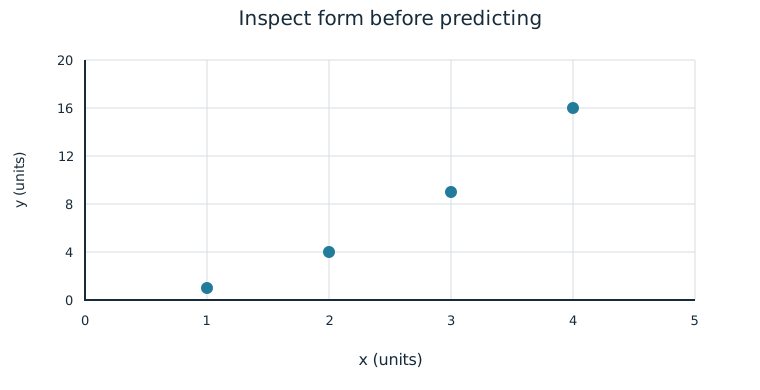
A proposed line is intended for the full pairs (1,1),(2,4),(3,9),(4,16).
Part a
Does x=2.5 being inside the observed interval establish that a linear regression model is appropriate? Explain using the shape and the meaning of interpolation.
No. x=2.5 is an interpolation input because it lies between 1 and 4, but the observed form is curved rather than approximately straight. A linear model requires attention to linear form; being inside the input range does not make an inappropriate model suitable.
| Evidence for credit | Points |
|---|---|
| Identifies the input as within range. | 1 |
| Uses the curved form to reject guaranteed linear appropriateness. | 1 |
| Separates interpolation classification from form suitability. | 1 |
Route predictions with a stated model: worked answer
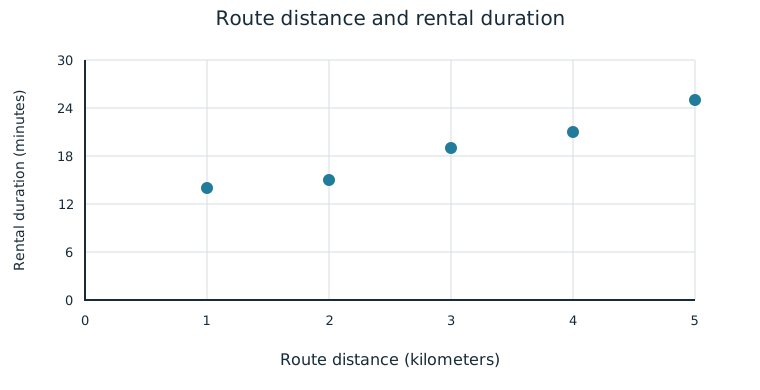
A rental shop records the generated pairs (route kilometers, rental minutes)=(1,14),(2,15),(3,19),(4,21),(5,25). The shop proposes the supplied model ; it is not presented as a recovered historical or least-squares equation.
Part a
Explain whether the scatterplot’s form reasonably supports using a linear model as an approximation. Identify x, y, y-hat, a, and b.
The points follow a roughly straight upward pattern, so a linear approximation is reasonable from the form. x is route kilometers, y is observed rental minutes, and y-hat is predicted rental minutes. In the supplied model a=10 minutes and b=3 minutes per kilometer.
| Evidence for credit | Points |
|---|---|
| Uses approximately straight form rather than merely upward direction. | 1 |
| Identifies all variables and the predicted response. | 1 |
| Gives a and b with their roles and units. | 1 |
Part b
Calculate and interpret the predicted rental duration for a 4.5-kilometer route. Classify the prediction and explain how its predicted value differs conceptually from an individual observed value.
minutes: the model predicts a 23.5-minute duration at 4.5 kilometers. It is interpolation because 4.5 is within 1–5. An individual observed duration could be above or below this model prediction.
| Evidence for credit | Points |
|---|---|
| Calculates 23.5 minutes with substitution. | 1 |
| Interprets y-hat as predicted duration, not a guaranteed observation. | 1 |
| Identifies interpolation using the distance interval. | 1 |
Part c
Calculate predictions at 6 and 20 kilometers. Classify each and compare their reliability using the observed interval.
At 6 kilometers, minutes; at 20 kilometers, minutes. Both extrapolate beyond the largest observed x=5. The 20-kilometer prediction extends much farther beyond the data and is generally less reliable because the relationship may change outside the studied routes.
| Evidence for credit | Points |
|---|---|
| Calculates 28 and 70 minutes. | 1 |
| Identifies both as extrapolation from the x range. | 1 |
| Explains the relative reliability limitation in context. | 1 |