Experiment and Exam Practice: Worked Solutions
Try the four original tasks before reading on. These solutions and rubrics are teaching tools written for this book. Other correct approaches can earn the same teaching points; the rubrics are not official College Board scoring guidelines.
1. Mathematical Routines: a hanging spring
- Draw gravity mg downward and spring force ky upward. With downward positive, write ma = mg − ky. Why: A free-body diagram identifies every external force and prevents treating the spring force alone as the net force.
- At equilibrium y₀ = mg/k. Substitute y = x + mg/k to obtain ma = mg − k(x + mg/k) = −kx, so aₓ = −(k/m)x. Why: Displacement must be measured from the stretched equilibrium. Gravity shifts that equilibrium but cancels from the linear restoring equation.
- Choose mass–spring–Earth, neglect resistance, and write U = ½ky² − mgy. Completing the square gives U = ½k(y − mg/k)² − (mg)²/(2k). Why: This system includes both spring and gravitational potential; the negative sign uses the stated downward coordinate.
- Set x = y − mg/k and shift the arbitrary potential zero. Then E_osc = ½mv² + ½kx² = ½kA² = 0.060 J. Why: At release the speed is zero and x = A = 0.040 m. Potential-energy zeros may shift by a constant without changing energy differences or motion.
- At x = 0, all oscillation energy is kinetic, so v_max = A√(k/m) = 0.040√(75/0.30) = 0.632 m/s. Why: Kinetic energy is largest when the equilibrium-centered combined potential is smallest.
- If A doubles, T = 2π√(m/k) remains 0.397 s while E_osc = ½kA² quadruples to 0.240 J. Why: Period depends on mass and stiffness, while total oscillation energy depends on amplitude squared. The assumptions remain ideal and linear.
Teaching rubric
| Evidence | Points | What earns them |
|---|---|---|
| Force diagram and restoring derivation | 3 | Both forces with directions (2); equilibrium substitution and a = −kx/m (1). |
| System and energy | 3 | Includes Earth and both potential terms (1); equilibrium-centered potential derivation (1); conserved E = ½kA² (1). |
| Maximum speed | 2 | Symbolic derivation (1); 0.632 m/s with units (1). |
| Amplitude comparison | 2 | Unchanged period with reason (1); fourfold energy with reason (1). |
2. Translation Between Representations: a sensor’s story
- At x = +A/2 draw only the horizontal restoring force left, with magnitude kA/2. Show vertical normal and weight balancing if you draw a full free-body diagram. Why: The spring force opposes displacement; horizontal SHM assumes the vertical forces produce no vertical acceleration.
- Use U/E = x²/A² = 1/4 and K/E = 3/4 for an energy chart at this position. Why: Energy shares come from squared displacement and sum to the fixed total.
- Compute ω = √(k/m) = 10 rad/s and T = 2π/ω = 0.628 s. Use x = 0.080 cos(10t), v = −0.80 sin(10t), and a = −8.0 cos(10t), with SI units. Why: The cosine start matches release from the positive turning point; graph slopes and restoring acceleration determine the other signs.
- At t/T = 0, 1/4, 1/2, 3/4, 1, use x/A = 1, 0, −1, 0, 1; v/v_max = 0, −1, 0, 1, 0; and a/a_max = −1, 0, 1, 0, −1. Sketch smooth curves through these features on aligned axes. Why: The table pins down extrema, zeros, and phase relations instead of relying on a memorized wave shape.
- From energy conservation, K(x) = ½k(A² − x²) = 0.160 J − (25 N/m)x². Sketch a downward parabola from x = −0.080 m to +0.080 m, with zeros at both endpoints and peak 0.160 J at zero. Why: The spring potential subtracts from constant total energy; a negative K outside the endpoints signals a position not reached in this run.
- For double A, x, v, and a graph heights double while the period stays fixed. K versus x has endpoints at ±0.160 m and peak 0.640 J; its curvature coefficient remains −k/2. Why: The same k and m keep frequency fixed. Energy quadruples because both amplitude and maximum speed enter squared energy formulas.
Teaching rubric
| Evidence | Points | What earns them |
|---|---|---|
| Representations at A/2 | 2 | Restoring direction and force label (1); energy fractions 1/4 and 3/4 (1). |
| Aligned time graphs | 4 | Correct x extrema and zeros (1); v phase and signs (1); a opposite to x (1); aligned time labels and correct extrema units (1). |
| Energy relation and graph | 3 | K(x) derived (1); correct parabola and endpoints (1); E = 0.160 J (1). |
| New-run consistency | 3 | Time-graph heights double and T stays fixed (1); K graph peak quadruples and endpoints double (1); explanation connects both to same energy relation (1). |
3. Experimental Design and Analysis: find g
- Choose at least five lengths spanning a useful range. Measure from pivot to bob center, keep the same bob and a small similar release angle, and release without a push. Why: Varying one parameter lets the graph test the length dependence while controlling changes that would spoil the model.
- Time 10 full cycles from one turning point back to that same turning point, repeat three times at each length, and compute T = mean elapsed time/10. Why: Timing many cycles makes reaction time a smaller fraction of the total; repeats reveal random spread. A full cycle includes the return trip.
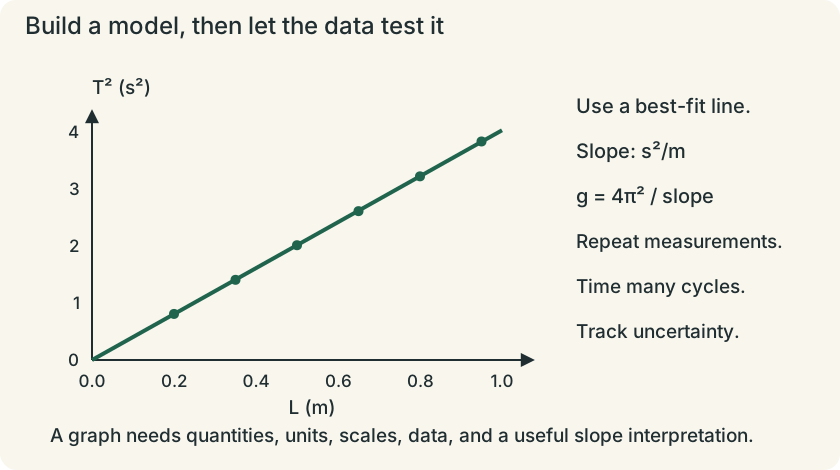
- Square T = 2π√(L/g) to get T² = (4π²/g)L. Plot T² vertically in s² against L horizontally in m, with scales, data points, and a best-fit line. Why: Linearization makes the slope a directly interpretable model parameter instead of hiding the square-root dependence.
- For the six listed data rows, T values are 0.899, 1.186, 1.419, 1.616, 1.795, and 1.958 s. Corresponding T² values are 0.808, 1.407, 2.014, 2.611, 3.222, and 3.834 s². Why: The elapsed times cover 10 cycles, so dividing before squaring is essential. Squaring the full elapsed time would give values 100 times too large.
- A least-squares fit gives slope approximately 4.033 s²/m and intercept approximately −0.003 s². A well-drawn graphical slope near 4.0 s²/m is appropriate. Compute g = 4π²/slope ≈ 9.79 m/s², reported as about 9.8 m/s² for these measurements. Why: Slope has units s²/m, so its reciprocal times 4π² has acceleration units. The fit precision does not mean the physical measurements are exact.
- For a ±0.10 s uncertainty in 10-cycle elapsed time, period uncertainty is about ±0.010 s. The approximate T² uncertainty is 2TΔT, about 0.018 to 0.039 s² over these data. Compare plausible slopes through those uncertainties rather than asserting exact equality. Why: Small changes in T² are proportional to twice T times the period change. These spreads and length uncertainty support a result near 9.8 m/s², but no precise confidence interval is implied.
- A constant length-zero error shifts the T²-versus-L intercept if a free intercept is fitted; forcing the line through zero can then bias its slope. A systematic time-scale error changes the slope directly. Why: Repeated readings do not remove an error that affects every trial the same way. Model checking and calibration address different limitations from averaging.
Teaching rubric
| Evidence | Points | What earns them |
|---|---|---|
| Experimental procedure | 4 | Defines varied length and measured timing (1); pivot-to-center length and full cycles (1); controls angle/bob and repeats (1); specific uncertainty reduction with reason (1). |
| Data and graph | 3 | Divides elapsed time by 10 and squares T (1); labeled scales and plotted data (1); useful best-fit line (1). |
| Interpretation | 3 | Slope with units around 4.03 s²/m (1); g = 4π²/slope around 9.8 m/s² (1); reasoned uncertainty or systematic-error discussion (1). |
4. Qualitative/Quantitative Translation: buoyancy and acceleration
- Both fully submerged blocks displace the same volume, so their buoyant forces are equal. The lighter block has less weight and less inertia, so its initial upward acceleration is larger. Why: Buoyancy is set by the displaced fluid, while net force and mass together set acceleration.
- Use ρV = 3m to get F_B = 3mg for each block. For A: ma_A = 3mg − mg, giving a_A = 2g upward. Why: The equal-volume condition fixes buoyancy; the first object still has its own gravitational force mg.
- For B: 2ma_B = 3mg − 2mg, giving a_B = g/2 upward. Why: Doubling mass also doubles weight, so the upward net force is now only mg.
- The acceleration of B is one-quarter of A, not one-half. The shared buoyancy is not the shared net force. Why: Newton’s second law uses total external force after subtracting weight; ignoring that subtraction gives the wrong ratio.
- At floating equilibrium, F_B = weight. Thus V_sub,A/V = m/(ρV) = 1/3 and V_sub,B/V = 2m/(ρV) = 2/3. Why: Each block rises far enough that its displaced volume decreases until buoyancy matches its own weight.
- Both can accelerate upward while fully submerged and later float at rest with different submerged fractions. Why: The submerged volume and therefore buoyancy change on reaching the surface, so the force balance need not match the initial submerged balance.
Teaching rubric
| Evidence | Points | What earns them |
|---|---|---|
| Qualitative claim | 2 | Equal buoyancy because equal displaced volume (1); larger acceleration for lighter object with net-force reasoning (1). |
| Quantitative result | 2 | a_A = 2g from force balance (1); a_B = g/2 from force balance (1). |
| Consistency check | 2 | Explains unequal net forces (1); correct one-quarter acceleration ratio (1). |
| Floating state | 2 | Fractions 1/3 and 2/3 (1); explains reduced displaced volume and zero final acceleration (1). |