Unit 8 / Fluids
Unit 8: 38 practice problems
Work from memory first. Draw a diagram, choose a system, and say why your model applies. The 30 selected questions revisit every topic in Fluids; 8 additional problems at the end ask you to explain and apply the models. The worked solutions live on their own page.
This is mixed topic review: short concept checks, calculations, and experiment tasks appear together. Choose a topic below to revisit its lesson, then return to the questions that challenge your model.
Question 1 · AP topic 8.1
1. Put topic 8.1 to work
A best-fit total-mass graph obeys m_total = (0.90 g/mL)V + 45 g. Find the liquid density in SI units and explain what the intercept means. What total mass should the balance show for 60 mL?
Your written working
Drawing is temporarily unavailable. Work on paper if needed, then record your reasoning here.
Saving written working requires JavaScript. The problem remains available above; keep your work on paper or in your own notes.
See this question in its original context ↗Separate worked solution ↗
Question 2 · AP topic 8.2
2. Put topic 8.2 to work
A small horizontal window of area 0.020 m² is 1.5 m below an open water surface. Air behind it is at the same atmospheric pressure as the surface. Approximate the pressure as uniform over the window. Find the net pressure force and explain why using absolute water pressure alone would be wrong.
Your written working
Drawing is temporarily unavailable. Work on paper if needed, then record your reasoning here.
Saving written working requires JavaScript. The problem remains available above; keep your work on paper or in your own notes.
See this question in its original context ↗Separate worked solution ↗
Question 3 · AP topic 8.3
3. Put topic 8.3 to work
Two rigid objects with equal external volume V are fully submerged in the same fluid. Object A has mass m and object B has mass 2m. Derive their initial upward accelerations when released from rest with drag neglected. Is B’s acceleration always half of A’s?
Your written working
Drawing is temporarily unavailable. Work on paper if needed, then record your reasoning here.
Saving written working requires JavaScript. The problem remains available above; keep your work on paper or in your own notes.
See this question in its original context ↗Separate worked solution ↗
Question 4 · AP topic 8.4
4. Put topic 8.4 to work
A horizontal jet leaves a reservoir hole 0.20 m above a catch tray. A fitted graph of R² versus water depth h passes through the origin and has slope 0.72 m. Find the ideal expected slope and compare the measured range to the ideal range at h = 0.30 m.
Your written working
Drawing is temporarily unavailable. Work on paper if needed, then record your reasoning here.
Saving written working requires JavaScript. The problem remains available above; keep your work on paper or in your own notes.
See this question in its original context ↗Separate worked solution ↗
Question 5 · AP topic 8.1
5. Put topic 8.1 to work
Two samples of the same uniform liquid have volumes V and 3V at the same conditions. Their densities…
- are equal.
- differ by a factor of 3.
- depend on their weights.
Your written working
Drawing is temporarily unavailable. Work on paper if needed, then record your reasoning here.
Saving written working requires JavaScript. The problem remains available above; keep your work on paper or in your own notes.
See this question in its original context ↗Separate worked solution ↗
Question 6 · AP topic 8.2
6. Put topic 8.2 to work
Pressure is a scalar. Which statement follows?
- Pressure forces have no direction.
- A fluid cannot push sideways.
- Each pressure force has a direction normal to its surface, but pressure itself has no direction.
Your written working
Drawing is temporarily unavailable. Work on paper if needed, then record your reasoning here.
Saving written working requires JavaScript. The problem remains available above; keep your work on paper or in your own notes.
See this question in its original context ↗Separate worked solution ↗
Question 7 · AP topic 8.3
7. Put topic 8.3 to work
A light block is fully submerged and initially accelerates upward after release. Which statement is correct?
- Buoyancy equals weight.
- Buoyancy exceeds weight if other forces are negligible.
- There is no gravitational force underwater.
Your written working
Drawing is temporarily unavailable. Work on paper if needed, then record your reasoning here.
Saving written working requires JavaScript. The problem remains available above; keep your work on paper or in your own notes.
See this question in its original context ↗Separate worked solution ↗
Question 8 · AP topic 8.4
8. Put topic 8.4 to work
In steady incompressible flow, a filled pipe diameter halves. At the same flow rate the speed…
- doubles.
- quadruples.
- halves.
Your written working
Drawing is temporarily unavailable. Work on paper if needed, then record your reasoning here.
Saving written working requires JavaScript. The problem remains available above; keep your work on paper or in your own notes.
See this question in its original context ↗Separate worked solution ↗
Question 9 · AP topic 8.1
9. Put topic 8.1 to work
A graph has liquid mass on the vertical axis and volume on the horizontal axis. Its slope is…
- the volume.
- the density.
- the inverse density.
Your written working
Drawing is temporarily unavailable. Work on paper if needed, then record your reasoning here.
Saving written working requires JavaScript. The problem remains available above; keep your work on paper or in your own notes.
See this question in its original context ↗Separate worked solution ↗
Question 10 · AP topic 8.2
10. Put topic 8.2 to work
An open pool has zero gauge pressure at its surface. Its absolute pressure there is…
- the atmospheric pressure.
- zero.
- ρgh with h equal to pool depth.
Your written working
Drawing is temporarily unavailable. Work on paper if needed, then record your reasoning here.
Saving written working requires JavaScript. The problem remains available above; keep your work on paper or in your own notes.
See this question in its original context ↗Separate worked solution ↗
Question 11 · AP topic 8.3
11. Put topic 8.3 to work
A rigid fully submerged block is lowered deeper into the same incompressible fluid. Its buoyant force…
- stays unchanged.
- increases because all pressures increase.
- decreases because the fluid gets heavier.
Your written working
Drawing is temporarily unavailable. Work on paper if needed, then record your reasoning here.
Saving written working requires JavaScript. The problem remains available above; keep your work on paper or in your own notes.
See this question in its original context ↗Separate worked solution ↗
Question 12 · AP topic 8.4
12. Put topic 8.4 to work
Which term can be dropped when comparing two points at the same height with Bernoulli?
- The difference in gravitational terms.
- Both pressure terms in every case.
- Both kinetic terms in every case.
Your written working
Drawing is temporarily unavailable. Work on paper if needed, then record your reasoning here.
Saving written working requires JavaScript. The problem remains available above; keep your work on paper or in your own notes.
See this question in its original context ↗Separate worked solution ↗
Question 13 · AP topic 8.1
13. Put topic 8.1 to work
Which pair defines the ideal-fluid model here?
- Fixed shape and zero density.
- Compressible and highly viscous.
- Incompressible and nonviscous.
Your written working
Drawing is temporarily unavailable. Work on paper if needed, then record your reasoning here.
Saving written working requires JavaScript. The problem remains available above; keep your work on paper or in your own notes.
See this question in its original context ↗Separate worked solution ↗
Question 14 · AP topic 8.2
14. Put topic 8.2 to work
A gauge-pressure-versus-depth graph for a uniform resting fluid has slope…
- g/ρ
- ρg
- the tank bottom area.
Your written working
Drawing is temporarily unavailable. Work on paper if needed, then record your reasoning here.
Saving written working requires JavaScript. The problem remains available above; keep your work on paper or in your own notes.
See this question in its original context ↗Separate worked solution ↗
Question 15 · AP topic 8.3
15. Put topic 8.3 to work
A freely floating object has average density 600 kg/m³ in water of density 1000 kg/m³. Its submerged volume fraction is…
- 1.67
- 0.40
- 0.60
Your written working
Drawing is temporarily unavailable. Work on paper if needed, then record your reasoning here.
Saving written working requires JavaScript. The problem remains available above; keep your work on paper or in your own notes.
See this question in its original context ↗Separate worked solution ↗
Question 16 · AP topic 8.4
16. Put topic 8.4 to work
A large open reservoir has a small hole depth h below the surface. Increasing h to 4h changes ideal exit speed by…
- a factor of 4.
- no factor.
- a factor of 2.
Your written working
Drawing is temporarily unavailable. Work on paper if needed, then record your reasoning here.
Saving written working requires JavaScript. The problem remains available above; keep your work on paper or in your own notes.
See this question in its original context ↗Separate worked solution ↗
Question 17 · AP topic 8.2
17. Pressure below two liquid layers
An open tank has a 0.350 m layer of oil of density 850 kg/m³ above a 1.20 m layer of water of density 1000 kg/m³. Find the gauge pressure at the bottom. Use g = 9.81 m/s².
Your written working
Drawing is temporarily unavailable. Work on paper if needed, then record your reasoning here.
Saving written working requires JavaScript. The problem remains available above; keep your work on paper or in your own notes.
See this question in its original context ↗Review the model ↗Separate worked solution ↗
Question 18 · AP topic 8.3
18. Buoyancy · question 1
A cube with side length 2 m and mass 50 kg floats with a horizontal face in water of density 1000 kg/m³. What is its submerged depth?
Your written working
Drawing is temporarily unavailable. Work on paper if needed, then record your reasoning here.
Saving written working requires JavaScript. The problem remains available above; keep your work on paper or in your own notes.
See this question in its original context ↗Separate worked solution ↗
Question 19 · AP topic 8.4
19. Bernoulli’s Equation · question 1
A fluid flows through the inlet of a pipe with diameter and velocity . The fluid exits at the outlet of the pipe which has a diameter of . What is the velocity at this point?
Your written working
Drawing is temporarily unavailable. Work on paper if needed, then record your reasoning here.
Saving written working requires JavaScript. The problem remains available above; keep your work on paper or in your own notes.
See this question in its original context ↗Separate worked solution ↗
Question 20 · AP topic 8.2
20. A water-and-alcohol U-tube
Both arms of a U-tube are open to air. A column of alcohol of density 790 kg/m³ sits above water in one arm. The water surface in the other arm is 8.00 cm above the alcohol–water interface. Find the alcohol-column height, assuming static equilibrium.
Your written working
Drawing is temporarily unavailable. Work on paper if needed, then record your reasoning here.
Saving written working requires JavaScript. The problem remains available above; keep your work on paper or in your own notes.
See this question in its original context ↗Review the model ↗Separate worked solution ↗
Question 21 · AP topic 8.3
21. Buoyancy · question 2
A floating boat in a small pond releases a dense anchor, which sinks to the bottom and is no longer supported by the boat. Does the pond water level rise or fall?
Your written working
Drawing is temporarily unavailable. Work on paper if needed, then record your reasoning here.
Saving written working requires JavaScript. The problem remains available above; keep your work on paper or in your own notes.
See this question in its original context ↗Separate worked solution ↗
Question 22 · AP topic 8.4
22. Bernoulli’s Equation · question 2
Given that the final velocity in a pipe system is , what must be the ratio of in order to achieve an initial velocity of ?
Your written working
Drawing is temporarily unavailable. Work on paper if needed, then record your reasoning here.
Saving written working requires JavaScript. The problem remains available above; keep your work on paper or in your own notes.
See this question in its original context ↗Separate worked solution ↗
Question 23 · AP topic 8.3
23. Buoyancy · question 3
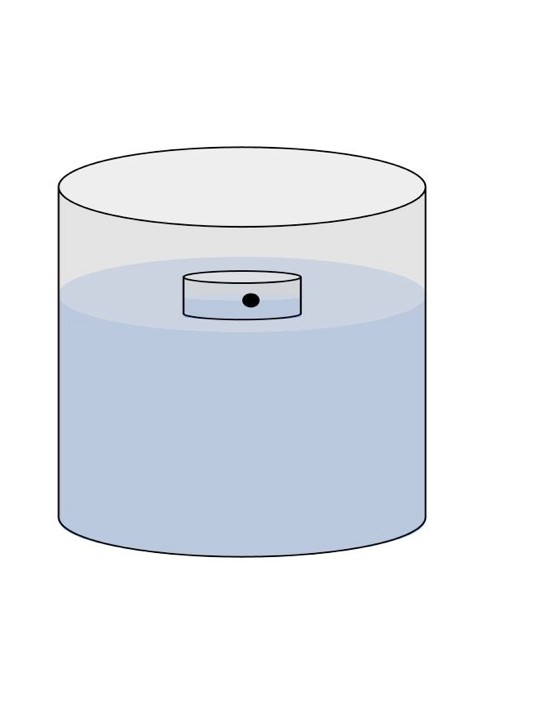
A cylinder is 100 mm long, 250 mm in radius, and has mass 100 kg. It is released upright in water. Will a hole halfway up its side become submerged?
Your written working
Drawing is temporarily unavailable. Work on paper if needed, then record your reasoning here.
Saving written working requires JavaScript. The problem remains available above; keep your work on paper or in your own notes.
See this question in its original context ↗Separate worked solution ↗
Question 24 · AP topic 8.4
24. Bernoulli’s Equation · question 3
In steady incompressible lossless flow along a horizontal streamline, if fluid speed increases, its static pressure must:
Your written working
Drawing is temporarily unavailable. Work on paper if needed, then record your reasoning here.
Saving written working requires JavaScript. The problem remains available above; keep your work on paper or in your own notes.
See this question in its original context ↗Separate worked solution ↗
Question 25 · AP topic 8.3
25. Buoyancy · question 4
An ice cube with sides is floating in water. If ice has a density of , how far below the water's surface will the bottom of the ice cube be?
Your written working
Drawing is temporarily unavailable. Work on paper if needed, then record your reasoning here.
Saving written working requires JavaScript. The problem remains available above; keep your work on paper or in your own notes.
See this question in its original context ↗Separate worked solution ↗
Question 26 · AP topic 8.4
26. Bernoulli’s Equation · question 4
For steady incompressible flow through the pictured sections, rank the mean speeds from greatest to least (I–IV).
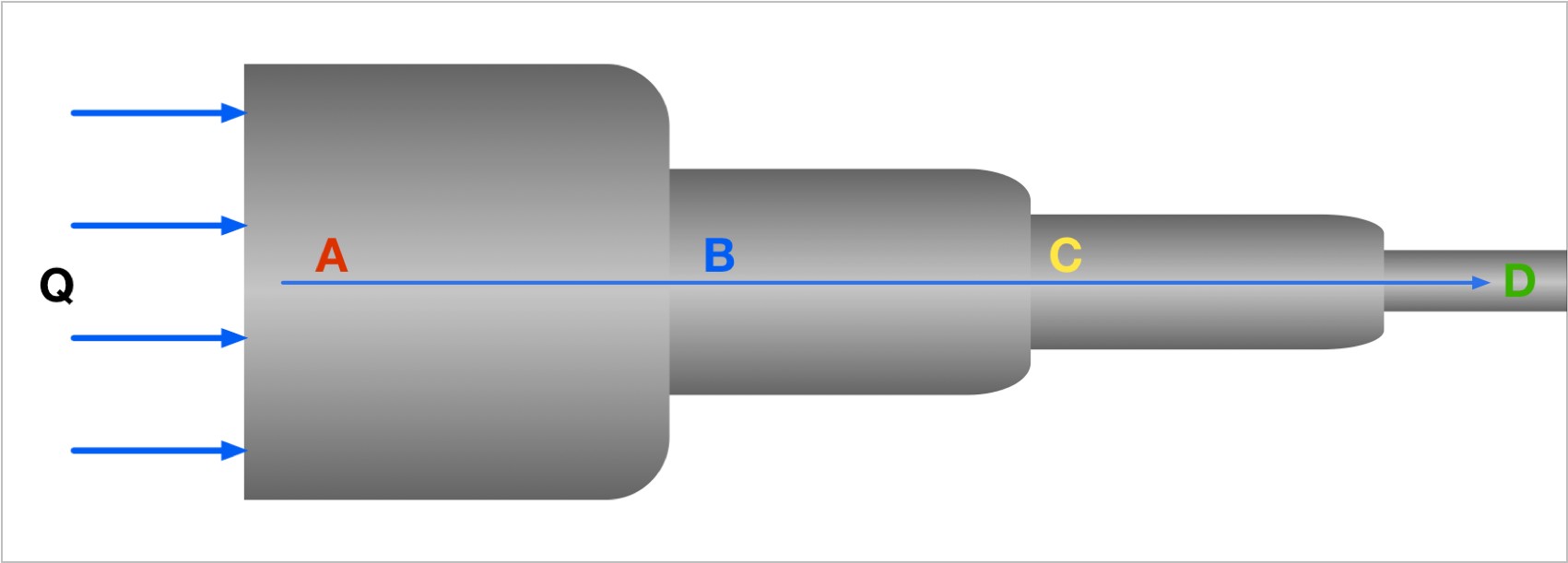
Assign rank I (greatest), II, III and IV (least) to the labeled sections A–D. Write your ranking before opening the solution.
Your written working
Drawing is temporarily unavailable. Work on paper if needed, then record your reasoning here.
Saving written working requires JavaScript. The problem remains available above; keep your work on paper or in your own notes.
See this question in its original context ↗Separate worked solution ↗
Question 27 · AP topic 8.3
27. Buoyancy · question 5
A rectangular box 1 m long with a 0.2 m square end floats with its long axis horizontal in water of density 1000 kg/m³. Find its mass if the submerged depth is 0.02 m.
Your written working
Drawing is temporarily unavailable. Work on paper if needed, then record your reasoning here.
Saving written working requires JavaScript. The problem remains available above; keep your work on paper or in your own notes.
See this question in its original context ↗Separate worked solution ↗
Question 28 · AP topic 8.4
28. Bernoulli’s Equation · question 5
Assume the pictured pipe is horizontal and the flow is steady, incompressible, and lossless. Rank the static pressures from greatest to least (I–IV).
Assign rank I (greatest), II, III and IV (least) to the labeled sections A–D. Write your ranking before opening the solution.
Your written working
Drawing is temporarily unavailable. Work on paper if needed, then record your reasoning here.
Saving written working requires JavaScript. The problem remains available above; keep your work on paper or in your own notes.
See this question in its original context ↗Separate worked solution ↗
Question 29 · AP topic 8.3
29. Work it out
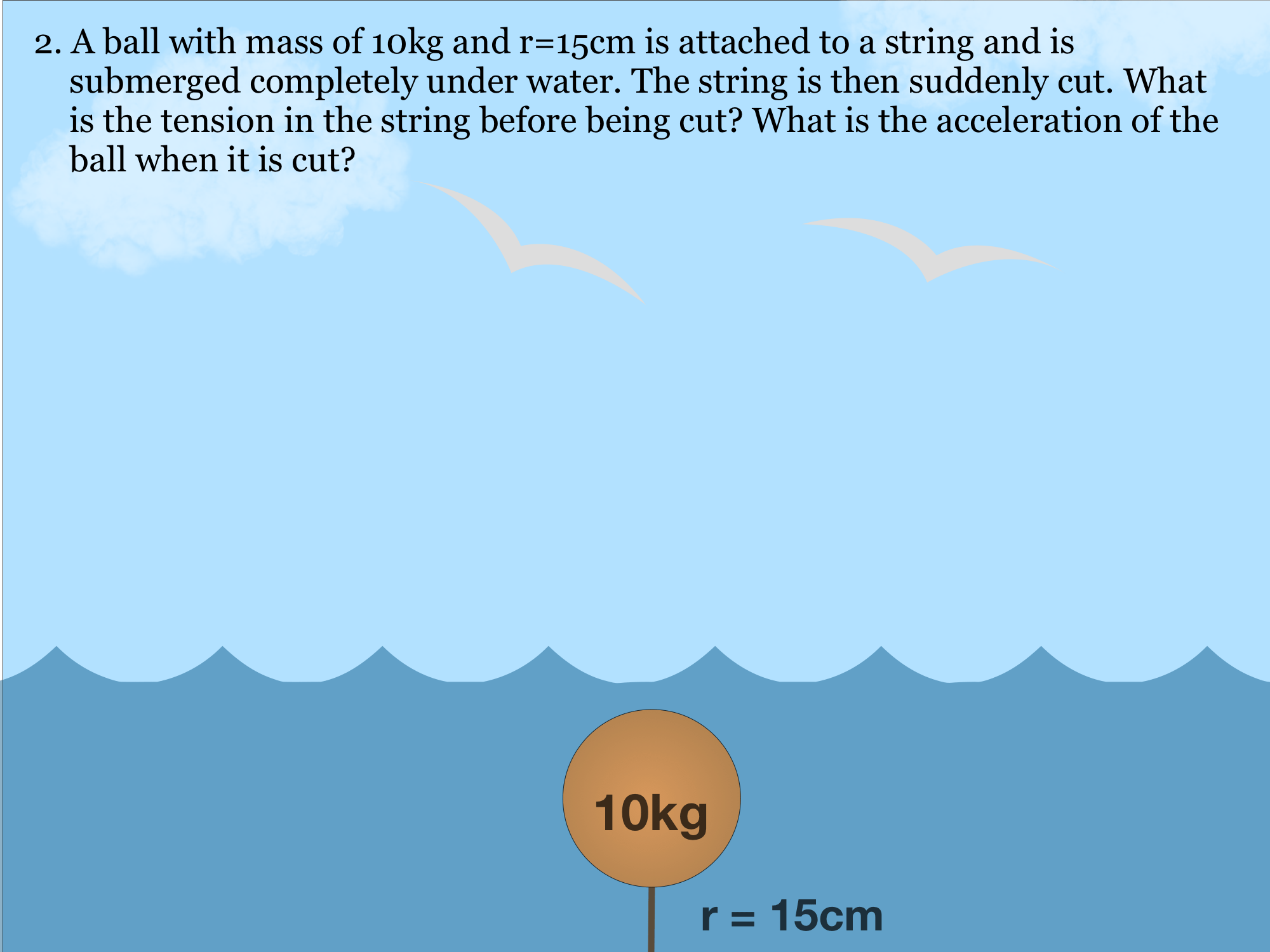
A 10 kg sphere of radius 15 cm is fully submerged in water and held at rest by a string attached below it, as shown. Find the string tension and the initial acceleration just after it is cut. Use water density 1000 kg/m³ and g = 9.81 m/s²; neglect drag and added-mass effects.
Your written working
Drawing is temporarily unavailable. Work on paper if needed, then record your reasoning here.
Saving written working requires JavaScript. The problem remains available above; keep your work on paper or in your own notes.
See this question in its original context ↗Review the model ↗Separate worked solution ↗
Question 30 · AP topic 8.4
30. Work it out
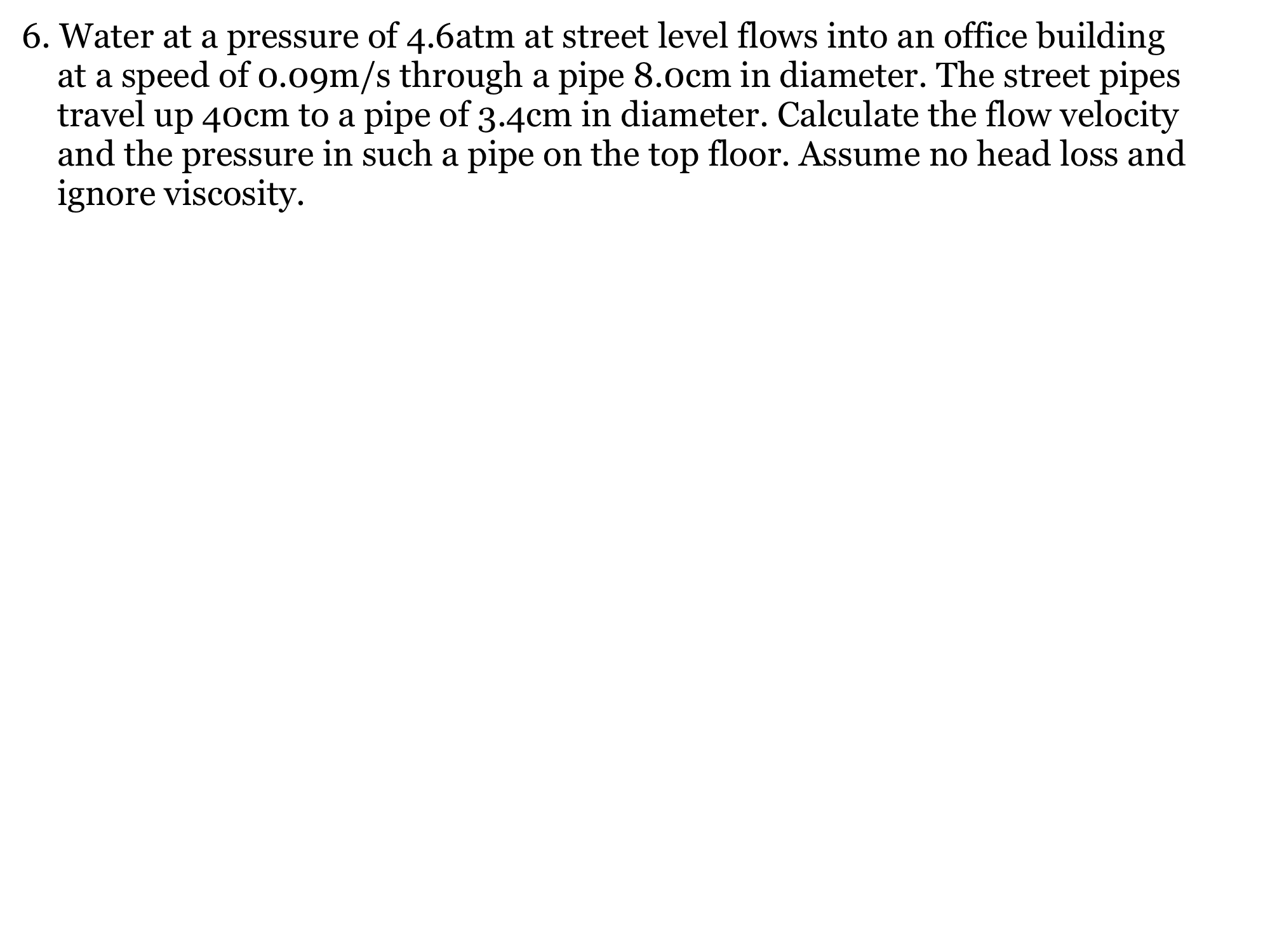
Water at street level has pressure 4.6 atm and speed 0.09 m/s in an 8.0 cm diameter pipe. It rises 40 cm to a 3.4 cm diameter pipe. Find the upper speed and pressure, assuming steady incompressible flow, no head loss, water density 1000 kg/m³, and g = 9.81 m/s². Keep the pressure convention the same at both points.
Your written working
Drawing is temporarily unavailable. Work on paper if needed, then record your reasoning here.
Saving written working requires JavaScript. The problem remains available above; keep your work on paper or in your own notes.
See this question in its original context ↗Review the model ↗Separate worked solution ↗
Explain and apply the model
Try these problems before opening the solutions. State your assumptions, show the diagram or calculation, and explain what makes your answer follow.
Explain shape using particle interactions
A solid sample, a liquid sample, and a dilute gas sample of the same substance are considered under suitable conditions for each phase. Each is moved to a differently shaped container. Separately, a 0.180 kg sample of ideal incompressible liquid has volume 200 mL before it is poured from a narrow cylinder into a wide bowl. Ignore evaporation and spilling.
(a) Describe how interactions and arrangements of atoms or molecules explain the distinguishing shape and volume responses of the solid, liquid, and gas. Classify which phases are fluids and justify that classification using the lack of fixed shape. Avoid explaining the change by making the individual particles larger.
(b) Calculate the liquid density in kg/m³ before and after pouring. State the mass and volume after pouring, and explain why changing shape does not require a density change.
Your written working
Drawing is temporarily unavailable. Work on paper if needed, then record your reasoning here.
Saving written working requires JavaScript. The problem remains available above; keep your work on paper or in your own notes.
Worked solution and rubric →Revisit the worked example →Read the relevant section →
Pressure changes without compressing the ideal sample
A sealed 300 mL sample of ideal incompressible liquid has mass 0.240 kg. Its pressure is changed from 100 kPa to 250 kPa at fixed temperature. A separate small vertical plate has area 0.0060 m², approximately uniform liquid pressure 130 kPa on its left face and air pressure 100 kPa on its right face. The two faces are at the same height; treat all stated pressures as absolute.
(a) Find the sample volume and density at both pressures. Sketch volume-versus-pressure and density-versus-pressure graphs over 100–250 kPa with labeled axes. Explain what incompressibility holds fixed for this given amount and whether it also holds pressure fixed.
(b) Explain how the collective interactions of the fluid particles with a surface create pressure. Draw and calculate the two normal forces on the plate and their resultant. Explain why scalar pressure can produce a force with a direction and why using only the liquid force gives the wrong net force.
Your written working
Drawing is temporarily unavailable. Work on paper if needed, then record your reasoning here.
Saving written working requires JavaScript. The problem remains available above; keep your work on paper or in your own notes.
Worked solution and rubric →Revisit the worked example →Read the relevant section →
Describe every way fluid velocity can change
Follow a material parcel of ideal fluid of constant mass 0.10 kg. For a short 0.20 s interval its opposing left and right faces each have area 0.0020 m², with uniform pressures 110,000 Pa on the left and 109,500 Pa on the right. These face forces are approximately constant during the interval; other horizontal forces are negligible. Right is positive. Also consider a separate parcel traveling around a bend at constant speed and a closed material sample containing two neighboring interacting fluid particles.
(a) Describe the conditions under which a fluid’s bulk velocity changes. Use Newton’s laws to distinguish a parcel with zero net force, a net-force component along its velocity, a component opposite its velocity, and a component perpendicular to its velocity. Explain whether fluid going around the bend at constant speed has changing velocity and which forces can supply that change.
(b) Explain how internal interactions between neighboring fluid particles or parcels and external forces together determine macroscopic fluid behavior. Identify the Newton’s-third-law internal pair for the two particles in the closed sample, explain what cancels in the whole-sample momentum sum, and give two external force sources. Why does that cancellation not imply that internal interactions are irrelevant to individual particle motion?
(c) Draw the parcel’s horizontal force diagram and calculate its acceleration and velocity change over 0.20 s. Find its final velocity for initial velocity +1.0 m/s, then for initial velocity −1.0 m/s. Explain the motion through the second interval, including any reversal.
Your written working
Drawing is temporarily unavailable. Work on paper if needed, then record your reasoning here.
Saving written working requires JavaScript. The problem remains available above; keep your work on paper or in your own notes.
Worked solution and rubric →Revisit the worked example →Read the relevant section →
Build buoyancy from the surface forces
A rigid rectangular block is fully submerged in resting uniform water, with horizontal face area A = 0.0080 m² and height H = 0.25 m. The top is 0.40 m below the free surface. Water density is 1000 kg/m³, g = 9.8 m/s², and the surface absolute pressure is 101,000 Pa. The block mass is 2.50 kg and it is held stationary by an upward support force. Ignore surface tension and contact with the tank.
(a) Explain how collective forces from the water particles on all the block’s faces produce buoyancy. Calculate top and bottom pressures and draw their pressure-force arrows. Show how the resultant surface force becomes F_B = ρgV_displaced instead of assuming that formula. Explain what happens to opposing side forces.
(b) Calculate the required upward support force. Then lower the block by 0.30 m without changing its volume. Predict the changes to the top and bottom forces, buoyancy and support force, and explain why larger absolute pressure does or does not alter the net buoyant force.
Your written working
Drawing is temporarily unavailable. Work on paper if needed, then record your reasoning here.
Saving written working requires JavaScript. The problem remains available above; keep your work on paper or in your own notes.
Worked solution and rubric →Revisit the worked example →Read the relevant section →
Follow the mass and identify the driving force
Ideal water of density 1000 kg/m³ flows steadily through a rigid filled pipe with no branches or leaks. Inlet area is 0.0040 m² and average inlet speed is 2.0 m/s. Outlet area is 0.0016 m². Separately, consider a horizontal uniform-area fluid segment initially at rest with end area 0.0040 m², pressure 115,000 Pa on its left end and 110,000 Pa on its right. There is no other horizontal force on that segment. All pipes are completely filled; dissipative forces are neglected.
(a) Derive Q = Av by finding the volume that crosses a section in a time Δt. Calculate the inlet volume flow rate in m³/s and L/s, the mass flow rate in kg/s, and the volume crossing in 3.0 s.
(b) Explain why the mass entering per second must equal the mass leaving per second in this filled steady pipe, then derive continuity and calculate the outlet speed. A sensor claims 8.0 kg/s enters but only 7.0 kg/s leaves: explain the implied accumulation and why it contradicts the setup.
(c) For the initially resting horizontal segment, draw its two pressure forces and calculate their net horizontal force. Describe the initial flow direction and explain causally why the pressure difference starts the fluid moving. Why would a stationary vertical hydrostatic pressure difference need a separate gravity force balance?
Your written working
Drawing is temporarily unavailable. Work on paper if needed, then record your reasoning here.
Saving written working requires JavaScript. The problem remains available above; keep your work on paper or in your own notes.
Worked solution and rubric →Revisit the worked example →Read the relevant section →
Keep all three terms in a rising pipe
Steady ideal incompressible water, density 1000 kg/m³, flows through a completely filled pipe without a pump or dissipative loss between two points on one streamline. At point 1, A₁ = 0.0040 m², v₁ = 2.0 m/s, y₁ = 0 and absolute P₁ = 170,000 Pa. At point 2, A₂ = 0.0020 m² and y₂ = +1.50 m. Take g = 9.8 m/s².
(a) Use mass conservation to find v₂. For a moving 1.0 L parcel, calculate its mass, kinetic-energy change and gravitational-potential-energy change between these points. Explain why a speed-only energy comparison is incomplete.
(b) Starting from pressure work (P₁ − P₂)ΔV = ΔK + ΔU_g, derive the general Bernoulli equation by dividing through by ΔV. Use it to find P₂, then make a numerical pressure/kinetic/height energy-per-volume table for both points. State the conditions that make this conservation equation applicable.
(c) Explain in words how pressure work is redistributed into kinetic and gravitational potential energy in this pipe. If point 2 were instead 1.50 m below point 1 at the same speeds, calculate P₂ and explain whether a faster stream can also have higher pressure.
Your written working
Drawing is temporarily unavailable. Work on paper if needed, then record your reasoning here.
Saving written working requires JavaScript. The problem remains available above; keep your work on paper or in your own notes.
Worked solution and rubric →Revisit the worked example →Revisit the worked example →Read the relevant section →
Derive the reservoir speed and test its assumptions
An open tank drains through a small opening at depth h below its free surface. The free-surface area is much larger than the opening area. Follow a streamline from the free surface to the emerging jet, assume locally steady ideal incompressible flow and negligible losses, and use g = 9.8 m/s². Both exposed points are at atmospheric pressure. For a later comparison the liquid is water of density 1000 kg/m³ and a sealed tank has surface pressure 5000 Pa above the exit pressure.
(a) Write the complete surface-to-exit Bernoulli balance and derive Torricelli’s theorem v_exit = √(2gh). State separately why the pressure terms cancel, why the surface kinetic term is negligible, and why the height difference supplies the exit kinetic energy. Do not begin by assuming the final theorem.
(b) Calculate the exit speed at h = 0.50 m. Construct a labeled numerical graph of v_exit² versus h using h = 0.20, 0.50 and 0.80 m. Find its slope and intercept and explain what energy relationship that graph tests.
(c) For the sealed water tank at the same depth h = 0.50 m and negligible surface speed, derive the modified exit-speed expression and calculate its speed. Explain which open-tank cancellation fails and how the v_exit²-versus-h graph changes if the extra surface pressure stays constant.
Your written working
Drawing is temporarily unavailable. Work on paper if needed, then record your reasoning here.
Saving written working requires JavaScript. The problem remains available above; keep your work on paper or in your own notes.
Worked solution and rubric →Revisit the worked example →Read the relevant section →
Can faster flow have greater pressure?
Assume a filled pipe, ideal incompressible water, steady flow, no intervening pump and no dissipative loss. Compare the specified points along one streamline.
(a) Ideal water of density 1000 kg/m³ flows steadily along one streamline without losses. From point 1 to point 2 its speed increases from 1.0 to 3.0 m/s while it drops 2.0 m in height. With g = 9.8 m/s², which pressure claim is consistent with the complete mechanical-energy balance?
Worked solution and rubric →Revisit the worked example →Read the relevant section →