Oscillator Energy: Where Did the Speed Go?
Track oscillator kinetic and potential energy, including the vertical spring-gravity system.
Where did the speed go?
Our spring cart stops for an instant at a turning point, yet it starts moving again without another push. Where did its kinetic energy go? Into the spring. A moment later that stored energy returns to the cart’s motion. Let’s follow that exchange carefully, because “the cart stopped” doesn’t mean “the system ran out of energy.”
Choose the cart–spring system, and neglect friction and other energy transfers across its boundary. For a horizontal ideal spring, with x measured from its unstretched equilibrium, spring potential energy is Uₛ = ½kx². The cart has K = ½mv². Mechanical energy is therefore E = K + Uₛ and stays constant for this isolated ideal oscillator. At either turning point x = ±A and v = 0, so E = ½kA². Both turning points have the same energy because squaring removes the sign of x.
Energy tells us the speed
Set the energy at an arbitrary x equal to the turning-point energy:
½mv² + ½kx² = ½kA².
Rearranging gives v² = (k/m)(A² − x²). Therefore the speed is √[(k/m)(A² − x²)]. This positive square root doesn’t tell us the direction. The cart visits most positions once moving left and once moving right, so signed velocity can be positive or negative. At x = 0, speed is largest: v_max = A√(k/m). At x = ±A, speed is zero and potential energy is largest. At equilibrium, spring potential is smallest and kinetic energy largest. OpenStax’s oscillator energy discussion supports this energy model.
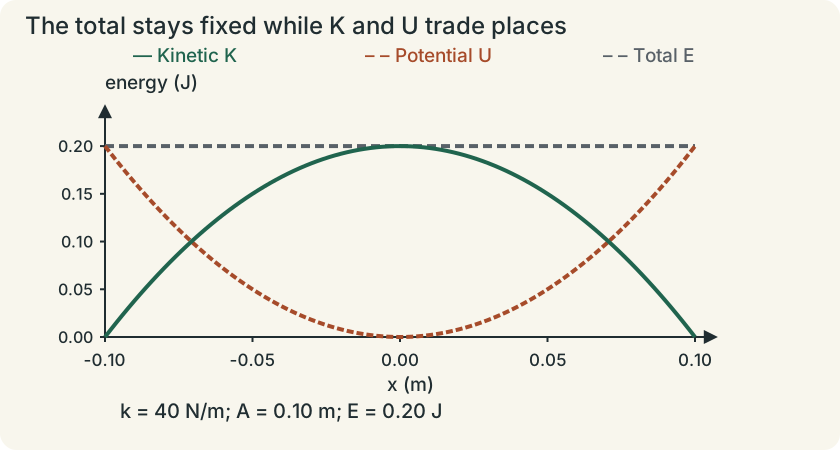
A 0.50 kg cart on a 40 N/m spring oscillates with A = 0.10 m. Its total energy is ½(40)(0.10)² = 0.20 J. At x = 0.060 m, Uₛ = 0.072 J, so K = 0.128 J and speed is √(2K/m) = 0.716 m/s. Check that this is less than v_max = √(2E/m) = 0.894 m/s. At x = A/2, Uₛ/E = (x/A)² = 1/4, so K/E = 3/4. Halfway out does not mean half the energy is potential.
Changing amplitude
Double A with the same spring and mass: total energy becomes four times bigger. Maximum speed doubles, since kinetic energy is proportional to speed squared. The period remains unchanged in the ideal model. Increase the mass at fixed k and A instead: total energy stays the same but maximum speed falls. That comparison is easier if you decide what is held fixed before using a formula. The spring doesn’t know the mass when storing ½kA²; the mass matters when that energy becomes motion.
On a K-versus-x graph, the curve is a downward parabola with zeros at ±A. On a K-versus-x² graph, the same relationship is a straight line with slope −k/2 and intercept E. The energy-versus-position plot has no time direction, so it cannot distinguish which way the cart is moving. An energy-versus-time graph shows K and U trading places twice during each full displacement cycle, because both depend on squared quantities.
The hanging spring: include gravity
This is where we need to be careful. For a hanging mass, the spring is already stretched at equilibrium. Let y point downward from the spring’s unstretched length, and choose gravitational potential U_g = −mgy. The spring–mass–Earth system has:
U_total = ½ky² − mgy.
Equilibrium is at y₀ = mg/k. Completing the square gives U_total = ½k(y − y₀)² − (mg)²/(2k). If we define x = y − y₀ and shift the arbitrary zero of potential energy, the oscillation energy becomes E_osc = ½mv² + ½kx² = ½kA². Here ½kx² represents the combined change of spring and gravitational potential about equilibrium. It is not the spring’s actual energy ½ky². That distinction prevents us from losing or counting gravity twice.
For m = 0.20 kg and k = 49 N/m, equilibrium extension is 0.040 m. Pull down another 0.020 m and release. The oscillation amplitude is 0.020 m, not the total 0.060 m extension. The oscillation energy is 0.0098 J, and the maximum speed at equilibrium is 0.313 m/s. You could also calculate the separate changes in spring and gravitational energy; their sum gives the same result.
Measure the exchange
Use a motion sensor for a known mass and a spring constant found from a force–displacement test. Record x and v, taking x = 0 at the measured equilibrium. Compute Uₛ = ½kx² and K = ½mv² for several instants, then plot K, Uₛ, and their sum versus time. Include axis units and explain which peaks line up. If the sum slowly declines, real resistance is transferring energy to thermal energy in the surroundings. If the sum oscillates wildly, check sensor noise, coordinate offsets, and whether a vertical setup included gravity correctly before blaming friction.
Follow the energy
Pause & try it
Let's see what stuck.
Choose an answer, then check the reasoning. Try the written problems below before opening their solutions.
0 of 3 checked · 0 correct
Written practice: equal kinetic and potential energies
For a horizontal ideal spring, find the positions where K = Uₛ. Then explain why there are four such moments per cycle.
Open the separate worked solution.
Keep the original Dampened Harmonics and Complex Harmonics discussions as enrichment. Ideal AP SHM conserves mechanical energy; real damping calls for an expanded energy accounting.
Teaching reference: CED topic 7.4, printed page 127 covers the kinetic–potential exchange and the way amplitude sets the total energy.
Glossary and deeper reading · 13 refreshers
These editorial refreshers supplement the reading. Definitions and examples are added guidance; original source wording and recorded answers remain in their original context.
-
Kinetic energy
Kinetic energy is energy associated with motion relative to a chosen reference frame. For a nonrelativistic translating object it is one half of its mass times speed squared. For example, doubling a cart’s speed quadruples its translational kinetic energy when its mass stays fixed.
-
Spring potential energy
Spring potential energy is energy stored in an ideal spring’s deformation from its relaxed length. It is proportional to the square of deformation, so equal extension and compression magnitudes store equal energy. For example, compressing a spring before releasing a toy transfers energy that can later become kinetic energy.
-
Mechanical energy
Mechanical energy is the sum of the kinetic and potential energies included in a model. It stays constant when transfers to or from other energy stores and across the chosen boundary are absent. For example, a pendulum’s mechanical energy can remain approximately constant while energy shifts between motion and gravitational configuration.
-
Velocity
Velocity describes how position changes with time and includes direction. Instantaneous velocity describes one moment, while average velocity is displacement divided by elapsed time. For example, a car turning a corner can change velocity while maintaining the same speed.
-
Potential energy
Potential energy describes energy associated with the configuration of interacting parts of a system. Its numerical zero is a chosen reference, while differences in potential energy determine physical energy changes. For example, separating Earth and a ball changes their gravitational potential energy even though the energy belongs to their interaction.
-
Oscillation period
An oscillation period is the time required for one complete repeating cycle. It is the reciprocal of frequency and is measured in seconds. For example, measuring the time for several pendulum swings and dividing by the number of cycles estimates the period.
-
Displacement
Displacement is the vector change in position from the start of an interval to its end. It depends on those endpoints rather than the length or shape of the path traveled. For example, walking around a closed track and returning to the start gives zero displacement but a nonzero distance traveled.
-
Gravity
Gravity is the attractive interaction between masses in the Newtonian model. For spherical bodies or point-mass approximations, its strength decreases with the square of the separation between their centers. For example, Earth’s gravity provides the inward force that keeps a satellite in orbit.
-
Amplitude
Amplitude is the maximum magnitude of a repeating disturbance measured from its equilibrium value. It describes the size of the oscillation rather than its frequency or propagation speed. For example, pulling a spring-mounted mass farther from equilibrium increases its oscillation amplitude when it is released from rest.
-
Gravitational potential energy
Gravitational potential energy is energy associated with the relative positions of attracting masses. Near Earth, changes can be approximated by mass times gravitational field strength times height change when that field is nearly constant. For example, lifting a book increases the gravitational potential energy of the book–Earth system.
-
Spring constant
A spring constant measures the stiffness of a spring within its approximately linear range. Its units are newtons per meter, and a larger value means more force is needed for the same deformation. For example, two springs stretched by the same distance exert different forces if one is stiffer.
-
Force
A force describes an interaction that can change an object’s momentum. It is a vector measured in newtons, so both size and direction matter when forces are added. For example, a rope can pull a cart while the floor exerts friction in another direction.
-
Simple harmonic motion
Simple harmonic motion occurs when the net restoring force is proportional to displacement from equilibrium and points in the opposite direction. The resulting position varies sinusoidally with time in the ideal model. For example, a mass attached to an ideal spring can execute simple harmonic motion when damping is negligible.