Rotational Kinetic Energy
Build rotational kinetic energy from the motions of the system’s parts.
A spinning object has moving parts
A flywheel’s center can stay put while the wheel stores kinetic energy. That is not a new kind of motion hiding in the axle: the points away from the axle are moving. Rotational kinetic energy is a convenient way to add up their ordinary kinetic energies.
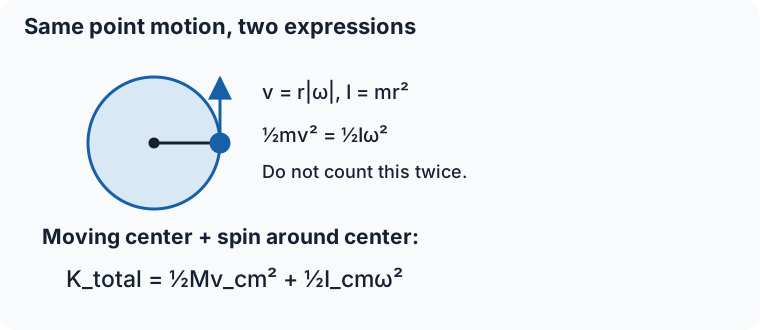
For a point mass moving around a fixed axis, v = r|ω| and I = mr². Substitute into K = ½mv² to get K = ½m(rω)² = ½Iω². For a rigid system, every point has the same ω, so adding all the pieces gives K_rot = ½Iω². Inertia must be about the axis used to describe that rotation.
Kinetic energy is a scalar. Reversing the spin while keeping the same angular speed leaves K_rot unchanged. Double the angular speed and the energy becomes four times as large. Double I at the same angular speed and the energy doubles. These comparisons are useful before any arithmetic.
Worked example: a wheel on a fixed axle
A wheel has provided inertia I = 0.080 kg·m² and angular speed 10 rad/s. Its rotational kinetic energy is ½(0.080)(10²) = 4.0 J. At −10 rad/s using a counterclockwise-positive convention, it still has 4.0 J. At 20 rad/s, it has 16 J. A graph of K_rot versus ω is a symmetric upward parabola; a graph of K_rot versus ω² is a straight line through the origin with slope I/2.
For a point mass on a massless arm, there is no extra energy to add: ½mv² and ½Iω² describe the same kinetic energy. Counting both would double-count it. The rotational expression is a compact replacement for the sum over particles when using a fixed-axis description.
Translation and spin can happen together
A wheel rolling across a floor has a moving center of mass and also spins about its center. A useful decomposition is K_total = ½Mv_cm² + ½I_cmω². The first term describes the center’s translation; the second describes motion around that center. Here the rotational inertia is specifically about the center-of-mass axis.
A 2.0 kg wheel has I_cm = 0.040 kg·m², v_cm = 3.0 m/s, and angular speed 15 rad/s. Its translational energy is ½(2.0)(3.0²) = 9.0 J. Its rotational energy is ½(0.040)(15²) = 4.5 J. The total is 13.5 J. If a wheel happens to slip, the decomposition is still valid; what fails is automatically setting v_cm = Rω. That relationship requires rolling without slipping.
At the same center-of-mass speed, two wheels can have different total energies because their angular speeds or inertias differ. At the same total energy, the wheel with a larger rotational share can have a smaller center-of-mass speed. This will explain rolling races later without saying that one wheel “has less gravity.”
Choose one description and stay consistent
If a rigid system rotates about a fixed external axis, K = ½I_axisω² describes its total kinetic energy in that frame. If you instead split its motion into center-of-mass translation and rotation, use I_cm and add the two terms. For a rod turning around one fixed end, its center moves; an end-axis inertia already accounts for that motion. Adding ½Mv_cm² to ½I_endω² would count part of the energy twice.
An energy bar chart helps catch this error. Name the system, the reference frame, and the motion represented by each bar. A fixed-axle wheel gets one rotation bar. A translating wheel gets a translation bar and a center-rotation bar. Potential energy belongs to interacting systems, such as wheel plus Earth; a wheel alone does not “contain gravity energy.”
Instructional example (guided activity):
Representation task: For the 2.0 kg moving wheel in the example, draw energy bars to scale for translation and rotation. Then redraw them after both v_cm and ω are halved. Explain the scale change with each energy equation, labeling the system and reference frame.
Worked example — A stationary center can have moving material
Two 0.50 kg masses sit at opposite ends of a massless rigid support, each 0.20 m from a fixed center axle. At ω = 10 rad/s their center of mass remains at the axle, but each mass has tangential speed 2.0 m/s in opposite directions. Each therefore has 1.0 J of kinetic energy, totaling 2.0 J. Opposite velocity vectors do not cancel scalar kinetic energies.
The inertia is I = 2(0.50)(0.20²) = 0.040 kg·m², so ½Iω² = 2.0 J gives the same sum. Zero center-of-mass speed removes the translation term; it does not remove the moving-particle energy represented by rotation. Counting ½Iω² and both individual kinetic energies again would count the same motion twice.
Build an energy ledger
Pause & try it
Let's see what stuck.
Choose an answer, then check the reasoning. Try the written problems below before opening their solutions.
0 of 3 checked · 0 correct
Assigned practice: compare equal energy
Wheel A has I = 0.020 kg·m² and wheel B has I = 0.080 kg·m². Both turn about fixed axles and each has 4.0 J of kinetic energy. Find their angular speeds.
Open the separate worked solution.
Assigned practice: compare a different speed change
A 2.0 kg wheel has center-of-mass rotational inertia 0.040 kg·m². In trial A its center speed is 3.0 m/s and angular speed is 15 rad/s. In trial B the center speed is 6.0 m/s and angular speed is 7.5 rad/s. Draw scaled translation and rotation energy bars for each trial. A classmate predicts equal total kinetic energies because one speed doubled while the other halved. Evaluate the prediction without assuming a rolling constraint.
Open the separate worked solution.
The original Rotational Energy keeps its longer wheel example and quizzes. Its slipping-to-rolling calculation is enrichment; the corrected energy accounting shows why frictional slipping cannot be assumed lossless.
Sources and scope: College Board CED, with edition-specific coverage verified against the supplied file. Supplied College Board CED, printed p. 107, 6.1.A, including fixed-axis point objects, stationary centers, and the translation-plus-rotation decomposition. OpenStax: Moment of Inertia and Rotational Kinetic Energy verifies K_rot = ½Iω². Original examples and graphic avoid double counting.
Explain and apply the model
Try these problems before opening the solutions. State your assumptions, show the diagram or calculation, and explain what makes your answer follow.
Explain energy with a stationary center
Two 0.40 kg masses are fixed to opposite ends of a massless rigid arm, each 0.25 m from a fixed axle through their center of mass. The arm rotates at angular speed 8.0 rad/s.
(a) Calculate each material point’s linear speed and kinetic energy and add the energies. Explain physically why the rigid system has kinetic energy even though its center of mass is at rest, and why opposite velocities do not cancel that energy.
(b) Find the rotational inertia and check the total using ½Iω². Identify the center-of-mass translation term and explain whether the two individual kinetic energies should be added again to ½Iω².
Your written working
Drawing is temporarily unavailable. Work on paper if needed, then record your reasoning here.
Saving written working requires JavaScript. The problem remains available above; keep your work on paper or in your own notes.
Glossary and deeper reading · 12 refreshers
These editorial refreshers supplement the reading. Definitions and examples are added guidance; original source wording and recorded answers remain in their original context.
-
Kinetic energy
Kinetic energy is energy associated with motion relative to a chosen reference frame. For a nonrelativistic translating object it is one half of its mass times speed squared. For example, doubling a cart’s speed quadruples its translational kinetic energy when its mass stays fixed.
-
Rotational kinetic energy
Rotational kinetic energy is the kinetic energy associated with rotation about an axis. For a rigid body about a fixed axis it is one half of rotational inertia times angular speed squared. For example, a rolling wheel can possess both translational kinetic energy of its center of mass and rotational kinetic energy about that center.
-
Inertia
Inertia is an object’s resistance to a change in its velocity. Mass measures translational inertia, whereas rotational inertia also depends on how mass is distributed relative to an axis. For example, a loaded cart accelerates less than an empty cart under the same net force.
-
Scalar
A scalar is a quantity described by a value and unit without a spatial direction. A scalar can have a sign when its definition or reference permits one; scalar does not mean always positive. For example, mass is a scalar, whereas the velocity of that mass also needs a direction.
-
Angular velocity
Angular velocity describes the rate and direction of rotation about an axis. For a fixed axis, a signed angular velocity is measured in radians per second, while its magnitude is angular speed. For example, points on one rigid turntable share the same angular speed even though outer points have greater linear speeds.
-
Center of mass
The center of mass is the position obtained by weighting each part’s position by its mass. Its motion represents the translational motion of the whole system under the net external force. For example, adding a heavy object to one end of a light bar shifts the center of mass toward that end.
-
Rotational inertia
Rotational inertia measures how strongly a mass distribution resists a change in angular velocity about a specified axis. Mass farther from that axis contributes more strongly because each contribution depends on squared distance. For example, moving small masses outward along a rotating rod increases its rotational inertia without changing its total mass.
-
Rolling without slipping
Rolling without slipping means the point of contact has no instantaneous relative motion along the contacting surface. For a wheel rolling on a stationary surface, the center-of-mass speed equals angular speed times radius. For example, a wheel rolling smoothly along a road has a momentarily stationary contact point while its top moves faster than its center.
-
Gravity
Gravity is the attractive interaction between masses in the Newtonian model. For spherical bodies or point-mass approximations, its strength decreases with the square of the separation between their centers. For example, Earth’s gravity provides the inward force that keeps a satellite in orbit.
-
Reference frame
A reference frame specifies the observer and coordinates used to describe positions and motion. Different observers can assign different velocities to the same object. For example, a seated passenger is at rest relative to a train but moving relative to the station.
-
Potential energy
Potential energy describes energy associated with the configuration of interacting parts of a system. Its numerical zero is a chosen reference, while differences in potential energy determine physical energy changes. For example, separating Earth and a ball changes their gravitational potential energy even though the energy belongs to their interaction.
-
Velocity
Velocity describes how position changes with time and includes direction. Instantaneous velocity describes one moment, while average velocity is displacement divided by elapsed time. For example, a car turning a corner can change velocity while maintaining the same speed.