Scalars and Vectors in One Dimension
Distinguish distance from displacement and draw one-dimensional vectors on a scale.
Which way did you actually go?
Say you leave your backpack at one end of a hallway, walk 6 m toward a water fountain, then walk 2 m back. Your legs traveled 8 m, but your backpack is only 4 m behind you. Both numbers are useful. They answer different questions.
A scalar needs a magnitude and unit. Distance and speed are scalars: “8 m” and “2 m/s” already tell us what those quantities mean. A vector needs magnitude, unit, and direction. Position, displacement, velocity, and acceleration are vectors. “4 m” does not completely describe your displacement until we say which way.
Let’s choose the fountain direction as positive x. Your two displacement components are +6 m and −2 m. Their sum is Δx = +6 m + (−2 m) = +4 m. The distance is 6 m + 2 m = 8 m. Notice that a negative sign doesn’t make a distance negative. It tells us a vector component points against our chosen positive direction.
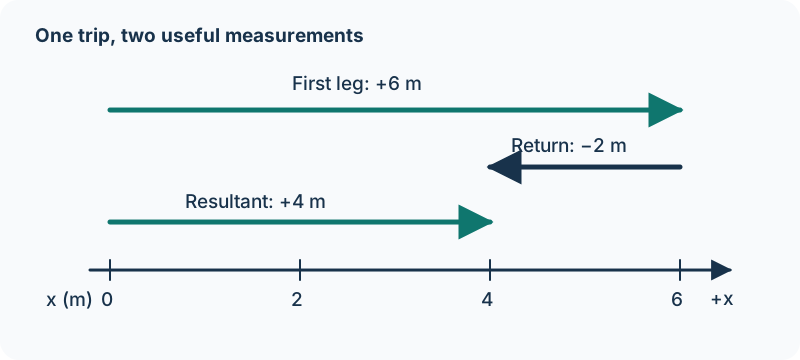
Arrows, signs, and an origin
Draw a vector as an arrow. Its direction shows the direction of the quantity, and its length represents the magnitude according to a stated scale. For our hallway, 1 cm on paper might represent 1 m. A 6 m displacement then gets an arrow three times as long as a 2 m displacement. Arrange successive displacement arrows head to tail; the resultant runs from the first tail to the final head.
An arrow over a symbol, such as v⃗, means the full vector. In one dimension, the signed component vₓ already gives all the directional information, so it doesn’t need an arrow. If vₓ = −3 m/s, the speed is 3 m/s and motion is in the negative x direction. The magnitude of a one-dimensional vector component is its absolute value.
Position needs an origin as well as an axis. Your final position is +4 m only if the backpack is x = 0. If we put the origin at the fountain instead, the backpack starts at −6 m and you finish at −2 m. The displacement is still (−2 m) − (−6 m) = +4 m. Moving the origin changes the position numbers; it doesn’t change the trip.
Example 1.1.1 — The hallway, backwards
Let’s reverse the positive axis so that toward the backpack is positive. The same trip has displacement components −6 m and +2 m. Their sum is −4 m, not +4 m. The direction described by that sign is still toward the fountain. The distance stays 8 m. We changed our labels, not the physical motion.
This is also why adding vector magnitudes without considering directions fails. If two people push a cart with 9 N right and 5 N left, the net force component is +4 N when right is positive. The magnitude is 4 N. It isn’t 14 N, and the cart’s direction of motion cannot be inferred just from that force; later we’ll connect net force to acceleration.
Try the representation before the calculator
A one-dimensional vector sum can be positive, negative, or zero. Opposite vectors cancel when their magnitudes match. Zero displacement doesn’t tell us that nothing happened in between. You can walk a long distance and return to the backpack.
For a quick measurement task, tape meter marks along a clear floor and choose an origin. Have a partner record the signed start and end positions for a short out-and-back walk. Independently measure each leg with a tape. Draw arrows on the same scale, and compare the resultant with final position minus initial position. If the results disagree, check whether you silently changed the axis direction or counted the return leg as positive displacement. Recording both positions with the same ruler reduces ambiguity in the comparison.
Example 1.1.2 — Classify the measurements, then write the vectors
A delivery robot starts 2 m west of a doorway, travels 8 m east, and then travels 3 m west. Choose the doorway as the origin and east as positive. Its final position is +3 m, its displacement is +5 m east, and its distance is 11 m. Position and displacement need an origin or direction, respectively; distance is the total path length and has no direction.
Distance and speed are scalars. Position, displacement, velocity, and acceleration are vectors. If the robot finishes with velocity 2 m/s west while accelerating 1 m/s² east, its speed is 2 m/s, vₓ = −2 m/s, and aₓ = +1 m/s². The acceleration initially reduces its speed because it points opposite the velocity. Classifying all six quantities prevents a signed velocity component from being mistaken for a negative speed.
An arrow above a symbol identifies the full vector: r⃗ for position, Δr⃗ for displacement, v⃗ for velocity, and a⃗ for acceleration. Write v⃗ = v⃗₀ + a⃗Δt when acceleration is constant; in this one-dimensional example its x-component equation is vₓ = vₓ₀ + aₓΔt. The component signs encode direction along the chosen axis, while an arrow over the symbol distinguishes the full vector from a scalar magnitude.
Check what you know
Pause & try it
Let's see what stuck.
Choose an answer, then check the reasoning. Try the written problems below before opening their solutions.
0 of 3 checked · 0 correct
Give it a try
Practice 1
A robot starts at x = −2 m, moves to x = +5 m, then ends at x = +1 m. Find each displacement, the total displacement, and the distance.
Practice 2
Draw two opposite displacement arrows, 4 m and 4 m, on a scale of 1 cm per meter. What can you conclude about the final position? What cannot you conclude about the travel time?
Practice 3
A student says “negative acceleration always means slowing down.” Explain why a direction sign by itself cannot establish that claim.
Keep exploring
Revisit the original Vectors and Vector Math galleries and quizzes for more arrow practice.
Course scope and standards: the supplied AP Physics 1 CED, printed pages 27; Topic 1.1 and its exact learning objectives. The official College Board CED is the public source; the project audit records the supplied edition.
Supporting physics references: OpenStax: graphical vector addition. These lessons, diagrams, examples, and practice questions were written for this book.
Explain and apply the model
Try these problems before opening the solutions. State your assumptions, show the diagram or calculation, and explain what makes your answer follow.
Audit a robot’s motion report
A robot starts at x = −3 m, goes to x = +5 m, and returns to x = +1 m in a total of 6 s. East is positive and x = 0 is a doorway. At the final instant its velocity is 2 m/s west and its acceleration is 0.50 m/s² east.
(a) Calculate final position, total displacement, distance, average velocity, average speed, final speed, and final signed acceleration. Classify each of these measurements as scalar or vector; your classification must explicitly include position, displacement, distance, velocity, speed, and acceleration.
(b) Write symbols for position, displacement, velocity, and acceleration with an arrow above each symbol. Write the constant-acceleration vector equation for velocity using that notation and its separate x-component equation. Explain what the arrow and the signed component each communicate; use the robot’s final velocity as an example.
Your written working
Drawing is temporarily unavailable. Work on paper if needed, then record your reasoning here.
Saving written working requires JavaScript. The problem remains available above; keep your work on paper or in your own notes.
Glossary and deeper reading · 9 refreshers
These editorial refreshers supplement the reading. Definitions and examples are added guidance; original source wording and recorded answers remain in their original context.
-
Scalar
A scalar is a quantity described by a value and unit without a spatial direction. A scalar can have a sign when its definition or reference permits one; scalar does not mean always positive. For example, mass is a scalar, whereas the velocity of that mass also needs a direction.
-
Magnitude
Magnitude is the nonnegative size of a vector quantity. It does not specify direction, and it differs from a signed component. For example, a westward velocity can have a negative x component while its speed, the velocity magnitude, stays positive.
-
Displacement
Displacement is the vector change in position from the start of an interval to its end. It depends on those endpoints rather than the length or shape of the path traveled. For example, walking around a closed track and returning to the start gives zero displacement but a nonzero distance traveled.
-
Vector component
A vector component describes the part of a vector along a chosen axis. Its signed value changes when the axes change, even though the physical vector remains the same. For example, a diagonal launch velocity can be resolved into horizontal and vertical components that share the same elapsed time.
-
Vector
A vector is a quantity with a magnitude and a direction, represented by an arrow or by components along chosen axes. Vectors add by adding corresponding components rather than simply adding their magnitudes. For example, an eastward displacement followed by a northward displacement produces a resultant pointing northeast. The zero vector has zero magnitude and no unique direction.
-
Resultant vector
A resultant vector is the vector sum of two or more vectors. Its components are the sums of the corresponding components of the vectors being combined. For example, two equal forces in opposite directions have a zero resultant even though both forces are present.
-
Velocity
Velocity describes how position changes with time and includes direction. Instantaneous velocity describes one moment, while average velocity is displacement divided by elapsed time. For example, a car turning a corner can change velocity while maintaining the same speed.
-
Acceleration
Acceleration is the vector rate of change of velocity with time. It can change an object’s speed, direction, or both, and it is measured in meters per second squared. For example, a satellite moving at constant speed in a circular orbit accelerates toward the center.
-
Average velocity
Average velocity is the displacement over an interval divided by the elapsed time. It is a vector and need not equal the average speed, which uses total distance. For example, a runner who returns to the starting line has zero average velocity for the full lap.