Rolling
Use contact-point motion to distinguish rolling without slipping from sliding.
A wheel can translate, spin, or do both
A wheel turning on a fixed axle has rotation but no center-of-mass translation. A wheel sliding without spinning has translation but no rotation. A rolling wheel has both, so its kinetic energy is K = ½Mv_cm² + ½I_cmω². That sum is valid whether or not the wheel slips.
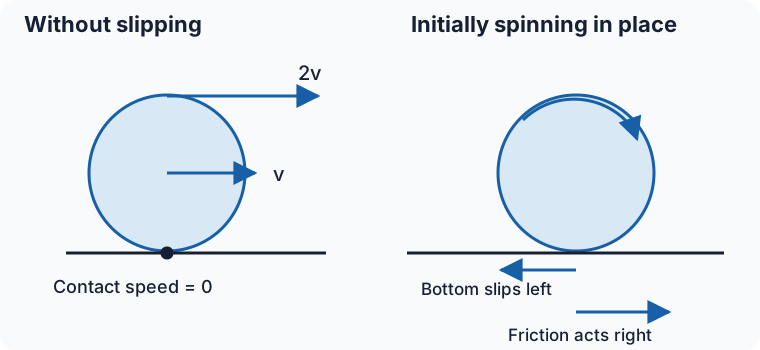
The extra condition for rolling without slipping on a stationary surface is v_cm = R|ω|, with the corresponding magnitudes a_cm = R|α| when the no-slip constraint continues. The point touching the ground is instantaneously at rest in the ground frame. It is not the whole wheel that stops; its center moves and its top point moves faster than the center.
Do not set v_cm = Rω just because a diagram contains a round object. A spinning wheel placed on a floor can initially have v_cm = 0 and nonzero ω, so it is slipping. A wheel dragged without enough spin can also slip. Ask what the contact point is doing relative to the surface.
Worked example: down a ramp without slipping
A solid disk rolls from rest through a vertical height h = 0.60 m on a stationary rigid ramp. Its provided inertia is I_cm = ½MR². Assume enough static friction to prevent slipping, no deformation losses, and g = 9.8 m/s².
For disk plus Earth, gravitational potential energy becomes translation and rotation: Mgh = ½Mv² + ½(½MR²)(v/R)² = ¾Mv². Thus v = √(4gh/3) = 2.8 m/s. A hoop with provided I = MR² has Mgh = Mv², giving v = √(gh) ≈ 2.43 m/s at the same height. The disk is faster because a smaller share of its energy is needed for rotation at a given center speed.
A nonrotating low-friction cart starting from the same height has v = √(2gh) ≈ 3.43 m/s. The ranking is cart, disk, hoop. Their gravitational energy changes can be equal while their translational kinetic energies differ. Use energy bars rather than claiming gravity is stronger on the faster one.
Why static friction can be present without dissipating energy
For an ideal rigid wheel rolling without slipping on a stationary rigid surface, the point where static friction acts has no instantaneous displacement relative to the surface. The contact friction does not dissipate mechanical energy in that ideal model. It can still provide a torque and change the division between translational and rotational kinetic energy.
On an incline, gravity acts through the disk’s center, so it supplies no torque about the center. Static friction up the ramp supplies the torque that increases the spin. The center-of-mass equation is Mg sinβ − f = Ma, while the rotation equation is fR = Iα. Combining them with a = Rα gives a = g sinβ/(1 + I/(MR²)). This derives the same disk/hoop ordering as energy. Friction is not automatically downhill or opposite the center’s velocity; its direction opposes the tendency to slip at contact.
What changes when the wheel slips?
Place a clockwise-spinning wheel with initially stationary center on a rough level floor. Its bottom surface slips left, so kinetic friction on the wheel acts right. That force increases the center’s rightward velocity, and its torque about the center reduces the clockwise angular speed. Mechanical energy decreases during slipping because the contact surfaces move relative to each other and energy becomes internal energy.
For a right-moving wheel with too little clockwise spin, the bottom surface slips right. Kinetic friction then acts left, reducing translation while increasing the clockwise spin. The two rates must be analyzed separately until rolling without slipping begins. AP requires these qualitative explanations, not the precise time-dependent mathematical relationships for slipping. Rolling resistance from deformation is also outside the stated AP boundary.
Change it & predict
Where did the energy go?
Release a rigid object from rest. It rolls without slipping through a vertical drop h, with no energy lost. Choose its mass distribution before predicting its speed.
Use mgh = ½mv² + ½Iω² and v = Rω. More inertia relative to mR² means a larger rotational share and a smaller center speed. This model excludes slipping and losses. The energy bars show the proportions; at h = 0, both actual energies are zero.
Instructional example (guided activity):
Argument task: Sketch center-of-mass force and torque diagrams for a disk and hoop on identical inclines. Match those to energy bars at the bottom. Explain why the object with more inertia has smaller acceleration and a smaller translational-energy share. In a real race, check that both objects roll without slipping and that ramp heights match before interpreting the finish order.
Worked example — Accelerate without dissipating at static contact
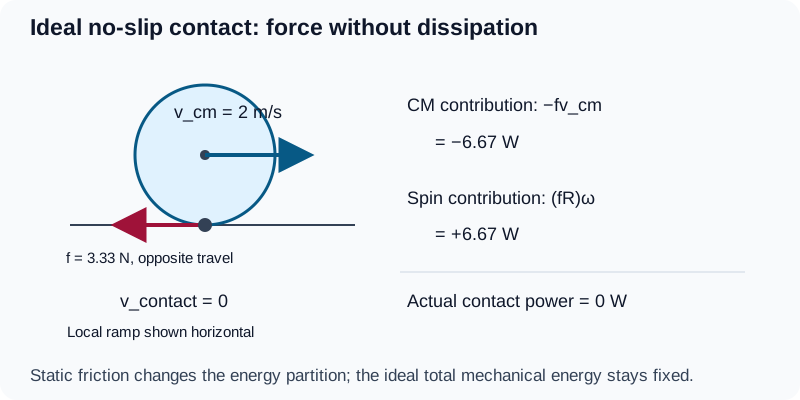
A 2.0 kg solid disk of radius 0.20 m rolls down a stationary rigid 30° incline without slipping. Its provided I_cm = ½MR² = 0.040 kg·m²; take g = 10 m/s² and assume sufficient static friction and no deformation loss. Downhill is positive for translation; clockwise down the slope is positive for rotation. The balances are Mg sin30° − f = Ma and fR = I_cmα, connected by a = Rα. Solving gives a = 10/(2 + 1) = 3.33 m/s², f = 3.33 N uphill, and α = a/R = 16.7 rad/s².
After 0.60 s from rest, the center moves s_cm = ½at² = 0.60 m, the disk turns through Δθ = ½αt² = 3.0 rad, v_cm = 2.0 m/s, and ω = 10 rad/s. All three no-slip constraints hold: s_cm = RΔθ, v_cm = Rω, and a_cm = Rα, in the stated compatible sign convention. The speed relation differentiates into the acceleration relation only while no slip persists with constant radius; matching speeds at one instant does not alone guarantee matching accelerations later.
At that instant the contact point is at rest in the stationary-ramp frame, so the static-friction force has zero instantaneous power at its actual point of application and dissipates no mechanical energy in the ideal rigid model. Its center-of-mass contribution −fv_cm ≈ −6.67 W and rotational contribution (fR)ω ≈ +6.67 W cancel. Friction can redistribute the translational and rotational shares without removing energy. This reasoning fails for relative slipping or deformation losses; rolling resistance and quantitative slipping evolution are outside this AP model.
Inspect diagram labels
The diagram keeps its full size here. Focus the view and use the arrow keys, or scroll across it, to inspect every label.
Check the contact point
Pause & try it
Let's see what stuck.
Choose an answer, then check the reasoning. Try the written problems below before opening their solutions.
0 of 3 checked · 0 correct
Assigned practice: energy fractions in a rolling hoop
A hoop of mass 1.5 kg rolls without slipping at 2.0 m/s. Its provided inertia is I_cm = MR². Find translational, rotational, and total kinetic energy without needing its radius.
Open the separate worked solution.
Assigned practice: diagnose the contact motion
A disk and hoop, each of radius 0.25 m, move right on a rough level stationary floor with clockwise spin. At one instant the disk has center speed 3.0 m/s and angular speed 8.0 rad/s; the hoop has 2.5 m/s and 10 rad/s. Identify which is instantaneously consistent with rolling without slipping. For the slipping object, predict the direction of kinetic friction and its qualitative effects on translation, spin, and mechanical energy. Can these data alone rank the two objects’ total kinetic energies? Explain what else is needed.
Open the separate worked solution.
The original Rotational Energy retains its corrected slipping-wheel example and end-of-chapter problems. Its quantitative transition-to-rolling derivation is enrichment; use the qualitative contact reasoning above for AP scope.
Sources and scope: College Board CED, with edition-specific coverage verified against the supplied file. Supplied College Board CED, printed pp. 114–115, 6.5.A–C and both slipping/rolling-friction boundaries. OpenStax: Rolling Motion verifies the ideal no-slip constraint and energy split. Our ramp, hoop, and contact-point tasks are original.
Explain and apply the model
Try these problems before opening the solutions. State your assumptions, show the diagram or calculation, and explain what makes your answer follow.
Connect rolling acceleration and contact work
A rigid 3.0 kg solid disk of radius 0.20 m rolls from rest down a stationary rigid incline with sinβ = 0.50. Its provided inertia is I_cm = ½MR² = 0.060 kg·m². Use g = 10 m/s². There is enough static friction to prevent slipping, and deformation losses are negligible. Downhill translation and the corresponding clockwise rotation are positive.
(a) Write separate center-of-mass force and rotational torque balances, derive the no-slip displacement, speed and acceleration constraints, and use them to find a_cm, α and the static-friction magnitude/direction. State when the acceleration constraint is valid.
(b) After 0.60 s, find center displacement, angular displacement, center speed and angular speed, and numerically verify all three constraints. Calculate the two kinetic-energy shares and check them against the gravitational potential-energy decrease.
(c) Explain using the actual contact-point velocity why static friction does not dissipate energy in this ideal case. At t=0.60 s calculate its separate center-of-mass and rotational power contributions and their sum. State what changes if the contact slips, without quantitatively modeling the slipping evolution.
Your written working
Drawing is temporarily unavailable. Work on paper if needed, then record your reasoning here.
Saving written working requires JavaScript. The problem remains available above; keep your work on paper or in your own notes.
Glossary and deeper reading · 14 refreshers
These editorial refreshers supplement the reading. Definitions and examples are added guidance; original source wording and recorded answers remain in their original context.
-
Kinetic energy
Kinetic energy is energy associated with motion relative to a chosen reference frame. For a nonrelativistic translating object it is one half of its mass times speed squared. For example, doubling a cart’s speed quadruples its translational kinetic energy when its mass stays fixed.
-
Static friction
Static friction opposes the tendency for relative sliding between surfaces that are not sliding at their contact. In the simple model it adjusts up to a maximum set by the coefficient of static friction and normal force. For example, static friction can push a walking person forward when the foot pushes backward on the ground.
-
Mechanical energy
Mechanical energy is the sum of the kinetic and potential energies included in a model. It stays constant when transfers to or from other energy stores and across the chosen boundary are absent. For example, a pendulum’s mechanical energy can remain approximately constant while energy shifts between motion and gravitational configuration.
-
Gravity
Gravity is the attractive interaction between masses in the Newtonian model. For spherical bodies or point-mass approximations, its strength decreases with the square of the separation between their centers. For example, Earth’s gravity provides the inward force that keeps a satellite in orbit.
-
Torque
Torque describes a force’s turning effect about a chosen axis or point. Its magnitude is force times the perpendicular lever arm, and its direction or sign describes the rotation tendency. For example, pushing near the handle of a door produces more torque than the same perpendicular push near the hinge.
-
Kinetic friction
Kinetic friction acts between surfaces that slide relative to one another. It opposes their relative slipping and is often modeled with magnitude equal to the kinetic-friction coefficient times the normal force. For example, a rapidly moving belt can exert forward kinetic friction on a slower box sliding on it.
-
Force
A force describes an interaction that can change an object’s momentum. It is a vector measured in newtons, so both size and direction matter when forces are added. For example, a rope can pull a cart while the floor exerts friction in another direction.
-
Inertia
Inertia is an object’s resistance to a change in its velocity. Mass measures translational inertia, whereas rotational inertia also depends on how mass is distributed relative to an axis. For example, a loaded cart accelerates less than an empty cart under the same net force.
-
Acceleration
Acceleration is the vector rate of change of velocity with time. It can change an object’s speed, direction, or both, and it is measured in meters per second squared. For example, a satellite moving at constant speed in a circular orbit accelerates toward the center.
-
Angular velocity
Angular velocity describes the rate and direction of rotation about an axis. For a fixed axis, a signed angular velocity is measured in radians per second, while its magnitude is angular speed. For example, points on one rigid turntable share the same angular speed even though outer points have greater linear speeds.
-
Magnitude
Magnitude is the nonnegative size of a vector quantity. It does not specify direction, and it differs from a signed component. For example, a westward velocity can have a negative x component while its speed, the velocity magnitude, stays positive.
-
Angular displacement
Angular displacement is the change in an object’s rotation angle about a specified axis. Its sign follows the chosen rotation convention, and it is commonly measured in radians. For example, a wheel can return to the same orientation after one turn while having an angular displacement of two pi radians.
-
Velocity
Velocity describes how position changes with time and includes direction. Instantaneous velocity describes one moment, while average velocity is displacement divided by elapsed time. For example, a car turning a corner can change velocity while maintaining the same speed.
-
Power
Power is the rate at which energy is transferred or converted. It is measured in watts, with one watt equal to one joule per second. For example, two motors can lift the same load through the same height but have different average powers if they take different times.