Reference Frames and Relative Motion
Compare measurements made by observers moving at different constant velocities.
Why does the other car seem to move backward?
You’re sitting on a train traveling right at 12 m/s. A passenger walks toward the front at 2 m/s relative to the train. To you, that person moves at 2 m/s. To someone standing beside the track, the person moves at 14 m/s. Neither observer made a mistake. They used different reference frames.
A reference frame includes an origin, coordinate directions, and a clock. Position and velocity depend on the observer’s frame. Always put that relationship into your words: “passenger relative to train,” not just “passenger speed.” You can shift an origin without changing velocity, or choose a frame whose origin moves and change the measured velocity.
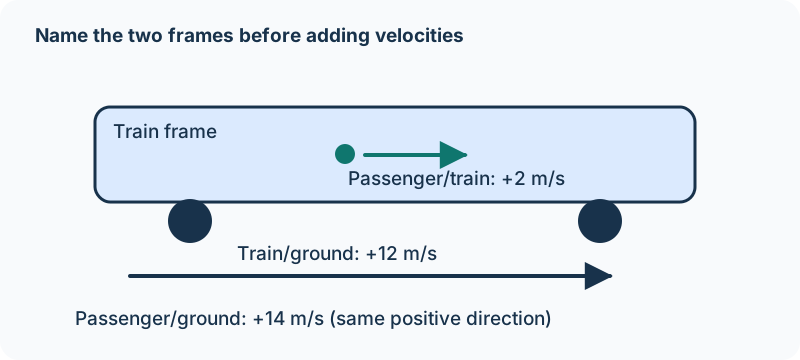
Keep the subscripts in the story
Let v_PG mean passenger relative to ground, v_PT passenger relative to train, and v_TG train relative to ground. In one dimension, use a shared positive direction. The velocity relation is:
v_PG = v_PT + v_TG
Solving for the train measurement gives v_PT = v_PG − v_TG. This is signed vector addition, not automatically “add the speeds.” A passenger walking toward the rear at 2 m/s has v_PT = −2 m/s, so v_PG = −2 + 12 = +10 m/s. The passenger still moves right relative to the ground even while moving left relative to the train.
Why does the equation work? During the same interval Δt, the passenger’s ground displacement equals the train’s ground displacement plus the passenger’s displacement within the train. Divide all three terms by that common Δt. The clocks describe the same event interval in this ordinary, nonrelativistic model.
Example 1.4.1 — Passing bicycles
Two bicycles travel east at 8 m/s and 5 m/s relative to the road. With east positive, the faster bicycle’s velocity relative to the slower bicycle is 8 − 5 = +3 m/s. The slower bicycle’s velocity relative to the faster is 5 − 8 = −3 m/s. Reciprocal relative velocities have equal magnitude and opposite direction.
If the second bicycle instead travels west at 5 m/s, its road velocity is −5 m/s. The faster bicycle’s velocity relative to it is 8 − (−5) = +13 m/s. Subtract the signed component. Subtracting the magnitude would predict 3 m/s and miss how quickly they approach each other.
A closing speed can tell you how rapidly separation shrinks, but it doesn’t by itself tell you whether or when two objects meet. You also need initial positions, and you must know whether the velocity model lasts long enough. If the first bicycle starts 15 m behind the second in the same-direction case, the meeting time is 15 m/(3 m/s) = 5 s.
Which frames keep the same acceleration?
An inertial frame is one in which an object with zero net force maintains constant velocity. Frames moving at constant velocity relative to an inertial frame are also inertial. Their velocity graphs differ by a constant vertical shift, so their slopes—and their measured accelerations—match.
For instance, if the passenger changes walking velocity from +1 to +3 m/s relative to a constant-speed train in 2 s, the acceleration is +1 m/s². The ground observer measures a change from +13 to +15 m/s and gets the same acceleration. The speeds differ; the changes don’t.
A train speeding up or turning is a noninertial frame, and that simple acceleration equality no longer applies. This section’s numerical relative-velocity tasks stay in one dimension, as required by AP Physics 1. The original vector tools remain useful for other purposes, but two-dimensional relative-velocity calculations are enrichment rather than an AP requirement.
Make an observer comparison
Record two toy cars on the same straight track with a stationary camera. Put distance marks in the frame. Fit position versus time for each car over an interval of approximately constant velocity. Subtract the measured slopes, then plot the difference in their positions versus time. The slope of that difference graph should match the relative velocity. This compares two independently constructed representations and makes the reference frame explicit.
Example 1.4.2 — Describe the observer before subtracting velocities
At t = 0, a road observer and the rear of a constant-speed bus pass the same lamp post. The road frame has its origin fixed at the lamp post, +x east along the road, and a clock set to zero at that passing event. The bus observer’s frame has its origin fixed to the bus rear, the same eastward axis direction, and a clock synchronized to the same event. Both use meters and seconds. These origins, directions, and clock settings fully describe the two reference frames.
The bus origin moves at +8 m/s in the road frame, so x_bus = x_road − 8t and v_object,bus = v_object,road − 8 m/s. At t = 3 s a cyclist at x_road = 30 m has x_bus = 6 m. If its road velocity is +5 m/s, its bus velocity is −3 m/s. The cyclist is east of the bus rear while falling behind it. Both frames are inertial under the constant-velocity assumption; this comparison uses only one-dimensional relative motion.
Check what you know
Pause & try it
Let's see what stuck.
Choose an answer, then check the reasoning. Try the written problems below before opening their solutions.
0 of 3 checked · 0 correct
Give it a try
Practice 1
A walkway moves +1.5 m/s. A traveler has +2.0 m/s relative to it. Find the traveler velocity relative to the building, then find the traveler velocity if they turn and walk at the same speed relative to the walkway.
Practice 2
A ground velocity graph rises from 4 to 10 m/s in 3 s. Sketch the velocity graph measured from a frame moving +2 m/s. Compare slopes and accelerations.
Practice 3
Cars A and B have x_A = 2 + 4t and x_B = 14 + 2t, with x in meters and t in seconds. Use relative motion to find when they meet.
Keep exploring
Review signed-vector addition in Vectors. Relative-motion subscripts add the missing observer information to those same arrows.
Course scope and standards: the supplied AP Physics 1 CED, printed pages 32; Topic 1.4 and its exact learning objectives. The official College Board CED is the public source; the project audit records the supplied edition.
Supporting physics references: OpenStax: addition of velocities. These lessons, diagrams, examples, and practice questions were written for this book.
Explain and apply the model
Try these problems before opening the solutions. State your assumptions, show the diagram or calculation, and explain what makes your answer follow.
Specify two observers’ frames
A bus rear passes a lamp post while traveling east at a constant 9 m/s. A road observer stands at the lamp post and another observer sits at the bus rear. Three seconds after that passing event a cyclist has road coordinate +33 m and road velocity +6 m/s. All motion is along the straight east–west road.
(a) Describe the reference frame of each observer. Specify an origin attached to the observer, an axis and positive direction, a clock zero event and units. Explain why the two frames can be regarded as inertial for this comparison.
(b) Using your stated frames, calculate the cyclist’s position and signed velocity relative to the bus at 3 s. Explain how the cyclist can be east of the bus rear while moving west relative to it.
Your written working
Drawing is temporarily unavailable. Work on paper if needed, then record your reasoning here.
Saving written working requires JavaScript. The problem remains available above; keep your work on paper or in your own notes.
Glossary and deeper reading · 5 refreshers
These editorial refreshers supplement the reading. Definitions and examples are added guidance; original source wording and recorded answers remain in their original context.
-
Velocity
Velocity describes how position changes with time and includes direction. Instantaneous velocity describes one moment, while average velocity is displacement divided by elapsed time. For example, a car turning a corner can change velocity while maintaining the same speed.
-
Vector
A vector is a quantity with a magnitude and a direction, represented by an arrow or by components along chosen axes. Vectors add by adding corresponding components rather than simply adding their magnitudes. For example, an eastward displacement followed by a northward displacement produces a resultant pointing northeast. The zero vector has zero magnitude and no unique direction.
-
Inertial frame
An inertial frame is a reference frame in which an object with no net external force moves at constant velocity. Frames moving at constant velocity relative to an inertial frame are also inertial in the Newtonian model. For example, a steadily moving train is approximately inertial, whereas a train accelerating out of a station is not.
-
Net force
Net force is the vector sum of all forces acting on the object or system under consideration. For constant mass in an inertial frame, it equals mass times acceleration. For example, equal upward and downward forces give zero net force even though neither force is zero.
-
Acceleration
Acceleration is the vector rate of change of velocity with time. It can change an object’s speed, direction, or both, and it is measured in meters per second squared. For example, a satellite moving at constant speed in a circular orbit accelerates toward the center.