Newton’s Second Law in Rotational Form
Connect net torque and rotational inertia to angular acceleration.
What changes the spin?
A steady turn requires no net torque in the ideal model. To change that turn, we need an unbalanced turning effect. Newton’s second law in rotational form is Στ = Iα for rotation about the relevant fixed axis, or for the corresponding center-of-mass rotational analysis. It connects net external torque, inertia about that same axis, and angular acceleration.
With constant inertia, doubling the net torque doubles α. With the same torque, doubling I halves α. Torque changes angular velocity, not automatically angular speed: a braking torque can decrease the speed of a wheel that is already turning. State a positive turning sense and keep the signs consistent when using the one-plane equation.
Worked example: a driven disk
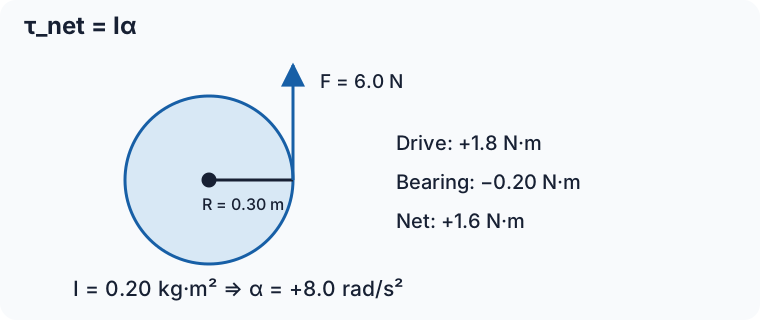
A disk has a provided rotational inertia of 0.20 kg·m². A tangential 6.0 N force acts at radius 0.30 m, tending counterclockwise. A bearing exerts a 0.20 N·m opposing torque. Choose counterclockwise positive.
The applied torque is +6.0(0.30) = +1.8 N·m. The net torque is 1.8 − 0.20 = +1.6 N·m, so α = 1.6/0.20 = +8.0 rad/s². If the disk initially turns at +4.0 rad/s and these torques stay constant for 0.50 s, ω_f = 4.0 + 8.0(0.50) = +8.0 rad/s. Using the applied torque alone would overestimate the acceleration because the bearing torque also belongs in the sum.
A hanging mass can drive rotation
A light string unwinds without slipping from a fixed-axis pulley of radius R and inertia I. A hanging mass m falls, and the pulley spins. The mass and pulley need related but separate analyses. For the mass, with downward positive, mg − T = ma. For the pulley, tension is the driving torque: TR = Iα. The no-slip constraint gives a = Rα.
Substitute α = a/R into the torque equation to get T = Ia/R². Then mg = a(m + I/R²), so a = mg/(m + I/R²). The acceleration is smaller than g because the tension is nonzero and some of the gravitational energy supplies pulley rotation. For a massless ideal pulley, I = 0 and this single-mass setup approaches free fall; a real pulley with inertia resists the change in spin.
For m = 0.50 kg, R = 0.10 m, I = 0.0020 kg·m², and g = 9.8 m/s², a = 4.9/(0.50 + 0.20) = 7.0 m/s². The tension is 0.50(9.8 − 7.0) = 1.4 N. Thus α = 70 rad/s² and TR = 0.14 N·m = Iα. Each equation describes a different part of the system; the constraint connects them.
Avoid the “tension equals weight” shortcut
The falling mass accelerates, so T is smaller than mg. Replacing T with mg in the torque equation would imply zero net force on the mass and contradict the acceleration. Similarly, the pulley’s support force can balance its center-of-mass forces while exerting no torque about its axle. Translation and rotation have separate equations, even when the motion constraints tie them together.
For a rolling object, a force diagram can be used for its center-of-mass acceleration and a torque diagram about its center for α. Do not treat the contact point as a fixed axle throughout an acceleration without checking the conditions behind the chosen equation. The center-of-mass approach plus a no-slip constraint is a clear route in the rolling section.
Instructional example (guided activity):
A graph can measure inertia
Apply several known applied driving torques to a fixed-axis rotating frame. Find α from the slope of measured ω against t over an interval when torque is approximately constant. If a constant bearing torque opposes the drive, plot applied torque vertically against α horizontally. The model τ_applied = Iα + τ_bearing predicts slope I, in kg·m², and intercept τ_bearing. If you have already subtracted the resistance and plot true net torque instead, τ_net = Iα predicts a line through the origin. Repeating the trials and fitting a line uses all the measurements rather than relying on one pair of numbers.
Worked example — Two balances and one connecting constraint
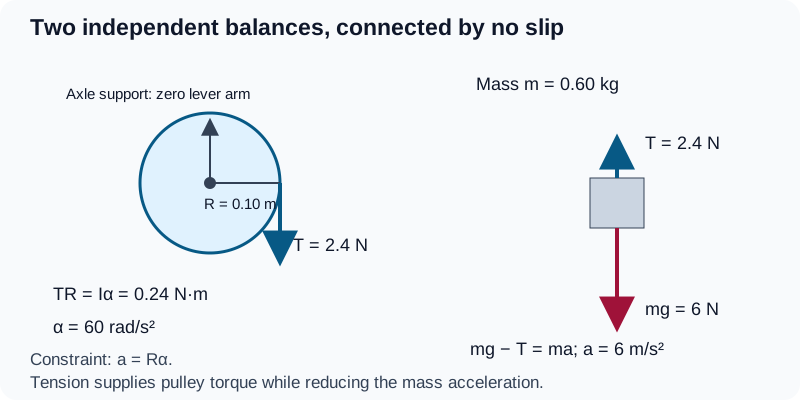
A 0.60 kg hanging mass drives a fixed-axis pulley with R = 0.10 m and provided I = 0.0040 kg·m². The string is light, inextensible, and does not slip; bearing torque is negligible. Use g = 10 m/s². Draw weight 6.0 N downward and tension T upward on the mass. Draw the string tension tangentially at the pulley rim and the axle support at its center. The support affects the pulley’s force balance but has zero torque about the axle.
The mass’s independent linear balance is mg − T = ma. The pulley’s independent rotational balance is TR = Iα. The no-slip constraint a = Rα connects them, giving T = Ia/R² and a = mg/(m + I/R²) = 6.0/(0.60 + 0.40) = 6.0 m/s². Hence T = 2.4 N, α = 60 rad/s², and TR = 0.24 N·m = Iα. Setting tension equal to 6.0 N would contradict the mass’s nonzero acceleration.
Check the same motion through energy after the mass falls 0.30 m from rest: v² = 2as = 3.6 m²/s² and ω = v/R. The mass gains ½mv² = 1.08 J and the pulley gains ½I(v/R)² = 0.72 J. Their sum 1.80 J equals mgs. Linear and rotational balances must both be performed even though energy gives a compact independent check.
Inspect diagram labels
The diagram keeps its full size here. Focus the view and use the arrow keys, or scroll across it, to inspect every label.
Connect the analyses
Pause & try it
Let's see what stuck.
Choose an answer, then check the reasoning. Try the written problems below before opening their solutions.
0 of 3 checked · 0 correct
Assigned practice: same torque, different distribution
Compare two separate trials of a rotating frame. In trial A its masses remain fixed in a configuration with I = 0.050 kg·m². In trial B they remain fixed farther outward, with I = 0.080 kg·m². Apply constant net torque +0.40 N·m for 2.0 s in each trial. Compare α and the change in ω.
Open the separate worked solution.
Assigned practice: separate the bearing torque from the inertia
A fixed-axis frame has the same inertia in three trials. Measured applied driving torques are 0.20, 0.40, and 0.60 N·m, and the corresponding angular accelerations are 1.0, 3.0, and 5.0 rad/s². A constant unknown bearing torque opposes the drive. Choose axes for a linear graph that would let you infer both inertia and bearing torque, and find them from the data. A classmate labels the vertical axis “net torque” without changing the plotted values. Explain the error and where a graph of true net torque would meet the axis.
Open the separate worked solution.
Read the original Angular Forces and Moment of Inertia for further examples and retained quizzes. The new pulley analysis makes the translational and rotational equations explicit.
Sources and scope: College Board CED, with edition-specific coverage verified against the supplied file. Supplied College Board CED, printed p. 100, 5.6.A, requires separate linear and rotational analyses when needed. OpenStax: Newton’s Second Law for Rotation verifies τ_net = Iα. All calculations use one rotation plane and original values.
Explain and apply the model
Try these problems before opening the solutions. State your assumptions, show the diagram or calculation, and explain what makes your answer follow.
Couple a falling mass and pulley
A 0.80 kg mass falls while a light inextensible string unwinds without slipping from a fixed central axle pulley. Pulley radius is 0.10 m and provided inertia about that axle is 0.0040 kg·m². Bearing torque is negligible. Use g = 10 m/s²; the mass starts from rest. Downward mass motion and the corresponding pulley turn are positive.
(a) Draw the mass’s free-body diagram and an extended force diagram for the pulley, including tension at the rim and axle support. Independently write the mass’s linear balance and the pulley’s rotational balance, then write the no-slip constraint. Explain why the axle force has no axle torque and why tension is not mg.
(b) Solve the coupled equations for a, T and α. Then, after the mass falls 0.30 m, calculate its speed and the pulley angular speed and independently check that gravitational energy lost equals the sum of mass and pulley kinetic-energy gains.
Your written working
Drawing is temporarily unavailable. Work on paper if needed, then record your reasoning here.
Saving written working requires JavaScript. The problem remains available above; keep your work on paper or in your own notes.
Glossary and deeper reading · 10 refreshers
These editorial refreshers supplement the reading. Definitions and examples are added guidance; original source wording and recorded answers remain in their original context.
-
Torque
Torque describes a force’s turning effect about a chosen axis or point. Its magnitude is force times the perpendicular lever arm, and its direction or sign describes the rotation tendency. For example, pushing near the handle of a door produces more torque than the same perpendicular push near the hinge.
-
Inertia
Inertia is an object’s resistance to a change in its velocity. Mass measures translational inertia, whereas rotational inertia also depends on how mass is distributed relative to an axis. For example, a loaded cart accelerates less than an empty cart under the same net force.
-
Angular velocity
Angular velocity describes the rate and direction of rotation about an axis. For a fixed axis, a signed angular velocity is measured in radians per second, while its magnitude is angular speed. For example, points on one rigid turntable share the same angular speed even though outer points have greater linear speeds.
-
Tension
Tension is a pulling force transmitted through a stretched rope, string, or similar connector. It acts along the connector away from the object it pulls, and an ideal massless rope has the same tension throughout an uninterrupted segment. For example, a rope supporting an accelerating load can have a tension different from the load’s weight.
-
Acceleration
Acceleration is the vector rate of change of velocity with time. It can change an object’s speed, direction, or both, and it is measured in meters per second squared. For example, a satellite moving at constant speed in a circular orbit accelerates toward the center.
-
Gravitational potential energy
Gravitational potential energy is energy associated with the relative positions of attracting masses. Near Earth, changes can be approximated by mass times gravitational field strength times height change when that field is nearly constant. For example, lifting a book increases the gravitational potential energy of the book–Earth system.
-
Net force
Net force is the vector sum of all forces acting on the object or system under consideration. For constant mass in an inertial frame, it equals mass times acceleration. For example, equal upward and downward forces give zero net force even though neither force is zero.
-
Force
A force describes an interaction that can change an object’s momentum. It is a vector measured in newtons, so both size and direction matter when forces are added. For example, a rope can pull a cart while the floor exerts friction in another direction.
-
Angular acceleration
Angular acceleration is the rate of change of angular velocity. For a fixed axis its sign follows the chosen positive rotation direction, and its units are radians per second squared. For example, a fan speeding up has angular acceleration, whereas one turning steadily does not.
-
Free-body diagram
A free-body diagram shows the external forces acting on one selected object or system. Each arrow names a real interaction, and its direction is the direction of that force. For example, a book resting on a desk has a downward gravitational force and an upward normal force; velocity is not an extra force arrow.