Simple Harmonic Motion: Worked Solutions
Try the questions on the lesson page first. Then compare both the answer and the reasoning. The worked steps here are original.
Question 1: A cart passes through spring equilibrium while moving right. What is true at that instant?
A cart passes through spring equilibrium while moving right. What is true at that instant?
- Locate the equilibrium position x = 0. Why: The coordinate is measured from the point of zero net restoring force.
- Use F = −kx to get F = 0 there. Why: Zero displacement makes the restoring term vanish.
- Allow a nonzero velocity through that point. Why: Newton’s second law sets acceleration, not the instantaneous velocity; momentum carries the cart through.
Question 2: Which signed force graph describes SHM about x = 0?
Which signed force graph describes SHM about x = 0?
- Keep signs for both force and displacement. Why: A signed graph must encode the direction of the restoring force.
- Use F = −kx with k positive. Why: The force is proportional to displacement and points the opposite way.
- Choose a straight line through zero with negative slope. Why: The slope is −k; a positive slope would push the cart away from equilibrium.
Question 3: Why is a small-angle pendulum approximately harmonic?
Why is a small-angle pendulum approximately harmonic?
- Identify gravity’s torque about the pendulum pivot as −mgL sinθ. Why: The tangential gravity component tends to return the bob to the bottom.
- For small θ in radians, replace sinθ by θ. Why: This approximation gives a linear relationship over the small-angle range.
- Conclude that restoring torque is proportional to angular displacement. Why: The linear, opposite-sign restoring relation is the requirement for angular SHM.
Question 4: from graph slope to motion
A signed acceleration-versus-displacement graph has slope −64 s⁻² for a 0.50 kg cart. Find k and the acceleration at x = −0.025 m. Explain what happens if the cart is moving left there.
- Use slope = −k/m = −64 s⁻² and solve k = (64)(0.50) = 32 N/m. Why: The signed acceleration-displacement graph measures the restoring acceleration per displacement.
- At x = −0.025 m, calculate a = (−64)(−0.025) = +1.60 m/s². Why: The opposite-sign force points toward equilibrium, so the acceleration is rightward.
- The cart moving left slows down before turning. Why: Velocity and acceleration have opposite signs; positive acceleration does not mean the cart is already moving right.
Try this written problem again.
Question 5: a force graph with a different origin
A 0.30 kg cart moves horizontally on an ideal spring with negligible friction. A position sensor reports coordinate s from a mark on the track, rather than from spring equilibrium. Measurements of the spring’s signed horizontal force are listed below; right is positive. Plot F vertically in N against s horizontally in m, with labeled scales. Find the equilibrium sensor reading and spring constant. Then derive acceleration as a function of s, calculate it at s = 0.230 m, and explain whether a cart moving right there speeds up or slows down.
| Sensor coordinate s (m) | Spring force F (N) |
|---|---|
| 0.160 | +1.20 |
| 0.200 | 0.00 |
| 0.240 | −1.20 |
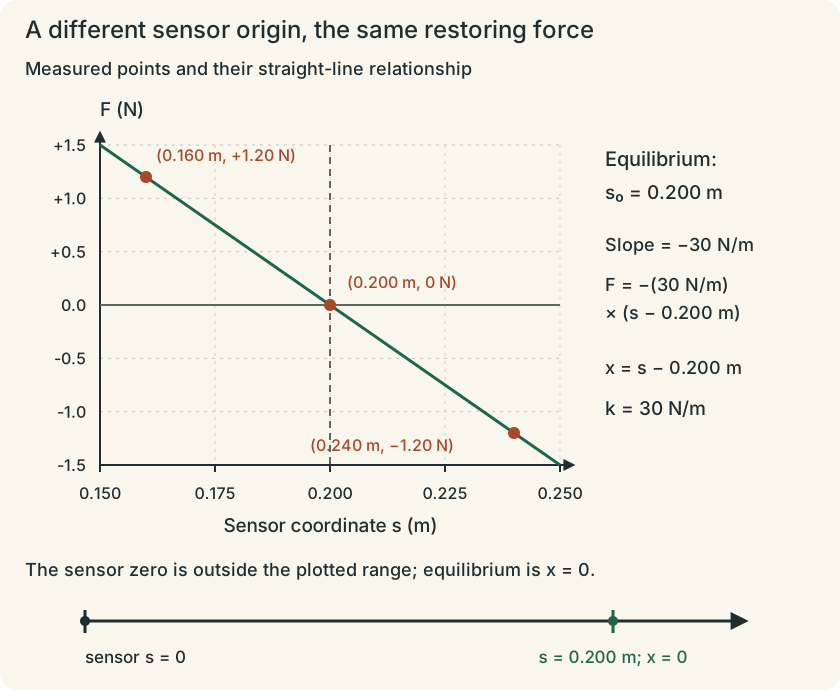
- Plot the three points on axes spanning about s = 0.15 to 0.25 m and F = −1.5 to +1.5 N; label both quantities, scales, and units. A straight line through the points crosses F = 0 at s₀ = 0.200 m. Why: Zero spring force locates equilibrium. The sensor’s coordinate zero does not have to be the spring’s equilibrium.
- Find the signed slope: ΔF/Δs = (−1.20 − 1.20)/(0.240 − 0.160) = −30 N/m, giving k = 30 N/m. Why: For an ideal spring, the signed force-displacement slope is −k. Translating the coordinate origin changes the intercept, not the slope.
- Define equilibrium displacement x = s − 0.200 m. Then F = −(30 N/m)(s − 0.200 m) and a = F/m = −(100 s⁻²)(s − 0.200 m). Why: The restoring law is proportional to displacement from equilibrium; Newton’s second law converts the net horizontal spring force into acceleration.
- At s = 0.230 m, x = +0.030 m and a = −100(0.030) = −3.00 m/s². A cart moving right slows down at that instant. Why: Acceleration points left toward equilibrium and therefore opposes the stated rightward velocity. Using s itself as equilibrium displacement would wrongly give −23 m/s².