Unit 7 / Oscillations
Unit 7: 32 practice problems
Work from memory first. Draw a diagram, choose a system, and say why your model applies. The 30 selected questions revisit every topic in Oscillations; 2 additional problems at the end ask you to explain and apply the models. The worked solutions live on their own page.
This is mixed topic review: short concept checks, calculations, and experiment tasks appear together. Choose a topic below to revisit its lesson, then return to the questions that challenge your model.
Question 1 · AP topic 7.1
1. Put topic 7.1 to work
A signed acceleration-versus-displacement graph has slope −64 s⁻² for a 0.50 kg cart. Find k and the acceleration at x = −0.025 m. Explain what happens if the cart is moving left there.
Your written working
Drawing is temporarily unavailable. Work on paper if needed, then record your reasoning here.
Saving written working requires JavaScript. The problem remains available above; keep your work on paper or in your own notes.
See this question in its original context ↗Separate worked solution ↗
Question 2 · AP topic 7.2
2. Put topic 7.2 to work
A student times 20 successive turning-point-to-turning-point trips of a spring oscillator, counting both directions: right to left, then left to right, and so on. The total time is 8.0 s. The student treats each trip as a full cycle and reports T = 0.40 s. Correct the cycle count, find f, and explain the effect on a spring constant found from this T.
Your written working
Drawing is temporarily unavailable. Work on paper if needed, then record your reasoning here.
Saving written working requires JavaScript. The problem remains available above; keep your work on paper or in your own notes.
See this question in its original context ↗Separate worked solution ↗
Question 3 · AP topic 7.3
3. Put topic 7.3 to work
A position graph has peaks +0.050 m and troughs −0.050 m, with successive positive peaks 0.40 s apart. Find its maximum speed. A second oscillator has the same amplitude and half the period. Compare their maximum accelerations.
Your written working
Drawing is temporarily unavailable. Work on paper if needed, then record your reasoning here.
Saving written working requires JavaScript. The problem remains available above; keep your work on paper or in your own notes.
See this question in its original context ↗Separate worked solution ↗
Question 4 · AP topic 7.4
4. Put topic 7.4 to work
For a horizontal ideal spring, find the positions where K = Uₛ. Then explain why there are four such moments per cycle.
Your written working
Drawing is temporarily unavailable. Work on paper if needed, then record your reasoning here.
Saving written working requires JavaScript. The problem remains available above; keep your work on paper or in your own notes.
See this question in its original context ↗Separate worked solution ↗
Question 5 · AP topic 7.1
5. Written practice: a force graph with a different origin
A 0.30 kg cart moves horizontally on an ideal spring with negligible friction. A position sensor reports coordinate s from a mark on the track, rather than from spring equilibrium. Measurements of the spring’s signed horizontal force are listed below; right is positive. Plot F vertically in N against s horizontally in m, with labeled scales. Find the equilibrium sensor reading and spring constant. Then derive acceleration as a function of s, calculate it at s = 0.230 m, and explain whether a cart moving right there speeds up or slows down.
| Sensor coordinate s (m) | Spring force F (N) |
|---|---|
| 0.160 | +1.20 |
| 0.200 | 0.00 |
| 0.240 | −1.20 |
Your written working
Drawing is temporarily unavailable. Work on paper if needed, then record your reasoning here.
Saving written working requires JavaScript. The problem remains available above; keep your work on paper or in your own notes.
See this question in its original context ↗Separate worked solution ↗
Question 6 · AP topic 7.2
6. Put topic 7.2 to work
A spring oscillator mass increases by a factor of 9; its spring is unchanged. What happens to T?
- T becomes 9 times larger.
- T becomes 3 times larger.
- T becomes one-third as large.
Your written working
Drawing is temporarily unavailable. Work on paper if needed, then record your reasoning here.
Saving written working requires JavaScript. The problem remains available above; keep your work on paper or in your own notes.
See this question in its original context ↗Separate worked solution ↗
Question 7 · AP topic 7.3
7. Written practice: turn measured positions into a graph
A motion sensor records displacement from equilibrium for a horizontal spring cart. Its position uncertainty is approximately ±0.002 m; assume negligible friction and an ideal linear spring. Plot the measured positions below on a numerical x-versus-t graph with labeled units and scales, then sketch a smooth trend. Estimate amplitude and period from the graph and calculate maximum speed. On aligned qualitative velocity and acceleration graphs, mark the signs and important features at t = 0.20 s and t = 0.40 s. Explain whether the measured points are consistent with an SHM model, while recognizing what a short data record can establish.
| Time t (s) | Measured displacement x (m) |
|---|---|
| 0.00 | +0.081 |
| 0.10 | +0.056 |
| 0.20 | +0.001 |
| 0.30 | −0.057 |
| 0.40 | −0.079 |
| 0.50 | −0.056 |
| 0.60 | −0.001 |
| 0.70 | +0.057 |
| 0.80 | +0.080 |
Your written working
Drawing is temporarily unavailable. Work on paper if needed, then record your reasoning here.
Saving written working requires JavaScript. The problem remains available above; keep your work on paper or in your own notes.
See this question in its original context ↗Separate worked solution ↗
Question 8 · AP topic 7.4
8. Put topic 7.4 to work
At x = A/2 in a horizontal ideal spring oscillator, what fraction of total energy is kinetic?
- 1/2
- 1/4
- 3/4
Your written working
Drawing is temporarily unavailable. Work on paper if needed, then record your reasoning here.
Saving written working requires JavaScript. The problem remains available above; keep your work on paper or in your own notes.
See this question in its original context ↗Separate worked solution ↗
Question 9 · AP topic 7.1
9. Put topic 7.1 to work
A cart passes through spring equilibrium while moving right. What is true at that instant?
- Its net spring force is zero but its velocity can be nonzero.
- Its velocity must be zero.
- Its restoring force is largest.
Your written working
Drawing is temporarily unavailable. Work on paper if needed, then record your reasoning here.
Saving written working requires JavaScript. The problem remains available above; keep your work on paper or in your own notes.
See this question in its original context ↗Separate worked solution ↗
Question 10 · AP topic 7.2
10. Put topic 7.2 to work
Which graph gives a straight line for the ideal spring model?
- T versus m.
- f versus m.
- T² versus m.
Your written working
Drawing is temporarily unavailable. Work on paper if needed, then record your reasoning here.
Saving written working requires JavaScript. The problem remains available above; keep your work on paper or in your own notes.
See this question in its original context ↗Separate worked solution ↗
Question 11 · AP topic 7.3
11. Put topic 7.3 to work
At the positive turning point of ideal SHM, which pair is correct?
- v is maximum and a is zero.
- v is zero and a is most negative.
- v and a are both zero.
Your written working
Drawing is temporarily unavailable. Work on paper if needed, then record your reasoning here.
Saving written working requires JavaScript. The problem remains available above; keep your work on paper or in your own notes.
See this question in its original context ↗Separate worked solution ↗
Question 12 · AP topic 7.4
12. Put topic 7.4 to work
Amplitude doubles while the ideal spring and mass stay unchanged. Total energy…
- quadruples.
- doubles.
- stays unchanged.
Your written working
Drawing is temporarily unavailable. Work on paper if needed, then record your reasoning here.
Saving written working requires JavaScript. The problem remains available above; keep your work on paper or in your own notes.
See this question in its original context ↗Separate worked solution ↗
Question 13 · AP topic 7.1
13. Put topic 7.1 to work
Which signed force graph describes SHM about x = 0?
- A straight line through zero with positive slope.
- A straight line through zero with negative slope.
- Any repeating force graph.
Your written working
Drawing is temporarily unavailable. Work on paper if needed, then record your reasoning here.
Saving written working requires JavaScript. The problem remains available above; keep your work on paper or in your own notes.
See this question in its original context ↗Separate worked solution ↗
Question 14 · AP topic 7.2
14. Put topic 7.2 to work
A small-angle pendulum bob mass doubles at fixed L and g. Its period…
- stays unchanged.
- doubles.
- falls by a factor of √2.
Your written working
Drawing is temporarily unavailable. Work on paper if needed, then record your reasoning here.
Saving written working requires JavaScript. The problem remains available above; keep your work on paper or in your own notes.
See this question in its original context ↗Separate worked solution ↗
Question 15 · AP topic 7.3
15. Put topic 7.3 to work
Amplitude doubles while m and k stay fixed. What changes?
- Period doubles.
- Maximum speed stays fixed.
- Maximum speed doubles and period stays fixed.
Your written working
Drawing is temporarily unavailable. Work on paper if needed, then record your reasoning here.
Saving written working requires JavaScript. The problem remains available above; keep your work on paper or in your own notes.
See this question in its original context ↗Separate worked solution ↗
Question 16 · AP topic 7.4
16. Put topic 7.4 to work
In a vertical spring, x is displacement from the stretched equilibrium. The term ½kx² represents…
- the actual spring energy measured from its natural length.
- combined spring-plus-gravity potential relative to equilibrium, with an appropriate zero.
- gravitational energy alone.
Your written working
Drawing is temporarily unavailable. Work on paper if needed, then record your reasoning here.
Saving written working requires JavaScript. The problem remains available above; keep your work on paper or in your own notes.
See this question in its original context ↗Separate worked solution ↗
Question 17 · AP topic 7.1
17. Put topic 7.1 to work
Why is a small-angle pendulum approximately harmonic?
- Tension is constant.
- Gravity disappears at the bottom.
- The restoring torque is approximately proportional to angular displacement.
Your written working
Drawing is temporarily unavailable. Work on paper if needed, then record your reasoning here.
Saving written working requires JavaScript. The problem remains available above; keep your work on paper or in your own notes.
See this question in its original context ↗Separate worked solution ↗
Question 18 · AP topic 7.2
18. Pendulums · question 1
For an ideal small-angle simple pendulum with fixed length, what happens to its period if the point-bob mass doubles and all other factors stay the same?
Your written working
Drawing is temporarily unavailable. Work on paper if needed, then record your reasoning here.
Saving written working requires JavaScript. The problem remains available above; keep your work on paper or in your own notes.
See this question in its original context ↗Separate worked solution ↗
Question 19 · AP topic 7.3
19. Put topic 7.3 to work
Position crosses its equilibrium midline with a negative slope. The cart is…
- moving left with zero restoring acceleration.
- at rest with negative acceleration.
- moving right with positive acceleration.
Your written working
Drawing is temporarily unavailable. Work on paper if needed, then record your reasoning here.
Saving written working requires JavaScript. The problem remains available above; keep your work on paper or in your own notes.
See this question in its original context ↗Separate worked solution ↗
Question 20 · AP topic 7.4
20. Energy with two wall springs
A 0.75 kg cart on a frictionless horizontal rail lies between two walls. It is attached to a 120 N/m spring on the left and a 180 N/m spring on the right. Both are unstrained at equilibrium. The cart is pulled 0.080 m right and released. Find the restoring force at release, total energy and maximum speed.
Your written working
Drawing is temporarily unavailable. Work on paper if needed, then record your reasoning here.
Saving written working requires JavaScript. The problem remains available above; keep your work on paper or in your own notes.
See this question in its original context ↗Review the model ↗Separate worked solution ↗
Question 21 · AP topic 7.2
21. Pendulums · question 3
An ideal small-angle simple pendulum has period T. If its length increases by a factor of 4 with gravity unchanged, what is its new period?
Your written working
Drawing is temporarily unavailable. Work on paper if needed, then record your reasoning here.
Saving written working requires JavaScript. The problem remains available above; keep your work on paper or in your own notes.
See this question in its original context ↗Separate worked solution ↗
Question 22 · AP topic 7.3
22. Reconstructing a glider’s motion
A 0.50 kg glider moves on a frictionless track attached to a 50 N/m spring. At t=0 its displacement from equilibrium is +0.030 m and its velocity is −0.400 m/s. Find its amplitude, a displacement equation with the correct phase, and maximum speed.
Your written working
Drawing is temporarily unavailable. Work on paper if needed, then record your reasoning here.
Saving written working requires JavaScript. The problem remains available above; keep your work on paper or in your own notes.
See this question in its original context ↗Review the model ↗Separate worked solution ↗
Question 23 · AP topic 7.4
23. Embedding collision starts an oscillation
A 0.030 kg pellet moving horizontally at 60.0 m/s embeds in a stationary 0.500 kg block attached to a 212 N/m spring. The spring is initially unstrained on a frictionless track. Treat the impact as instantaneous so the spring impulse during it is negligible. Find the subsequent oscillation amplitude and the mechanical energy lost in the impact.
Your written working
Drawing is temporarily unavailable. Work on paper if needed, then record your reasoning here.
Saving written working requires JavaScript. The problem remains available above; keep your work on paper or in your own notes.
See this question in its original context ↗Review the model ↗Separate worked solution ↗
Question 24 · AP topic 7.2
24. Work it out
An ideal spring carries a 5 kg mass. Replacing it with a 10 kg mass increases the oscillation period by 8 s. Find the spring constant. Neglect the spring mass and damping.
Your written working
Drawing is temporarily unavailable. Work on paper if needed, then record your reasoning here.
Saving written working requires JavaScript. The problem remains available above; keep your work on paper or in your own notes.
See this question in its original context ↗Review the model ↗Separate worked solution ↗
Question 25 · AP topic 7.3
25. How much time is spent near equilibrium?
An ideal oscillator has x(t)=A cos(8.00t), with t in seconds. What fraction of each period does it spend within |x|≤A/2? Find the total time in that region during one period.
Your written working
Drawing is temporarily unavailable. Work on paper if needed, then record your reasoning here.
Saving written working requires JavaScript. The problem remains available above; keep your work on paper or in your own notes.
See this question in its original context ↗Review the model ↗Separate worked solution ↗
Question 26 · AP topic 7.2
26. Work it out
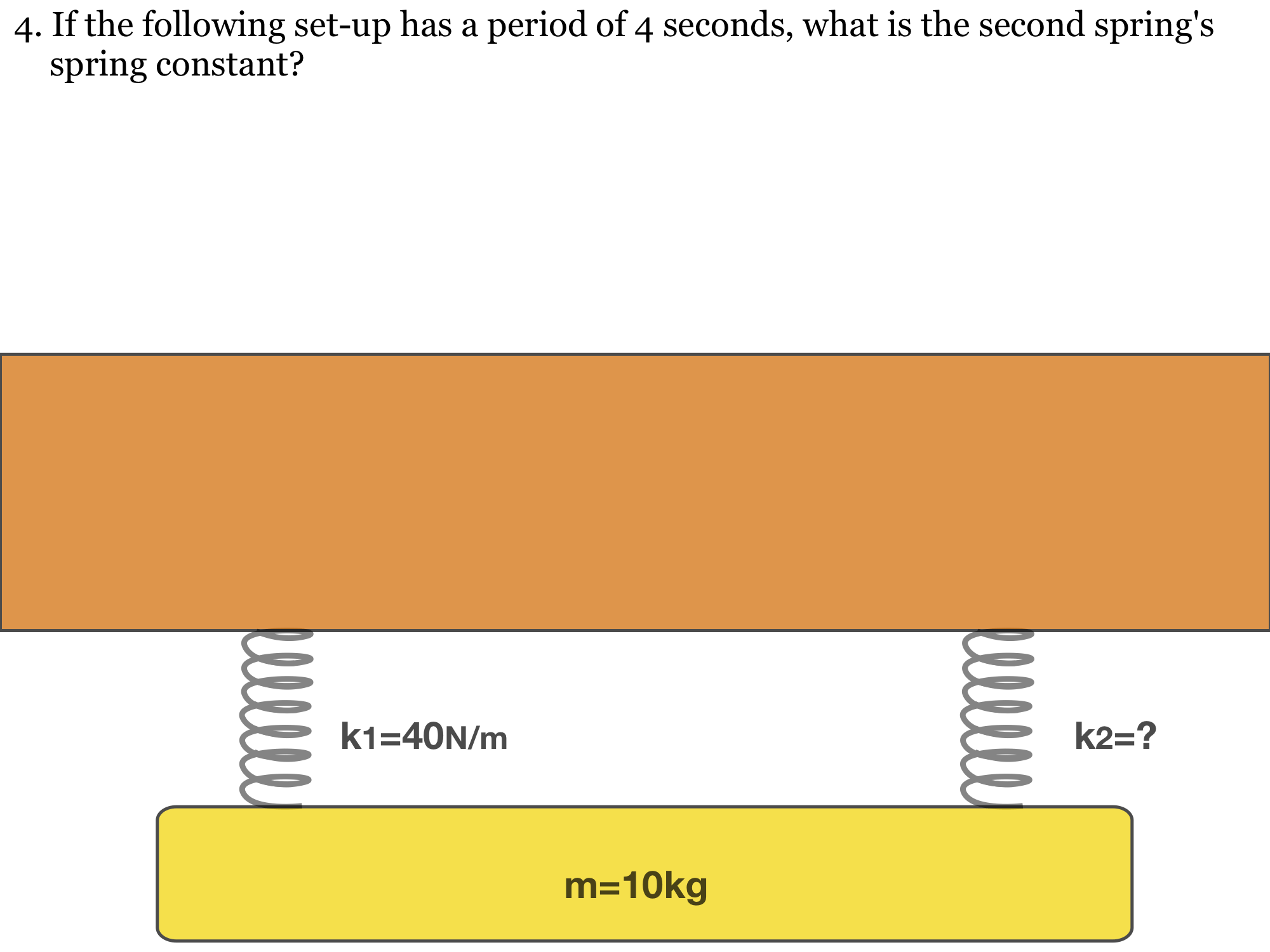
A 10 kg rigid block hangs from two ideal springs in parallel, as shown in the source diagram. One spring has k₁=40 N/m and the claimed period of pure vertical translation is 4 s. Solve for k₂ and assess whether that value can describe an ordinary positive-stiffness spring.
Your written working
Drawing is temporarily unavailable. Work on paper if needed, then record your reasoning here.
Saving written working requires JavaScript. The problem remains available above; keep your work on paper or in your own notes.
See this question in its original context ↗Review the model ↗Separate worked solution ↗
Question 27 · AP topic 7.2
27. Work it out
The same pendulum has a 10 s period on Earth. Find its period on Mars, where g=3.71 m/s². Take Earth’s g=9.8 m/s² and keep the pendulum geometry and oscillation amplitude unchanged; neglect damping.
Your written working
Drawing is temporarily unavailable. Work on paper if needed, then record your reasoning here.
Saving written working requires JavaScript. The problem remains available above; keep your work on paper or in your own notes.
See this question in its original context ↗Review the model ↗Separate worked solution ↗
Question 28 · AP topic 7.2
28. Static stretch predicts a vertical period
A 0.60 kg laboratory mass stretches a light vertical spring 7.5 cm at rest. The mass is then displaced slightly and released. With g=9.8 m/s² and no damping, find the spring constant and the oscillation period. Explain the role of gravity.
Your written working
Drawing is temporarily unavailable. Work on paper if needed, then record your reasoning here.
Saving written working requires JavaScript. The problem remains available above; keep your work on paper or in your own notes.
See this question in its original context ↗Review the model ↗Separate worked solution ↗
Question 29 · AP topic 7.2
29. Two series springs share the extension
A 1.20 kg oscillator is attached to a fixed wall through two light springs in series with constants 200 N/m and 300 N/m. The track is frictionless. Find the effective spring constant, period, and the individual spring extensions when the total extension is 0.050 m.
Your written working
Drawing is temporarily unavailable. Work on paper if needed, then record your reasoning here.
Saving written working requires JavaScript. The problem remains available above; keep your work on paper or in your own notes.
See this question in its original context ↗Review the model ↗Separate worked solution ↗
Question 30 · AP topic 7.2
30. An elevator changes a pendulum’s period
A small-angle pendulum of length 0.800 m hangs in an elevator accelerating steadily upward. Its measured period relative to the elevator is 1.60 s. Take Earth’s g=9.8 m/s². Find the elevator acceleration and its direction.
Your written working
Drawing is temporarily unavailable. Work on paper if needed, then record your reasoning here.
Saving written working requires JavaScript. The problem remains available above; keep your work on paper or in your own notes.
See this question in its original context ↗Review the model ↗Separate worked solution ↗
Explain and apply the model
Try these problems before opening the solutions. State your assumptions, show the diagram or calculation, and explain what makes your answer follow.
Repeating is only the first test
Motion A is a frictionless 0.50 kg cart on a light ideal horizontal spring. Its signed force measurements are: x = −0.030 m, F = +1.20 N; x = 0, F = 0; x = +0.030 m, F = −1.20 N. Assume the straight-line relation holds throughout its motion. Motion B is an ideal vertically bouncing ball that returns to the same maximum height after each lossless bounce. During flight, a = −9.8 m/s² with upward positive; floor collisions provide brief upward impulses. Both motions repeat.
(a) Describe the relationship between periodic motion and SHM. Classify both A and B, and use the restoring-acceleration rule to explain why one repeating motion is a counterexample to the claim that all periodic motion is SHM.
(b) Sketch a signed force-versus-displacement graph for A with numerical axis labels and identify the equilibrium position from the zero net force. Calculate k and the acceleration at x = +0.015 m. If the cart is moving left there, explain whether it speeds up or slows down.
Your written working
Drawing is temporarily unavailable. Work on paper if needed, then record your reasoning here.
Saving written working requires JavaScript. The problem remains available above; keep your work on paper or in your own notes.
Worked solution and rubric →Revisit the worked example →Read the relevant section →
Choose a sinusoid from the release
Two ideal horizontal spring carts each have amplitude A = 0.060 m and period T = 1.20 s. Displacement x is measured from equilibrium, with right positive. At t = 0, cart C is released from rest at x = +A; cart S passes x = 0 moving right. Use radians in trigonometric arguments. You may use sin(π/4) = cos(π/4) = 1/√2.
(a) Calculate f, then select and write a sine or cosine displacement function x(t) for each cart. Verify each choice from its initial displacement and graph direction rather than from its name.
(b) Evaluate both functions at t = 0.15 s and t = 0.30 s. Sketch both x-versus-t curves for one period on the same labeled axes, mark those times, and explain why equal positions at 0.15 s do not imply equal velocities.
(c) A third cart has the same A and T but starts at equilibrium moving left. Write its displacement function and explain which properties change and which stay fixed.
Your written working
Drawing is temporarily unavailable. Work on paper if needed, then record your reasoning here.
Saving written working requires JavaScript. The problem remains available above; keep your work on paper or in your own notes.
Worked solution and rubric →Revisit the worked example →Read the relevant section →