Vectors and Motion in Two Dimensions
Resolve motion into components and use one shared time for a projectile.
A ball can do two things at once
Roll a ball horizontally off a table and drop another ball from the same height at the same instant. If air resistance is negligible, both have the same vertical motion. The rolling ball also moves sideways, but that horizontal motion doesn’t give it extra time in the air.
Let’s choose horizontal x and upward y. A vector is the sum of perpendicular components along those axes. If a launch velocity has magnitude v₀ and angle θ measured above positive x, then v₀ₓ = v₀ cos θ and v₀ᵧ = v₀ sin θ. Those components are signed values. A launch below horizontal has a negative y component.
The triangle is doing real work
The component vectors form a right triangle with the original vector as hypotenuse. Pythagoras gives v = √(vₓ² + vᵧ²). The ratio vᵧ/vₓ gives tan θ, but check the signs and quadrant before reporting a direction. Two vectors with negative x and negative y don’t point into the first quadrant just because their ratio is positive.
Vectors add component by component. The x components give the resultant x component; the y components give the resultant y component. Components depend on the chosen axes, while the physical vector does not. Choosing axes that simplify the situation is part of the model, not a trick to change the motion.
For a projectile after release, with only gravity significant, aₓ = 0 and aᵧ = −g. Therefore:
Δx = v₀ₓt
Δy = v₀ᵧt − ½gt²
vₓ = v₀ₓ, and vᵧ = v₀ᵧ − gt.
The directions can be analyzed independently, but they share the same elapsed time. Horizontal and vertical velocities can have different values without separate clocks. A powered rocket, a thrown ball while still in the hand, or a projectile with substantial drag doesn’t satisfy this simple two-component model.
Example 1.5.1 — Across the table edge
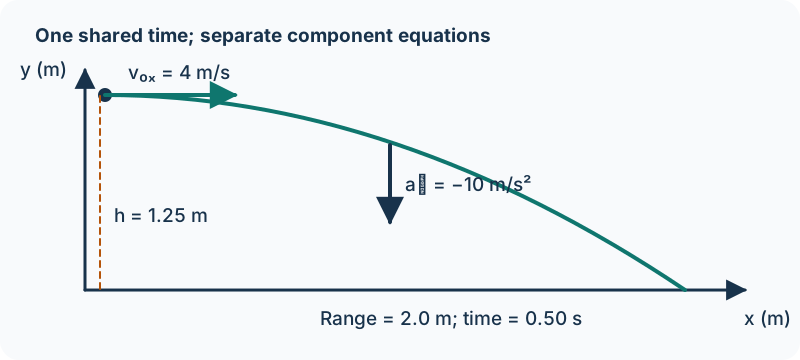
A ball leaves a 1.25 m high table horizontally at 4.0 m/s. Its initial vertical velocity is zero, and the floor is Δy = −1.25 m. Using g = 10 m/s² gives −1.25 = −5t², so t = 0.50 s. The negative root has no meaning for the interval after release. Horizontal range is 4.0(0.50) = 2.0 m.
Just before landing, vₓ = +4.0 m/s and vᵧ = −5.0 m/s. The speed is √(4² + 5²) = 6.40 m/s, directed about 51° below horizontal. Notice that 4 + 5 = 9 m/s would add perpendicular magnitudes incorrectly.
If we double the table height while keeping launch speed fixed, fall time grows by √2, and range also grows by √2. If instead we double horizontal launch speed at the same height, fall time stays fixed and range doubles. State what you hold constant before using a scaling argument.
A toss with an upward component
For launch and landing at the same height, the vertical displacement equation gives t_flight = 2v₀ sin θ/g, excluding the t = 0 launch event. Substituting into horizontal displacement gives R = v₀² sin(2θ)/g. This range formula assumes equal launch and landing heights, level geometry, constant g, and negligible air resistance. When the landing height differs, use the component equations instead.
At the highest point, the vertical velocity is zero. Horizontal velocity generally isn’t, so the whole velocity vector need not be zero. Acceleration remains downward. The velocity is tangent to the trajectory; acceleration points down rather than along that trajectory.
Predict, measure, compare
Use a low-speed ball launcher or ramp on a low table. Measure height and horizontal launch speed independently, predict range, then mark a broad landing zone before release. Keep the launch direction horizontal and measure height to the ball’s center. Repeat trials, report spread, and compare the mean range with your prediction. A systematic shortfall may indicate drag, a launch speed error, or a nonhorizontal exit; naming a plausible mechanism is better than just saying “human error.”
A basketball target at a different height
Treat the ball as a point projectile after release, with negligible air resistance and constant gravitational acceleration. Use one consistent coordinate system: changing the origin requires changing both release and target coordinates. The release and rim heights differ, so the equal-height range shortcut does not apply.
Notation and model qualifications in the retained source
- The printed y_y means the vertical coordinate y. Original wording →
- Keep the split equation cross-reference with textShape-460-p0 and link to the native component equations. Original wording →
Review the model and equations used here →
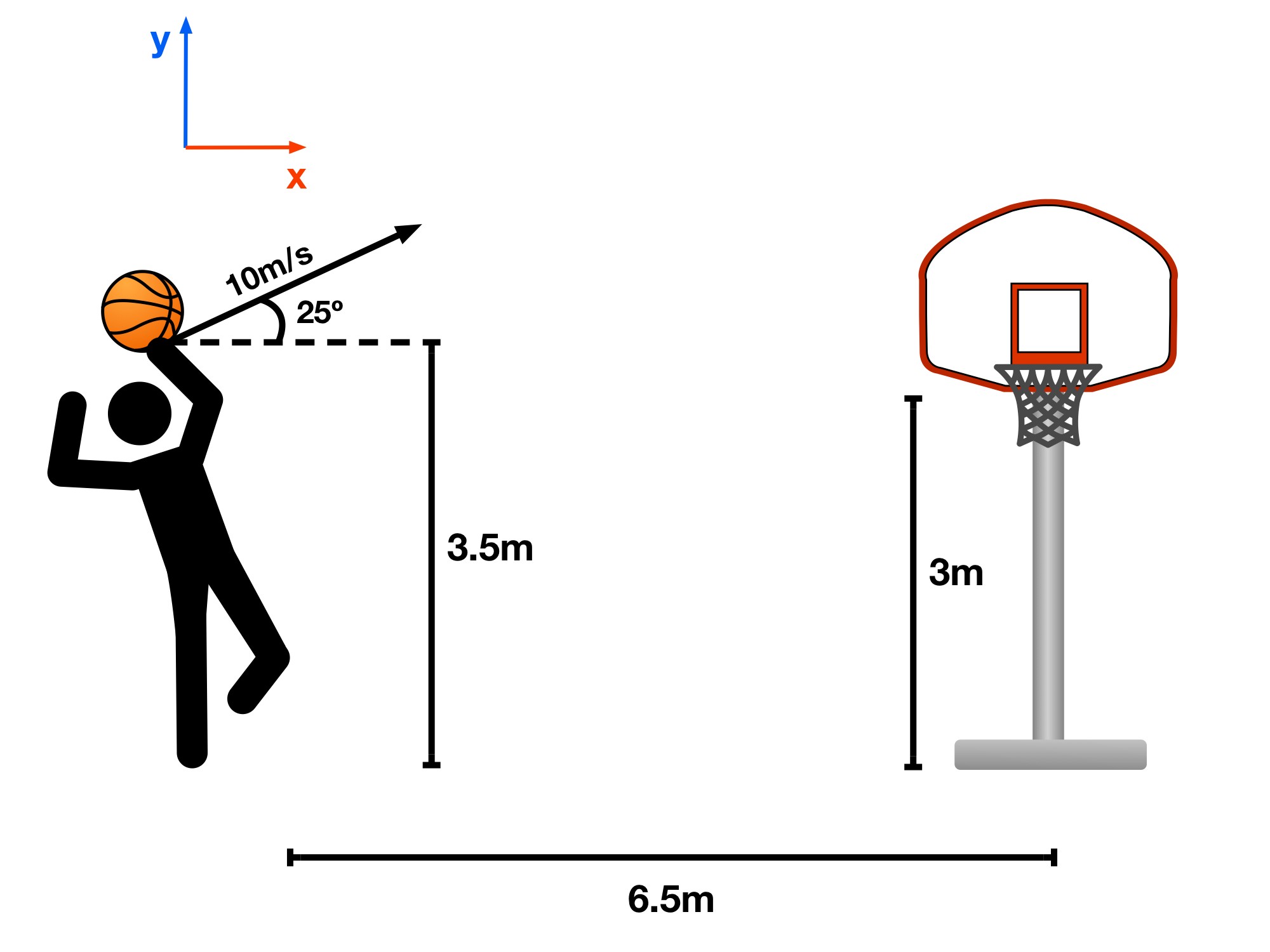
A basketball player attempts to sink a 3-pointer, and his shot has a height of , an angle of , and , and he is away from the net. If the basket is high, will his shot make it into the basket? If not, how far away is the shot?
Example Problem 3.2.4
Step 1: Figure out the knowns and unknowns
The rim is at x = 6.5 m and y = 3.0 m relative to a release point at (0, 3.5) m. We can evaluate the trajectory height at x = 6.5 m, or find the horizontal coordinate where the descending ball reaches y = 3.0 m.
What we do have is an initial point for , which we can say is . You could also say that the shot starts at , it’s up to you. We also can use time as a second unknown.
Step 2: Set up the system of equations.
For this problem, we use the same equation as
in Example Problem 3.2.3.
for the -direction
for the -direction
The system we get is:
x = (10 cos 25°)t = (9.06308 m/s)t.
y = 3.5 m + (10 sin 25°)t − ½(9.81 m/s²)t² = 3.5 m + (4.22618 m/s)t − (4.905 m/s²)t².
At the rim’s height, 0 = 0.5 + x tan 25° − [9.81/(2·10² cos²25°)]x², with x in metres.
Solving this equation gives us:
The descending ball reaches y = 3.0 m at x ≈ 8.764 m, so it overshoots that rim-height crossing by 2.264 m. At the actual rim location x = 6.5 m, its center is approximately 4.008 m high, 1.008 m above the rim. Under the point-projectile model, the shot misses.
Physics I by Jake Yap and Laurence Vincent. Complete historical context and correction history →
Check what you know
Pause & try it
Let's see what stuck.
Choose an answer, then check the reasoning. Try the written problems below before opening their solutions.
0 of 3 checked · 0 correct
Give it a try
Practice 1
Resolve a 10 m/s launch at 37° using sin 37° ≈ 0.60 and cos 37° ≈ 0.80. Find the speed at the peak and the time to reach it using g = 10 m/s².
Practice 2
Draw x–time, y–time, vₓ–time, and vᵧ–time graphs for a horizontal launch. Describe one feature that connects each position graph to its velocity graph.
Practice 3
Derive how horizontal range depends on table height h for fixed horizontal launch speed u. Which axes would linearize experimental range data?
Keep exploring
The original Projectile Motion keeps its longer galleries and quizzes. Use the shared-time component approach here to check their assumptions.
Course scope and standards: the supplied AP Physics 1 CED, printed pages 33, 34; Topic 1.5 and its exact learning objectives. The official College Board CED is the public source; the project audit records the supplied edition.
Supporting physics references: OpenStax: analytical vector components; OpenStax: projectile motion. These lessons, diagrams, examples, and practice questions were written for this book.
Glossary and deeper reading · 6 refreshers
These editorial refreshers supplement the reading. Definitions and examples are added guidance; original source wording and recorded answers remain in their original context.
-
Drag
Drag is a force from a fluid that opposes an object’s motion relative to that fluid. Its dependence on speed, shape, and fluid properties varies with the physical regime. For example, a parachute increases air drag by presenting a large area to the moving air.
-
Vector component
A vector component describes the part of a vector along a chosen axis. Its signed value changes when the axes change, even though the physical vector remains the same. For example, a diagonal launch velocity can be resolved into horizontal and vertical components that share the same elapsed time.
-
Velocity
Velocity describes how position changes with time and includes direction. Instantaneous velocity describes one moment, while average velocity is displacement divided by elapsed time. For example, a car turning a corner can change velocity while maintaining the same speed.
-
Resultant vector
A resultant vector is the vector sum of two or more vectors. Its components are the sums of the corresponding components of the vectors being combined. For example, two equal forces in opposite directions have a zero resultant even though both forces are present.
-
Gravity
Gravity is the attractive interaction between masses in the Newtonian model. For spherical bodies or point-mass approximations, its strength decreases with the square of the separation between their centers. For example, Earth’s gravity provides the inward force that keeps a satellite in orbit.
-
Acceleration
Acceleration is the vector rate of change of velocity with time. It can change an object’s speed, direction, or both, and it is measured in meters per second squared. For example, a satellite moving at constant speed in a circular orbit accelerates toward the center.