Work
Calculate work from force direction and signed force-displacement area.
“That felt like work” isn’t quite the physics definition
Holding a heavy backpack makes your arms tired, but if its position doesn’t change, the force from your hands does zero mechanical work on the backpack. Lift it and that changes. In physics, work describes energy transferred by a force through displacement of the point where the force acts.
For a constant force during a straight displacement, W = Fd cos θ = F_parallel d. F and d are magnitudes, and θ is their angle. Work is a scalar measured in joules, with 1 J = 1 N·m. It can be positive, negative, or zero. A force component along displacement transfers energy in; an opposite component transfers energy out. A perpendicular force does zero work on a particle even when it changes the direction of motion.
Example 3.2.1 — Pulling a crate
A rope pulls a 2 kg crate with constant 10 N force at 60° above horizontal. The crate moves 3 m horizontally. Rope work is 10(3) cos 60° = 15 J. If kinetic friction is 2 N opposing motion, its work is −6 J. Normal force and gravity do zero work during this horizontal displacement.
Net work is 15 − 6 = 9 J. For the translating crate modeled as an object, the work-energy theorem gives W_net = ΔK = ½mv_f² − ½mv_i². If it starts at rest, 9 = ½(2)v_f², so v_f = 3 m/s.
A constant force perpendicular to velocity can bend the path without changing speed. That’s why the inward force in uniform circular motion does zero work on the moving particle: at each instant, the inward force is perpendicular to the small tangential displacement.
Area turns a changing force into work
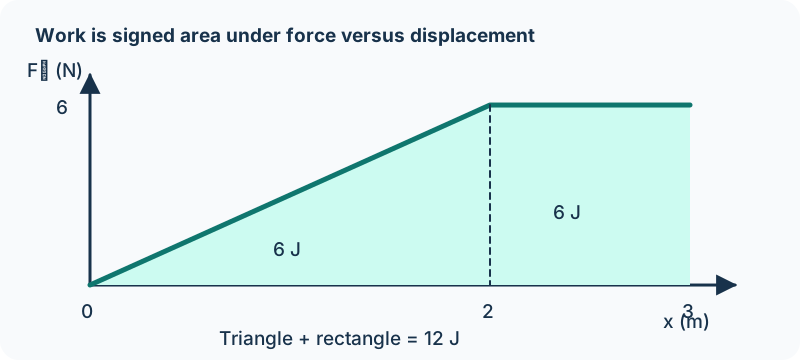
If the parallel force changes with position, work equals signed area under an F_parallel-versus-displacement graph. A constant force gives a rectangle. A force rising linearly from 0 to 8 N over 2 m gives a triangle with area ½(2)(8) = 8 J. A force below the axis gives negative work.
You don’t need calculus to find areas of the simple pieces used here. Be careful with the axes: force versus time gives impulse, introduced in Unit 4, not work. Units make the distinction visible: N·m versus N·s.
Conservative and nonconservative interactions
A conservative force does work that depends only on initial and final configuration, not on the path. Gravity and ideal spring forces are examples. The work by such a force around a closed path is zero, and we can associate a potential energy with the interaction: W_conservative = −ΔU.
Kinetic friction and air resistance are nonconservative. Their effects depend on the actual path and motion. For constant sliding-friction magnitude, mechanical energy dissipated is typically f_k times path length, even when net displacement is zero. A box dragged out and back loses mechanical energy on both legs. The energy appears as thermal energy, sound, or other internal changes rather than vanishing.
AP Physics 1 focuses on mechanical energy transfers while acknowledging these dissipated forms. Quantitative heating and cooling belong to AP Physics 2 and enrichment.
Match the model to the system
For a single object whose structure is ignored, the net-work theorem relates all external force work to translational kinetic-energy change. For an extended system that can deform, the point where an external force acts may move differently from its center of mass. Work can then change internal configuration as well as overall motion; don’t use center-of-mass displacement as a substitute for point-of-application displacement without checking the object model.
For example, stretching a spring slowly can transfer energy into elastic potential energy while the system’s center of mass barely moves. In a rigid nonrotating translation, all points move with the center of mass, so that mismatch disappears. Rotation gets its own work model in Unit 6.
Measure work independently
Pull a low-friction cart with a force sensor and record force against position. Estimate signed area over a measured interval, then compare it with ½m(v_f² − v_i²) from speed measurements at the interval endpoints. State the system and include residual friction work if needed. Calibrate the sensor and use several points or a best-fit force trend. An experiment comparing two independent measurements tests the theorem more meaningfully than computing both sides from the same assumed acceleration.
Worked example — A return trip does not erase every work
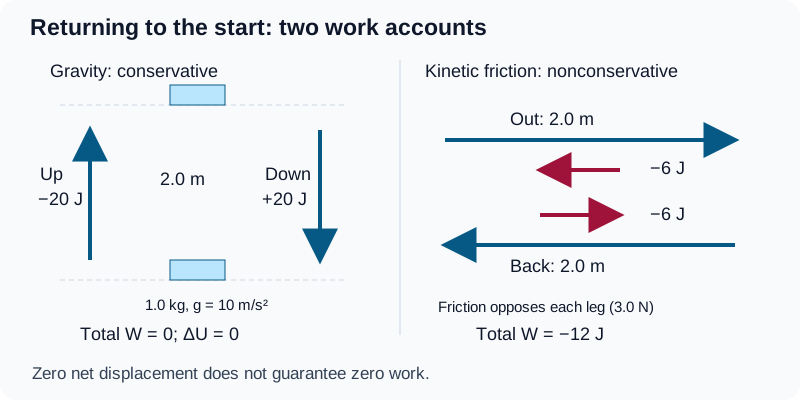
A 1.0 kg package is lifted 2.0 m and returned to its starting height, with g = 10 m/s². Gravity does −20 J on the upward leg and +20 J on the downward leg. The net gravitational work is zero because the gravitational configuration returns to its initial value; ΔU_g is also zero. That closed-path test is what allows a conservative interaction to have a configuration potential energy.
Now drag the package 2.0 m out and 2.0 m back on a level floor with 3.0 N kinetic friction. Friction opposes each leg and does −6.0 J on each, totaling −12 J despite zero net displacement. Air resistance also opposes relative motion and is nonconservative: an out-and-back flight through still air can return to the same position while air resistance removes mechanical energy. Neither friction nor air resistance has a path-independent potential energy; potential energies are associated with conservative forces.
Work is a scalar: −12 J describes energy transferred out, not a leftward work vector. A 3.0 N force along a 2.0 m displacement does +6.0 J; the same force opposing it does −6.0 J; a perpendicular force does zero work on a particle. The positive, negative, and zero values are scalar energy amounts. In uniform circular motion a perpendicular inward force changes velocity direction while speed and K = ½mv² stay constant; zero work does not mean zero acceleration.
Inspect diagram labels
The diagram keeps its full size here. Focus the view and use the arrow keys, or scroll across it, to inspect every label.
Worked example — Track the place where the force acts
A constant 8.0 N horizontal force pulls the free end of a deformable apparatus 0.50 m to the right while its center of mass moves only 0.20 m right. The force transfers W = (8.0 N)(0.50 m) = 4.0 J through the application point. If this is the only net external horizontal force, F_netΔx_cm = 1.6 J gives the change in center-of-mass translational kinetic energy. The remaining 2.4 J changes internal energy, such as elastic configuration energy or motion relative to the center. Force times center-of-mass displacement and force work are different quantities here.
External force can change configuration. Consequently, application-point work does not generally equal only ΔK for a deformable system: the full energy account must include configuration and other internal changes. The source’s unqualified application-point ΔK statement needs this model limit; replacing 4.0 J by 1.6 J would instead use the wrong displacement for the energy transfer.
For comparison, a nonrotating 2.0 kg cart treated as structureless moves 0.50 m under the same net force on a frictionless horizontal track. Its application point and center of mass both move 0.50 m, and no modeled internal energy changes. Thus ΔK = 4.0 J; from rest its final speed is 2.0 m/s. Matching displacements supports this object model only together with those assumptions. Equal distances alone do not rule out deformation, heating, or internal energy conversion in a real extended system.
Check what you know
Pause & try it
Let's see what stuck.
Choose an answer, then check the reasoning. Try the written problems below before opening their solutions.
0 of 3 checked · 0 correct
Give it a try
Practice 1
A 5 N horizontal force acts over 4 m while a 1 N opposing force acts throughout. For a 2 kg object starting at rest, find each work, net work, and final speed.
Practice 2
A force graph rises linearly from 0 to 6 N over 2 m, then stays at 6 N for another 1 m. Find total work and explain your area decomposition.
Practice 3
Compare gravitational work on a book lifted to height h by two different paths. Then compare friction work for two rough paths of different lengths that share endpoints.
Keep exploring
The original Work and Introduction to Energy retain their examples and quizzes. The displacement-of-application and graph distinctions here provide the added AP checks.
Course scope and standards: the supplied AP Physics 1 CED, printed pages 66, 67, 68; Topic 3.2 and its exact learning objectives. The official College Board CED is the public source; the project audit records the supplied edition.
Supporting physics references: OpenStax: the scientific definition of work; OpenStax: work-energy theorem; OpenStax: nonconservative forces. These lessons, diagrams, examples, and practice questions were written for this book.
Explain and apply the model
Try these problems before opening the solutions. State your assumptions, show the diagram or calculation, and explain what makes your answer follow.
Follow a return path
Use g = 10 m/s². A 1.5 kg package is lifted 2.0 m and returned to its initial height. Separately, the package is dragged 3.0 m out and 3.0 m back on a level floor with constant kinetic-friction magnitude 4.0 N. In a third trial an object flies out and back through still air with air resistance throughout. Ignore rotation in these trials.
(a) Calculate gravity work on each leg and over the entire lift-and-return trip. State the change in gravitational potential energy of the package–Earth system after it returns to its initial configuration, and explain the closed-path conservative test.
(b) Calculate friction work on each floor leg and in total. Compare the closed-path effects of kinetic friction and air resistance with gravity, and explain why a configuration potential energy may be assigned to gravity but cannot be assigned to friction or air resistance.
(c) A 5.0 N force separately acts over a 2.0 m straight displacement parallel to it, opposite to it, and perpendicular to it. Calculate the three works and state whether these are scalars or vectors; explain what a negative work value tells you.
Your written working
Drawing is temporarily unavailable. Work on paper if needed, then record your reasoning here.
Saving written working requires JavaScript. The problem remains available above; keep your work on paper or in your own notes.
Choose the correct displacement
A constant 10 N horizontal external force pulls an application point on a deformable apparatus 0.60 m right while the center of mass moves 0.20 m right. All other external forces do zero work and give no net horizontal force. In a comparison trial, the same net force moves a structureless, nonrotating 3.0 kg cart 0.60 m on a frictionless level track; it starts from rest.
(a) Calculate the energy transferred through the deformable apparatus’s application point and its change in center-of-mass translational kinetic energy. Quantify the difference and identify possible internal energy changes that can receive it. Explain why using center-of-mass displacement for the force work fails.
(b) Evaluate this claim for the deformable apparatus: “Application-point work must equal only the system’s kinetic-energy change, even when the external force changes configuration.” Give the scientifically valid energy account and name the condition the claim omits.
(c) For the cart trial, first test whether the force application point and center of mass share the same displacement. State the additional object-model assumptions that let net work change only modeled kinetic energy, and then find the final speed. Explain why equal displacement alone would not settle the deformable case.
Your written working
Drawing is temporarily unavailable. Work on paper if needed, then record your reasoning here.
Saving written working requires JavaScript. The problem remains available above; keep your work on paper or in your own notes.
Zero work can still turn motion
A structureless 0.50 kg puck travels at 4.0 m/s around a frictionless horizontal circle. Its only unbalanced force is always inward and perpendicular to its instantaneous motion.
(a) Which statement correctly explains the work, velocity direction and kinetic energy during the circular motion?
Related source reading
These alternative explanations and examples retain their source context. Draft placement does not add accepted exam coverage.
- Variable-force work · source context; placement review pending
Glossary and deeper reading · 20 refreshers
These editorial refreshers supplement the reading. Definitions and examples are added guidance; original source wording and recorded answers remain in their original context.
-
Displacement
Displacement is the vector change in position from the start of an interval to its end. It depends on those endpoints rather than the length or shape of the path traveled. For example, walking around a closed track and returning to the start gives zero displacement but a nonzero distance traveled.
-
Magnitude
Magnitude is the nonnegative size of a vector quantity. It does not specify direction, and it differs from a signed component. For example, a westward velocity can have a negative x component while its speed, the velocity magnitude, stays positive.
-
Scalar
A scalar is a quantity described by a value and unit without a spatial direction. A scalar can have a sign when its definition or reference permits one; scalar does not mean always positive. For example, mass is a scalar, whereas the velocity of that mass also needs a direction.
-
Impulse
Impulse is the change in linear momentum produced by a force over a time interval. It equals the signed vector area under a force-versus-time graph and is measured in newton-seconds. For example, a padded landing spreads the stopping impulse over more time, reducing the average force for the same momentum change.
-
Conservative force
A conservative force does work that depends only on the starting and ending configurations. A potential-energy function can describe it, and its work around a closed path is zero. For example, near-Earth gravity does the same work between two heights whether a ball follows a vertical or a curved path.
-
Gravity
Gravity is the attractive interaction between masses in the Newtonian model. For spherical bodies or point-mass approximations, its strength decreases with the square of the separation between their centers. For example, Earth’s gravity provides the inward force that keeps a satellite in orbit.
-
Kinetic friction
Kinetic friction acts between surfaces that slide relative to one another. It opposes their relative slipping and is often modeled with magnitude equal to the kinetic-friction coefficient times the normal force. For example, a rapidly moving belt can exert forward kinetic friction on a slower box sliding on it.
-
Drag
Drag is a force from a fluid that opposes an object’s motion relative to that fluid. Its dependence on speed, shape, and fluid properties varies with the physical regime. For example, a parachute increases air drag by presenting a large area to the moving air.
-
Mechanical energy
Mechanical energy is the sum of the kinetic and potential energies included in a model. It stays constant when transfers to or from other energy stores and across the chosen boundary are absent. For example, a pendulum’s mechanical energy can remain approximately constant while energy shifts between motion and gravitational configuration.
-
External force
An external force is exerted on part of a chosen system by something outside that system. The sum of external forces determines the rate of change of the system’s total momentum. For example, Earth’s gravitational force is external to a system consisting only of a falling ball.
-
Center of mass
The center of mass is the position obtained by weighting each part’s position by its mass. Its motion represents the translational motion of the whole system under the net external force. For example, adding a heavy object to one end of a light bar shifts the center of mass toward that end.
-
Spring potential energy
Spring potential energy is energy stored in an ideal spring’s deformation from its relaxed length. It is proportional to the square of deformation, so equal extension and compression magnitudes store equal energy. For example, compressing a spring before releasing a toy transfers energy that can later become kinetic energy.
-
Force
A force describes an interaction that can change an object’s momentum. It is a vector measured in newtons, so both size and direction matter when forces are added. For example, a rope can pull a cart while the floor exerts friction in another direction.
-
Acceleration
Acceleration is the vector rate of change of velocity with time. It can change an object’s speed, direction, or both, and it is measured in meters per second squared. For example, a satellite moving at constant speed in a circular orbit accelerates toward the center.
-
Gravitational potential energy
Gravitational potential energy is energy associated with the relative positions of attracting masses. Near Earth, changes can be approximated by mass times gravitational field strength times height change when that field is nearly constant. For example, lifting a book increases the gravitational potential energy of the book–Earth system.
-
Potential energy
Potential energy describes energy associated with the configuration of interacting parts of a system. Its numerical zero is a chosen reference, while differences in potential energy determine physical energy changes. For example, separating Earth and a ball changes their gravitational potential energy even though the energy belongs to their interaction.
-
Vector
A vector is a quantity with a magnitude and a direction, represented by an arrow or by components along chosen axes. Vectors add by adding corresponding components rather than simply adding their magnitudes. For example, an eastward displacement followed by a northward displacement produces a resultant pointing northeast. The zero vector has zero magnitude and no unique direction.
-
Net force
Net force is the vector sum of all forces acting on the object or system under consideration. For constant mass in an inertial frame, it equals mass times acceleration. For example, equal upward and downward forces give zero net force even though neither force is zero.
-
Kinetic energy
Kinetic energy is energy associated with motion relative to a chosen reference frame. For a nonrelativistic translating object it is one half of its mass times speed squared. For example, doubling a cart’s speed quadruples its translational kinetic energy when its mass stays fixed.
-
Velocity
Velocity describes how position changes with time and includes direction. Instantaneous velocity describes one moment, while average velocity is displacement divided by elapsed time. For example, a car turning a corner can change velocity while maintaining the same speed.