Translational Kinetic Energy
Compare translational kinetic energy while keeping mass, speed, and reference frame clear.
Faster costs more than you might think
A skateboard rolling gently is easy to stop. The same board moving twice as fast needs much more energy removed before it stops. Translational kinetic energy is the energy associated with an object’s overall motion: K = ½mv².
Mass m is in kilograms, speed v is in meters per second, and K is in joules. One joule is one kg·m²/s². The square is doing a lot of work here. At fixed mass, doubling speed quadruples kinetic energy; tripling speed multiplies it by nine. At fixed speed, doubling mass only doubles kinetic energy.
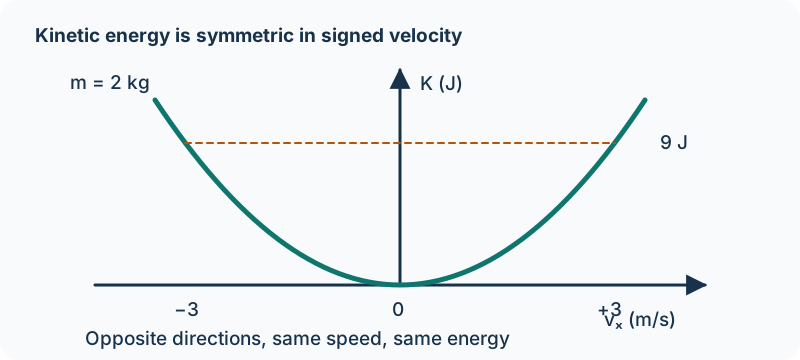
Kinetic energy is a scalar. It has no direction and is nonnegative in this model. A 2 kg cart moving at +3 m/s and the same cart moving at −3 m/s each have K = ½(2)(3²) = 9 J. Direction still matters for other quantities, but opposite velocity signs don’t produce opposite energies.
Example 3.1.1 — Two carts, equal energy?
Cart A has mass 1 kg and speed 4 m/s, so its kinetic energy is ½(1)(4²) = 8 J. Cart B has mass 4 kg and speed 2 m/s, so its kinetic energy is ½(4)(2²) = 8 J as well. Equal energy doesn’t require equal speed or equal mass.
For equal kinetic energies, m_Av_A² = m_Bv_B². Rearranging gives v_B/v_A = √(m_A/m_B). Making a cart four times as massive requires half the speed to keep its kinetic energy unchanged. This is a square-root relationship, not a direct inverse relationship.
If you know K and mass and want speed, solve v = √(2K/m). The square root gives the speed magnitude. It doesn’t tell you whether the object moves left or right. That information has to come from the motion description or a separate vector analysis.
The graph isn’t a straight line in speed
A K-versus-speed graph is an upward-curving parabola through the origin. A K-versus-signed-velocity graph is symmetric about zero: leftward and rightward speeds of the same magnitude give equal energy. If instead you plot K versus v², the graph is a straight line through the origin with slope m/2. Label the horizontal axis in m²/s²; the slope then has kilograms as its unit.
For two masses, the heavier object’s K-versus-v² line is steeper. A graph can communicate that comparison without plugging in a particular speed. In a written explanation, connect the graph shape to the squared velocity dependence rather than just describing the curve as “going up.”
Motion energy depends on the observer
A traveler sitting on a train is at rest relative to the train and has zero translational kinetic energy in that frame. Relative to the ground, the traveler moves with the train and has nonzero K. This doesn’t violate energy conservation; a full energy analysis must use one frame consistently.
For a 2 kg cart moving +5 m/s relative to the ground, K_ground = 25 J. An observer moving +2 m/s sees velocity +3 m/s and K_observer = 9 J. You can’t subtract the observer’s own kinetic energy from 25 J to get that result. Transform the velocity first, then square it.
This section concerns translational kinetic energy. Spinning wheels can also have rotational kinetic energy, developed in Unit 6. If a problem asks for the total energy of a rolling cart, the object model may need to be expanded. A kinetic-energy number alone doesn’t settle which energy forms exist in the system.
A measurement that tests the square
Record a low-friction cart passing a motion sensor at several speeds. Infer the energy removed while stopping it against a calibrated spring from that spring’s deformation, after learning the energy model in Topic 3.3. Plot the measured stopping energy versus v² at fixed cart mass. Compare the slope with m/2 and discuss energy going into wheel rotation, friction, or sound. Keep the same stopping apparatus and measure speed immediately before contact. This uses an independent energy measurement; calculating K from v and then plotting it would only redraw the equation you already assumed.
Check what you know
Pause & try it
Let's see what stuck.
Choose an answer, then check the reasoning. Try the written problems below before opening their solutions.
0 of 3 checked · 0 correct
Give it a try
Practice 1
A 3 kg cart moves at 4 m/s. Find K. What speed would a 12 kg cart need to have the same kinetic energy?
Practice 2
Sketch K versus signed velocity for one mass, marking velocities −2, 0, and +2 m/s. Explain the symmetry and why K isn’t a vector.
Practice 3
A 1 kg cart moves +6 m/s relative to ground. Find its kinetic energy measured from a frame moving +4 m/s, and explain why subtracting ½(1)(4²) from its ground energy would fail.
Keep exploring
The original Kinetic Energy keeps its explanations and quizzes. The frame comparison here adds traceability to the updated course objective.
Course scope and standards: the supplied AP Physics 1 CED, printed pages 65; Topic 3.1 and its exact learning objectives. The official College Board CED is the public source; the project audit records the supplied edition.
Supporting physics references: OpenStax: kinetic energy and the work-energy theorem. These lessons, diagrams, examples, and practice questions were written for this book.
Glossary and deeper reading · 5 refreshers
These editorial refreshers supplement the reading. Definitions and examples are added guidance; original source wording and recorded answers remain in their original context.
-
Scalar
A scalar is a quantity described by a value and unit without a spatial direction. A scalar can have a sign when its definition or reference permits one; scalar does not mean always positive. For example, mass is a scalar, whereas the velocity of that mass also needs a direction.
-
Velocity
Velocity describes how position changes with time and includes direction. Instantaneous velocity describes one moment, while average velocity is displacement divided by elapsed time. For example, a car turning a corner can change velocity while maintaining the same speed.
-
Magnitude
Magnitude is the nonnegative size of a vector quantity. It does not specify direction, and it differs from a signed component. For example, a westward velocity can have a negative x component while its speed, the velocity magnitude, stays positive.
-
Conservation of energy
Conservation of energy means total energy is unchanged when the full isolated system is considered. Energy can transfer between objects or change form, so one selected energy store need not remain constant. For example, friction can reduce a sliding block’s kinetic energy while increasing the thermal energy of the block and floor.
-
Rotational kinetic energy
Rotational kinetic energy is the kinetic energy associated with rotation about an axis. For a rigid body about a fixed axis it is one half of rotational inertia times angular speed squared. For example, a rolling wheel can possess both translational kinetic energy of its center of mass and rotational kinetic energy about that center.