Motion of Orbiting Satellites
Return later to compare satellite energy and angular momentum in circular and elliptical orbits.
Before this connection: Potential energy and energy conservation; Angular momentum and angular impulse; Conservation of angular momentum.
An orbit is a conservation problem too
A satellite keeps falling toward its planet while moving sideways fast enough to miss the surface. Gravity provides the inward acceleration; there is no extra outward “orbital force” balancing gravity in the usual inertial frame. Here we use a central object of mass M and a much smaller satellite of mass m. With m negligible compared with M, the central object’s motion is negligible in our model. In a full two-body model both objects move around their common center of mass.
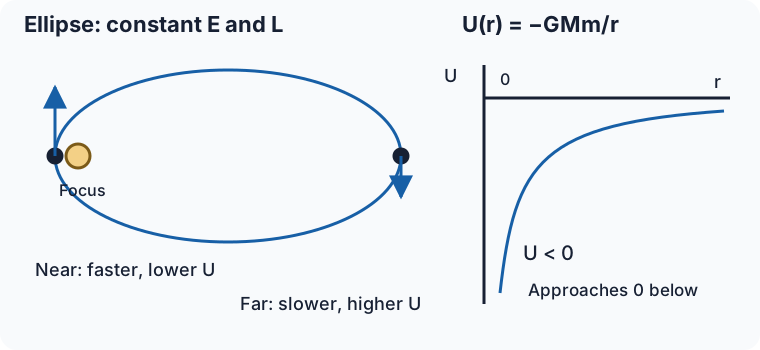
The gravitational potential energy of the satellite–central-object system is U = −GMm/r, with zero defined at infinite separation. Here r is center-to-center distance, not height above the surface. U is negative at finite separation: energy must be supplied to separate the bodies all the way to infinity. Near a planet’s surface, mgΔh is a useful small-height approximation for the change in U; it is not the general orbital expression.
Circular motion gives a useful benchmark
For a circular orbit, gravity supplies the inward net force: GMm/r² = mv²/r. Cancel m and one factor of r to get v_circular = √(GM/r). The speed is constant because the force is perpendicular to velocity. The radius is also constant, so U, K, total mechanical energy, and angular momentum are all constant.
Substitute the circular speed into K = ½mv² to get K = GMm/(2r). Then E = K + U = −GMm/(2r). A bound circular orbit has negative total energy. The angular momentum magnitude is L = mvr because the radius and velocity are perpendicular.
Worked example: comparison: Move from circular radius r to a different circular orbit at radius 4r. The new circular speed is half as large, K is one quarter as large, and U is one quarter as large in magnitude, becoming less negative. Total E also becomes one quarter as negative. Angular momentum doubles because L_new = m(4r)(v/2) = 2mrv. Getting to the new orbit requires an interaction that transfers energy and angular momentum; these are comparisons of two different circular orbits, not claims that one unpowered satellite can spontaneously change them.
In an ellipse, the ledger stays constant while the entries change
When gravity is the only interaction, total mechanical energy stays constant. As the satellite moves inward, U decreases and K increases, so it speeds up. Moving outward, it slows down. Gravitational force is radial, so its lever arm about the central object is zero. Its torque about that point is zero, and angular momentum stays constant too.
Use L = mrv sinθ, not automatically mrv, because the velocity is not generally perpendicular to the radius in an ellipse. At the nearest and farthest points, the velocity is perpendicular, so r_near v_near = r_far v_far. If the farthest radius is three times the nearest radius, the near-point speed is three times the far-point speed. The center is at a focus of the ellipse, not generally at its geometric center.
A sketch of K versus time rises during inward travel and falls during outward travel. U does the opposite, while E is horizontal. A sketch of L versus time is horizontal throughout. These representation differences help separate a varying speed from a changing conservation total.
How much speed is enough to escape?
The threshold escape case reaches infinite separation with speed tending to zero. At infinity U = 0 and K tends to 0, so its total mechanical energy is E = 0. At starting radius r, set ½mv_escape² − GMm/r = 0. Therefore v_escape = √(2GM/r) = √2 v_circular at the same radius.
A speed larger than this has positive energy and a nonzero speed even very far from the planet in the ideal gravity-only model. A speed below it has negative energy and cannot escape to infinity without further energy transfer. “Escape speed” is more precise than a velocity because the formula supplies a magnitude. A trajectory aimed into the planet can collide even if the speed meets the energy threshold, so assume a collision-free outward trajectory and neglect atmosphere or other bodies.
Instructional example (guided activity):
Representation task: Sketch U against r, label its negative values and zero-at-infinity limit, then put two points on it. Explain which point has the lower U. For an ellipse, build paired energy bars at the nearest and farthest points with the same total. Label the force direction and explain the zero torque about the central object using its line of action.
Worked example — Circular constants and an escape limit
For two isolated gravitating bodies, both orbit their common center of mass. Their distances from it obey Mr_M = mr_m, so r_M/r_m = m/M. If m/M = 10⁻⁸ and the center separation is about 1.0 × 10⁷ m, the central body’s orbital radius is about 0.10 m. Its motion is negligible compared with the satellite’s radius in this approximation. If the masses were comparable, holding the central body fixed would fail.
For a 100 kg satellite in a gravity-only circular orbit with GM = 4.0 × 10¹⁴ m³/s² and r = 1.0 × 10⁷ m, v² = GM/r = 4.0 × 10⁷ m²/s². Hence v ≈ 6.32 × 10³ m/s, K = 2.0 × 10⁹ J, U = −4.0 × 10⁹ J, E = −2.0 × 10⁹ J, and L = mrv ≈ 6.32 × 10¹² kg·m²/s. All four quantities K, U, E, and L are constant along this one circular orbit: r and speed stay fixed, gravity is conservative, and its radial force exerts zero torque about the central body.
To derive the escape threshold, choose U = 0 at infinity and a collision-free outward trajectory with gravity as the only force. At threshold, r tends to infinity while speed tends to zero, so the conserved total mechanical energy is E = 0. At starting radius r₀, ½mv_esc² − GMm/r₀ = 0 gives v_esc² = 2GM/r₀ and v_esc = √(2GM/r₀). For the same model world, v_esc ≈ 8.94 × 10³ m/s. This is a speed magnitude; the outward trajectory assumption is also necessary.
Along the threshold trajectory, ½mv² = GMm/r, so v = √(2GM/r). At 4r₀ the speed is half its launch value, about 4.47 × 10³ m/s, rather than zero. At every finite r, the model speed is positive; zero is approached only as an infinite-distance limit, not at a finite stopping location. A launch above threshold has E > 0 and a nonzero limiting speed, while one below threshold cannot reach infinity without extra energy.
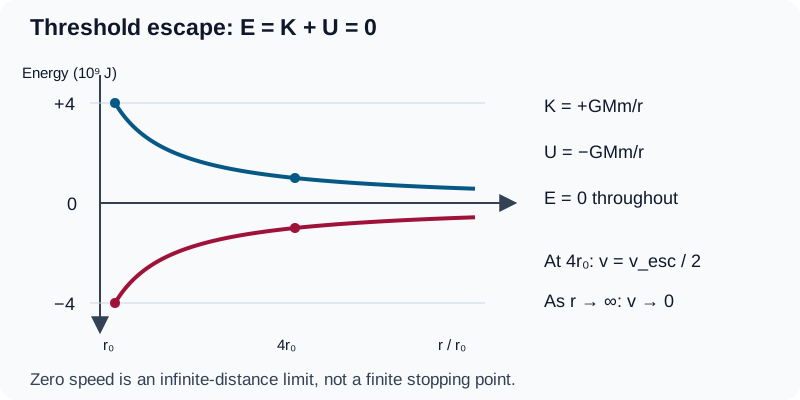
Inspect diagram labels
The diagram keeps its full size here. Focus the view and use the arrow keys, or scroll across it, to inspect every label.
Keep r, U, and E distinct
Pause & try it
Let's see what stuck.
Choose an answer, then check the reasoning. Try the written problems below before opening their solutions.
0 of 3 checked · 0 correct
Assigned practice: a model world
For a model planet, GM = 3.20 × 10¹⁴ m³/s². A satellite is at center-to-center distance 8.0 × 10⁶ m. Find its circular speed and the threshold escape speed there.
Open the separate worked solution.
Assigned practice: check an elliptical orbit ledger
A 100 kg satellite has a gravity-only elliptical orbit around a model central object with GM = 1.20 × 10¹⁴ m³/s². At its nearest point, r = 2.0 × 10⁷ m and speed is 3.0 × 10³ m/s; at its farthest point, r = 6.0 × 10⁷ m. Predict the far-point speed and build labeled kinetic/potential energy bars at both points using zero gravitational potential energy at infinity. Decide whether the orbit is bound. Explain why the same satellite can change speed while keeping angular momentum constant.
Open the separate worked solution.
The original Gravity in Depth and Kepler’s Laws keep their orbital examples and quizzes. This section fills the gravitational-energy and escape-speed gap while connecting those readings to angular momentum. Use center-to-center distances in the original equations too.
Sources and scope: College Board CED, with edition-specific coverage verified against the supplied file. Supplied College Board CED, printed pp. 116–117, 6.6.A, includes circular/elliptical conservation and escape energy. OpenStax: Satellite Orbits and Energy verifies the circular and escape equations; NASA: Orbits and Kepler’s Laws supports the focus and changing-speed picture. Our calculations and diagrams are original.
Explain and apply the model
Try these problems before opening the solutions. State your assumptions, show the diagram or calculation, and explain what makes your answer follow.
Justify the satellite approximation and derive escape
A gravity-only, collision-free satellite–central-body model has GM = 3.0 × 10¹⁴ m³/s², G = 6.67 × 10⁻¹¹ N·m²/kg² and center separation r₀ = 6.0 × 10⁶ m. The satellite mass is 200 kg. Use an inertial center-of-mass frame, and U=0 at infinite separation. Treat central-body motion as negligible only after justifying it.
(a) Infer the central mass M from GM and G, then use the two-body center-of-mass condition to estimate the central body’s orbital radius relative to the satellite’s. Explain why neglecting central-body motion is valid here and how that approximation fails for comparable masses.
(b) For a circular orbit at r₀, derive the circular speed from gravitational force balance and calculate K, U, E and angular-momentum magnitude L about the central body. Identify which of these four quantities are constant along that orbit and justify each constancy.
(c) Derive threshold escape speed at r₀ from conservation of energy, beginning with the zero-speed, zero-potential-energy limit at infinity. Show why threshold total energy is zero, solve for v_esc and calculate it. State the force and trajectory assumptions needed.
(d) For a launch exactly at threshold, derive speed at a later radius r from the same E=0 condition. Find it at 4r₀ and explain whether the satellite reaches zero speed at any finite distance or only as an infinite-distance limit. Contrast with a launch above threshold.
Your written working
Drawing is temporarily unavailable. Work on paper if needed, then record your reasoning here.
Saving written working requires JavaScript. The problem remains available above; keep your work on paper or in your own notes.
Related source reading
These alternative explanations and examples retain their source context. Draft placement does not add accepted exam coverage.
- Kepler orbit models · source context; placement review pending
Glossary and deeper reading · 11 refreshers
These editorial refreshers supplement the reading. Definitions and examples are added guidance; original source wording and recorded answers remain in their original context.
-
Gravity
Gravity is the attractive interaction between masses in the Newtonian model. For spherical bodies or point-mass approximations, its strength decreases with the square of the separation between their centers. For example, Earth’s gravity provides the inward force that keeps a satellite in orbit.
-
Acceleration
Acceleration is the vector rate of change of velocity with time. It can change an object’s speed, direction, or both, and it is measured in meters per second squared. For example, a satellite moving at constant speed in a circular orbit accelerates toward the center.
-
Gravitational potential energy
Gravitational potential energy is energy associated with the relative positions of attracting masses. Near Earth, changes can be approximated by mass times gravitational field strength times height change when that field is nearly constant. For example, lifting a book increases the gravitational potential energy of the book–Earth system.
-
Net force
Net force is the vector sum of all forces acting on the object or system under consideration. For constant mass in an inertial frame, it equals mass times acceleration. For example, equal upward and downward forces give zero net force even though neither force is zero.
-
Force
A force describes an interaction that can change an object’s momentum. It is a vector measured in newtons, so both size and direction matter when forces are added. For example, a rope can pull a cart while the floor exerts friction in another direction.
-
Angular momentum
Angular momentum describes motion about a specified point or axis. For rigid rotation about a fixed principal axis it can be written as rotational inertia times angular velocity; a translating particle can also have angular momentum about a point. For example, a ball moving past a pole has angular momentum about the pole even though the ball’s path is straight.
-
Magnitude
Magnitude is the nonnegative size of a vector quantity. It does not specify direction, and it differs from a signed component. For example, a westward velocity can have a negative x component while its speed, the velocity magnitude, stays positive.
-
Escape speed
Escape speed is the minimum launch speed needed to reach indefinitely large separation in a specified gravitational model without further propulsion. Its value depends on the launch position and attracting mass, with air resistance and other bodies omitted in the simplest model. For example, launching from a greater distance from the same spherical planet requires a smaller escape speed.
-
Potential energy
Potential energy describes energy associated with the configuration of interacting parts of a system. Its numerical zero is a chosen reference, while differences in potential energy determine physical energy changes. For example, separating Earth and a ball changes their gravitational potential energy even though the energy belongs to their interaction.
-
Linear momentum
Linear momentum is a vector describing an object’s motion and equals mass times velocity in the nonrelativistic model. The vector sum of momenta is conserved when the net external impulse on the system is zero. For example, two identical carts moving equally fast in opposite directions have zero total linear momentum but nonzero total kinetic energy.
-
Conservation of energy
Conservation of energy means total energy is unchanged when the full isolated system is considered. Energy can transfer between objects or change form, so one selected energy store need not remain constant. For example, friction can reduce a sliding block’s kinetic energy while increasing the thermal energy of the block and floor.