Angular Momentum and Angular Impulse
After rotation tools, compare angular impulse and angular momentum with their linear counterparts.
Before this connection: Torque, angular speed, and rotational inertia.
The rotational momentum ledger
Linear momentum helped us track motion through short interactions. Angular momentum plays a similar role for motion about a specified reference point or axis. For a rigid system rotating about that axis, its angular momentum magnitude is L = I|ω|. In a one-plane calculation we can use signed values with a chosen positive turning sense, much as we used signed linear momentum.
The axis belongs in the statement. The same object can have different angular momentum about different reference points. A point object moving in a straight line can have angular momentum about a point that is not on its line of motion. It does not have to be traveling around a physical axle.
A straight path can have angular momentum
For an object at distance r from a reference point, with momentum magnitude p and angle θ between its position vector and velocity, L = rp sinθ = mvr sinθ. Equivalently, L = mvb, where b is the perpendicular distance from the reference point to the object’s straight line of motion. This is the momentum counterpart of a lever arm.
A 0.20 kg puck moves at 3.0 m/s along a line 0.40 m from a reference point. Its angular momentum magnitude is 0.20(3.0)(0.40) = 0.24 kg·m²/s. As it travels along that line, r and θ change but r sinθ = b stays 0.40 m. Its angular momentum about the point remains constant if no torque acts. About a point on the puck’s path, b = 0 and its angular momentum is zero.
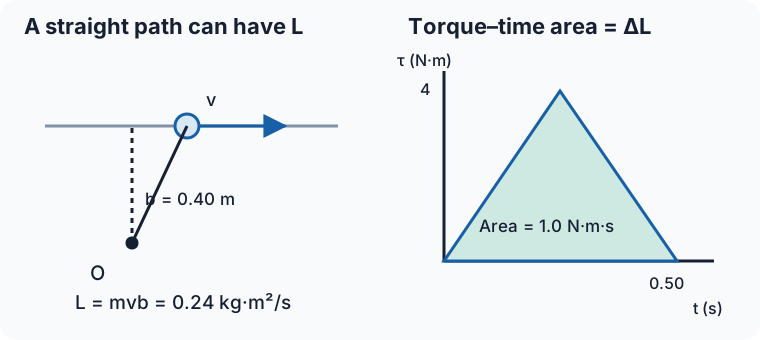
Torque acting over time changes angular momentum
Angular impulse for a constant torque is J_angular = τΔt. For varying torque, use the signed area under its torque–time graph, or an average torque over the interval. For a constant torque over positive Δt, signed angular impulse has the same sign or turning sense as that torque. Its units are N·m·s, equivalent to kg·m²/s. The net external angular impulse equals ΔL = L_f − L_i for the selected system and reference axis.
For constant inertia, ΔL = IΔω. Dividing by Δt gives τ_net,avg = IΔω/Δt = Iα_avg. So the angular impulse theorem agrees with Newton’s second law in rotational form; it simply organizes the interaction by before-and-after angular momentum instead of the acceleration at every instant.
AP Physics 1 uses one-dimensional sign conventions and magnitude reasoning here. Three-dimensional directions of angular momentum and angular impulse, and cross-product direction calculations, are outside the stated scope. Use clockwise and counterclockwise turning senses when helpful without requiring a vector perpendicular to the page.
Worked example: a triangular torque pulse
A wheel has I = 0.10 kg·m² and initial angular velocity +2.0 rad/s. A net torque pulse is triangular, above zero, lasting 0.50 s with peak 4.0 N·m. Its angular impulse is ½(0.50)(4.0) = +1.0 N·m·s. Initial angular momentum is Iω_i = +0.20 kg·m²/s. Final angular momentum is +1.20 kg·m²/s, so ω_f = 1.20/0.10 = +12 rad/s.
The average torque is 1.0/0.50 = 2.0 N·m. It is half the peak for this triangular shape. Replacing the pulse with its 4.0 N·m peak for the whole interval would double the predicted angular impulse.
Read the companion graph
The slope of an L–t graph is net external torque. A horizontal line at nonzero L means zero net torque, not zero rotation. An increasing slope means increasing torque in the chosen positive sense. The torque pulse peaks when the L–t graph is steepest; L itself reaches its final value only after the full area accumulates.
A net torque that changes sign can give a small net angular impulse despite large positive and negative areas. Compute signed areas first, then add that result to L_i. A given angular impulse changes angular momentum by the same amount regardless of I, while the resulting Δω depends on I. Halving inertia doubles Δω for the same angular impulse and fixed configuration.
Instructional example (guided activity):
Graph task: Draw L against t for a wheel with initial L = +1.0 kg·m²/s under a constant −0.40 N·m brake for 1.5 s, label the initial and final values, and calculate the slope with units. Then draw the matching τ–t rectangle. Its signed area must equal the change on your L graph. This is a translation between two representations, not two separate phenomena.
Worked example — Angular momentum without a curved path
A 0.40 kg puck moves right at 5.0 m/s. Relative to a fixed point O, at one instant r = 0.60 m and the angle between the radial vector and velocity is 30°. Its angular-momentum magnitude is L = rmv sinθ = (0.60)(0.40)(5.0)sin30° = 0.60 kg·m²/s. The perpendicular path distance is b = r sinθ = 0.30 m. At the closest position on this same force-free straight path, r = 0.30 m and θ = 90°, giving the same L; r and angle change together, not independently.
For independent comparisons at the same r and θ, doubling mass or speed doubles L. At the same m, v, and θ, doubling r doubles L; at the same m, v, and r, changing θ from 30° to 90° doubles L. These are different trajectories or reference-point arrangements, not four independent changes along one fixed straight path. If the reference point lies on the path, sinθ = 0 and L = 0.
For a separate constant-inertia wheel, start with the rotational second law τ_net = Iα. Over a constant-torque interval, α = Δω/Δt; since L = Iω and I is unchanged, IΔω = ΔL. Therefore τ_net = IΔω/Δt = ΔL/Δt and τ_netΔt = ΔL. The same chain for varying torque uses average torque and α_avg over an interval. A wheel with I = 0.20 kg·m² under net +0.60 N·m for 0.50 s receives +0.30 kg·m²/s of angular impulse and Δω = +1.50 rad/s. A τ–t rectangle and an L–t slope encode the same theorem.
Read slope and area
Pause & try it
Let's see what stuck.
Choose an answer, then check the reasoning. Try the written problems below before opening their solutions.
0 of 3 checked · 0 correct
Assigned practice: remove angular momentum
A wheel has I = 0.20 kg·m² and initial angular velocity +5.0 rad/s. A constant braking torque of −0.40 N·m acts for 1.5 s. Find L_f and ω_f.
Open the separate worked solution.
Assigned practice: follow a pulse and an opposing torque
A fixed-axis wheel starts with angular momentum +0.50 kg·m²/s. From t = 0 to 2.0 s its net torque forms a positive triangle, rising from zero to +2.0 N·m at 1.0 s and returning to zero at 2.0 s. From 2.0 to 3.5 s the net torque is −1.0 N·m. Sketch angular momentum against time with labeled values and explain its changing slopes. Does the wheel ever reverse its turning sense during this interval? Justify your answer from the data.
Open the separate worked solution.
The original Angular Momentum keeps its detailed readings and quizzes; its vector cross products are enrichment. The retained rotational practice has a time-dependent-torque scenario to connect with the graph methods here.
Sources and scope: College Board CED, with edition-specific coverage verified against the supplied file. Supplied College Board CED, printed pp. 109–111, 6.3.A–C and the direction boundary. OpenStax: Angular Momentum verifies axis dependence, the particle expression, and the torque relation. All examples and the pulse diagram are original.
Explain and apply the model
Try these problems before opening the solutions. State your assumptions, show the diagram or calculation, and explain what makes your answer follow.
Use four factors and derive angular impulse
For a straight-moving puck, m = 0.50 kg and v = 4.0 m/s. At one instant relative to a fixed point O, r = 0.80 m and the angle between the radial vector and velocity is 30°. Separately, a wheel with fixed I = 0.30 kg·m² receives constant net torque +0.60 N·m for 0.50 s; counterclockwise is positive.
(a) Calculate the puck’s angular-momentum magnitude about O. Holding all other factors fixed, predict the new magnitude when (i) mass doubles, (ii) speed doubles, (iii) r doubles, or (iv) the angle changes to 90°. State why these are independent arrangement comparisons rather than changes that can all occur independently on one unchanged straight path.
(b) Find the puck’s perpendicular path distance b. Predict L at the closest point on that same force-free path where r=b and the radial vector is perpendicular to velocity. Contrast with a reference point directly on the path.
(c) Starting from τ_net = Iα, derive the rotational impulse–momentum theorem for constant I. Show the chain τ_net = IΔω/Δt = ΔL/Δt and explain how τ_netΔt = ΔL follows. Then calculate the wheel’s angular impulse and Δω.
Your written working
Drawing is temporarily unavailable. Work on paper if needed, then record your reasoning here.
Saving written working requires JavaScript. The problem remains available above; keep your work on paper or in your own notes.
Related source reading
These alternative explanations and examples retain their source context. Draft placement does not add accepted exam coverage.
- Angular-momentum directions · source context; placement review pending
Glossary and deeper reading · 11 refreshers
These editorial refreshers supplement the reading. Definitions and examples are added guidance; original source wording and recorded answers remain in their original context.
-
Linear momentum
Linear momentum is a vector describing an object’s motion and equals mass times velocity in the nonrelativistic model. The vector sum of momenta is conserved when the net external impulse on the system is zero. For example, two identical carts moving equally fast in opposite directions have zero total linear momentum but nonzero total kinetic energy.
-
Magnitude
Magnitude is the nonnegative size of a vector quantity. It does not specify direction, and it differs from a signed component. For example, a westward velocity can have a negative x component while its speed, the velocity magnitude, stays positive.
-
Vector
A vector is a quantity with a magnitude and a direction, represented by an arrow or by components along chosen axes. Vectors add by adding corresponding components rather than simply adding their magnitudes. For example, an eastward displacement followed by a northward displacement produces a resultant pointing northeast. The zero vector has zero magnitude and no unique direction.
-
Velocity
Velocity describes how position changes with time and includes direction. Instantaneous velocity describes one moment, while average velocity is displacement divided by elapsed time. For example, a car turning a corner can change velocity while maintaining the same speed.
-
Torque
Torque describes a force’s turning effect about a chosen axis or point. Its magnitude is force times the perpendicular lever arm, and its direction or sign describes the rotation tendency. For example, pushing near the handle of a door produces more torque than the same perpendicular push near the hinge.
-
Angular impulse
Angular impulse is the change in angular momentum caused by torque acting over time. It is the signed area under a torque-versus-time graph about a consistent axis. For example, applying a braking torque to a wheel for a longer interval changes its angular momentum more.
-
Inertia
Inertia is an object’s resistance to a change in its velocity. Mass measures translational inertia, whereas rotational inertia also depends on how mass is distributed relative to an axis. For example, a loaded cart accelerates less than an empty cart under the same net force.
-
Acceleration
Acceleration is the vector rate of change of velocity with time. It can change an object’s speed, direction, or both, and it is measured in meters per second squared. For example, a satellite moving at constant speed in a circular orbit accelerates toward the center.
-
Angular velocity
Angular velocity describes the rate and direction of rotation about an axis. For a fixed axis, a signed angular velocity is measured in radians per second, while its magnitude is angular speed. For example, points on one rigid turntable share the same angular speed even though outer points have greater linear speeds.
-
Cross product
A cross product combines two vectors to form a vector perpendicular to both. Its magnitude depends on both magnitudes and the sine of their included angle, while reversing input order reverses its direction. For example, a force whose line of action passes through the pivot gives zero torque cross product about that pivot.
-
Impulse
Impulse is the change in linear momentum produced by a force over a time interval. It equals the signed vector area under a force-versus-time graph and is measured in newton-seconds. For example, a padded landing spreads the stopping impulse over more time, reducing the average force for the same momentum change.