Kinetic and Static Friction
Choose static or kinetic friction from the motion at the contacting surfaces.
Friction doesn’t always point backward
Try pushing a heavy box gently. It doesn’t move, even though you’re applying a force. Push harder and it may suddenly begin sliding. Before sliding, static friction adjusts to oppose the tendency of the contacting surfaces to slip. During sliding, kinetic friction acts opposite their relative motion.
That word relative matters. A box riding on an accelerating conveyor belt can move relative to the room while remaining at rest relative to the belt. Its friction is static, and the belt can push it forward to speed it up. Friction doesn’t have a universal direction opposite an object’s velocity relative to the ground.
For the dry sliding model used here, the magnitude is f_k = μ_kN. N is the perpendicular contact-force component, directed away from the surface. The coefficient μ_k depends on the materials and surface condition. In the ideal classroom model, kinetic friction doesn’t depend on apparent contact area. Real surfaces can depart from that approximation, so don’t generalize it to every material and speed.
Static friction has a limit, not a fixed value
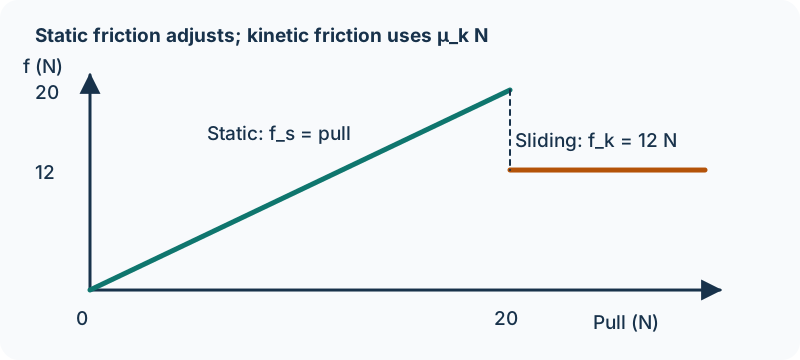
The static-friction magnitude obeys 0 ≤ f_s ≤ μ_sN. Its maximum value is f_s,max = μ_sN. It takes the value and direction needed to prevent sliding, provided that required value doesn’t exceed the maximum. For typical surface pairs, μ_s is greater than μ_k, explaining why it often takes more force to start a box sliding than to keep it sliding.
A stationary box with a 3 N horizontal pull may have 3 N of static friction even when its maximum is 10 N. Writing f_s = μ_sN immediately would invent an unnecessarily large force and predict motion that isn’t occurring. Equality applies at impending slip, not at every static contact.
Example 2.7.1 — Will the box move?
A 4 kg box rests on a level floor with μ_s = 0.50 and μ_k = 0.30. No other vertical force acts, so N = mg = 40 N using g = 10 m/s². Maximum static friction is 0.50(40) = 20 N.
Apply a 12 N horizontal pull. The required static friction is 12 N, which is within the limit, so the box stays at rest. Apply 24 N instead. Static friction can’t hold it. Once it slides right, kinetic friction is 0.30(40) = 12 N left, giving net force 24 − 12 = 12 N and acceleration 3 m/s² right.
The friction force doesn’t jump to 20 N and stay there during sliding. The model changes when surfaces begin moving relative to one another. Also, N = mg was valid only because vertical acceleration and other vertical forces were zero. An upward-angled pull reduces N and changes both friction limits.
What if the floor tilts?
For a block stationary on an incline of angle θ, normal balance gives N = mg cos θ. The required static friction is mg sin θ uphill. No slipping requires mg sin θ ≤ μ_smg cos θ, or tan θ ≤ μ_s. The mass cancels: in this ideal model, the threshold angle depends on the coefficient rather than mass.
Once a block slides downhill, kinetic friction points uphill. Then a_downhill = g(sin θ − μ_k cos θ). If a block is already sliding uphill, kinetic friction points downhill along with gravity, so the equation changes. Draw the relative sliding direction before choosing the friction sign.
Measure the limit with a graph
Pull a block horizontally with a force sensor, increasing the force slowly until it slips. Record the maximum just before motion, then the approximately steady force during a constant-speed slide. Repeat with added masses, calculating N for each trial. Plot maximum static friction versus N and kinetic friction versus N. Best-fit slopes estimate μ_s and μ_k. Keep the same surfaces and orientation, and repeat measurements because surface irregularities cause scatter. A zero-load intercept far from zero suggests a calibration or modeling issue worth investigating.
Example 2.7.2 — A faster belt pushes a sliding box forward
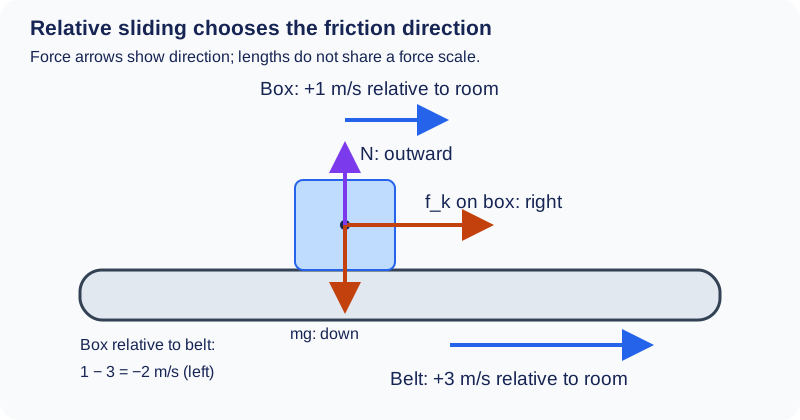
A box moves right at 1 m/s while the belt beneath it moves right at 3 m/s. Relative to the belt, the box slides left at 2 m/s. Kinetic friction on the box therefore points right, opposite the box surface’s motion relative to the belt surface. The box exerts an equal leftward friction force on the belt, opposing the belt surface’s rightward motion relative to the box. A ground-frame velocity alone cannot choose either friction direction.
For a 2 kg box with no vertical acceleration or other vertical force, N = 20 N and μ_k = 0.25 gives f_k = 5 N rightward on the box. The normal force is the surface’s perpendicular contact-force component, directed away from the surface, so it points upward on this horizontal belt. On a tilted belt it would still point perpendicular outward, not vertically upward.
Now turn the same block onto a narrower face, keeping the material pair, surface condition, and 20 N normal load fixed. The ideal dry-friction model predicts the same 5 N kinetic friction because it does not depend on apparent contact area. Replacing the surface material so that μ_k becomes 0.40 instead predicts 8 N. The coefficient represents the material properties and condition of the contacting pair, so changing materials can change friction even when area and load do not.
For a typical dry surface pair, μ_s exceeds μ_k. If μ_s = 0.45 and μ_k = 0.25 at N = 20 N, the maximum static friction is 9 N while sliding friction is 5 N. That comparison concerns the maximum available static force; actual static friction may be any needed value from zero to that limit. Area independence and the coefficient comparison are useful classroom approximations, not claims about every adhesive, deformable, or speed-dependent contact.
Inspect diagram labels
The diagram keeps its full size here. Focus the view and use the arrow keys, or scroll across it, to inspect every label.
Check what you know
Pause & try it
Let's see what stuck.
Choose an answer, then check the reasoning. Try the written problems below before opening their solutions.
0 of 3 checked · 0 correct
Give it a try
Practice 1
A 2 kg block has μ_s = 0.40 and μ_k = 0.25 on a level floor. Determine its friction and acceleration under a 5 N pull, then under a 10 N pull starting from rest.
Practice 2
Derive the largest angle at which a block can remain at rest on an incline. Explain why changing mass alone doesn’t change that angle in this model.
Practice 3
Sketch friction magnitude versus increasing horizontal pull for the box in Example 2.7.1, first at rest and then after slip. Mark the 20 N maximum and 12 N kinetic value.
Keep exploring
The original Common Forces and Force Analysis preserve friction examples and quizzes. The adjustable static-friction rule here is the check to apply before using them.
Course scope and standards: the supplied AP Physics 1 CED, printed pages 53, 54; Topic 2.7 and its exact learning objectives. The official College Board CED is the public source; the project audit records the supplied edition.
Supporting physics references: OpenStax: friction. These lessons, diagrams, examples, and practice questions were written for this book.
Explain and apply the model
Try these problems before opening the solutions. State your assumptions, show the diagram or calculation, and explain what makes your answer follow.
Choose friction direction in a moving-surface frame
A 3 kg box moves east at 2 m/s while a horizontal belt beneath it moves east at 5 m/s. Their surfaces slide relative to one another. The kinetic coefficient is 0.20; no other horizontal force acts on the box and it has no vertical acceleration. Use g = 10 m/s².
(a) Find the box surface’s velocity relative to the belt surface and the belt surface’s velocity relative to the box. Determine and justify the kinetic-friction direction on each surface, explicitly referring to their relative motion rather than ground velocity.
(b) Draw the box’s actual force arrows and identify the normal force as the perpendicular contact component directed away from the surface. Calculate N, the kinetic-friction magnitude, and the box’s instantaneous acceleration. Describe how the normal-force direction would change if the belt were tilted.
Your written working
Drawing is temporarily unavailable. Work on paper if needed, then record your reasoning here.
Saving written working requires JavaScript. The problem remains available above; keep your work on paper or in your own notes.
Separate area, material and friction regime
A rectangular block is tested with a fixed 50 N normal load. On the same dry material pair it slides on a 200 cm² face and then a 100 cm² face; μ_k = 0.30. The narrow face is then tested on a different surface with μ_k = 0.50. Keep speed in the ideal dry-friction regime and surface condition fixed within each pair. For the original pair a measured μ_s is 0.45.
(a) Compare the kinetic-friction magnitudes for the two face orientations on the original material pair. Calculate them and explain what this equal-load comparison establishes about contact area in the ideal model. State why material and normal load must be controlled.
(b) Calculate the kinetic-friction magnitude on the replacement surface. Explain what property of the contacting surfaces changes the coefficient and why the area result in part a does not imply all material pairs have the same friction.
(c) For a typical dry material pair, state which is usually greater, μ_s or μ_k. Use the supplied original-pair values to compare maximum static friction with kinetic friction. Explain why this does not make the actual static force automatically equal to its maximum.
Your written working
Drawing is temporarily unavailable. Work on paper if needed, then record your reasoning here.
Saving written working requires JavaScript. The problem remains available above; keep your work on paper or in your own notes.
Glossary and deeper reading · 6 refreshers
These editorial refreshers supplement the reading. Definitions and examples are added guidance; original source wording and recorded answers remain in their original context.
-
Force
A force describes an interaction that can change an object’s momentum. It is a vector measured in newtons, so both size and direction matter when forces are added. For example, a rope can pull a cart while the floor exerts friction in another direction.
-
Velocity
Velocity describes how position changes with time and includes direction. Instantaneous velocity describes one moment, while average velocity is displacement divided by elapsed time. For example, a car turning a corner can change velocity while maintaining the same speed.
-
Magnitude
Magnitude is the nonnegative size of a vector quantity. It does not specify direction, and it differs from a signed component. For example, a westward velocity can have a negative x component while its speed, the velocity magnitude, stays positive.
-
Gravity
Gravity is the attractive interaction between masses in the Newtonian model. For spherical bodies or point-mass approximations, its strength decreases with the square of the separation between their centers. For example, Earth’s gravity provides the inward force that keeps a satellite in orbit.
-
Acceleration
Acceleration is the vector rate of change of velocity with time. It can change an object’s speed, direction, or both, and it is measured in meters per second squared. For example, a satellite moving at constant speed in a circular orbit accelerates toward the center.
-
Normal force
A normal force is a contact force perpendicular to the local surface of contact. Its magnitude is set by the motion and the other forces, so it need not equal the object’s weight. For example, a wall’s normal force on a leaning ladder points horizontally rather than upward.