Newton’s First Law
Recognize force balance in both stationary and constant-velocity systems.
Constant motion doesn’t need a constant push
Slide a puck along a rough floor and it slows down. Slide it across smoother ice and it travels much farther. The rough-floor experience can make us think motion itself needs a continuing force. Instead, friction is a force changing the puck’s velocity. With zero net force, the puck keeps its current velocity.
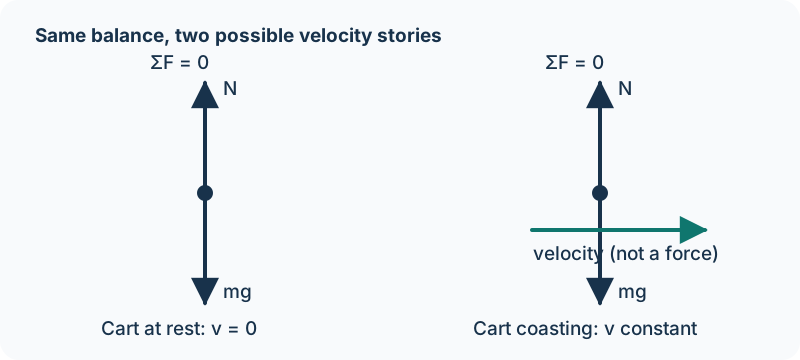
Newton’s first law states: if the net force on a system is zero, its velocity remains constant. Constant velocity includes being at rest, but it also includes moving steadily along a straight line. Translational equilibrium means the force configuration has ΣF⃗ = 0. It doesn’t mean there are no forces.
A hanging lamp has upward tension and downward gravity that balance. A cart coasting on an ideal horizontal track has upward normal force and downward gravity that balance. Their net forces are zero, even though their individual forces aren’t. A stationary object at one instant isn’t automatically in equilibrium: a tossed ball at the top of its flight is momentarily at rest but has a downward net force.
Balance each direction
The net force is the vector sum of the forces on the selected system. Opposite components cancel. In two dimensions, translational equilibrium requires ΣFₓ = 0 and ΣFᵧ = 0. Balancing just the vertical direction leaves the horizontal motion undecided.
A projectile without air resistance has zero horizontal net force, so its horizontal velocity remains constant. Its vertical force is unbalanced, so vertical velocity changes. “Balanced forces” must say which axis—or the whole vector—you mean.
Circular motion at constant speed also isn’t translational equilibrium. Velocity direction changes, requiring nonzero acceleration and nonzero net force. Constant speed is weaker than constant velocity. For equilibrium, both magnitude and direction of velocity stay fixed.
Example 2.4.1 — A sign supported by two cables
A 6 kg sign hangs from two identical cables, each making 30° above horizontal. Its weight is 60 N using g = 10 m/s². Horizontal components cancel by symmetry. Vertical balance gives 2T sin 30° = mg, so T = 60/[2(0.5)] = 60 N in each cable.
That may look surprisingly large. Each cable supplies only 30 N of upward component, even though its total tension is 60 N. If the cables become more horizontal, sin θ decreases and the required tension increases. At θ = 90°, the two vertical cables need only 30 N each. At exactly horizontal, ideal cables can’t support the weight with finite tension.
This symbolic expression, T = mg/(2 sin θ), is more informative than just the numerical result. It tells us how changing mass or angle changes the force. Derive before substituting so those dependencies remain visible.
What makes a reference frame inertial?
An inertial reference frame is one in which Newton’s first law holds. Observers in frames moving at constant velocity relative to one another agree that an unforced object maintains constant velocity. Earth-fixed frames are treated as approximately inertial for ordinary classroom experiments.
Inside a braking bus, a loose object appears to accelerate relative to the bus even if no horizontal interaction pushes it forward. The bus frame is accelerating and is noninertial. Use a ground inertial frame to analyze the ordinary forces. Unless a problem says otherwise, the supplied CED lets us assume the stated frame is inertial.
A test that can fail usefully
Give a low-friction cart a short push, then let go. Use a motion sensor to examine velocity after contact ends, not while your hand is pushing. A nearly horizontal velocity graph supports approximately zero net horizontal force. If its slope is consistently negative, estimate the residual acceleration and identify track tilt or friction as a possible interaction. Reverse the cart direction and compare trends: a tilt affects the sign differently from friction. A good claim includes the measured interval, uncertainty, and the interactions your model neglects.
Example 2.4.2 — Use the first law to test a frame
An inertial frame is one in which an observer verifies Newton’s first law: an object with zero net force keeps constant velocity. Suppose a released puck has no horizontal force. A ground observer records x = 0, 3, 6, and 9 m at t = 0, 1, 2, and 3 s. Equal displacements in equal times give constant +3 m/s velocity and support treating that ground frame as inertial.
A second observer moves at constant +1 m/s, so the same puck positions relative to that observer are 0, 2, 4, and 6 m. Its velocity is again constant, now +2 m/s, verifying the first law in that frame too. An observer accelerating at +2 m/s² from rest instead assigns positions 0, 2, 2, and 0 m; the force-free puck appears to accelerate relative to this observer. That frame is noninertial. The test concerns the constancy of velocity, not whether one selected object is momentarily at rest.
Check what you know
Pause & try it
Let's see what stuck.
Choose an answer, then check the reasoning. Try the written problems below before opening their solutions.
0 of 3 checked · 0 correct
Give it a try
Practice 1
A 4 kg lamp hangs from one vertical cable. Find tension. Describe how the FBD differs if the lamp moves upward at a constant velocity.
Practice 2
A cart has forces 5 N east and 5 N west, plus 8 N upward and 8 N downward. Can you determine its velocity from those forces? Explain.
Practice 3
Derive the cable tension for a stationary sign of mass m suspended by two symmetric cables at angle θ above horizontal. Predict the factor of change when m doubles at fixed angle.
Keep exploring
The original Newton’s Laws and FBDs keeps the first-law discussion. Use these equilibrium and frame checks alongside its quizzes.
Course scope and standards: the supplied AP Physics 1 CED, printed pages 48; Topic 2.4 and its exact learning objectives. The official College Board CED is the public source; the project audit records the supplied edition.
Supporting physics references: OpenStax: Newton’s first law and inertia. These lessons, diagrams, examples, and practice questions were written for this book.
Explain and apply the model
Try these problems before opening the solutions. State your assumptions, show the diagram or calculation, and explain what makes your answer follow.
Use force-free motion to test a frame
A released puck has negligible horizontal external force. A ground observer measures its positions as 0, 4, 8 and 12 m at t = 0, 1, 2 and 3 s. Observer A’s origin has ground position x_A = (1 m/s)t and observer B’s origin has x_B = (1 m/s²)t² with t in seconds. Both use axes parallel to the ground axis and synchronized clocks. The ground frame is approximately inertial.
(a) Find the puck’s positions and interval velocities in observer A’s frame. Define an inertial reference frame in terms of an observer verifying Newton’s first law, and explain whether observer A’s result is consistent with that definition.
(b) Find the puck’s positions and interval velocities in B’s frame. Explain whether B verifies Newton’s first law for this force-free puck, and why the apparent velocity change does not show a new horizontal contact force on the puck.
Your written working
Drawing is temporarily unavailable. Work on paper if needed, then record your reasoning here.
Saving written working requires JavaScript. The problem remains available above; keep your work on paper or in your own notes.
Glossary and deeper reading · 14 refreshers
These editorial refreshers supplement the reading. Definitions and examples are added guidance; original source wording and recorded answers remain in their original context.
-
Force
A force describes an interaction that can change an object’s momentum. It is a vector measured in newtons, so both size and direction matter when forces are added. For example, a rope can pull a cart while the floor exerts friction in another direction.
-
Velocity
Velocity describes how position changes with time and includes direction. Instantaneous velocity describes one moment, while average velocity is displacement divided by elapsed time. For example, a car turning a corner can change velocity while maintaining the same speed.
-
Net force
Net force is the vector sum of all forces acting on the object or system under consideration. For constant mass in an inertial frame, it equals mass times acceleration. For example, equal upward and downward forces give zero net force even though neither force is zero.
-
Mechanical equilibrium
Mechanical equilibrium means there is no translational or angular acceleration for the system being considered. For a rigid body, both the net external force and the net external torque must vanish. For example, a stationary ladder supported against a wall requires both force balance and torque balance.
-
Tension
Tension is a pulling force transmitted through a stretched rope, string, or similar connector. It acts along the connector away from the object it pulls, and an ideal massless rope has the same tension throughout an uninterrupted segment. For example, a rope supporting an accelerating load can have a tension different from the load’s weight.
-
Gravity
Gravity is the attractive interaction between masses in the Newtonian model. For spherical bodies or point-mass approximations, its strength decreases with the square of the separation between their centers. For example, Earth’s gravity provides the inward force that keeps a satellite in orbit.
-
Vector
A vector is a quantity with a magnitude and a direction, represented by an arrow or by components along chosen axes. Vectors add by adding corresponding components rather than simply adding their magnitudes. For example, an eastward displacement followed by a northward displacement produces a resultant pointing northeast. The zero vector has zero magnitude and no unique direction.
-
Vector component
A vector component describes the part of a vector along a chosen axis. Its signed value changes when the axes change, even though the physical vector remains the same. For example, a diagonal launch velocity can be resolved into horizontal and vertical components that share the same elapsed time.
-
Projectile motion
Projectile motion describes an object after launch when gravity is the only significant force in the chosen model. Near Earth, horizontal and vertical motion can be analyzed separately using the same time interval and approximately constant downward acceleration. For example, a ball rolling off a table continues horizontally while its downward velocity increases.
-
Drag
Drag is a force from a fluid that opposes an object’s motion relative to that fluid. Its dependence on speed, shape, and fluid properties varies with the physical regime. For example, a parachute increases air drag by presenting a large area to the moving air.
-
Acceleration
Acceleration is the vector rate of change of velocity with time. It can change an object’s speed, direction, or both, and it is measured in meters per second squared. For example, a satellite moving at constant speed in a circular orbit accelerates toward the center.
-
Magnitude
Magnitude is the nonnegative size of a vector quantity. It does not specify direction, and it differs from a signed component. For example, a westward velocity can have a negative x component while its speed, the velocity magnitude, stays positive.
-
Inertial frame
An inertial frame is a reference frame in which an object with no net external force moves at constant velocity. Frames moving at constant velocity relative to an inertial frame are also inertial in the Newtonian model. For example, a steadily moving train is approximately inertial, whereas a train accelerating out of a station is not.
-
External force
An external force is exerted on part of a chosen system by something outside that system. The sum of external forces determines the rate of change of the system’s total momentum. For example, Earth’s gravitational force is external to a system consisting only of a falling ball.