Conservation of Angular Momentum
After angular momentum, apply the conservation idea to changing rotating configurations.
Before this connection: Angular momentum and external angular impulse.
The system can change shape without losing its ledger
A skater pulls in their arms and spins faster. Their angular speed changes, but that does not mean an external torque suddenly appeared. Their mass moved closer to the rotation axis, reducing rotational inertia. With negligible net external torque, the system’s total angular momentum stays constant.
Start with the general balance L_f = L_i + J_angular,external. For a selected system with zero net external angular impulse, L_f = L_i. If a shape-changing system can be described by an effective inertia before and after, I_iω_i = I_fω_f in the one-plane model. It need not be rigid during the change; it can have fixed configurations at the initial and final moments.
Total angular momentum is the sum of the angular momenta of the system’s parts about the same axis. Internal interactions can transfer angular momentum between parts. Their equal and opposite angular impulses cancel in the total, just as Newton’s third-law forces canceled in the linear momentum ledger. A motor inside an isolated apparatus can spin one part faster while making another part turn the other way.
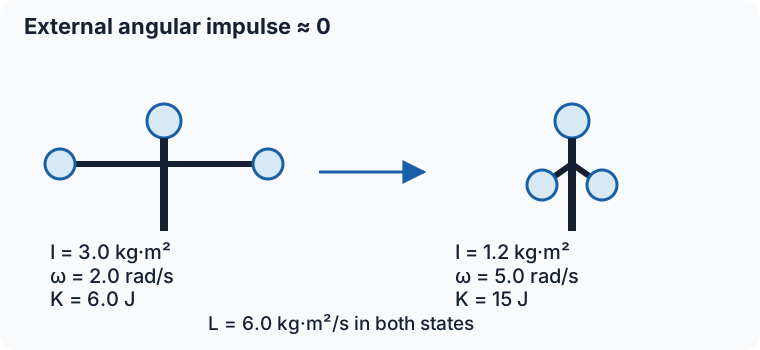
Worked example: arms in
A rotating rider has I_i = 3.0 kg·m² and ω_i = +2.0 rad/s. Pulling masses inward changes the inertia to I_f = 1.2 kg·m². Assume negligible external angular impulse about the vertical axis. Then L_i = +6.0 kg·m²/s, so ω_f = 6.0/1.2 = +5.0 rad/s.
Initial kinetic energy is ½(3.0)(2.0²) = 6.0 J. Final kinetic energy is ½(1.2)(5.0²) = 15 J. That additional 9.0 J came from internal energy used to move the masses inward. Angular momentum conservation does not imply kinetic-energy conservation. There is no need for an external torque to supply that energy when forces within the system do work during the shape change.
If the masses move outward, inertia increases and angular speed decreases at fixed L. Using K = L²/(2I) shows that rotational kinetic energy decreases as I increases at fixed angular momentum. Ask where that energy goes: the person can absorb it through their muscles, or another internal process can store or dissipate it.
An interaction can transfer angular momentum between parts
A spinning disk with inertia I₁ shares an axle with an initially stationary disk of inertia I₂. They are pressed together and eventually turn at one common angular velocity. Choose both disks as the system and assume the bearing’s external angular impulse is negligible. Internal friction redistributes their angular momentum: I₁ω_i = (I₁ + I₂)ω_f.
If I₁ = 0.20 kg·m², I₂ = 0.10 kg·m², and ω_i = +6.0 rad/s, the common velocity is +4.0 rad/s. Initial kinetic energy is 3.6 J, while final kinetic energy is ½(0.30)(4.0²) = 2.4 J. The 1.2 J difference becomes internal energy during slipping between the disks. This is a rotational version of a sticking collision.
The boundary still makes the difference
Choose only the first disk, and its angular momentum changes because friction from the second disk is external to that smaller system. Choose both disks, and that friction is internal. A brake attached to the room transfers angular momentum between a wheel and its surroundings. Including the brake and Earth can reveal the compensating transfer; the wheel alone does not have constant L while braking.
Also state the reference axis. Zero external torque about one axis does not mean torque is zero about every possible axis. For the fixed-axis examples here, identify the axle and use every inertia and angular momentum about it. In the orbital lesson, the central object supplies a radial force with zero torque about its center.
Instructional example (guided activity):
Video/data task: Use safe recorded footage of a rotating stool or skater with measured effective inertias supplied. Estimate angular speeds by timing several turns before and after the shape change. Compare I_iω_i and I_fω_f, with uncertainty from turn timing. Predict a horizontal L–t graph but a changing ω–t graph when external torque is negligible. A slight systematic L decrease could indicate bearing or air drag, so use a baseline coast-down trial if available.
Worked example — Add components and account for the surroundings
Two coaxial disks have I_A = 0.20 kg·m² and I_B = 0.10 kg·m². Initially ω_A = +6.0 rad/s and ω_B = −3.0 rad/s, with counterclockwise positive. Their component angular momenta are +1.20 and −0.30 kg·m²/s, so L_total = +0.90 kg·m²/s. Neglecting external bearing torque, contact friction brings them to a common ω_f = 0.90/(0.20 + 0.10) = +3.0 rad/s. The final components are +0.60 and +0.30 kg·m²/s; their sum remains +0.90.
About the same axle, each tangential contact force from A on B has an equal-and-opposite force from B on A at the same contact radius. Newton’s third law therefore gives opposite contact torques, and over the same contact interval the angular impulses are equal and opposite. Here ΔL_A = −0.60 and ΔL_B = +0.60 kg·m²/s. The internal transfers cancel only when both disks are included.
Afterward a brake attached to the room removes 0.15 kg·m²/s from the two-disk system. Its L falls to +0.75 kg·m²/s, while brake plus Earth gains +0.15 kg·m²/s about the same axis. The enlarged total stays +0.90 when other external torque is negligible. Angular momentum is conserved in a complete interaction account even though a selected subsystem changes its L.
Name what stays constant
Pause & try it
Let's see what stuck.
Choose an answer, then check the reasoning. Try the written problems below before opening their solutions.
0 of 3 checked · 0 correct
Assigned practice: external torque during a shape change
A rotating system initially has I_i = 2.0 kg·m² and ω_i = +3.0 rad/s. Its inertia falls to 1.0 kg·m² while an external braking angular impulse of −1.0 kg·m²/s acts. Find ω_f.
Open the separate worked solution.
Assigned practice: judge a conservation claim with uncertainty
A rotating stool system has effective inertia 2.4 kg·m² with arms out and 0.80 kg·m² with arms in. Video gives angular speeds 2.0 ± 0.10 rad/s before the change and 5.5 ± 0.10 rad/s afterward; treat each quoted interval as possible measurement values and the inertias as exact for this task. Are these data consistent with zero external angular impulse? Determine the sign of any supported transfer and propose a control measurement that could test whether bearing drag explains it.
Open the separate worked solution.
The book’s Angular Momentum includes longer conservation examples and quizzes. The new system-choice and energy comparison here explain what those examples assume.
Sources and scope: College Board CED, with edition-specific coverage verified against the supplied file. Supplied College Board CED, printed pp. 112–113, 6.4.A–B, explicitly includes nonrigid shape changes and system/environment transfers. OpenStax: Conservation of Angular Momentum verifies the constant-L condition and inertia/speed comparison. Practice and diagrams here are original.
Explain and apply the model
Try these problems before opening the solutions. State your assumptions, show the diagram or calculation, and explain what makes your answer follow.
Account for both disks and the room
Two coaxial disks have I_A = 0.30 kg·m², ω_A = +4.0 rad/s and I_B = 0.20 kg·m², ω_B = −1.0 rad/s. They make contact and eventually turn together. Neglect external torque during contact. After contact, a brake connected to the room removes 0.20 kg·m²/s from the pair. All quantities refer to the same fixed axle; counterclockwise is positive.
(a) Calculate the initial component angular momenta and their signed sum. Find the common final angular velocity, then calculate the final component momenta and verify their sum.
(b) Calculate the angular impulse on each disk during contact. Derive why these impulses must be equal and opposite from Newton’s third law for tangential contact forces at matching radii over the same interval. Explain why either disk alone does not have constant angular momentum.
(c) After braking, find the disk pair’s angular momentum and the compensating change in the brake plus Earth. Calculate the enlarged-system total and explain how angular momentum conservation remains valid while the pair’s own momentum changes.
Your written working
Drawing is temporarily unavailable. Work on paper if needed, then record your reasoning here.
Saving written working requires JavaScript. The problem remains available above; keep your work on paper or in your own notes.
Glossary and deeper reading · 11 refreshers
These editorial refreshers supplement the reading. Definitions and examples are added guidance; original source wording and recorded answers remain in their original context.
-
Angular velocity
Angular velocity describes the rate and direction of rotation about an axis. For a fixed axis, a signed angular velocity is measured in radians per second, while its magnitude is angular speed. For example, points on one rigid turntable share the same angular speed even though outer points have greater linear speeds.
-
Torque
Torque describes a force’s turning effect about a chosen axis or point. Its magnitude is force times the perpendicular lever arm, and its direction or sign describes the rotation tendency. For example, pushing near the handle of a door produces more torque than the same perpendicular push near the hinge.
-
Angular impulse
Angular impulse is the change in angular momentum caused by torque acting over time. It is the signed area under a torque-versus-time graph about a consistent axis. For example, applying a braking torque to a wheel for a longer interval changes its angular momentum more.
-
Inertia
Inertia is an object’s resistance to a change in its velocity. Mass measures translational inertia, whereas rotational inertia also depends on how mass is distributed relative to an axis. For example, a loaded cart accelerates less than an empty cart under the same net force.
-
Angular momentum
Angular momentum describes motion about a specified point or axis. For rigid rotation about a fixed principal axis it can be written as rotational inertia times angular velocity; a translating particle can also have angular momentum about a point. For example, a ball moving past a pole has angular momentum about the pole even though the ball’s path is straight.
-
Force
A force describes an interaction that can change an object’s momentum. It is a vector measured in newtons, so both size and direction matter when forces are added. For example, a rope can pull a cart while the floor exerts friction in another direction.
-
Velocity
Velocity describes how position changes with time and includes direction. Instantaneous velocity describes one moment, while average velocity is displacement divided by elapsed time. For example, a car turning a corner can change velocity while maintaining the same speed.
-
Kinetic energy
Kinetic energy is energy associated with motion relative to a chosen reference frame. For a nonrelativistic translating object it is one half of its mass times speed squared. For example, doubling a cart’s speed quadruples its translational kinetic energy when its mass stays fixed.
-
Drag
Drag is a force from a fluid that opposes an object’s motion relative to that fluid. Its dependence on speed, shape, and fluid properties varies with the physical regime. For example, a parachute increases air drag by presenting a large area to the moving air.
-
Linear momentum
Linear momentum is a vector describing an object’s motion and equals mass times velocity in the nonrelativistic model. The vector sum of momenta is conserved when the net external impulse on the system is zero. For example, two identical carts moving equally fast in opposite directions have zero total linear momentum but nonzero total kinetic energy.
-
Impulse
Impulse is the change in linear momentum produced by a force over a time interval. It equals the signed vector area under a force-versus-time graph and is measured in newton-seconds. For example, a padded landing spreads the stopping impulse over more time, reducing the average force for the same momentum change.