Linear Momentum
Draw object and system momentum vectors in a stated reference frame.
What are we keeping track of?
Imagine two carts rolling toward you. One is empty, and the other is full of books. Even if their speeds match, stopping them will feel different. Momentum gives us a way to keep track of mass and velocity together. It is a vector, written p = mv, with units kg·m/s. The direction of momentum matches the direction of velocity. A mass is positive; the sign of a momentum component comes from your choice of direction.
Take right as positive. A 0.50 kg cart going right at 4.0 m/s has p = +2.0 kg·m/s. Another 1.0 kg cart going left at 2.0 m/s has p = −2.0 kg·m/s. Their momenta have equal magnitudes, but they are different vectors. If you select both carts as your system, the total momentum is zero. That does not mean both carts are sitting still! It means their momentum vectors add to zero.
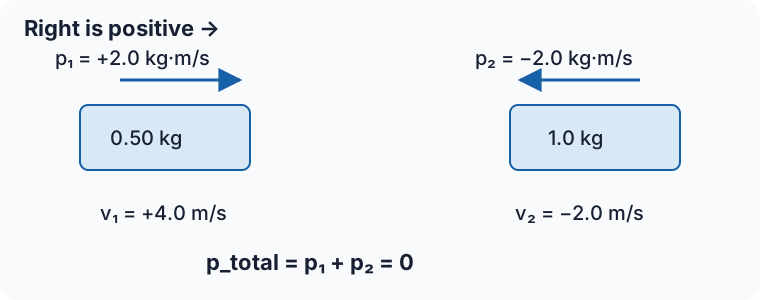
Momentum is a description of motion
Momentum is not an extra force pushing an object along. With no net external force, an object keeps its velocity because of Newton’s first law. Momentum helps describe that motion and how interactions change it. Mass measures inertia; momentum depends on the reference frame as well as mass. A rider sitting still on a moving train has zero momentum in the train frame and nonzero momentum in the platform frame. Use one frame consistently for every object in a calculation.
Momentum and kinetic energy also tell different stories. Momentum changes sign when velocity reverses; kinetic energy, K = ½mv², does not. Two objects can have equal momenta and different kinetic energies. In the cart example, their kinetic energies are 4.0 J and 2.0 J. A system with zero total momentum can still have lots of kinetic energy available to deform objects or produce sound during a collision.
Why collisions are useful models
During a collision, the objects exert large forces on each other for a short time. We can often ignore the external impulse during that short interval compared with the internal impulses. That is an assumption to check, not a magic property of the word “collision.” A cart collision on a low-friction horizontal track is a useful example. A slow interaction on a rough track may require accounting for friction.
We usually compare the state immediately before contact with the state immediately after it. We can then model each cart as an object located at its center of mass, without describing every dent or vibration. This model is about the overall translational motion. It does not claim that the cart has no size or no internal energy.
An explosion is the other common interaction model: forces within a system push its parts apart. “Explosion” can mean a spring released between two carts; it need not involve anything dramatic. If those carts begin at rest, the spring can give them equal and opposite momenta while supplying kinetic energy from stored spring energy. A lighter cart then has a larger speed for the same momentum magnitude.
Try a comparison before reaching for the calculator
Suppose cart A has mass m and speed v. Cart B has mass 2m and speed v/2 in the same direction. Both have momentum mv. However, K_A = ½mv² while K_B = ¼mv². Equal momentum does not guarantee equal energy or equal collision force. The time and details of the interaction matter too.
For a momentum–time sketch, a cart traveling steadily to the right gets a horizontal line above zero. If it reverses and eventually moves steadily left, the line crosses zero and levels off below zero. The crossing means the cart is momentarily at rest. In the next section, the slope will tell us about force.
Instructional example (guided activity):
Make a representation: Put masses on two low-friction carts and measure velocities with a motion sensor or video. Draw each momentum arrow to scale, then add them. Name the frame and include units. If the measured total changes, look for external impulse, mismatched measurement times, or uncertainty in velocity before claiming the law failed. This practices diagram creation, comparison, and evidence-based claims.
Worked example — Decide whether the collision approximation is useful
Two carts interact for 0.020 s. Their mutual average horizontal contact-force magnitude is 100 N, while the net external horizontal force on the pair is at most 0.50 N. The internal impulse magnitude on either cart is about 2.0 N·s; the pair’s external impulse magnitude is at most 0.010 N·s. The external contribution is at most 0.5% of the individual contact impulse. Large mutual forces over this same short interval support a collision model with approximately constant total horizontal momentum.
To predict the velocities immediately before and after contact, model each cart as an object at its center of mass. The model uses the initial and final translational states, so the detailed temporary bumper compression is unnecessary for the momentum balance. It does not describe stresses, vibration, or bumper energy during contact. If external force were instead 50 N over the same interval, the 1.0 N·s external impulse would no longer be negligible compared with 2.0 N·s; calling the event a collision would not justify ignoring it.
Check the model
Pause & try it
Let's see what stuck.
Choose an answer, then check the reasoning. Try the written problems below before opening their solutions.
0 of 3 checked · 0 correct
Assigned practice: a spring between carts
A 0.40 kg cart and a 0.60 kg cart start at rest on a level low-friction track. A spring between them is released. The lighter cart moves left at 3.0 m/s. Find the other cart’s velocity and compare their kinetic energies.
Open the separate worked solution.
Assigned practice: compare the cart evidence
Two carts travel on a level track in one camera frame. Cart A has mass 0.40 kg and velocity +3.0 m/s; cart B has mass 0.60 kg and velocity −1.0 m/s. Draw their momentum arrows to scale and show the system total. A second camera rides rightward at 1.0 m/s relative to the track. Without changing the physical motion, what total momentum would that camera measure? Explain why comparing one cart from each camera would be a poor test of momentum conservation.
Open the separate worked solution.
Continue with the book’s Introduction to Momentum, including its original in-place quizzes. It has a longer recoil example; treat repeated mass-loss calculations as enrichment, since the AP course does not require quantitative variable-mass systems.
Sources and scope: College Board CED, with edition-specific coverage verified against the supplied file. College Board, supplied AP Physics 1 Course and Exam Description, effective Fall 2024, summer 2026 update, printed p. 80, topic 4.1 and its collision/explosion definitions. OpenStax: Linear Momentum and Force verifies p = mv and the vector and unit conventions. Examples, diagram, and practice here are original.
Explain and apply the model
Try these problems before opening the solutions. State your assumptions, show the diagram or calculation, and explain what makes your answer follow.
Justify a short-interaction model
Two carts interact on a horizontal track for 0.030 s. Their average mutual force magnitude is 80 N, while the magnitude of the net external horizontal force on the pair is at most 0.40 N. A comparison interaction of the same duration has 40 N net external force. Velocities are measured immediately before and immediately after contact.
(a) Compare internal and net external force magnitudes and calculate their impulse scales in the first trial. Use that comparison to justify or reject approximately constant pair momentum over contact. Explain why duration and the shared interval matter.
(b) Explain why an object model at each cart’s center of mass is adequate for the requested initial/final velocity analysis, and name a contact-stage question it cannot answer. Evaluate whether the comparison trial allows the same negligible-external-impulse approximation.
Your written working
Drawing is temporarily unavailable. Work on paper if needed, then record your reasoning here.
Saving written working requires JavaScript. The problem remains available above; keep your work on paper or in your own notes.
Glossary and deeper reading · 8 refreshers
These editorial refreshers supplement the reading. Definitions and examples are added guidance; original source wording and recorded answers remain in their original context.
-
Velocity
Velocity describes how position changes with time and includes direction. Instantaneous velocity describes one moment, while average velocity is displacement divided by elapsed time. For example, a car turning a corner can change velocity while maintaining the same speed.
-
Vector
A vector is a quantity with a magnitude and a direction, represented by an arrow or by components along chosen axes. Vectors add by adding corresponding components rather than simply adding their magnitudes. For example, an eastward displacement followed by a northward displacement produces a resultant pointing northeast. The zero vector has zero magnitude and no unique direction.
-
Magnitude
Magnitude is the nonnegative size of a vector quantity. It does not specify direction, and it differs from a signed component. For example, a westward velocity can have a negative x component while its speed, the velocity magnitude, stays positive.
-
Force
A force describes an interaction that can change an object’s momentum. It is a vector measured in newtons, so both size and direction matter when forces are added. For example, a rope can pull a cart while the floor exerts friction in another direction.
-
External force
An external force is exerted on part of a chosen system by something outside that system. The sum of external forces determines the rate of change of the system’s total momentum. For example, Earth’s gravitational force is external to a system consisting only of a falling ball.
-
Kinetic energy
Kinetic energy is energy associated with motion relative to a chosen reference frame. For a nonrelativistic translating object it is one half of its mass times speed squared. For example, doubling a cart’s speed quadruples its translational kinetic energy when its mass stays fixed.
-
Impulse
Impulse is the change in linear momentum produced by a force over a time interval. It equals the signed vector area under a force-versus-time graph and is measured in newton-seconds. For example, a padded landing spreads the stopping impulse over more time, reducing the average force for the same momentum change.
-
Center of mass
The center of mass is the position obtained by weighting each part’s position by its mass. Its motion represents the translational motion of the whole system under the net external force. For example, adding a heavy object to one end of a light bar shifts the center of mass toward that end.