Conservation of Linear Momentum
Choose a system and test when negligible external impulse supports momentum conservation.
Draw the boundary first
When one cart hits another, the first cart’s momentum changes. So does the second cart’s. That does not prevent their total momentum from staying constant. The useful question is: What did we include in the system, and what impulse crossed its boundary? Before writing “momentum is conserved,” draw a dashed boundary around the objects you are tracking.
For any chosen system, p_f = p_i + J_external. If the net external impulse is zero, p_f = p_i. Forces between objects inside the boundary are internal. Newton’s third law gives equal and opposite internal forces, acting over the same interval, so their impulses cancel in the system total. They can still change each object’s momentum a lot.
Momentum is conserved in interactions in the broader transfer sense: what one part gains, another part or the surroundings loses. A small selected system can receive momentum from its environment. A ball’s momentum changes when it hits a wall; include the wall and Earth and the compensating momentum is present, though Earth’s resulting velocity change is tiny.
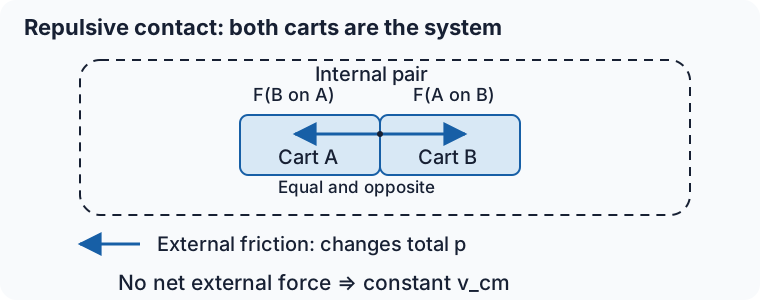
Worked example: two carts stick
A 0.60 kg cart moving right at 3.0 m/s collides with a stationary 0.90 kg cart. They stick. Choose both carts as the system, take right as positive, and assume negligible horizontal external impulse over the collision.
Initial momentum is 0.60(3.0) + 0.90(0) = 1.8 kg·m/s. Since both move together afterward, final momentum is (0.60 + 0.90)v_f. Therefore v_f = 1.8/1.5 = +1.2 m/s. The second cart did not “use up” momentum. Momentum was redistributed while some translational kinetic energy became internal energy.
If a known friction impulse of −0.30 N·s acts during the interval, replace the conserved-momentum equation with 1.5v_f = 1.8 − 0.30. Now v_f = +1.0 m/s. This is the same law with a nonzero transfer across the system boundary.
Follow the center of mass
The center-of-mass velocity is the mass-weighted average velocity:
v_cm = (m₁v₁ + m₂v₂ + …)/(m₁ + m₂ + …) = p_total/M.
Use signed components in this expression. An ordinary average only works when the masses are equal. In the sticking-cart example, v_cm is +1.2 m/s before the collision and +1.2 m/s after it. Before contact, one cart is moving and one is still; after contact, both move at v_cm. Internal forces changed the arrangement and individual velocities while leaving the system’s center-of-mass motion alone.
When net external force is zero, v_cm stays constant even during the collision, not just before and afterward. A graph of x_cm against time is a straight line. A graph of v_cm against time is horizontal. If net external force is nonzero, the center of mass accelerates according to F_external = Ma_cm for the constant total mass here.
What changes in two dimensions?
Add momentum vectors, or write separate x and y component balances. Suppose a system initially has momentum to the right and no vertical momentum. After an explosion, one part goes above the original line. The other parts together must supply an equal downward component if external impulse is negligible. That conclusion needs no simultaneous-equation calculation.
For two outgoing objects at angles, a setup might be p_initial,x = m₁v₁cosθ₁ + m₂v₂cosθ₂ and 0 = m₁v₁sinθ₁ + m₂v₂sinθ₂, with angles or signs defined consistently. AP Physics 1 expects this setup and semiquantitative reasoning in two dimensions; solving simultaneous equations for a full two-dimensional collision is outside its stated boundary.
Instructional example (guided activity):
Data task: Track two carts in video using the same spatial scale and clock. Plot x_cm = (m₁x₁ + m₂x₂)/(m₁ + m₂) before, during, and after their interaction. Fit a line and interpret its slope. Repeat trials and report how position-reading uncertainty affects the fitted velocity. A claim of constant v_cm needs the straight-line evidence and a reason that external impulse is negligible.
Worked example — The wall receives the other impulse
A 0.20 kg ball approaches a wall at +5.0 m/s and leaves at −3.0 m/s. Its momentum changes from +1.0 to −0.60 kg·m/s, so the wall’s impulse on the ball is −1.60 N·s. At every contact instant, Newton’s third law gives F_wall-on-ball = −F_ball-on-wall. Adding these equal-and-opposite forces over the identical contact interval gives J_wall-on-ball = −J_ball-on-wall; the ball delivers +1.60 N·s to the wall.
For ball alone, momentum is not constant because the wall is outside the boundary. For ball plus wall plus Earth, neglecting other external impulse over contact, the surroundings gain +1.60 kg·m/s while the ball loses 1.60 kg·m/s. The sum of those changes is zero. A very massive Earth has a tiny velocity change, not zero compensating momentum. Momentum conservation in all interactions means a complete transfer account; it does not mean every selected subsystem keeps its own momentum.
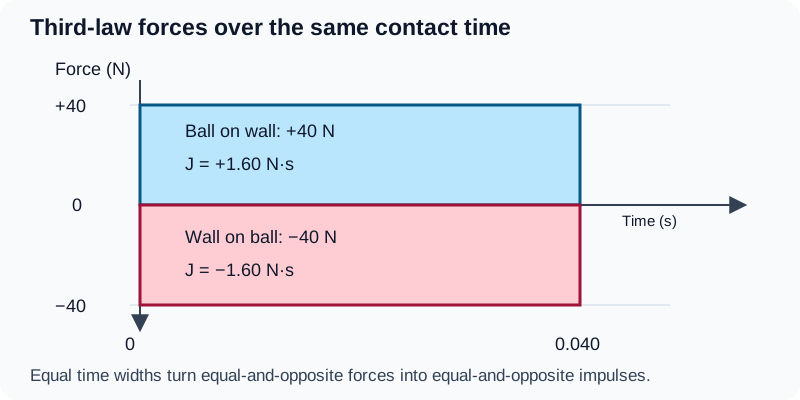
Inspect diagram labels
The diagram keeps its full size here. Focus the view and use the arrow keys, or scroll across it, to inspect every label.
Choose, justify, then calculate
Pause & try it
Let's see what stuck.
Choose an answer, then check the reasoning. Try the written problems below before opening their solutions.
0 of 3 checked · 0 correct
Assigned practice: internal push on a moving platform
Two riders of masses 40 kg and 60 kg move together at +2.0 m/s on a frictionless surface. They push apart. The 40 kg rider ends at +5.0 m/s. Find the other rider’s velocity and v_cm.
Open the separate worked solution.
Assigned practice: test the center-of-mass motion
Two carts have masses m₁ = 1.0 kg and m₂ = 3.0 kg. A synchronized video gives positions in meters: at t = 0 s, (x₁, x₂) = (0, 6); at 1 s, (2, 5); at 2 s, (4, 4); at 3 s, (3.75, 3.75). The carts meet and stick at about 2 s. Decide whether these data support constant center-of-mass velocity across the interaction. Show the representation you would use, with scales and units, and explain why averaging the two positions without their masses could give a misleading conclusion.
Open the separate worked solution.
Revisit the book’s Introduction to Momentum and Inelastic Collisions for additional scenarios and quizzes. Keep their system boundaries explicit as you work.
Sources and scope: College Board CED, with edition-specific coverage verified against the supplied file. Supplied College Board CED, printed pp. 83–84, 4.3.A–B, including center-of-mass velocity, transfers, and the two-dimensional boundary. OpenStax: Conservation of Momentum supports the system and external-force conditions. Diagrams and problems here are original.
Explain and apply the model
Try these problems before opening the solutions. State your assumptions, show the diagram or calculation, and explain what makes your answer follow.
Find the compensating wall momentum
A 0.30 kg ball approaches a wall at +4.0 m/s and leaves at −2.0 m/s. Contact lasts 0.060 s. Take right as positive. Include the wall and Earth as the surroundings, with negligible other external impulse over contact.
(a) Use Newton’s third law at each contact instant to derive the equality of opposite wall-on-ball and ball-on-wall impulses over the same time interval. Calculate both impulses and both average contact forces.
(b) Calculate the compensating momentum change of the wall plus Earth. Compare whether momentum is constant for ball alone and for the enlarged ball–wall–Earth system, and explain how this interaction conserves momentum despite the ball reversing.
Your written working
Drawing is temporarily unavailable. Work on paper if needed, then record your reasoning here.
Saving written working requires JavaScript. The problem remains available above; keep your work on paper or in your own notes.
Related source reading
These alternative explanations and examples retain their source context. Draft placement does not add accepted exam coverage.
- collision two velocities · source context; placement review pending
Glossary and deeper reading · 10 refreshers
These editorial refreshers supplement the reading. Definitions and examples are added guidance; original source wording and recorded answers remain in their original context.
-
Linear momentum
Linear momentum is a vector describing an object’s motion and equals mass times velocity in the nonrelativistic model. The vector sum of momenta is conserved when the net external impulse on the system is zero. For example, two identical carts moving equally fast in opposite directions have zero total linear momentum but nonzero total kinetic energy.
-
Impulse
Impulse is the change in linear momentum produced by a force over a time interval. It equals the signed vector area under a force-versus-time graph and is measured in newton-seconds. For example, a padded landing spreads the stopping impulse over more time, reducing the average force for the same momentum change.
-
Force
A force describes an interaction that can change an object’s momentum. It is a vector measured in newtons, so both size and direction matter when forces are added. For example, a rope can pull a cart while the floor exerts friction in another direction.
-
Internal force
An internal force is an interaction between parts of a chosen system. Newton’s third-law partners cancel in the total force sum for the whole system, although individual parts can accelerate. For example, two skaters pushing each other exert internal forces when the two skaters are analyzed together.
-
Velocity
Velocity describes how position changes with time and includes direction. Instantaneous velocity describes one moment, while average velocity is displacement divided by elapsed time. For example, a car turning a corner can change velocity while maintaining the same speed.
-
Average velocity
Average velocity is the displacement over an interval divided by the elapsed time. It is a vector and need not equal the average speed, which uses total distance. For example, a runner who returns to the starting line has zero average velocity for the full lap.
-
External force
An external force is exerted on part of a chosen system by something outside that system. The sum of external forces determines the rate of change of the system’s total momentum. For example, Earth’s gravitational force is external to a system consisting only of a falling ball.
-
Center of mass
The center of mass is the position obtained by weighting each part’s position by its mass. Its motion represents the translational motion of the whole system under the net external force. For example, adding a heavy object to one end of a light bar shifts the center of mass toward that end.
-
Vector
A vector is a quantity with a magnitude and a direction, represented by an arrow or by components along chosen axes. Vectors add by adding corresponding components rather than simply adding their magnitudes. For example, an eastward displacement followed by a northward displacement produces a resultant pointing northeast. The zero vector has zero magnitude and no unique direction.
-
Physical system
A physical system is the object or collection of objects chosen for an analysis. Its boundary determines which forces and energy transfers count as internal or external. For example, friction between a block and a floor is an external interaction for the block alone but internal when both are included.