Systems and Center of Mass
Choose the system boundary and locate a mass-weighted center of mass.
What are we calling “the system”?
Suppose two carts are connected by a spring. You could study cart A, both carts, or both carts plus the spring. All three choices describe the same experiment, but they count interactions differently. A system is the collection of objects you choose to analyze; everything else is the environment.
An interaction between two objects inside the boundary is internal. An interaction across the boundary is external. For cart A alone, the spring’s force is external. For carts plus spring, that spring interaction is internal. Draw the boundary before writing an equation. Otherwise it’s easy to count an interaction twice, or forget one entirely.
System properties depend on the objects and how they interact. A loose pile of parts and an assembled cart contain the same material but behave differently when pushed. Substructure matters when a system deforms, stores energy, or lets one part move relative to another. Changing an external variable—such as increasing a pull—may stretch the internal spring and change the system’s shape.
Systems may exchange energy or mass with the environment. An external pull transfers energy; pouring sand into a cart transfers mass. We acknowledge such exchanges, but quantitative variable-mass dynamics aren’t required here. When internal structure doesn’t affect the macroscopic question, we can model the whole system as a single object.
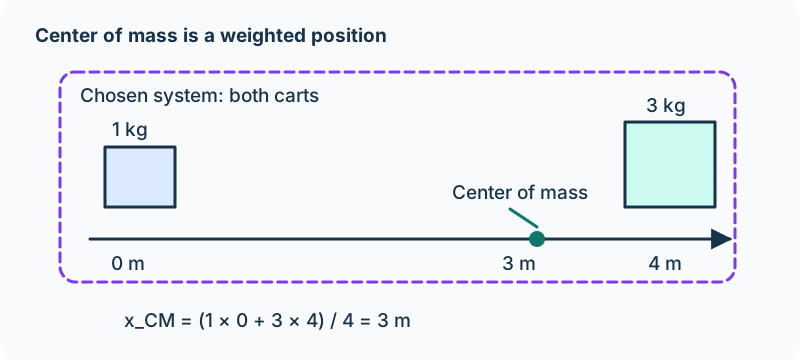
A position that takes mass seriously
The center of mass is a mass-weighted position. Along x:
x_CM = (m₁x₁ + m₂x₂ + ⋯)/(m₁ + m₂ + ⋯).
Use the same equation with y coordinates to find y_CM. The numerator has units kg·m, so dividing by total kilograms leaves meters. For positive masses, the result must lie between the most extreme coordinates along that axis. If it doesn’t, check your arithmetic or coordinates.
A highly symmetric mass distribution has its center of mass on its symmetry lines. A uniform circular ring has its center of mass at the center even though there’s no ring material there. Symmetry of shape alone isn’t enough if mass isn’t distributed symmetrically. Tape a heavy washer onto one side of a cardboard disk and the center shifts toward that side.
Example 2.1.1 — Two carts, one useful point
A 1 kg cart is at x = 0 m and a 3 kg cart is at x = 4 m. The center of mass is (1·0 + 3·4)/(1 + 3) = 3 m. It’s closer to the heavier cart, not halfway between the carts. A single object representing the system would be placed at that point and have mass 4 kg.
If the lighter cart moves to x = 2 m while the heavier stays at 4 m, x_CM becomes (1·2 + 3·4)/4 = 3.5 m. Moving the light cart by 2 m shifts the center of mass by only 0.5 m. Individual parts need not have the same motion as the system’s center of mass.
One motion preview: put both carts and a negligible-mass spring inside the system boundary on a horizontal low-friction track. The spring changes each cart’s motion, but its opposite pushes cancel in the whole-system force sum. With zero net external horizontal force, the center of mass has zero horizontal acceleration; if it starts at rest, it stays at rest while the carts separate. We’ll explain the paired forces in Topic 2.3 and the system’s acceleration in Topic 2.5.
For a two-dimensional example, place equal masses at (0, 0), (4, 0), and (0, 3), all in meters. Averaging each coordinate gives (4/3 m, 1 m). Don’t average the distances from the origin; that throws away direction. AP Physics 1 requires center-of-mass calculations for five or fewer particles in two dimensions, or highly symmetric systems. Integration over an irregular body belongs to enrichment.
Make a center-of-mass prediction
Cut a roughly triangular piece of stiff cardboard. Predict its center of mass by balancing it and marking the balance point. Then suspend it from two different holes, marking a plumb line each time. Their intersection identifies the center of mass because its weight acts along the vertical through the support when it hangs at rest. Add a washer at a measured location and predict the shift using the cardboard’s mass and original center of mass. Compare the new hanging result with the prediction, and account for the hole and washer placement uncertainty.
Example 2.1.2 — One point is enough for one question
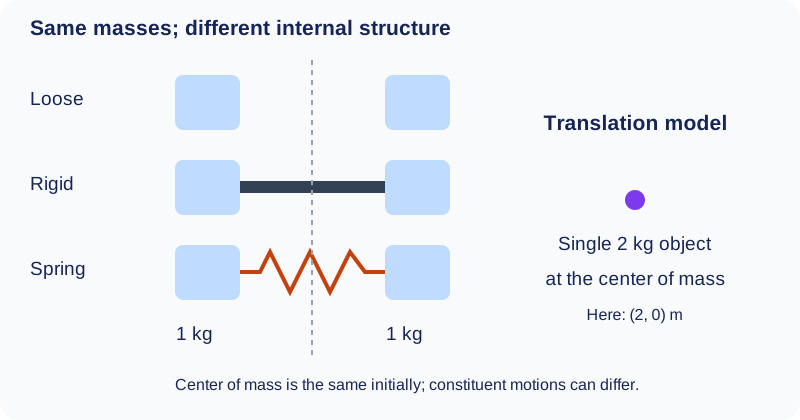
Two 1 kg modules at (0, 0) m and (4, 0) m form a system of total mass 2 kg. Its center of mass is (2, 0) m. Replace the system by a single 2 kg object at that center when the question concerns only center-of-mass translation under a known external resultant. Constituent shape, individual motion, and internal interactions need not be resolved for that question. This replacement does not predict rotation, stretching, or each module’s motion.
Compare the same two modules loose, joined rigidly, and joined by a spring. A 4 N rightward external force applied to one module gives the same whole-system center-of-mass acceleration, 4/2 = 2 m/s², while external horizontal forces on the other module are absent. In the loose case only the pushed module initially accelerates; in the rigid case the connection makes their translational accelerations equal; in the spring case the spring can deform and the modules initially respond differently. The same macroscopic force and total mass can therefore require different internal analyses.
For a spring-connected pair held at rest by equal opposite external pulls, increasing each pull from 2 N to 6 N changes a 100 N/m spring’s extension from 0.020 m to 0.060 m within its linear range. The net external force remains zero, but the external loading changes the internal separation. A zero center-of-mass acceleration does not imply an unchanged substructure.
Inspect diagram labels
The diagram keeps its full size here. Focus the view and use the arrow keys, or scroll across it, to inspect every label.
Example 2.1.3 — Trace a boundary crossing
Choose a cart, its attached heater, and all contents as a system. Energy can cross this boundary through electrical work done by an external power supply; mass can cross when sand is poured into the cart. The supply and incoming sand belong to the environment until the sand enters. A system is not automatically closed just because we draw a boundary around it.
An external 20 W supply operating for 3 s transfers 60 J to the system. Separately, adding 0.10 kg of sand changes a 0.50 kg system into a 0.60 kg system. These examples identify an energy transfer and a mass transfer without requiring a variable-mass acceleration calculation. A boundary description must say which objects are included and which interaction crosses it.
Check what you know
Pause & try it
Let's see what stuck.
Choose an answer, then check the reasoning. Try the written problems below before opening their solutions.
0 of 3 checked · 0 correct
Give it a try
Practice 1
Masses 2 kg, 1 kg, and 1 kg are at (0, 0), (4, 0), and (0, 4) m. Find the center-of-mass coordinates and check their location against the extreme coordinates.
Practice 2
Two carts initially at rest on a horizontal track move apart after releasing a compressed, negligible-mass spring between them. External horizontal forces are negligible. Explain why each cart can move while the center of mass remains at rest. Identify an external interaction that could change that result.
Practice 3
A 2 kg uniform board has center of mass at x = 0.50 m. A 1 kg washer is attached at x = 0.80 m. Predict the new balance point. Sketch how it changes as the washer moves farther right.
Keep exploring
The original Force Analysis uses systems of connected blocks. Keep its worked examples, and add the explicit boundaries and center-of-mass interpretation from this section.
Course scope and standards: the supplied AP Physics 1 CED, printed pages 42, 43; Topic 2.1 and its exact learning objectives. The official College Board CED is the public source; the project audit records the supplied edition.
Supporting physics references: OpenStax: center of mass. These lessons, diagrams, examples, and practice questions were written for this book.
Explain and apply the model
Try these problems before opening the solutions. State your assumptions, show the diagram or calculation, and explain what makes your answer follow.
Decide how much substructure to keep
A system contains a 3 kg module initially at (0, 0) m and a 1 kg module initially at (4, 0) m on a straight horizontal frictionless track. Neglect connection mass and external horizontal forces except a 12 N rightward pull applied to the 3 kg module along the line through both modules. Compare three versions of the same system: the modules are loose, are fixed together by a rigid connection, or are joined by an initially relaxed spring along their separation. Both modules start at rest; no rotation occurs in this collinear setup.
(a) Calculate the system’s center-of-mass coordinates. Replace the system by a single object at a specific location with a specified mass. Justify when constituent properties or interactions can be ignored for this replacement, and name a question it cannot answer.
(b) At the initial instant compare the individual motions of the loose, rigidly connected, and spring-connected modules. Explain why their internal structures change the needed analysis even though the total mass and external pull are identical. Calculate the center-of-mass acceleration and say which parts of the comparison the point model captures.
Your written working
Drawing is temporarily unavailable. Work on paper if needed, then record your reasoning here.
Saving written working requires JavaScript. The problem remains available above; keep your work on paper or in your own notes.
Track transfers and structural changes
Choose a stationary cart, an attached electric heater and its contents as a fixed system. An external supply powers the heater at 10 W for 4 s. In a separate operation 0.20 kg of sand is poured into the initially 0.60 kg system. In another experiment, two modules joined by a 150 N/m ideal spring are held at rest by equal outward external pulls on the two modules, first 3 N each and then 9 N each.
(a) Identify the interaction with the environment that transfers energy into the fixed cart system and calculate that transfer. Identify the mass transfer across the same boundary and find the system mass after the sand enters. Explain why choosing a boundary does not by itself make a system closed to either transfer.
(b) Calculate the spring extension under each pair of pulls. Describe which external variable changes, which internal substructure changes, and why this change can occur while the system’s net external force remains zero.
Your written working
Drawing is temporarily unavailable. Work on paper if needed, then record your reasoning here.
Saving written working requires JavaScript. The problem remains available above; keep your work on paper or in your own notes.
Worked solution and rubric →Revisit the worked example →Revisit the worked example →
Glossary and deeper reading · 5 refreshers
These editorial refreshers supplement the reading. Definitions and examples are added guidance; original source wording and recorded answers remain in their original context.
-
Force
A force describes an interaction that can change an object’s momentum. It is a vector measured in newtons, so both size and direction matter when forces are added. For example, a rope can pull a cart while the floor exerts friction in another direction.
-
Weight
Weight is the gravitational force exerted on an object by a specified attracting body. Near Earth’s surface its magnitude is approximately mass times the local gravitational field strength, and it is measured in newtons. For example, an astronaut has less weight on the Moon while retaining the same mass.
-
Acceleration
Acceleration is the vector rate of change of velocity with time. It can change an object’s speed, direction, or both, and it is measured in meters per second squared. For example, a satellite moving at constant speed in a circular orbit accelerates toward the center.
-
Power
Power is the rate at which energy is transferred or converted. It is measured in watts, with one watt equal to one joule per second. For example, two motors can lift the same load through the same height but have different average powers if they take different times.
-
External force
An external force is exerted on part of a chosen system by something outside that system. The sum of external forces determines the rate of change of the system’s total momentum. For example, Earth’s gravitational force is external to a system consisting only of a falling ball.