Conservation of Energy
Review the chosen system and energy account before modeling spring motion.
Before this connection: Potential energy.
Where did the energy go?
A ball rolls down a ramp, speeds up, hits a spring, and stops for an instant. We could write several force equations, but energy gives a direct connection between its starting arrangement and final arrangement. The first step still isn’t an equation. It’s choosing the system.
For a single object treated as a structureless point, the mechanical energy is its kinetic energy. Potential energy belongs to interacting parts of a larger system, such as ball plus Earth or block plus spring. A system that can deform reversibly can also store elastic potential energy. This object-model statement doesn’t deny that real objects have internal thermal energy; it identifies what our mechanical model includes.
Mechanical energy is E_mech = K + U. If the chosen system has no external energy transfer and no nonconservative interactions changing its mechanical energy, then K_i + U_i = K_f + U_f. Total energy is conserved in every interaction, but mechanical energy needn’t remain constant when some becomes thermal energy or sound.
The boundary determines the accounting
For a falling ball alone, Earth is outside the system. Gravity does external work, increasing the ball’s K. For ball plus Earth, the gravitational interaction is internal: U_g decreases while K increases. These two accounts describe the same fall. Don’t include gravity’s external work and the same internal potential-energy change in one account.
A useful expanded balance is K_i + U_i + W_external = K_f + U_f + ΔE_thermal, when thermal gain is the only additional internal energy change and sound losses are negligible. More generally, include every relevant form and transfer. External work can be positive or negative; it’s the energy crossing the boundary because an external force acts through displacement.
A system can be enlarged to include the environment receiving dissipated energy. The enlarged total may then be constant even while its mechanical-energy portion decreases. Conservation isn’t a claim that friction has no effect. It’s a requirement that the effect be accounted for.
Example 3.4.1 — The ramp and spring
A 1 kg block starts from rest 0.80 m above a horizontal ideal spring of k = 400 N/m. The track is frictionless, and spring compression stays horizontal. Choose block, Earth, and spring. Initial energy is mgh = 8 J using g = 10 m/s². At maximum compression, the block is momentarily at rest, so 8 = ½(400)x². Thus x = 0.20 m.
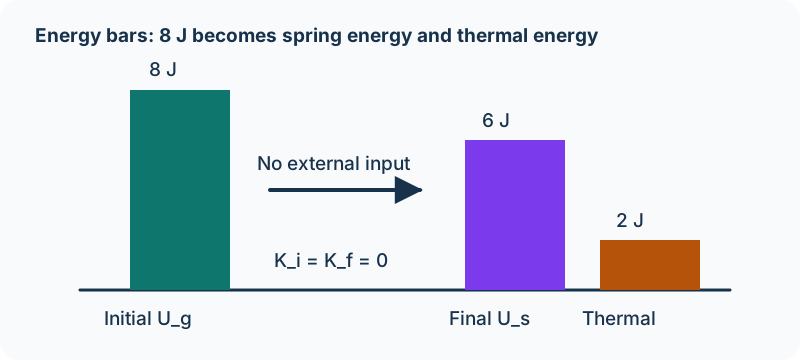
If 2 J becomes thermal energy before maximum compression, the spring receives only 6 J. Now x = √(2·6/400) = 0.173 m. The smaller compression doesn’t mean total energy disappeared; 2 J is stored thermally in the modeled system or transferred to an included environment.
The horizontal spring assumption matters. If the spring compresses vertically while the block keeps moving down, gravitational energy changes during compression too. You can’t stop counting gravity at the instant the spring is touched.
Example 3.4.2 — Gravity keeps helping
A 1 kg object is placed gently on an initially relaxed vertical spring with k = 200 N/m, then released from rest. Let downward compression x be positive and choose initial gravitational zero. At maximum compression, 0 = ½kx² − mgx. The nonzero root is x = 2mg/k = 0.10 m.
Static equilibrium would instead be x_eq = mg/k = 0.050 m. Maximum compression is greater because the object arrives at equilibrium still moving. At the turning point velocity is zero, but the net force isn’t generally zero. Distinguish equilibrium from an instant of zero speed.
Graphs and diagrams are part of the argument
An energy bar chart shows the amount in each energy form at two states and an arrow for transfers. Its total heights should satisfy your equation. A K-versus-position graph can show where speed vanishes; a U-versus-position graph shows how configuration changes. The sum K + U stays horizontal only for a mechanically conservative system.
Roll a cart from several starting heights into a horizontal spring. Measure maximum compression independently and plot x² versus height. For the simple frictionless model, the slope is 2mg/k. A smaller measured slope or nonzero intercept can reveal omitted energy storage, friction, or a reference-height error. Use repeated trials and explain the assumptions rather than forcing all points onto the predicted line.
Worked example — Change the boundary, keep one energy transfer
A 0.50 kg ball falls 2.0 m from rest with g = 10 m/s² and negligible air resistance. In the single structureless-object mechanical model, the ball has kinetic energy only: K increases from 0 to 10 J because gravity from the external Earth does +10 J of work. The ball alone has no internal gravitational potential-energy pair. This statement describes the mechanical object model; real balls can contain thermal energy or deform.
Enlarge the system to ball plus Earth. Gravity is now internal and conservative, so ΔU_g = −10 J and ΔK = +10 J. Both accounts predict v = √(2K/m) = √40 ≈ 6.32 m/s. Count either external gravity work for ball alone or the internal gravitational potential change for the pair; recording both as inputs would double-count the same transfer.
Check what you know
Pause & try it
Let's see what stuck.
Choose an answer, then check the reasoning. Try the written problems below before opening their solutions.
0 of 3 checked · 0 correct
Give it a try
Practice 1
A 2 kg object starts from rest 1.5 m above a floor. Before reaching the floor, 6 J goes into thermal energy. Find its kinetic energy and speed just before landing using g = 10 m/s².
Practice 2
A cart moves between two states with ΔK = +4 J, ΔU = −7 J, and ΔE_thermal = +1 J. Find the external work and explain its sign.
Practice 3
Derive maximum compression for a mass m released from rest on a relaxed vertical spring of stiffness k. Compare it with static equilibrium and explain why they differ.
Keep exploring
The original Introduction to Energy and Potential Energy retain their examples and quizzes. The preserved energy practice offers the full original problem set and separate solutions.
Course scope and standards: the supplied AP Physics 1 CED, printed pages 71, 72; Topic 3.4 and its exact learning objectives. The official College Board CED is the public source; the project audit records the supplied edition.
Supporting physics references: OpenStax: conservative forces and mechanical energy; OpenStax: nonconservative forces and energy accounting. These lessons, diagrams, examples, and practice questions were written for this book.
Explain and apply the model
Try these problems before opening the solutions. State your assumptions, show the diagram or calculation, and explain what makes your answer follow.
Choose a mechanical energy inventory
A 0.80 kg ball falls 1.5 m from rest, with g = 10 m/s². Ignore air resistance and rotation. Consider either the structureless ball alone or the ball–Earth system.
(a) Inventory the mechanical energy forms in the single structureless-ball model. Identify the external interaction that changes that inventory, calculate its work and the final kinetic energy, and state what this model omits about a real ball.
(b) For ball plus Earth, calculate ΔU_g and ΔK and find the final speed. Explain why gravity’s work must not be counted as an additional external energy input to this larger system.
Your written working
Drawing is temporarily unavailable. Work on paper if needed, then record your reasoning here.
Saving written working requires JavaScript. The problem remains available above; keep your work on paper or in your own notes.
Glossary and deeper reading · 7 refreshers
These editorial refreshers supplement the reading. Definitions and examples are added guidance; original source wording and recorded answers remain in their original context.
-
Force
A force describes an interaction that can change an object’s momentum. It is a vector measured in newtons, so both size and direction matter when forces are added. For example, a rope can pull a cart while the floor exerts friction in another direction.
-
Mechanical energy
Mechanical energy is the sum of the kinetic and potential energies included in a model. It stays constant when transfers to or from other energy stores and across the chosen boundary are absent. For example, a pendulum’s mechanical energy can remain approximately constant while energy shifts between motion and gravitational configuration.
-
Kinetic energy
Kinetic energy is energy associated with motion relative to a chosen reference frame. For a nonrelativistic translating object it is one half of its mass times speed squared. For example, doubling a cart’s speed quadruples its translational kinetic energy when its mass stays fixed.
-
Gravity
Gravity is the attractive interaction between masses in the Newtonian model. For spherical bodies or point-mass approximations, its strength decreases with the square of the separation between their centers. For example, Earth’s gravity provides the inward force that keeps a satellite in orbit.
-
Mechanical work
Mechanical work is energy transferred by a force through displacement of its point of application. For a constant force on a particle, it depends on the force component along the particle’s displacement, and it can be positive, negative, or zero. For example, a magnetic force perpendicular to a particle’s displacement does zero work on that particle.
-
External force
An external force is exerted on part of a chosen system by something outside that system. The sum of external forces determines the rate of change of the system’s total momentum. For example, Earth’s gravitational force is external to a system consisting only of a falling ball.
-
Drag
Drag is a force from a fluid that opposes an object’s motion relative to that fluid. Its dependence on speed, shape, and fluid properties varies with the physical regime. For example, a parachute increases air drag by presenting a large area to the moving air.