Pressure: More Than a Downward Push
Distinguish pressure from force and keep gauge and absolute pressure references clear.
More than a downward push
Your ears can feel more pressure as you dive deeper into a pool. But the water isn’t just pushing downward on you. It pushes on the sides, above, and below too. To understand that, we need to separate pressure from the forces it creates.
Pressure on a surface
P = F_perpendicular/A, where F_perpendicular is the magnitude of the force component normal to the surface. The SI unit is the pascal: 1 Pa = 1 N/m². A 24 N normal force spread over 0.0060 m² gives P = 4000 Pa. Spread the same force over twice the area, and the pressure halves. This is why a small contact area can make a modest force have a large local effect. If the force is angled, use its perpendicular component rather than its full magnitude.
Pressure is a scalar, so it has no direction. The pressure force on a particular surface does have a direction: for a fluid at rest it acts perpendicular to that surface. Equal pressure on two opposite faces of a cube produces equal and opposite forces, which can cancel. Equal pressure on unequal areas produces unequal force magnitudes. Also, a uniform pressure doesn’t imply zero force on every face; it means the vector sum over a closed surface can cancel. OpenStax’s pressure discussion supports these distinctions.
The pressure a fluid exerts comes from the interactions of its constituent particles with the surface. In a gas, collisions transfer momentum to the wall. Liquid particles interact with each other and with surfaces, transferring forces throughout the material. Don’t think of pressure as an extra substance stored inside water. It’s a useful macroscopic description of many microscopic interactions.
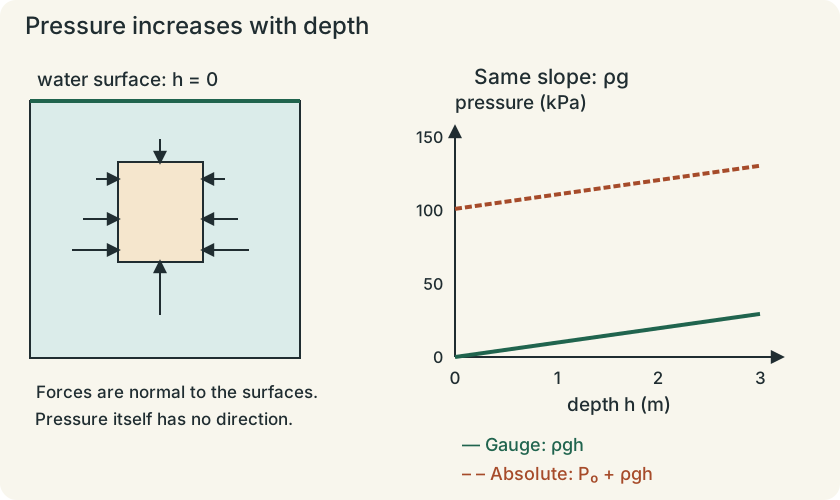
Why pressure increases with depth
Imagine a stationary column of uniform fluid with cross-sectional area A and height h. The upward pressure force at its bottom must balance the downward pressure force at the top plus the column’s weight. So P_bottom A − P_top A − mg = 0. Since m = ρAh, cancel A to get P_bottom − P_top = ρgh. Taking the surface pressure as P₀ gives P = P₀ + ρgh, where h is positive downward from that reference surface.
The gauge pressure relative to that reference is P_gauge = P − P₀ = ρgh. Absolute pressure includes the reference pressure: P_absolute = P₀ + P_gauge. If an open pool’s surface is at atmospheric pressure, its gauge pressure is zero at the surface while its absolute pressure is about atmospheric pressure. Zero gauge pressure doesn’t mean no particles, no force, or a vacuum. OpenStax’s depth derivation supports this hydrostatic model.
At 2.0 m depth in water with ρ = 1000 kg/m³ and g = 9.8 m/s², gauge pressure is 19,600 Pa. If atmospheric pressure is 101,000 Pa, absolute pressure is 120,600 Pa. A pressure sensor showing 19.6 kPa gauge and one showing 120.6 kPa absolute can both be correct at the same point. We need to know what each instrument takes as zero.
Depth, container shape, and area
For the same stationary connected uniform fluid, points at the same height have equal pressure. A wide tank and a narrow tube can have the same bottom pressure if the surface pressure and depth match. The wider bottom still experiences more total force because F = PA. Bottom force isn’t always equal to the entire fluid weight: in containers with sloping walls, the walls exert vertical forces on the fluid too. The pressure formula follows local force balance; it doesn’t assume all the fluid’s weight rests directly on the bottom.
In the required incompressible model, changing pressure does not change a given amount’s density or volume. This is an idealization of liquids, whose volumes change very little under ordinary pressure changes. As useful enrichment, an enclosed static fluid transmits an additional pressure throughout it, so a hydraulic piston uses the same pressure change across different piston areas. If the pistons are at comparable heights, F₂/F₁ = A₂/A₁. The larger output force comes with a shorter output displacement: volume conservation gives A₁Δx₁ = A₂Δx₂. A larger output force isn’t free energy: the larger piston moves a shorter distance.
A graph we can measure
Use a pressure sensor at several measured depths in an open container. Keep the same fluid and record whether the sensor is gauge or absolute. Let the fluid settle, then measure each depth from the free surface to the sensing point. Repeat readings, record units and instrument resolution, and avoid adding air bubbles to a liquid-filled sensor connection. Plot pressure vertically against depth horizontally with a best-fit line. The expected slope is ρg, in Pa/m; an absolute-pressure intercept is P₀, while an atmospheric-gauge intercept should be near zero.
A best-fit slope of 8.82 × 10³ Pa/m implies density 8820/9.8 = 900 kg/m³. Repeating measurements shows random spread, but a constant depth-zero error shifts the intercept and a badly calibrated pressure scale can change the slope. Distinguish those effects in your explanation. Sketch the graph before calculating: a constant-density static fluid should give a straight line, not a curve that gets steeper just because the pressure is larger.
Change it & predict
Go a little deeper
Our liquid is at rest and open to air at 101.3 kPa. Pressure grows with vertical depth, even if the container's shape changes.
At the surface, gauge pressure is zero while absolute pressure is atmospheric pressure. Doubling depth or density doubles the gauge pressure. It doesn't double the absolute pressure because the air-pressure term stays there. We use g = 9.8 m/s².
More pressure does not require more dense ideal fluid
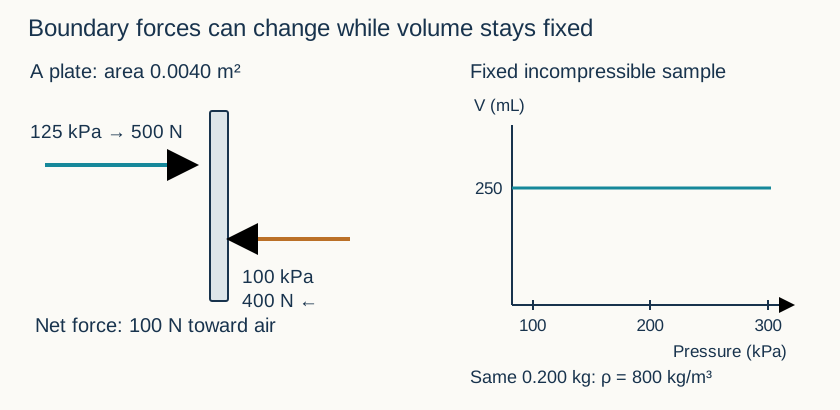
Take a sealed sample of incompressible liquid with mass 0.200 kg and volume 250 mL. Raise its pressure from 100 kPa to 300 kPa at fixed temperature. Within this ideal model the same amount still has volume 2.50 × 10⁻⁴ m³ and density 800 kg/m³. A graph of volume against pressure is horizontal, and so is a graph of density against pressure. Pressure can change the force on a boundary without changing these sample properties. Real liquids compress slightly; a real gas can compress substantially, so neither observation would justify imposing the ideal model without checking the stated assumptions.
Where does the boundary force come from? Many fluid particles interact with each small patch of surface, transferring momentum and forces to it. Their collective normal force, averaged over the patch and time, gives F = PA when pressure is uniform. Particle interactions throughout a liquid transmit those forces; we do not assign the full wall force to a single particle or introduce another downward force called “pressure.”
For a small vertical plate of area 0.0040 m², suppose the fluid pressure is approximately uniform at 125 kPa on one side and the air is at 100 kPa on the other. The fluid pushes perpendicular to the plate with 500 N; the air pushes back with 400 N. The net force is 100 N toward the air side. The pressure values are scalars. The opposing surface normals determine the force directions, and subtracting the two forces matters even though both pressures are positive.
Inspect diagram labels
The diagram keeps its full size here. Focus the view and use the arrow keys, or scroll across it, to inspect every label.
Check pressure and force
Pause & try it
Let's see what stuck.
Choose an answer, then check the reasoning. Try the written problems below before opening their solutions.
0 of 3 checked · 0 correct
Written practice: a submerged window
A small horizontal window of area 0.020 m² is 1.5 m below an open water surface. Air behind it is at the same atmospheric pressure as the surface. Approximate the pressure as uniform over the window. Find the net pressure force and explain why using absolute water pressure alone would be wrong.
Open the separate worked solution.
For retained companion practice, try problem 22 on hydraulic force and its separate solution. Pascal’s named hydraulic application is enrichment; pressure, force per area, and incompressibility are the required ideas.
Teaching reference: CED topic 8.2, printed page 135 covers pressure on a surface, particle interactions, and gauge versus absolute pressure.
Explain and apply the model
Try these problems before opening the solutions. State your assumptions, show the diagram or calculation, and explain what makes your answer follow.
Pressure changes without compressing the ideal sample
A sealed 300 mL sample of ideal incompressible liquid has mass 0.240 kg. Its pressure is changed from 100 kPa to 250 kPa at fixed temperature. A separate small vertical plate has area 0.0060 m², approximately uniform liquid pressure 130 kPa on its left face and air pressure 100 kPa on its right face. The two faces are at the same height; treat all stated pressures as absolute.
(a) Find the sample volume and density at both pressures. Sketch volume-versus-pressure and density-versus-pressure graphs over 100–250 kPa with labeled axes. Explain what incompressibility holds fixed for this given amount and whether it also holds pressure fixed.
(b) Explain how the collective interactions of the fluid particles with a surface create pressure. Draw and calculate the two normal forces on the plate and their resultant. Explain why scalar pressure can produce a force with a direction and why using only the liquid force gives the wrong net force.
Your written working
Drawing is temporarily unavailable. Work on paper if needed, then record your reasoning here.
Saving written working requires JavaScript. The problem remains available above; keep your work on paper or in your own notes.
Glossary and deeper reading · 11 refreshers
These editorial refreshers supplement the reading. Definitions and examples are added guidance; original source wording and recorded answers remain in their original context.
-
Magnitude
Magnitude is the nonnegative size of a vector quantity. It does not specify direction, and it differs from a signed component. For example, a westward velocity can have a negative x component while its speed, the velocity magnitude, stays positive.
-
Force
A force describes an interaction that can change an object’s momentum. It is a vector measured in newtons, so both size and direction matter when forces are added. For example, a rope can pull a cart while the floor exerts friction in another direction.
-
Scalar
A scalar is a quantity described by a value and unit without a spatial direction. A scalar can have a sign when its definition or reference permits one; scalar does not mean always positive. For example, mass is a scalar, whereas the velocity of that mass also needs a direction.
-
Fluid
A fluid is a material that flows and continuously deforms under a sustained shear stress. Liquids and gases are both fluids, although their compressibility and other properties can differ greatly. For example, both water in a pipe and air flowing through a duct are fluids.
-
Linear momentum
Linear momentum is a vector describing an object’s motion and equals mass times velocity in the nonrelativistic model. The vector sum of momenta is conserved when the net external impulse on the system is zero. For example, two identical carts moving equally fast in opposite directions have zero total linear momentum but nonzero total kinetic energy.
-
Gauge pressure
Gauge pressure is the difference between a system’s pressure and a specified surrounding reference pressure. An ordinary pressure gauge usually uses local atmospheric pressure as its zero. For example, a container open to the atmosphere has approximately zero gauge pressure while its absolute pressure is not zero.
-
Absolute pressure
Absolute pressure is pressure measured relative to a perfect vacuum. It includes the atmospheric contribution that gauge pressure omits and is required in the ideal gas law. For example, a tire’s absolute pressure is its gauge reading plus the surrounding atmospheric pressure.
-
Incompressible fluid
An incompressible-fluid model treats density as constant despite pressure changes in the modeled situation. This approximation often works for liquids over modest pressure ranges but is not a universal property of all fluids. For example, water flowing through a narrowing pipe can often be treated as incompressible.
-
Mass density
Mass density is mass per unit volume of a material or sample. It is commonly measured in kilograms per cubic meter and can vary with temperature or pressure. For example, equal-volume samples of water and oil generally have different masses because their densities differ.
-
Normal force
A normal force is a contact force perpendicular to the local surface of contact. Its magnitude is set by the motion and the other forces, so it need not equal the object’s weight. For example, a wall’s normal force on a leaning ladder points horizontally rather than upward.
-
Resultant vector
A resultant vector is the vector sum of two or more vectors. Its components are the sums of the corresponding components of the vectors being combined. For example, two equal forces in opposite directions have a zero resultant even though both forces are present.