Spring Forces
Review relaxed length, equilibrium, and the difference between spring force and restoring net force.
Before this connection: Force diagrams.
The spring wants its length back
It’s exactly what it sounds like: a spring force is the force a spring exerts on an object. Stretch the spring and it pulls back; compress it and it pushes back. Let’s turn that familiar behavior into a model we can actually test.
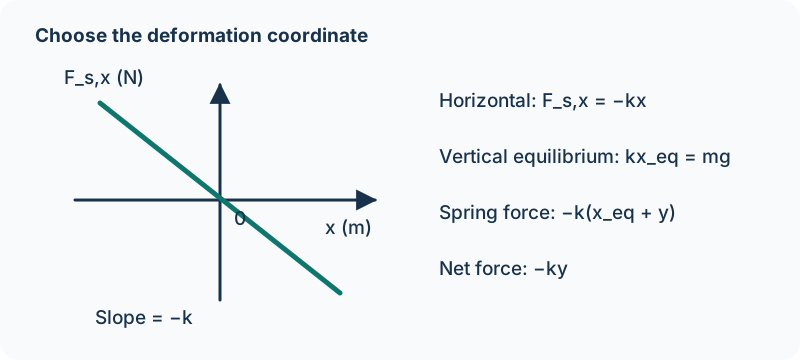
An ideal spring has negligible mass and a force proportional to its change in length from the relaxed length. For a horizontal spring with signed extension x measured from that length, F_s,x = −kx. In magnitude form, |F_s| = k|x|. The spring constant k has units N/m. A larger k means more force for the same extension or compression.
The minus sign is doing a specific job: it makes the spring force point opposite the signed deformation. If x is positive, the force component is negative. If x is negative, the force component is positive. That is why the force is called restoring. It isn’t a statement that every spring force is negative.
The model has a useful range
Hooke’s law assumes an approximately linear elastic response. A real spring may depart from a straight-line relationship if stretched too far, and permanent deformation can change its relaxed length. The word ideal tells us what we are neglecting, not that every rubber band and spring follows F = −kx under any load.
Measure deformation from the relaxed length, not from the spring’s total length. A 0.20 m long relaxed spring stretched to 0.25 m has extension 0.05 m. Substituting 0.25 m would count length that didn’t produce the modeled restoring force.
For a horizontal block–spring system with no other horizontal force, its equilibrium position is the relaxed-length position. The spring force points toward that equilibrium. With other constant forces, distinguish the spring force from the net restoring force about the system’s displaced equilibrium.
Example 2.8.1 — Stretch, then compress
An ideal spring has k = 200 N/m. When x = +0.030 m, the force component on its attached block is −200(0.030) = −6.0 N. When x = −0.020 m, the force is −200(−0.020) = +4.0 N. The compression is smaller, so the force magnitude is smaller.
Plotting F_s,x versus x gives a straight line through the origin with slope −k. Plotting the magnitude of an external holding force versus positive extension gives slope +k, because the holding force balances the spring force. Label which force you’re graphing; otherwise the slope sign can look like a contradiction.
A vertical spring adds gravity
Hang a 0.50 kg mass from a vertical spring with k = 100 N/m. Let downward deformation x be positive from the relaxed length. Spring force is −kx and gravity is +mg. At equilibrium, mg − kx_eq = 0, so x_eq = mg/k = 0.050 m with g = 10 m/s².
The spring still pulls upward at equilibrium; its force isn’t zero. Gravity balances it. If the mass is displaced an extra y below that equilibrium, x = x_eq + y. The net force becomes mg − k(x_eq + y) = −ky. Thus the net force restores the object toward the displaced equilibrium. Keeping these two origins separate prevents errors later when combining spring force, oscillations, and energy.
The elastic energy in Unit 3 depends on deformation from the relaxed length. The net-force equation for oscillation can instead use displacement from the gravity-shifted equilibrium. They’re both valid, but they use different coordinates for different questions.
Measure k rather than guessing it
Measure the unloaded length of a spring. Add several known masses slowly and wait for each to settle. Record extension and the applied force mg, keeping within the linear range. Plot force versus extension with labeled scales and units, then use the best-fit slope to determine k. Several loads reveal linearity better than one measurement.
Read the ruler at eye level to reduce parallax, and keep the same reference point. If a spring has initial tension, a nonzero intercept may be physical; if the initial length was read incorrectly, the intercept can signal a systematic error. Repeat loading and unloading to check whether the spring returns to the same relaxed length. A procedure should name what is measured and how the slope answers the question.
Example 2.8.2 — Restoring spring force or restoring net force?
An ideal spring has negligible mass. Its force magnitude is proportional to deformation measured from relaxed length within its linear range. A spring with relaxed length 0.20 m and k = 80 N/m held at length 0.25 m has extension 0.05 m and spring-force magnitude 4 N. Doubling the extension to 0.10 m doubles the magnitude to 8 N; doubling the total length would not be the correct proportional comparison.
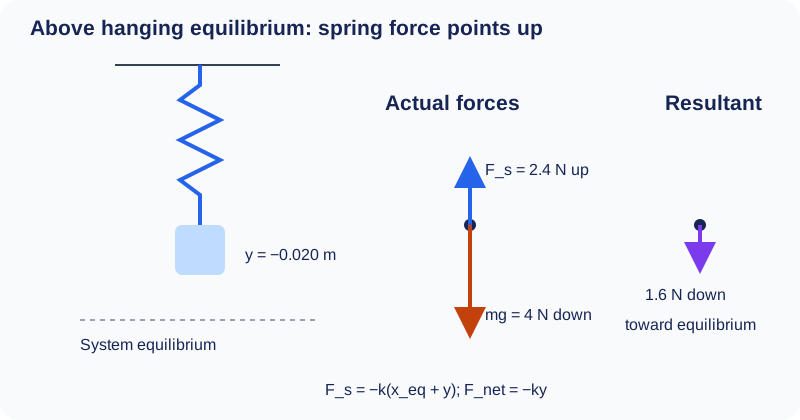
Hang a 0.40 kg mass on that spring with downward positive and g = 10 m/s². Its equilibrium extension is x_eq = mg/k = 0.050 m. When the mass is 0.020 m above equilibrium, y = −0.020 m and x = x_eq + y = 0.030 m. The spring force is F_s = −kx = −2.4 N, upward, while the net force is mg − kx = +1.6 N, downward toward equilibrium. Here the spring force points away from the system’s equilibrium even though the net force restores the mass toward it.
The source’s always-toward-equilibrium spring-force wording is therefore correctly applicable to the horizontal spring with no other horizontal force, where equilibrium coincides with relaxed length. For the hanging system, use F_s = −k(x_eq + y) for the spring force and F_net = −ky for the net restoring force. The two graphs have the same slope −k but different intercepts: at y = 0 the spring force is −mg and the net force is zero. To find the spring force, measure deformation from the relaxed length; to find the system’s net restoring force, measure displacement from its equilibrium.
Inspect diagram labels
The diagram keeps its full size here. Focus the view and use the arrow keys, or scroll across it, to inspect every label.
Infer kinetic friction from a spring and instantaneous acceleration
Assume a linear ideal spring and a block already sliding left while remaining in contact with the stationary horizontal floor. Continued floor contact establishes zero perpendicular acceleration; zero instantaneous vertical velocity alone would not establish that. The measured acceleration is instantaneous, and its direction follows the net force. Spring deformation and acceleration change during subsequent motion. The data determine the kinetic coefficient, not the static coefficient.
Historical force/component construction diagrams; link native dot-origin individual-force FBD instruction. Do not count component projections as extra forces. Individual-force diagram conventions →
Notation and model qualifications in the retained source
- Use continued floor contact to justify zero perpendicular acceleration. Original wording →
- Acceleration follows the net force; do not infer it from spring deformation alone. The compression comparison assumes symmetric Hooke behavior and reversed sliding. Original wording →
Review the model and equations used here →
Example Problem 2.3.1
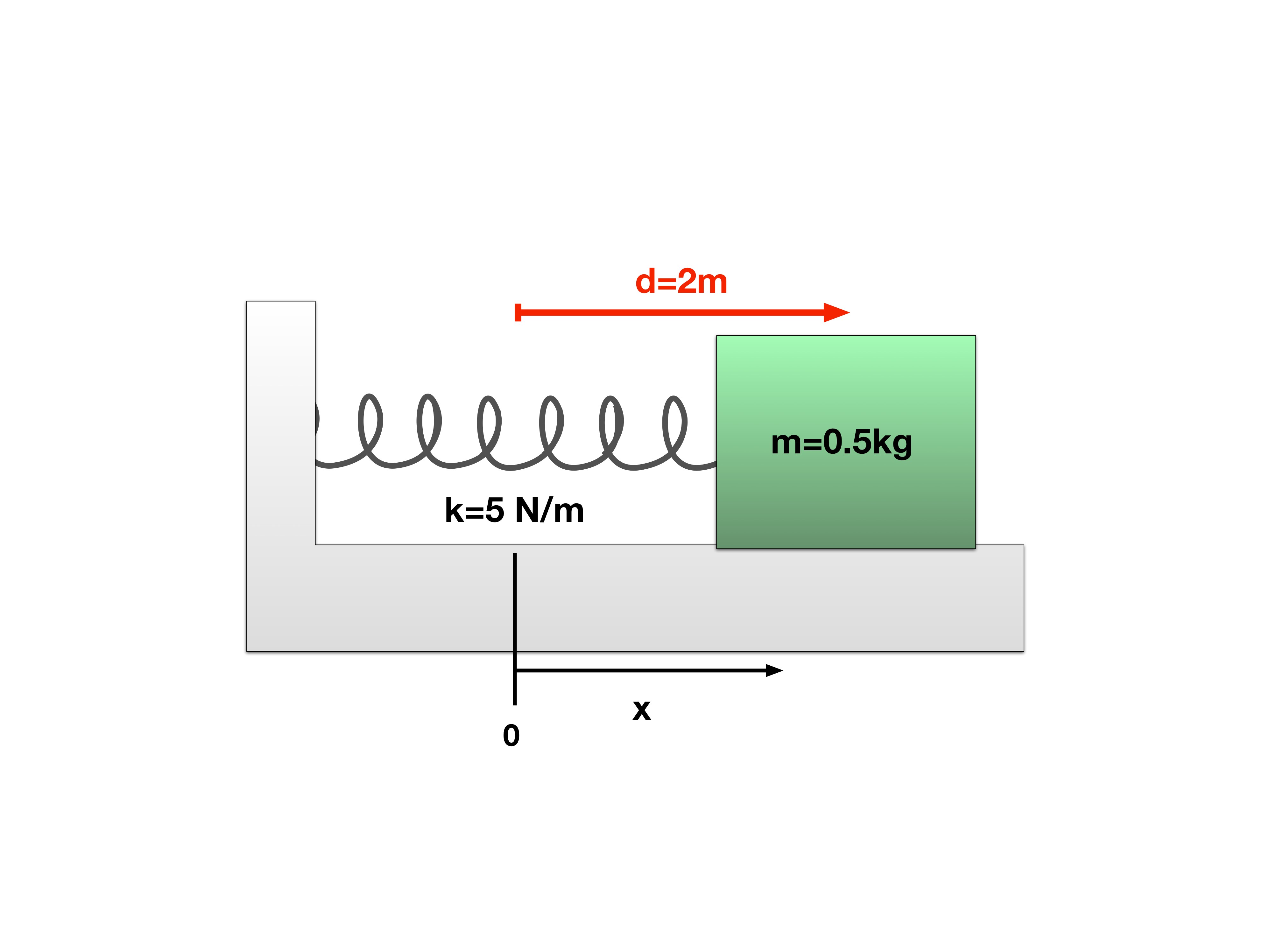
A 0.5 kg block on a level floor is attached to a spring with k = 5 N/m. The spring is extended by 2 m. Immediately after release, the block slides toward the wall and accelerates at 1 m/s². Find the kinetic friction coefficient. Use g = 9.81 m/s².
Step 1: Draw the Free Body Diagram
The spring force points opposite the displacement from the relaxed position. It need not point opposite velocity: when the block moves back toward equilibrium, force and velocity can point the same way.
Step 2: Break into components
In the second image of Gallery 2.3.2, we broke it down into x and y components. This will make it easier for us when we set up our equations of motion. In the x-direction, there is only the spring force and friction force acting on the block. In the the y-direction, you have to normal force and weight
Step 3: Set up equations of motion
In the y-direction we have:
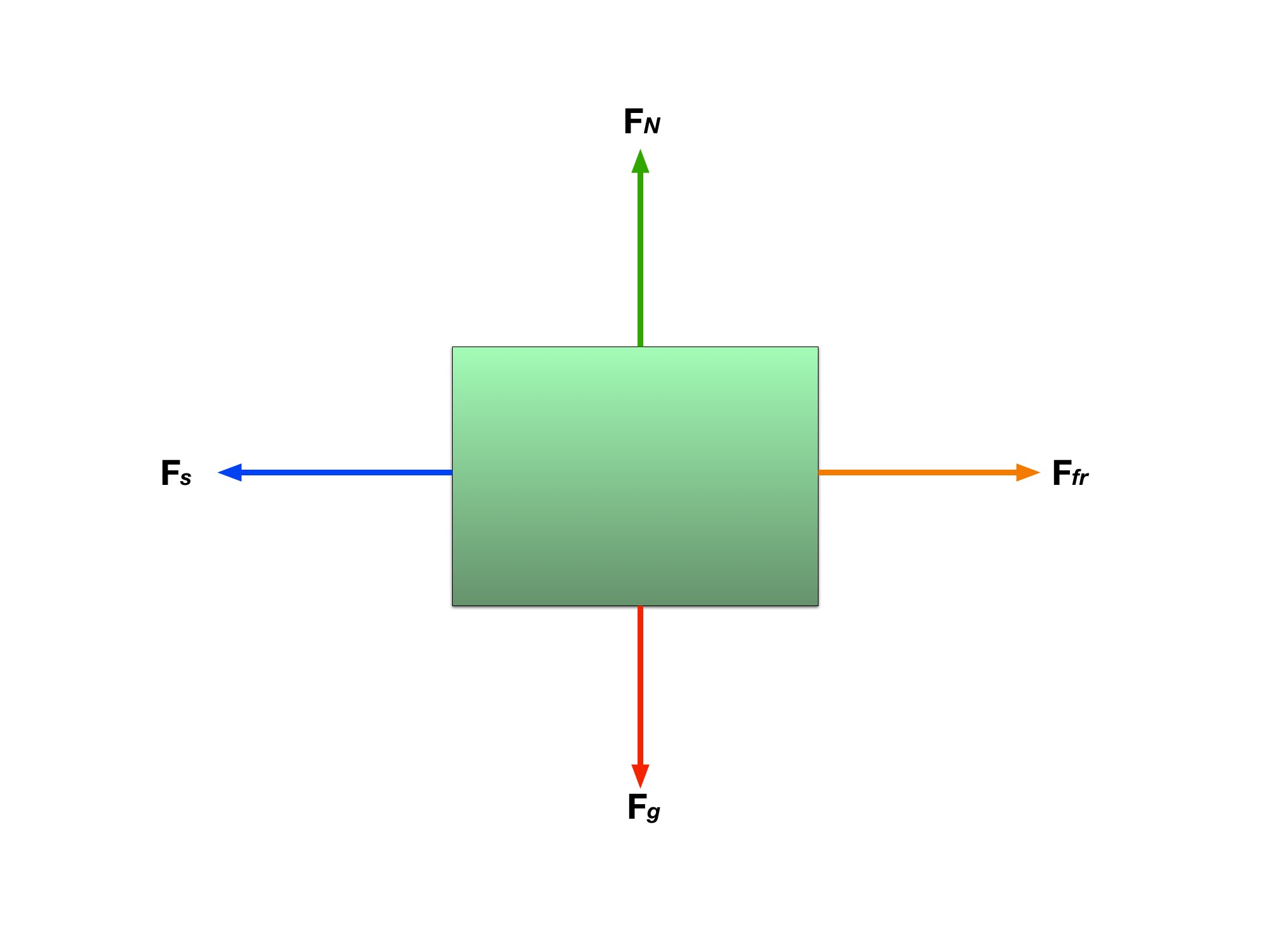
The spring adds a restoring force directed toward its relaxed position, opposite the extension in this diagram.
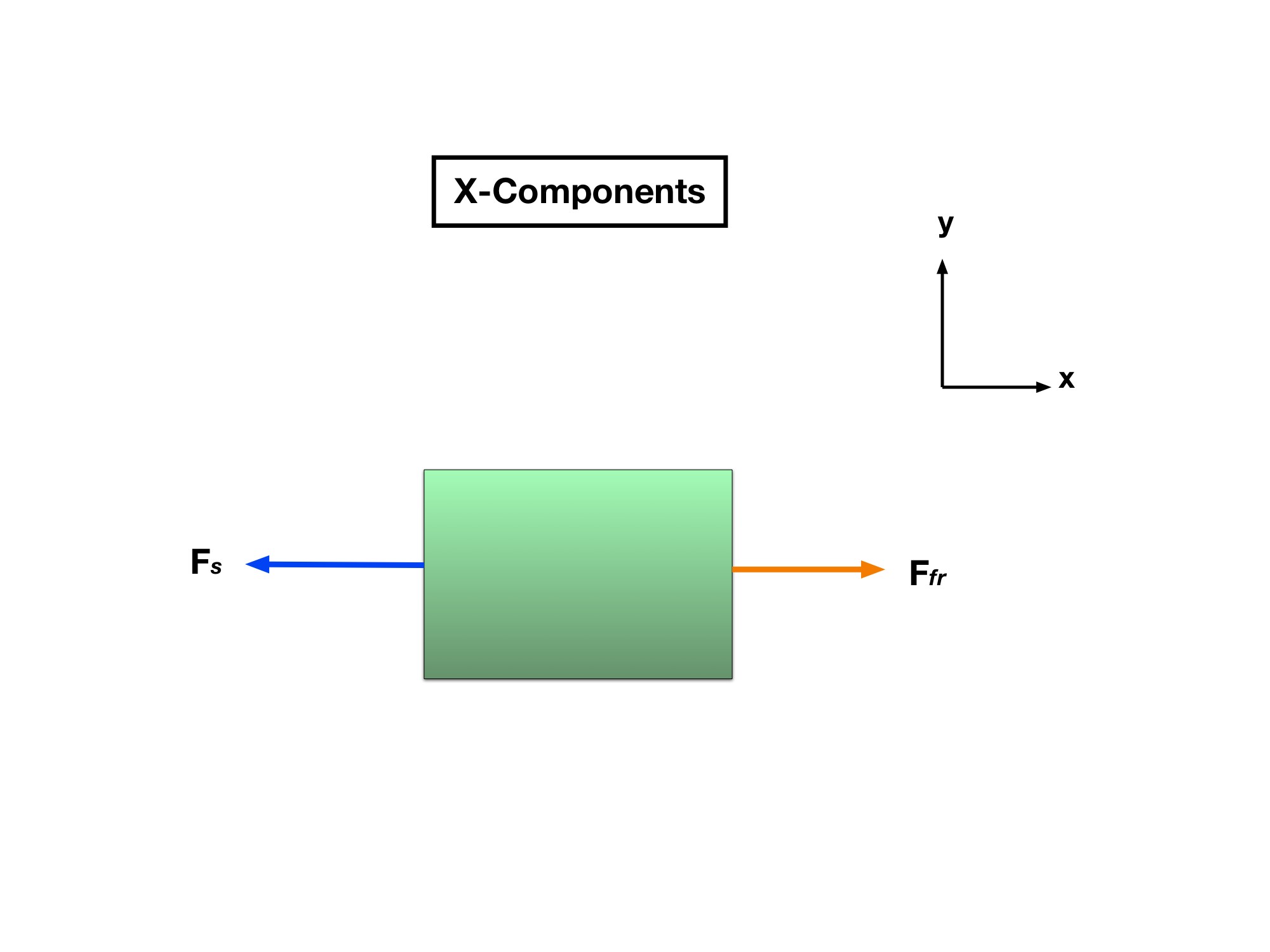
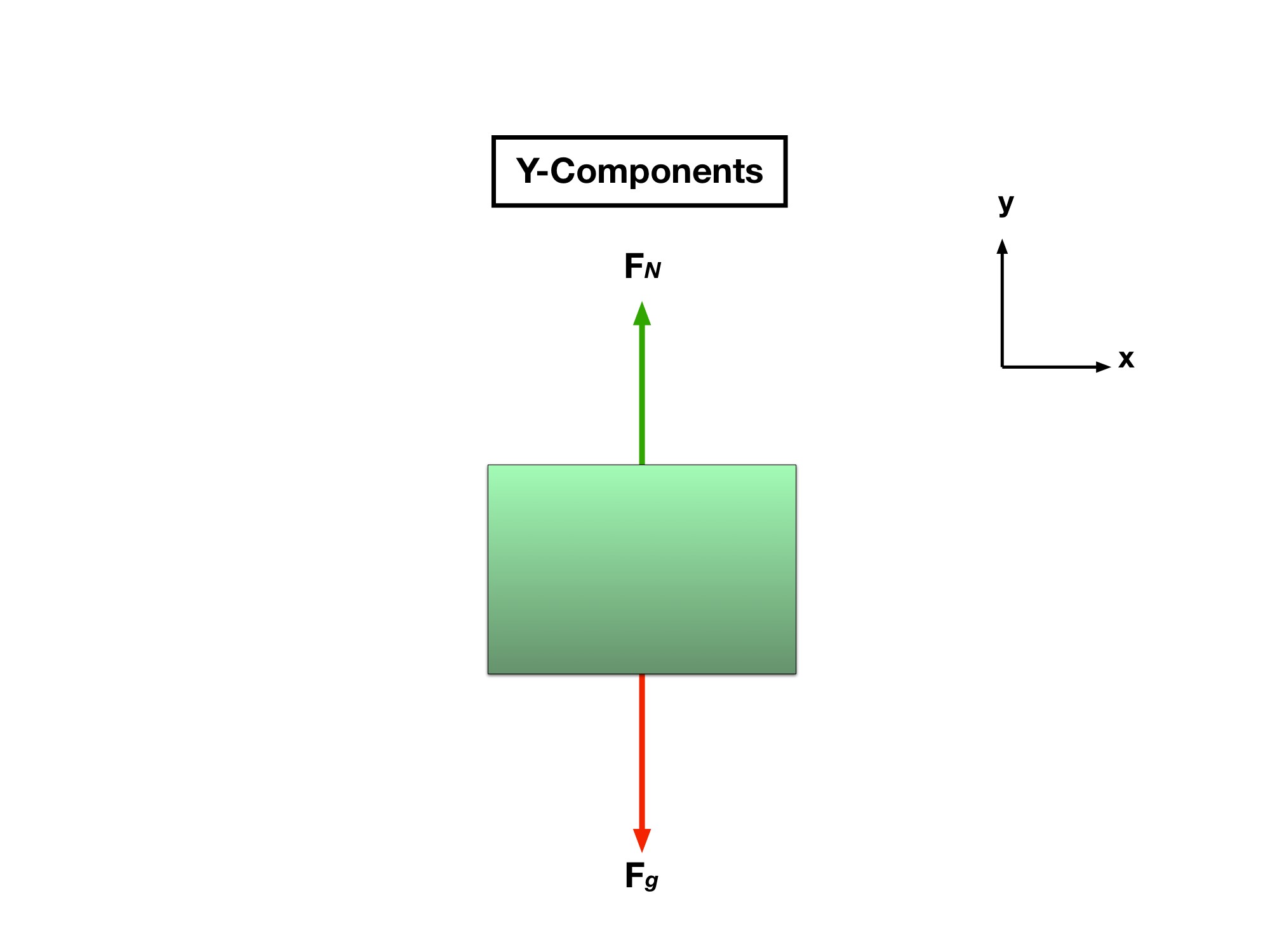
We know that , but we don’t have to worry about the negative sign since it is already taken into account in our equation of motion. This means our equation is now:
μₖN − kx = maₓ, so μₖ(4.905 N) − (5 N/m)(2 m) = (0.5 kg)(−1 m/s²).
μₖ(4.905 N) = 9.5 N.
μₖ = 9.5/4.905 = 1.937.
This is a large kinetic coefficient, but the equations allow it. The given data do not determine μₛ. Horizontal forces do not cause the block to bounce vertically.
Physics I by Jake Yap and Laurence Vincent. Complete historical context and correction history →
Check what you know
Pause & try it
Let's see what stuck.
Choose an answer, then check the reasoning. Try the written problems below before opening their solutions.
0 of 3 checked · 0 correct
Give it a try
Practice 1
A spring of relaxed length 0.15 m is held at length 0.21 m by a 9 N force. Find k, then predict the holding-force magnitude for length 0.18 m.
Practice 2
Derive the vertical equilibrium extension mg/k. For displacement y from that equilibrium, show why the net force is −ky even though the spring force isn’t −ky.
Practice 3
Experimental pairs are (extension, force): (0.01 m, 2 N), (0.02 m, 4 N), and (0.03 m, 6 N). Sketch the graph, infer k with units, and state one measurement that would test the limit of the linear model.
Keep exploring
The original Spring Force retains its visual galleries and quizzes. Use relaxed length for the deformation there; the later Simple Harmonics develops motion about equilibrium.
Course scope and standards: the supplied AP Physics 1 CED, printed pages 55; Topic 2.8 and its exact learning objectives. The official College Board CED is the public source; the project audit records the supplied edition.
Supporting physics references: OpenStax: Hooke’s law and spring restoring force. These lessons, diagrams, examples, and practice questions were written for this book.
Explain and apply the model
Try these problems before opening the solutions. State your assumptions, show the diagram or calculation, and explain what makes your answer follow.
Distinguish the two restoring-force origins
An ideal spring has relaxed length 0.18 m. A 12 N holding force stretches it to 0.24 m within the linear range. The spring is then used vertically to suspend a 0.60 kg mass. Use g = 10 m/s², measure downward spring deformation x from relaxed length and displacement y from the hanging equilibrium.
(a) State the ideal-spring mass assumption and its proportional force–length-change relation. Calculate k and predict the holding-force magnitude at total spring length 0.21 m. Explicitly identify the relaxed-length reference and explain why total length cannot replace deformation.
(b) Derive the hanging equilibrium extension. When the mass is 0.010 m above that equilibrium, calculate the spring force and net force with signs and directions. Evaluate the claim that the spring force always points toward the object–spring system’s equilibrium; identify the correctly scoped horizontal case and explain the counterexample.
(c) Sketch spring force and net force versus y for the hanging system, labeling slopes and intercepts. Explain why their intercepts differ even though both lines have slope −k, and identify which force is zero at system equilibrium.
Your written working
Drawing is temporarily unavailable. Work on paper if needed, then record your reasoning here.
Saving written working requires JavaScript. The problem remains available above; keep your work on paper or in your own notes.
Glossary and deeper reading · 13 refreshers
These editorial refreshers supplement the reading. Definitions and examples are added guidance; original source wording and recorded answers remain in their original context.
-
Force
A force describes an interaction that can change an object’s momentum. It is a vector measured in newtons, so both size and direction matter when forces are added. For example, a rope can pull a cart while the floor exerts friction in another direction.
-
Magnitude
Magnitude is the nonnegative size of a vector quantity. It does not specify direction, and it differs from a signed component. For example, a westward velocity can have a negative x component while its speed, the velocity magnitude, stays positive.
-
Spring constant
A spring constant measures the stiffness of a spring within its approximately linear range. Its units are newtons per meter, and a larger value means more force is needed for the same deformation. For example, two springs stretched by the same distance exert different forces if one is stiffer.
-
Restoring force
A restoring force points toward an equilibrium position when an object is displaced from it. Simple harmonic motion requires the net restoring force to be proportional to displacement and opposite in direction. For example, a compressed ideal spring pushes its attached object back toward the spring’s relaxed length.
-
Equilibrium position
An equilibrium position is a position at which the net force in the modeled coordinate is zero. In a stable oscillator, displacement to either side produces a restoring force back toward that position. For example, a mass on a vertical spring oscillates about a position below the spring’s relaxed-length position because gravity shifts the balance.
-
Mechanical equilibrium
Mechanical equilibrium means there is no translational or angular acceleration for the system being considered. For a rigid body, both the net external force and the net external torque must vanish. For example, a stationary ladder supported against a wall requires both force balance and torque balance.
-
Gravity
Gravity is the attractive interaction between masses in the Newtonian model. For spherical bodies or point-mass approximations, its strength decreases with the square of the separation between their centers. For example, Earth’s gravity provides the inward force that keeps a satellite in orbit.
-
Net force
Net force is the vector sum of all forces acting on the object or system under consideration. For constant mass in an inertial frame, it equals mass times acceleration. For example, equal upward and downward forces give zero net force even though neither force is zero.
-
Displacement
Displacement is the vector change in position from the start of an interval to its end. It depends on those endpoints rather than the length or shape of the path traveled. For example, walking around a closed track and returning to the start gives zero displacement but a nonzero distance traveled.
-
Tension
Tension is a pulling force transmitted through a stretched rope, string, or similar connector. It acts along the connector away from the object it pulls, and an ideal massless rope has the same tension throughout an uninterrupted segment. For example, a rope supporting an accelerating load can have a tension different from the load’s weight.
-
Acceleration
Acceleration is the vector rate of change of velocity with time. It can change an object’s speed, direction, or both, and it is measured in meters per second squared. For example, a satellite moving at constant speed in a circular orbit accelerates toward the center.
-
Velocity
Velocity describes how position changes with time and includes direction. Instantaneous velocity describes one moment, while average velocity is displacement divided by elapsed time. For example, a car turning a corner can change velocity while maintaining the same speed.
-
Free-body diagram
A free-body diagram shows the external forces acting on one selected object or system. Each arrow names a real interaction, and its direction is the direction of that force. For example, a book resting on a desk has a downward gravitational force and an upward normal force; velocity is not an extra force arrow.