Change in Momentum and Impulse
Connect force-time area and momentum-time slope to impulse.
A force needs some time
Catching a ball with a stiff hand hurts more than letting your hand move back with it. In both cases, the ball can go from the same incoming velocity to rest. Its momentum change is the same, but the time available for that change is different. Impulse connects these ideas: J = F_net,avg Δt = Δp. The units N·s and kg·m/s are equivalent. Impulse is a vector. Over a positive time interval, the net impulse points in the same direction as the average net external force; a constant force gives impulse in that force’s direction. If force reverses during the interval, use the signed areas or average net force instead of just its initial direction.
Be careful with the word “net.” A force sensor might record one contact force while gravity or friction also acts. The impulse–momentum theorem uses the net external impulse on your selected system. In a short horizontal cart collision, the vertical normal and gravitational forces balance and the horizontal friction impulse may be negligible. For a person pushing upward over a long interval, gravity cannot just disappear from the calculation.
Worked example: bounce instead of stop
A 0.20 kg ball moves right at 6.0 m/s and leaves a wall moving left at 4.0 m/s. Take right as positive. Then p_i = +1.2 kg·m/s and p_f = −0.80 kg·m/s. The change is Δp = p_f − p_i = −2.0 kg·m/s. Notice that we subtract a positive initial value from a negative final value. The speed fell by 2.0 m/s, but the velocity changed by −10 m/s because the ball reversed.
If contact lasts 0.050 s and other horizontal impulses are negligible, F_net,avg = −2.0/0.050 = −40 N. This is an average force, not necessarily the peak force. If the same momentum change happens over twice the time, the average force magnitude is halved. You cannot infer peak force without information about the shape of the force–time curve.
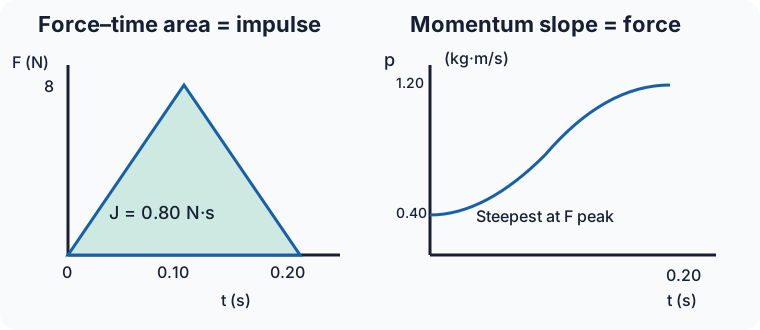
Two graphs, one interaction
On a graph of net force against time, the signed area is impulse. A rectangle gives FΔt; a triangle gives ½ × base × height. Add areas above the axis and subtract the magnitudes of areas below it. A force that reverses direction can produce zero net impulse even though it acted strongly during the interval.
In the diagram, a triangular pulse lasts 0.20 s with peak 8.0 N. Its area is ½(0.20)(8.0) = 0.80 N·s. A cart starting at p_i = 0.40 kg·m/s ends at p_f = 1.20 kg·m/s. The average force is 0.80/0.20 = 4.0 N, half the triangle’s peak. If the cart has mass 0.50 kg, its velocity changes from 0.80 to 2.40 m/s.
A momentum–time graph tells the same story differently. Its slope is net external force. A horizontal section means zero net force, even when momentum is nonzero. A straight sloping section means constant net force. A curve that grows steeper means the force magnitude is increasing. At the triangular pulse’s peak, momentum is changing fastest; it has not yet reached its final maximum.
Where Newton’s second law comes from
For constant mass, Δp = mΔv. Divide J = Δp by Δt to get F_net,avg = mΔv/Δt = ma_avg. On a sufficiently small time interval, the same relationship describes the instantaneous acceleration and force. AP Physics 1 uses constant-mass systems for this quantitative work; changing-mass rocket calculations are outside this topic’s required scope.
Instructional example (guided activity):
Plan a measurement that can test the relationship
Use a low-friction cart with known total mass, a motion sensor, and a force sensor attached to a bumper. Zero the force sensor before each trial. Measure signed velocity just before and just after contact, and record force frequently enough to resolve the short pulse. Calculate m(v_f − v_i), then compare it with the signed force–time area over the same interaction interval. Repeat with a softer bumper. Predict similar impulses when initial and final velocities match, but a longer pulse and lower average force for the softer bumper.
Worked derivation — From impulse to acceleration
For a constant-mass system, begin with J_net = F_net,avgΔt = Δp. Since p = mv and m does not change, Δp = m(v_f − v_i) = mΔv. Divide by the same positive Δt to obtain F_net,avg = Δp/Δt = mΔv/Δt = ma_avg. This is Newton’s second law averaged over the interval; for constant force it also gives the constant acceleration, and on a sufficiently short interval the instantaneous relation is F_net = ma.
A 0.80 kg cart changes velocity from −1.0 m/s to +2.0 m/s in 0.30 s. Its Δv is +3.0 m/s, so Δp = +2.4 kg·m/s, a_avg = +10 m/s², and F_net,avg = +8.0 N. A rectangle at +8.0 N lasting 0.30 s has the same +2.4 N·s area. A variable force can have that average without having constant instantaneous acceleration; the derivation does not replace the measured force with its peak.
Make the graphs agree
Pause & try it
Let's see what stuck.
Choose an answer, then check the reasoning. Try the written problems below before opening their solutions.
0 of 3 checked · 0 correct
Assigned practice: contact force includes gravity
A 2.0 kg object is moving downward at 3.0 m/s. A hand brings it to rest in 0.40 s. Find the average upward hand force, taking g = 9.8 m/s².
Open the separate worked solution.
Assigned practice: choose the sensor and comparison
A 0.50 kg cart approaches a bumper at +2.0 m/s and leaves at −1.0 m/s. Contact lasts about 0.020 s. You have a motion sensor and can record the bumper force at either 50 samples/s or 2,000 samples/s. Choose a force setting and describe what measurements would let you test the impulse–momentum theorem, including one check for a systematic error. A softer bumper produces the same endpoint velocities over 0.040 s. Predict how its net impulse and average net force compare with the first bumper; justify the signs and ratios.
Open the separate worked solution.
For the lab, discuss a specific uncertainty: velocity estimated over an interval that includes the collision can underestimate the true change. Shorten that fitting interval while retaining enough measurements to limit noise. Include scales and units on both graphs and compare uncertainty ranges, rather than expecting exact equality from real data.
The original momentum and impulse lesson supplies additional quizzes and a worked falling-system example. The system and gravitational impulse matter there too.
Sources and scope: College Board CED, with edition-specific coverage verified against the supplied file. Supplied College Board CED, printed pp. 81–82, 4.2.A–B, requires force–time areas, momentum–time slopes, and the constant-mass theorem. OpenStax: Impulse and Collisions verifies the impulse–momentum relation and average-force distinction. Original measurements and questions practice 1.B, 2.A, 2.D, 3.A, and 3.C.
Explain and apply the model
Try these problems before opening the solutions. State your assumptions, show the diagram or calculation, and explain what makes your answer follow.
Derive the force law from impulse
A constant-mass 1.2 kg cart changes velocity from −2.0 m/s to +1.0 m/s in 0.40 s. Right is positive. The measured force can vary during the interval.
(a) Starting from the net impulse–momentum theorem, derive the full chain F_net,avg = Δp/Δt = mΔv/Δt = ma_avg. State the constant-mass assumption and explain when the chain can represent instantaneous quantities.
(b) Calculate Δp, the net impulse, average acceleration and average net force with signs. Sketch a constant-force rectangle having the same impulse, labeling force/time axes and area, and explain why its height need not be the real peak force.
Your written working
Drawing is temporarily unavailable. Work on paper if needed, then record your reasoning here.
Saving written working requires JavaScript. The problem remains available above; keep your work on paper or in your own notes.
Glossary and deeper reading · 9 refreshers
These editorial refreshers supplement the reading. Definitions and examples are added guidance; original source wording and recorded answers remain in their original context.
-
Velocity
Velocity describes how position changes with time and includes direction. Instantaneous velocity describes one moment, while average velocity is displacement divided by elapsed time. For example, a car turning a corner can change velocity while maintaining the same speed.
-
Linear momentum
Linear momentum is a vector describing an object’s motion and equals mass times velocity in the nonrelativistic model. The vector sum of momenta is conserved when the net external impulse on the system is zero. For example, two identical carts moving equally fast in opposite directions have zero total linear momentum but nonzero total kinetic energy.
-
Force
A force describes an interaction that can change an object’s momentum. It is a vector measured in newtons, so both size and direction matter when forces are added. For example, a rope can pull a cart while the floor exerts friction in another direction.
-
Gravity
Gravity is the attractive interaction between masses in the Newtonian model. For spherical bodies or point-mass approximations, its strength decreases with the square of the separation between their centers. For example, Earth’s gravity provides the inward force that keeps a satellite in orbit.
-
Net force
Net force is the vector sum of all forces acting on the object or system under consideration. For constant mass in an inertial frame, it equals mass times acceleration. For example, equal upward and downward forces give zero net force even though neither force is zero.
-
Magnitude
Magnitude is the nonnegative size of a vector quantity. It does not specify direction, and it differs from a signed component. For example, a westward velocity can have a negative x component while its speed, the velocity magnitude, stays positive.
-
External force
An external force is exerted on part of a chosen system by something outside that system. The sum of external forces determines the rate of change of the system’s total momentum. For example, Earth’s gravitational force is external to a system consisting only of a falling ball.
-
Acceleration
Acceleration is the vector rate of change of velocity with time. It can change an object’s speed, direction, or both, and it is measured in meters per second squared. For example, a satellite moving at constant speed in a circular orbit accelerates toward the center.
-
Mechanical work
Mechanical work is energy transferred by a force through displacement of its point of application. For a constant force on a particle, it depends on the force component along the particle’s displacement, and it can be positive, negative, or zero. For example, a magnetic force perpendicular to a particle’s displacement does zero work on that particle.