Torque and Work
Use torque-angle area to connect rotational work and energy transfer.
A torque can transfer energy
A motor can push a wheel through several turns, and a brake can remove the wheel’s kinetic energy. The rotational form of work tracks that energy transfer. For constant torque in a single rotation plane, W = τΔθ, using a consistent signed turning sense and angle in radians. A torque acting with the angular displacement does positive work; an opposing torque does negative work.
We can see why this matches ordinary work. A tangential force F acts at radius r while its application point travels s = rΔθ. Then W = Fs = FrΔθ = τΔθ. A force component directed toward the axis does not contribute to torque work for that rotation because it is perpendicular to the point’s tangential motion.
A large torque does not guarantee a large energy transfer. If the system does not rotate while the torque acts, Δθ = 0 and the rotational work is zero. Holding a stationary wrench under torque can take effort from your muscles, but that does not mean energy is being transferred into the wrench’s rotational kinetic energy.
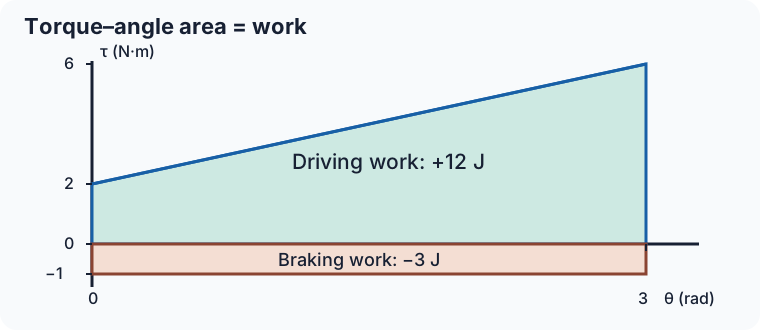
Worked example: a torque that grows with angle
A driving torque rises linearly from 2.0 N·m at θ = 0 to 6.0 N·m at θ = 3.0 rad. The torque–angle area is a trapezoid, so W_drive = ½(2.0 + 6.0)(3.0) = 12 J. A constant opposing torque of 1.0 N·m acts through the same positive angle, doing W_brake = −1.0(3.0) = −3.0 J. Net work is +9.0 J.
If the wheel starts with 4.0 J of rotational kinetic energy and there are no other energy transfers or changes of potential energy, its final rotational kinetic energy is 13 J. With inertia 0.20 kg·m², its final angular speed is √(2(13)/0.20) = √130 ≈ 11.4 rad/s. The graph gives the work even though the torque is not constant, so plugging the final torque into W = τΔθ would be wrong.
Read signed areas carefully
On a τ–θ graph, a rectangle area gives constant-torque work, a triangle area gives linearly changing-torque work, and separated pieces can be added. The units are N·m × rad, equivalent to joules. Torque and energy share the base units N·m, but they describe different physical quantities; label torque in N·m and work in J to keep their roles clear.
If the wheel reverses its angular displacement, the work sign also depends on that reversal. A constant clockwise torque on a clockwise displacement does positive work. It is not enough to see a negative torque value and declare the work negative without knowing the displacement direction. In graph problems, follow the stated motion from the initial angle to the final angle.
The area under a τ–t graph has units N·m·s and describes angular impulse, not work. A brake can deliver the same angular impulse during different angular displacements and remove different energies depending on the motion. Checking the horizontal-axis units is a quick way to prevent confusing the two.
Work and the change in spin
For constant inertia about a fixed axis, net torque work equals the change in rotational kinetic energy: W_net = ½Iω_f² − ½Iω_i². This is the rotational work–energy theorem. If energy also goes into translation, gravitational potential energy, deformation, or heat, include the appropriate terms in the full system energy balance. Do not force all applied work into rotation when the apparatus can move in other ways.
At fixed torque, doubling angular displacement doubles work. At fixed I and starting from rest, doubling net work increases angular speed by √2. The motor need not apply twice the torque; it could apply the same torque over twice the angle. These comparisons follow from the energy equations rather than memorized slogans.
Instructional example (guided activity):
Experiment plan: Wrap a light string around an axle of known radius and pull it with a force sensor while measuring wheel angle. Convert measured force to torque and plot τ versus θ with scales and units. Find work from the area, then compare with the change in ½Iω². Estimate bearing losses with a coast-down trial rather than silently assuming they vanish. Choose a sampling rate that resolves angle changes and repeat the trial.
Look at the axis labels
Pause & try it
Let's see what stuck.
Choose an answer, then check the reasoning. Try the written problems below before opening their solutions.
0 of 3 checked · 0 correct
Assigned practice: braking through an angle
A wheel with I = 0.050 kg·m² turns at 12 rad/s. A constant opposing torque of magnitude 0.30 N·m brings it to rest. Find the angle it turns through while stopping.
Open the separate worked solution.
Assigned practice: choose the work coordinate
A sensor records driving torque 2.0 N·m at angle 0, 4.0 N·m at 1.0 rad, and 4.0 N·m at 2.0 rad. Assume linear interpolation between measurements. A constant opposing bearing torque has magnitude 0.50 N·m. The wheel begins with 1.0 J of rotational kinetic energy and has a fixed axle. Decide whether a torque–time or torque–angle graph can directly determine the work here, then use the supplied data to predict final kinetic energy. State the energy-transfer assumption needed for that prediction.
Open the separate worked solution.
Use the original Rotational Energy and Work for related energy balances and quizzes. The retained rotational practice offers a braking scenario.
Sources and scope: College Board CED, with edition-specific coverage verified against the supplied file. Supplied College Board CED, printed p. 108, 6.2.A. OpenStax: Work and Power for Rotational Motion verifies torque work and the rotational work–energy theorem. Diagrams and tasks here are original.
Glossary and deeper reading · 11 refreshers
These editorial refreshers supplement the reading. Definitions and examples are added guidance; original source wording and recorded answers remain in their original context.
-
Kinetic energy
Kinetic energy is energy associated with motion relative to a chosen reference frame. For a nonrelativistic translating object it is one half of its mass times speed squared. For example, doubling a cart’s speed quadruples its translational kinetic energy when its mass stays fixed.
-
Mechanical work
Mechanical work is energy transferred by a force through displacement of its point of application. For a constant force on a particle, it depends on the force component along the particle’s displacement, and it can be positive, negative, or zero. For example, a magnetic force perpendicular to a particle’s displacement does zero work on that particle.
-
Torque
Torque describes a force’s turning effect about a chosen axis or point. Its magnitude is force times the perpendicular lever arm, and its direction or sign describes the rotation tendency. For example, pushing near the handle of a door produces more torque than the same perpendicular push near the hinge.
-
Rotational kinetic energy
Rotational kinetic energy is the kinetic energy associated with rotation about an axis. For a rigid body about a fixed axis it is one half of rotational inertia times angular speed squared. For example, a rolling wheel can possess both translational kinetic energy of its center of mass and rotational kinetic energy about that center.
-
Angular displacement
Angular displacement is the change in an object’s rotation angle about a specified axis. Its sign follows the chosen rotation convention, and it is commonly measured in radians. For example, a wheel can return to the same orientation after one turn while having an angular displacement of two pi radians.
-
Displacement
Displacement is the vector change in position from the start of an interval to its end. It depends on those endpoints rather than the length or shape of the path traveled. For example, walking around a closed track and returning to the start gives zero displacement but a nonzero distance traveled.
-
Angular impulse
Angular impulse is the change in angular momentum caused by torque acting over time. It is the signed area under a torque-versus-time graph about a consistent axis. For example, applying a braking torque to a wheel for a longer interval changes its angular momentum more.
-
Inertia
Inertia is an object’s resistance to a change in its velocity. Mass measures translational inertia, whereas rotational inertia also depends on how mass is distributed relative to an axis. For example, a loaded cart accelerates less than an empty cart under the same net force.
-
Gravitational potential energy
Gravitational potential energy is energy associated with the relative positions of attracting masses. Near Earth, changes can be approximated by mass times gravitational field strength times height change when that field is nearly constant. For example, lifting a book increases the gravitational potential energy of the book–Earth system.
-
Angular velocity
Angular velocity describes the rate and direction of rotation about an axis. For a fixed axis, a signed angular velocity is measured in radians per second, while its magnitude is angular speed. For example, points on one rigid turntable share the same angular speed even though outer points have greater linear speeds.
-
Magnitude
Magnitude is the nonnegative size of a vector quantity. It does not specify direction, and it differs from a signed component. For example, a westward velocity can have a negative x component while its speed, the velocity magnitude, stays positive.