Elastic and Inelastic Collisions
Compare kinetic-energy evidence to distinguish elastic and inelastic collisions.
Momentum alone does not tell the whole story
Two carts can bounce apart, scrape past each other, or stick together. If their net external impulse is negligible, total momentum is constant in all three cases. To distinguish the collision models, we also compare total kinetic energy immediately before and immediately after the interaction.
An elastic collision has the same initial and final total kinetic energy. Each object’s energy can change; it is their sum that matches. An inelastic collision leaves less total kinetic energy. Some of the original kinetic energy becomes deformation, thermal energy, sound, or other internal energy. Total energy is still conserved when we account for those forms and any transfers. Saying “energy is lost” without naming the form or boundary hides the physics.
A perfectly inelastic collision is the special case in which the objects stick and share one final velocity. “Inelastic” by itself does not mean “stick.” A ball that bounces to a lower height than it was dropped from gives a familiar example of an inelastic collision without sticking. We compare states outside the brief contact interval; energy can be stored elastically during contact and then returned.
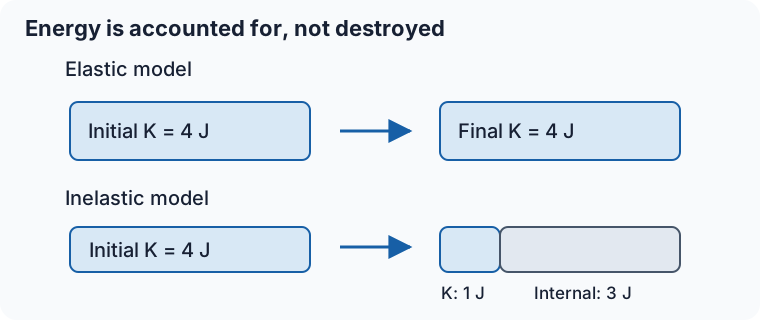
Worked example: classify a measured collision
A 0.50 kg cart starts at +4.0 m/s and an identical cart starts at rest. The initial momentum is +2.0 kg·m/s and the initial kinetic energy is ½(0.50)(4.0²) = 4.0 J.
Case A: The first cart stops and the second moves at +4.0 m/s. Final momentum is +2.0 kg·m/s and final kinetic energy is 4.0 J. This matches an elastic collision model. Energy moved between carts, so neither cart’s individual kinetic energy was constant.
Case B: The carts stick and move at +2.0 m/s. Final momentum is (1.0)(2.0) = +2.0 kg·m/s. Final kinetic energy is ½(1.0)(2.0²) = 2.0 J. The missing 2.0 J of kinetic energy went into other forms; the collision is perfectly inelastic.
Case C: They separate with velocities +1.0 m/s and +3.0 m/s. Momentum is still +2.0 kg·m/s, but total kinetic energy is ½(0.50)(1.0² + 3.0²) = 2.5 J. This collision is inelastic even though the carts did not stick. Measurements of final velocities settle the classification.
A symbolic result you can reuse
For a mass m₁ moving at v₁ into a stationary mass m₂ that sticks to it, momentum conservation gives v_f = m₁v₁/(m₁ + m₂). Substitute this velocity into K_f = ½(m₁ + m₂)v_f². Compared with K_i = ½m₁v₁², the ratio becomes K_f/K_i = m₁/(m₁ + m₂).
If the masses are equal, half the initial kinetic energy remains. If the stationary target is very massive, the final speed and remaining kinetic energy are small. These are predictions from the model, not extra formulas to memorize. The assumptions are a stationary target, sticking, and negligible external impulse. Change those assumptions and start from the general balances again.
For an equal-mass, one-dimensional elastic collision with one cart initially at rest, momentum and kinetic-energy conservation predict an exchange of velocities. Do not extend that shortcut to unequal masses or angled collisions. Always check which objects and components the model describes.
Instructional example (guided activity):
Test “elastic” with uncertainty
Measure both masses and signed velocities immediately before and after a cart interaction. Compute p_i, p_f, K_i, and K_f separately. A useful graph has the measured K_f on the vertical axis and K_i on the horizontal axis for repeated trials. The ideal elastic reference is K_f = K_i, a slope-one line through the origin. Points systematically below it suggest kinetic-energy conversion.
Use more than one trial and include uncertainty. Small differences could come from velocity measurement error. Because K depends on v², speed uncertainty can noticeably affect the energy comparison. Use calibrated distances, a consistent time base, and measurements close to contact to reduce unwanted frictional changes outside the collision interval.
Worked example — Elastic does not mean each energy stays fixed
A 0.50 kg cart A at +4.0 m/s collides elastically with an equal-mass stationary cart B on an isolated horizontal track. The measured final velocities are v_A = 0 and v_B = +4.0 m/s. Initially K_A = 4.0 J and K_B = 0; finally K_A = 0 and K_B = 4.0 J. Total kinetic energy is 4.0 J at both endpoints, while each cart’s energy changes by 4.0 J in opposite senses. Elasticity constrains the sum, not each term.
Total momentum is also +2.0 kg·m/s at both endpoints. Draw separate energy bars for A and B before adding their heights: an unchanged total can hide a complete redistribution. The equal-mass velocity exchange is a special one-dimensional result for this initial state, not a general shortcut for unequal masses.
Which conservation claim is justified?
Pause & try it
Let's see what stuck.
Choose an answer, then check the reasoning. Try the written problems below before opening their solutions.
0 of 3 checked · 0 correct
Assigned practice: a larger stationary target
A 0.40 kg cart at +3.0 m/s sticks to a stationary 0.80 kg cart. Find the final speed and the kinetic-energy decrease.
Open the separate worked solution.
Assigned practice: classify with measurement intervals
Two separate trials use the same initial total kinetic-energy interval, 1.16–1.24 J. In trial A the final interval is 1.12–1.22 J; in trial B it is 0.80–0.90 J. These intervals state the possible values given the measurement uncertainty. In both trials the carts separate after contact and the measured total momenta agree before and after. Which trial supports a clear inelastic classification? What can you claim about trial A? Choose one additional measurement improvement that would make the energy classification more useful and explain its connection to the calculation.
Open the separate worked solution.
The original Inelastic Collisions and Elastic Collisions offer longer examples and their original quiz placements. The momentum chapter’s kinetic-energy section connects the energy comparison to the retained end-of-chapter problems.
Sources and scope: College Board CED, with edition-specific coverage verified against the supplied file. Supplied College Board CED, printed p. 85, 4.4.A. OpenStax: Elastic Collisions and Inelastic Collisions verify the classification and sticking condition. Our cart numbers, diagram, derivation walkthrough, and questions are original.
Explain and apply the model
Try these problems before opening the solutions. State your assumptions, show the diagram or calculation, and explain what makes your answer follow.
Check individual energies in an elastic collision
Cart A and cart B each have mass 0.60 kg. Initially A moves at +3.0 m/s and B is at rest. Immediately after their one-dimensional collision A is at rest and B moves at +3.0 m/s. Net external impulse and external energy transfer are negligible.
(a) Calculate each cart’s initial and final kinetic energy, each individual ΔK, and the initial/final total. Use these values to decide whether the collision is elastic and evaluate the claim that elastic means every object keeps its own kinetic energy.
(b) Check total momentum before and after, and draw separate energy bars for A and B at both endpoints using the same scale. Explain why the unchanged total does not require either cart to keep its velocity.
Your written working
Drawing is temporarily unavailable. Work on paper if needed, then record your reasoning here.
Saving written working requires JavaScript. The problem remains available above; keep your work on paper or in your own notes.
Glossary and deeper reading · 5 refreshers
These editorial refreshers supplement the reading. Definitions and examples are added guidance; original source wording and recorded answers remain in their original context.
-
Impulse
Impulse is the change in linear momentum produced by a force over a time interval. It equals the signed vector area under a force-versus-time graph and is measured in newton-seconds. For example, a padded landing spreads the stopping impulse over more time, reducing the average force for the same momentum change.
-
Linear momentum
Linear momentum is a vector describing an object’s motion and equals mass times velocity in the nonrelativistic model. The vector sum of momenta is conserved when the net external impulse on the system is zero. For example, two identical carts moving equally fast in opposite directions have zero total linear momentum but nonzero total kinetic energy.
-
Kinetic energy
Kinetic energy is energy associated with motion relative to a chosen reference frame. For a nonrelativistic translating object it is one half of its mass times speed squared. For example, doubling a cart’s speed quadruples its translational kinetic energy when its mass stays fixed.
-
Velocity
Velocity describes how position changes with time and includes direction. Instantaneous velocity describes one moment, while average velocity is displacement divided by elapsed time. For example, a car turning a corner can change velocity while maintaining the same speed.
-
Conservation of energy
Conservation of energy means total energy is unchanged when the full isolated system is considered. Energy can transfer between objects or change form, so one selected energy store need not remain constant. For example, friction can reduce a sliding block’s kinetic energy while increasing the thermal energy of the block and floor.