Newton’s Third Law
Keep Newton’s third-law partners on separate objects and identify internal forces.
The truck doesn’t win the force contest
Imagine a small car colliding with a much heavier truck. It’s tempting to say the truck exerts a bigger force because the car’s motion changes more. Newton’s third law says the interaction forces have equal magnitude and opposite direction at every instant: F_A on B = −F_B on A.
The equal forces act on different objects. They don’t cancel in either object’s individual FBD. The car’s acceleration can be much larger because a = F/m, not because the force on it is larger. The force equality also doesn’t depend on whether either object is at rest or in equilibrium.
A good way to find the partner is to swap the object names. Earth pulls on the book; the book pulls on Earth. The table pushes on the book; the book pushes on the table. Gravity and the table’s normal force on the book may balance, but they’re not a third-law pair. Both act on the same object and come from different interactions.
Internal forces cancel in a system sum
Now choose a system containing both interacting objects. When adding all forces for the system’s translational motion, the internal pair cancels. Internal forces can change the parts’ individual motions or reshape the system, but they can’t change its center-of-mass motion. Only the net external force can do that.
Two skaters push apart on nearly frictionless ice. Each accelerates during the push; the system’s center of mass continues with its original velocity because the push forces are internal. “The forces cancel” is appropriate for the whole-system sum, not a claim that neither skater feels a force.
At a distance, AP Physics 1 limits interaction examples to gravitation. Microscopic electric forces help explain contact forces, but quantitative electric and magnetic interactions are not part of this course.
Example 2.3.1 — Same interaction, different response
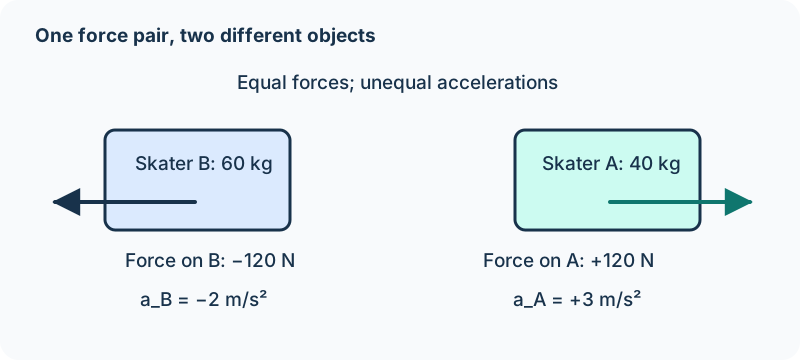
A 40 kg skater and a 60 kg skater push on each other with forces of magnitude 120 N. If the lighter skater’s acceleration is to the right, it is 120/40 = 3.0 m/s². The heavier skater accelerates left at 120/60 = 2.0 m/s².
The ratio of acceleration magnitudes is 60/40 = 1.5. The mass-weighted acceleration sum is 40(+3) + 60(−2) = 0, so the center-of-mass acceleration is zero. Equal interaction forces are completely consistent with unequal acceleration magnitudes.
What is tension actually doing?
A stretched rope transmits forces between its segments. Tension is the macroscopic result of those interactions in response to external pulling. An ideal string has negligible mass and doesn’t stretch under tension. Its tension magnitude is the same along its length in the ideal model, so a single T can be used in connected-object equations.
An ideal pulley has negligible mass and negligible axle friction, so it redirects the string without needing a tension difference to accelerate its rotation. Equal tensions across a real pulley are an assumption that must be justified, not something every pulley automatically provides. Unit 6 later considers rotational inertia and tension differences.
A hanging chain with appreciable mass has greater tension near the top: upper links must support more of the chain below them. The lower end of a free hanging chain has almost no tension; the top supports the entire chain. AP Physics 1 requires this massive-rope variation qualitatively, without calculating a tension function along the rope.
Test the pair rather than the damage
Connect two force sensors with a light spring and pull them apart at different rates. Plot both signed forces versus the same time axis. They should be equal and opposite within measurement uncertainty, even when the spring accelerates or stretches. Calibrate zero readings first, choose opposite-axis signs consistently, and compare simultaneous samples. If you plot both magnitudes as positive, the curves should overlap; that display hides the opposite directions, so explain your convention. Visible damage or motion alone isn’t a force measurement.
Example 2.3.2 — Follow the force through the string
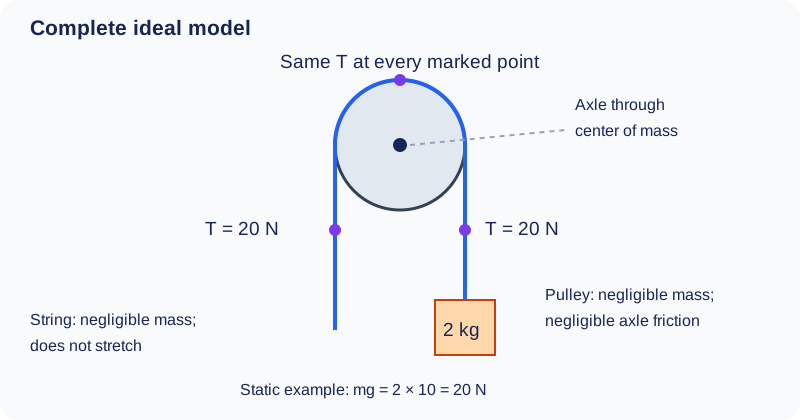
Imagine an ideal taut string supporting a 2 kg load at rest. Ideal means negligible string mass and no stretching under tension. The load pulls the lowest string segment downward; neighboring segments pull on one another, and the support pulls the uppermost segment upward. Tension is the macroscopic result of these successive segment interactions in response to external forces. It is not a force sent instantly from an endpoint without interaction with the intervening material.
For any short ideal-string segment, finite acceleration with negligible mass requires its opposing longitudinal pulls to have equal magnitude. Applying this argument successively gives the same tension at every interior point of the unbranched string when no other distributed longitudinal interaction acts. Here T = mg = 20 N at the bottom, middle, and top. An appreciably massive hanging chain does not satisfy this model: upper links support more material, so tension increases toward the top.
The complete ideal-pulley model also specifies its geometry: the pulley has negligible mass and rotates about an axle through its center of mass with negligible friction. With an ideal string that does not slip, this pulley redirects a 20 N tension without creating a tension difference across it. If pulley rotational inertia or axle friction matters, a tension difference can be required, and the equal-tension approximation needs reconsideration.
Inspect diagram labels
The diagram keeps its full size here. Focus the view and use the arrow keys, or scroll across it, to inspect every label.
Check what you know
Pause & try it
Let's see what stuck.
Choose an answer, then check the reasoning. Try the written problems below before opening their solutions.
0 of 3 checked · 0 correct
Give it a try
Practice 1
A 2 kg cart pushes a 5 kg cart with 10 N on a frictionless track. Find each acceleration due to that interaction alone and identify which cart feels each force.
Practice 2
Draw separate FBDs for a hanging mass and the ideal string supporting it. Explain why an arrow for mass-on-string doesn’t belong on the mass’s diagram.
Practice 3
Two force sensors give F₁ = +12.0 N and F₂ = −11.7 N, each with uncertainty ±0.3 N. Is this clear evidence against Newton’s third law? Explain the comparison.
Keep exploring
Return to the original Newton’s Laws and FBDs and Common Forces for the preserved interaction and tension examples.
Course scope and standards: the supplied AP Physics 1 CED, printed pages 46, 47; Topic 2.3 and its exact learning objectives. The official College Board CED is the public source; the project audit records the supplied edition.
Supporting physics references: OpenStax: center-of-mass dynamics and internal forces; OpenStax: tension and ideal strings. These lessons, diagrams, examples, and practice questions were written for this book.
Explain and apply the model
Try these problems before opening the solutions. State your assumptions, show the diagram or calculation, and explain what makes your answer follow.
Follow tension through an ideal apparatus
A 2 kg mass and a 3 kg mass hang on opposite sides of a taut unbranched string over a pulley. The string does not slip on the pulley. Use the ideal string and ideal pulley models, neglect air resistance, and use g = 10 m/s². Neither mass has reached a stop.
(a) State both ideal-string assumptions. State all ideal-pulley assumptions, explicitly including the axle’s location relative to the pulley’s center of mass. Explain which assumptions support treating the tension as the same across the pulley and the endpoints’ acceleration magnitudes as equal.
(b) Explain how the external loading is transmitted by forces between successive string segments. Compare the tensions at the two ends, the two interior straight sections, and the portion over the ideal pulley. Explain why uniform interior tension would fail for a significantly massive hanging chain.
(c) Draw the two masses’ separate free-body diagrams using actual force arrows, determine which mass accelerates downward, and calculate acceleration and the tension at every point of the ideal string.
Your written working
Drawing is temporarily unavailable. Work on paper if needed, then record your reasoning here.
Saving written working requires JavaScript. The problem remains available above; keep your work on paper or in your own notes.
Related source reading
These alternative explanations and examples retain their source context. Draft placement does not add accepted exam coverage.
- rope model · alternative source explanation
Glossary and deeper reading · 13 refreshers
These editorial refreshers supplement the reading. Definitions and examples are added guidance; original source wording and recorded answers remain in their original context.
-
Force
A force describes an interaction that can change an object’s momentum. It is a vector measured in newtons, so both size and direction matter when forces are added. For example, a rope can pull a cart while the floor exerts friction in another direction.
-
Magnitude
Magnitude is the nonnegative size of a vector quantity. It does not specify direction, and it differs from a signed component. For example, a westward velocity can have a negative x component while its speed, the velocity magnitude, stays positive.
-
Free-body diagram
A free-body diagram shows the external forces acting on one selected object or system. Each arrow names a real interaction, and its direction is the direction of that force. For example, a book resting on a desk has a downward gravitational force and an upward normal force; velocity is not an extra force arrow.
-
Acceleration
Acceleration is the vector rate of change of velocity with time. It can change an object’s speed, direction, or both, and it is measured in meters per second squared. For example, a satellite moving at constant speed in a circular orbit accelerates toward the center.
-
Gravity
Gravity is the attractive interaction between masses in the Newtonian model. For spherical bodies or point-mass approximations, its strength decreases with the square of the separation between their centers. For example, Earth’s gravity provides the inward force that keeps a satellite in orbit.
-
Normal force
A normal force is a contact force perpendicular to the local surface of contact. Its magnitude is set by the motion and the other forces, so it need not equal the object’s weight. For example, a wall’s normal force on a leaning ladder points horizontally rather than upward.
-
Internal force
An internal force is an interaction between parts of a chosen system. Newton’s third-law partners cancel in the total force sum for the whole system, although individual parts can accelerate. For example, two skaters pushing each other exert internal forces when the two skaters are analyzed together.
-
External force
An external force is exerted on part of a chosen system by something outside that system. The sum of external forces determines the rate of change of the system’s total momentum. For example, Earth’s gravitational force is external to a system consisting only of a falling ball.
-
Center of mass
The center of mass is the position obtained by weighting each part’s position by its mass. Its motion represents the translational motion of the whole system under the net external force. For example, adding a heavy object to one end of a light bar shifts the center of mass toward that end.
-
Velocity
Velocity describes how position changes with time and includes direction. Instantaneous velocity describes one moment, while average velocity is displacement divided by elapsed time. For example, a car turning a corner can change velocity while maintaining the same speed.
-
Tension
Tension is a pulling force transmitted through a stretched rope, string, or similar connector. It acts along the connector away from the object it pulls, and an ideal massless rope has the same tension throughout an uninterrupted segment. For example, a rope supporting an accelerating load can have a tension different from the load’s weight.
-
Rotational inertia
Rotational inertia measures how strongly a mass distribution resists a change in angular velocity about a specified axis. Mass farther from that axis contributes more strongly because each contribution depends on squared distance. For example, moving small masses outward along a rotating rod increases its rotational inertia without changing its total mass.
-
Drag
Drag is a force from a fluid that opposes an object’s motion relative to that fluid. Its dependence on speed, shape, and fluid properties varies with the physical regime. For example, a parachute increases air drag by presenting a large area to the moving air.