Gravitational Force
Connect inverse-square gravity, local field strength, real weight, and apparent weight.
Gravity goes beyond falling apples
Earth attracts a falling ball, and the ball attracts Earth with an equal and opposite force. The same gravitational interaction holds planets and satellites in their orbits. Newton’s universal law gives the magnitude for point masses or approximately spherical bodies treated outside their surfaces:
F_g = GmM/r².
Here r is the separation between the centers, not the height above a surface. G is the universal gravitational constant, approximately 6.67 × 10⁻¹¹ N·m²/kg². Gravity is attractive and acts along the line joining the centers. In the object model, we draw that force at the object’s center of mass.
Double one mass while keeping everything else fixed, and the force doubles. Double both masses, and it quadruples. Double separation, and it becomes one quarter as large. These are consequences of the equation, not different gravitational laws for different objects.
A field describes a location
A gravitational field models how a source mass influences a test object at different positions. Its strength is gravitational force per unit test mass: g = F_g/m = GM/r², directed toward the source. The unit N/kg is equivalent to m/s². A freely falling object’s acceleration is numerically equal to the field strength when gravity is its only force.
The field doesn’t depend on the test object’s mass in this model. A heavier object feels a proportionally larger force but also has proportionally more inertia. Those factors cancel in a = F/m. Inertial mass measures resistance to acceleration; gravitational mass sets the strength of gravitational attraction. Experiments establish their equivalence, which explains why objects fall together when drag is negligible.
Near Earth’s surface, a small height change barely alters the distance from Earth’s center. We can therefore approximate g as constant. In our AP numerical examples, use g = 10 m/s²; 9.8 or 9.81 m/s² are accepted more precise values when used consistently. For changes comparable to a planet’s radius, use GM/r² rather than holding g fixed.
Example 2.6.1 — One radius higher
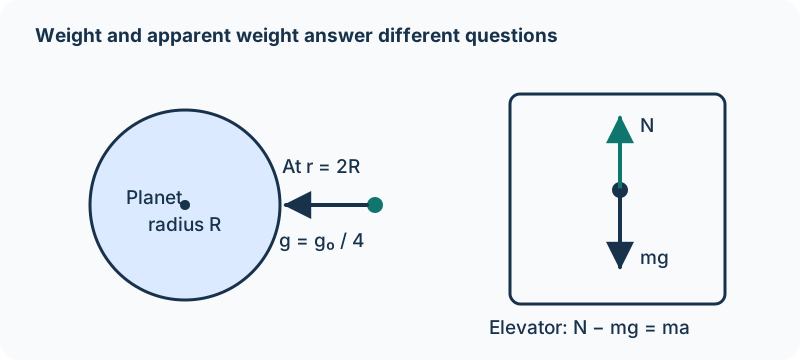
Suppose a planet has radius R and surface field g₀. At height R above its surface, the distance from its center is 2R. Thus g = GM/(2R)² = g₀/4. A 2 kg object weighing 20 N at a surface where g₀ = 10 N/kg weighs only 5 N at that location.
“Twice as high means half the weight” doesn’t follow from inverse-square dependence, and using height R as the center separation would miss the change entirely. Draw the planet center and the altitude before substituting.
The scale reads a contact force
The gravitational force on a relatively small nearby object is its weight, mg. Its apparent weight is the magnitude of the normal force supporting it. A scale measures that contact force, not gravity directly.
A 60 kg passenger in an elevator has weight 600 N using g = 10 m/s². With upward positive, N − mg = ma. If the elevator accelerates upward at 2 m/s², N = 60(10 + 2) = 720 N. If it accelerates downward at 2 m/s², a = −2 and N = 480 N. The direction of velocity isn’t the deciding factor; an elevator moving upward while slowing has downward acceleration and a smaller reading.
In free fall, a = −g, giving N = 0. The passenger appears weightless while gravity still acts. Astronauts in orbit are also in free fall; their apparent weightlessness doesn’t mean the gravitational field vanishes. An object in a force-free region can likewise have zero apparent weight.
The equivalence principle connects these experiences: in a sufficiently small local experiment, an observer cannot distinguish a uniform gravitational effect from the apparent weight produced by an accelerating frame. This is a local statement; spatially varying gravitational fields can produce differences across a large apparatus. We use the principle conceptually, rather than attempting a relativity calculation.
Compare the two mass measurements
Use a balance to compare an object’s gravitational response with a reference mass. Independently use a force sensor and low-friction cart to infer inertial mass from the slope of F versus a. Account for the cart and sensor mass in the inertial system. Agreement within uncertainty supports equivalence. If they disagree, check friction, calibration, and what mass was actually included before claiming that gravity works differently for that object.
Example 2.6.2 — Draw the attraction and define the field
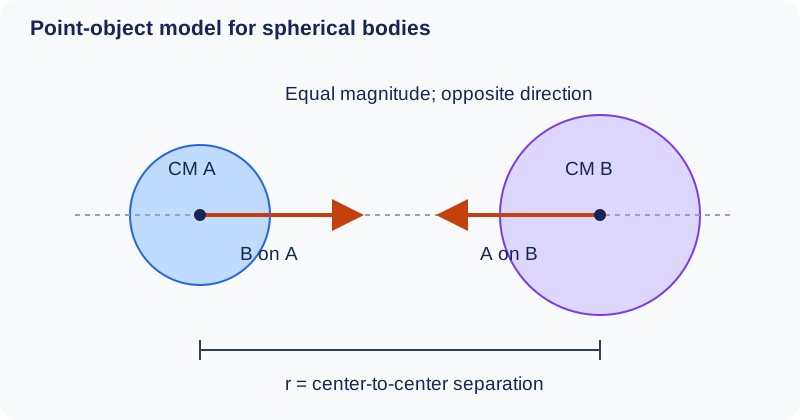
Treat two well-separated nearly spherical bodies as point objects at their centers of mass. Their gravitational interaction is attractive: each force arrow starts at that body’s modeled center of mass and points toward the other body along the line joining the two centers. For this point-mass or spherically symmetric exterior-field model, the force pair is equal and opposite. Complicated extended mass distributions can require integrating the distributed forces; the simple center-line picture is the course model used here.
At one location a 0.40 kg test object experiences gravitational force 2.0 N toward a planet. The field magnitude is the defining ratio g = F_g/m = 2.0/0.40 = 5.0 N/kg. A 1.20 kg test object at the same location feels 6.0 N and gives the same ratio 6.0/1.20 = 5.0 N/kg. For a spherical source the same field equals GM/r². Changing test mass changes force, not this field at the chosen location.
If gravity is the only force on either test object, a = F_g/m = 5.0 m/s² toward the planet. The observed acceleration in m/s² is numerically equal to the gravitational field strength in N/kg because 1 N/kg = 1 m/s². With a support force or drag, net acceleration is instead F_net/m and need not equal g.
Inspect diagram labels
The diagram keeps its full size here. Focus the view and use the arrow keys, or scroll across it, to inspect every label.
Example 2.6.3 — Which acceleration changes a scale reading?
A scale reads the magnitude of its supporting normal force. For a 4 kg block on a horizontal scale, upward normal-direction acceleration +2 m/s² gives N − mg = ma_y and N = 48 N using g = 10 m/s². Its gravitational weight is still 40 N. If a separate horizontal force accelerates the block at 2 m/s² while a_y = 0 and contact is maintained, vertical balance gives N = 40 N. The block accelerates yet its scale reading equals its gravitational weight.
The source’s broad accelerating-system statement therefore requires a supporting-normal-direction context: an acceleration component along that normal changes N in this setup. Purely horizontal acceleration is a counterexample to an unqualified statement that every acceleration changes apparent weight. Keep the actual force equation and the source qualification visible; apparent weight is not determined by speed or by the magnitude of total acceleration alone.
Compare two sealed, sufficiently small laboratories: one is supported at rest in an approximately uniform gravitational field of 10 N/kg, and one is far from significant gravity while its floor accelerates at 10 m/s². A 2 kg object pressed against the floor reads 20 N in either laboratory. The equivalence principle says the observer cannot distinguish these causes using only such local apparent-weight measurements: a noninertial frame’s support effect is locally equivalent to a gravitational effect. Large-scale field variations, tidal effects, or observations outside the laboratory can distinguish the situations.
Example 2.6.4 — Two measurements of the same mass
Inertial mass measures an object’s resistance to changes in motion under interaction: for a fixed net force, a larger inertial mass produces smaller acceleration. A 1.5 N net horizontal force producing 0.50 m/s² acceleration gives m_i = F_net/a = 3.0 kg. Gravitational mass measures the strength of attraction between systems with mass: a gravitational force of 30 N in a known 10 N/kg field gives m_g = F_g/g = 3.0 kg.
These are conceptually different measurements, and their equality is an experimental result. Inertial and gravitational mass have been experimentally verified to be equivalent within experimental precision. Using m_g = m_i in F_g = m_g g and F_net = m_i a explains equal free-fall acceleration when gravity is the only force. A comparison should include uncertainty and calibration rather than treat one calculated matching pair as a proof for every material.
Check what you know
Pause & try it
Let's see what stuck.
Choose an answer, then check the reasoning. Try the written problems below before opening their solutions.
0 of 3 checked · 0 correct
Give it a try
Practice 1
A 50 kg rider has upward acceleration 1.5 m/s². Find weight and scale reading using g = 10 m/s². Then find the scale reading for downward acceleration of the same magnitude.
Practice 2
Derive the ratio of gravitational forces when both masses double and center separation triples. State why the same ratio does not apply if the separation is merely a surface altitude.
Practice 3
Sketch gravitational field strength versus center distance outside a spherical planet. Mark R and 2R and their field values. Explain how a short near-surface interval can look approximately constant.
Keep exploring
The original Gravity in Depth and Common Forces retain the source explanations. The preserved apparent-weight problem 28 gives another chance to use the contact-force distinction.
Course scope and standards: the supplied AP Physics 1 CED, printed pages 50, 51, 52; Topic 2.6 and its exact learning objectives. The official College Board CED is the public source; the project audit records the supplied edition.
Supporting physics references: OpenStax: universal gravitation; OpenStax: normal forces and apparent weight. These lessons, diagrams, examples, and practice questions were written for this book.
Explain and apply the model
Try these problems before opening the solutions. State your assumptions, show the diagram or calculation, and explain what makes your answer follow.
Represent attraction and measure a field
A spherical planet has GM = 1.20 × 10¹⁴ m³/s². In separate trials, 0.20 kg and 0.60 kg small test objects are at center distance r = 2.00 × 10⁶ m outside the planet. Their measured gravitational force magnitudes are 6.0 N and 18.0 N. Neglect other astronomical bodies, drag and the test objects’ effect on the planet’s field.
(a) Describe the gravitational interaction between the planet and either test object. Draw the attractive force pair along the line connecting their centers of mass, locate each modeled force’s application point, and compare the two forces’ magnitudes and directions. State the body-model condition that makes this center-line representation appropriate.
(b) Use the defining ratio of gravitational force to test-object mass to find field strength in each trial. Independently calculate GM/r² and compare. Explain why the field does not grow when the test mass triples.
(c) If gravity is the only force, find each object’s acceleration magnitude and direction. Explicitly compare its numerical value in m/s² with the field value in N/kg. Explain how the comparison changes if a support balances gravity.
Your written working
Drawing is temporarily unavailable. Work on paper if needed, then record your reasoning here.
Saving written working requires JavaScript. The problem remains available above; keep your work on paper or in your own notes.
Test an apparent-weight claim
A 5.0 kg block remains in contact with a horizontal scale in a region where g = 10 m/s². Compare upward acceleration 3.0 m/s², horizontal acceleration 3.0 m/s² produced by a separate horizontal pull with zero vertical acceleration, and no acceleration. Separately compare small sealed laboratories at rest in an approximately uniform 10 N/kg field and far from gravity with a floor accelerating at 10 m/s². A 1.5 kg test object rests relative to each laboratory floor.
(a) Calculate the gravitational weight and scale reading in each block case. Evaluate the statement “any acceleration makes apparent weight different from gravitational weight.” Give the force-balance qualification needed for that statement and a numerical counterexample.
(b) Predict the test object’s local support-force reading in both sealed laboratories. Explain, using the equivalence principle, why an observer in the accelerating noninertial laboratory cannot distinguish its local apparent-weight effect from a uniform gravitational effect using only that measurement. State one limit of the comparison.
Your written working
Drawing is temporarily unavailable. Work on paper if needed, then record your reasoning here.
Saving written working requires JavaScript. The problem remains available above; keep your work on paper or in your own notes.
Measure inertial and gravitational mass
For one object, a corrected net horizontal force of 1.8 N produces acceleration 0.60 m/s² on a low-friction cart. An independent gravitational force measurement gives 30 N in a known 10 N/kg field. The resulting inertial mass uncertainty is ±0.10 kg and gravitational mass uncertainty is ±0.06 kg. Cart/sensor mass has been accounted for.
(a) Describe inertial mass and gravitational mass. Explain how inertial mass measures resistance to a change in motion under interaction and how gravitational mass relates to attraction between systems with mass. For a fixed net force, compare the acceleration of a larger inertial mass with a smaller one; for a fixed field, compare their gravitational-force responses if gravitational masses differ.
(b) Calculate both mass values and use the stated uncertainties to assess agreement. State whether inertial and gravitational mass equivalence is a definition or an experimentally verified result. Describe one systematic effect that would need checking before interpreting a disagreement.
Your written working
Drawing is temporarily unavailable. Work on paper if needed, then record your reasoning here.
Saving written working requires JavaScript. The problem remains available above; keep your work on paper or in your own notes.
Glossary and deeper reading · 13 refreshers
These editorial refreshers supplement the reading. Definitions and examples are added guidance; original source wording and recorded answers remain in their original context.
-
Force
A force describes an interaction that can change an object’s momentum. It is a vector measured in newtons, so both size and direction matter when forces are added. For example, a rope can pull a cart while the floor exerts friction in another direction.
-
Magnitude
Magnitude is the nonnegative size of a vector quantity. It does not specify direction, and it differs from a signed component. For example, a westward velocity can have a negative x component while its speed, the velocity magnitude, stays positive.
-
Center of mass
The center of mass is the position obtained by weighting each part’s position by its mass. Its motion represents the translational motion of the whole system under the net external force. For example, adding a heavy object to one end of a light bar shifts the center of mass toward that end.
-
Gravitational field
A gravitational field gives the gravitational force per unit mass at a location. Its direction is the direction of the force on a positive test mass, and its units can be written as newtons per kilogram. For example, near Earth the field points approximately downward, whether or not a ball is placed there.
-
Acceleration
Acceleration is the vector rate of change of velocity with time. It can change an object’s speed, direction, or both, and it is measured in meters per second squared. For example, a satellite moving at constant speed in a circular orbit accelerates toward the center.
-
Inertia
Inertia is an object’s resistance to a change in its velocity. Mass measures translational inertia, whereas rotational inertia also depends on how mass is distributed relative to an axis. For example, a loaded cart accelerates less than an empty cart under the same net force.
-
Inertial mass
Inertial mass measures how strongly an object resists acceleration under a given net force. It is the mass in Newton’s second law and is measured in kilograms. For example, comparing accelerations under the same calibrated force lets an experiment compare two objects’ inertial masses.
-
Weight
Weight is the gravitational force exerted on an object by a specified attracting body. Near Earth’s surface its magnitude is approximately mass times the local gravitational field strength, and it is measured in newtons. For example, an astronaut has less weight on the Moon while retaining the same mass.
-
Normal force
A normal force is a contact force perpendicular to the local surface of contact. Its magnitude is set by the motion and the other forces, so it need not equal the object’s weight. For example, a wall’s normal force on a leaning ladder points horizontally rather than upward.
-
Velocity
Velocity describes how position changes with time and includes direction. Instantaneous velocity describes one moment, while average velocity is displacement divided by elapsed time. For example, a car turning a corner can change velocity while maintaining the same speed.
-
Free fall
Free fall is motion in which gravity is the only significant force acting on the object. An object can be in free fall while moving upward, downward, or sideways. For example, a thrown ball is approximately in free fall after leaving the hand when air resistance is negligible.
-
Drag
Drag is a force from a fluid that opposes an object’s motion relative to that fluid. Its dependence on speed, shape, and fluid properties varies with the physical regime. For example, a parachute increases air drag by presenting a large area to the moving air.
-
Net force
Net force is the vector sum of all forces acting on the object or system under consideration. For constant mass in an inertial frame, it equals mass times acceleration. For example, equal upward and downward forces give zero net force even though neither force is zero.