Conductors and Insulators
Original source retained for reference; this draft does not establish AP coverage.
Original author draft. Original wording and recorded answer states are preserved without claiming reviewed scientific correctness or AP alignment.
Physics 2 original textbook · Chapter 3
Section 1
Section 1
Conductors and Insulators
We begin this chapter with a discussion of two classes materials are sometimes grouped under. These two classes, conductors and insulators, are of importance in many domains of science and engineering due to the properties of materials in these groups.
Conductors are materials which generally allow for the free flow of charge. Metals are commonly conductors which is why they are used so often in electronic equipment. If the wires did not allow the flow of charge they would not carry a current and our electronics would be unable to function.
An external field redistributes the conductor’s existing free electrons; it does not create charge. Electrons move opposite the field until electrostatic equilibrium is reached. A neutral isolated conductor develops separated positive and negative surface regions while retaining zero total charge.
At electrostatic equilibrium, excess charge resides on conductor surfaces. Its density is generally nonuniform and is greater where curvature is sharper. Uniform density follows only for geometries and surroundings with the appropriate symmetry, such as an isolated sphere.
Gallery 1.1 Charges in Conductors
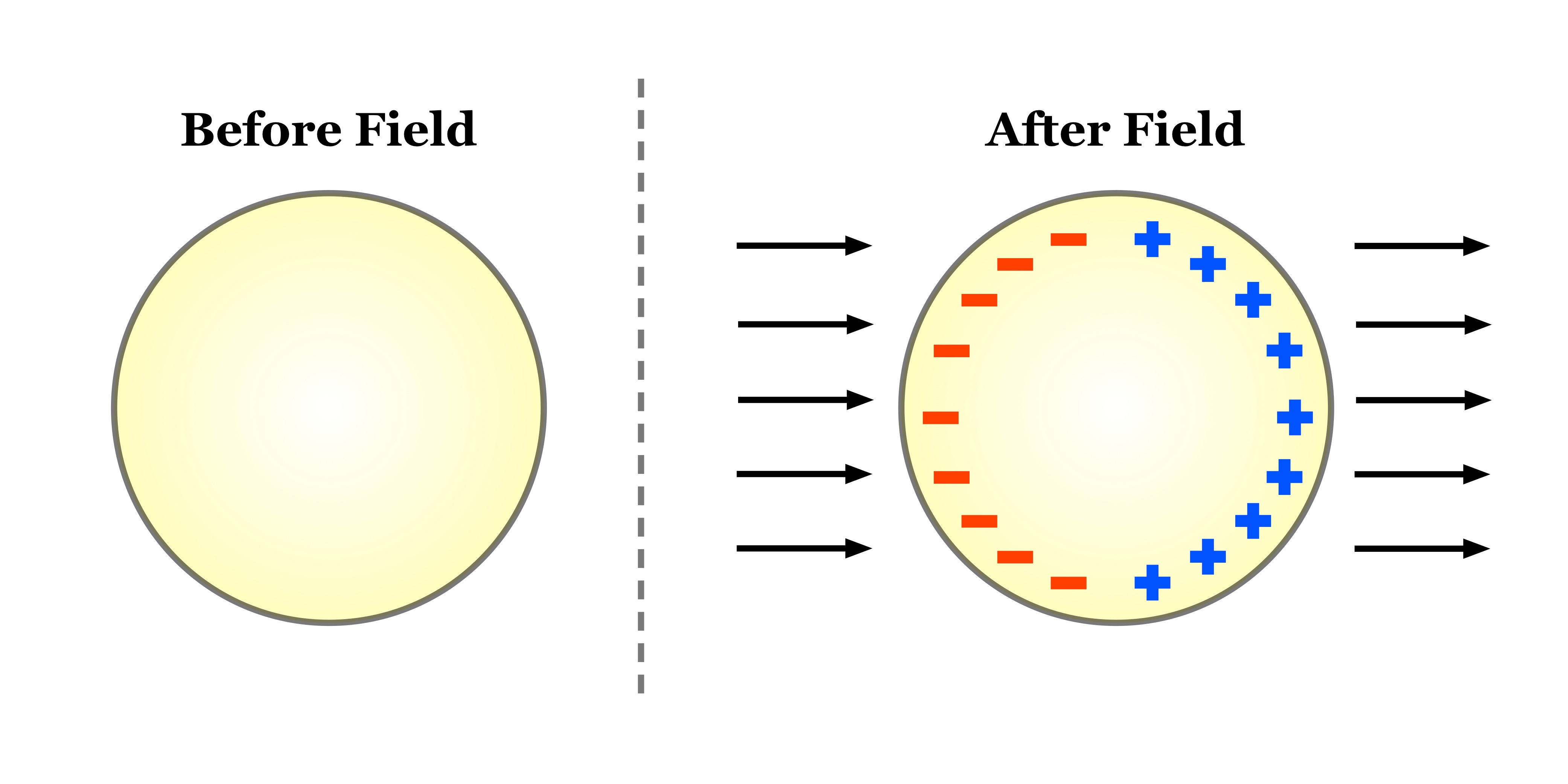
The initially neutral conductor polarizes in the external field. Electrons drift opposite the applied field, leaving a negative surface region on the left and a positive one on the right for an applied field pointing right. Existing charge is redistributed; no charge is created.
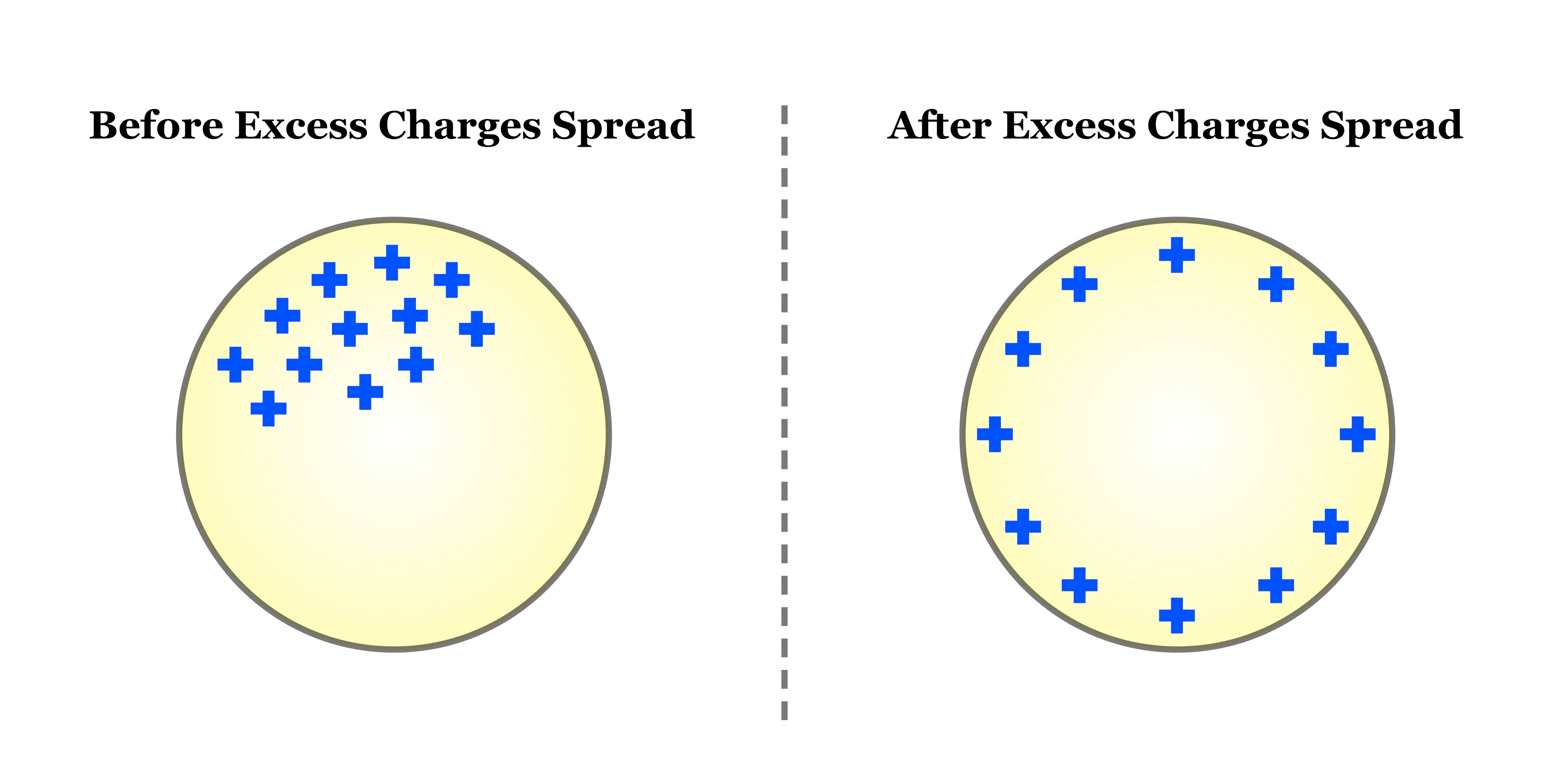
A uncharged conducting sphere has free charges placed on it. Initially the charges are bunched but because of electrostatic repulsion the charges quickly move to the surface of the conducting sphere.
Archived original widget · contains the source error
Originally the conductor is uncharged but after the application of an electric field the conductor becomes polarized. The free electrons move with the electric field leaving the protons alone creating a net negative charge on the left and a net positive charge on the right of the conducting sphere.
A uncharged conducting sphere has free charges placed on it. Initially the charges are bunched but because of electrostatic repulsion the charges quickly move to the surface of the conducting sphere.
At electrostatic equilibrium the electric field within conductor material is zero and the potential is constant, although that constant need not be zero. For a polarized neutral conductor, the induced field points from the induced positive region to the induced negative region and cancels the applied field inside.
A zero-flux Gaussian surface alone does not imply a zero field at every point. The zero internal field follows from electrostatic equilibrium: any nonzero field would move the free charges. Gauss’s law then confirms zero enclosed net charge for a surface lying entirely within the conductor material; the constant potential follows from .
Example 3.1.1
Optional Gaussian-flux and potential-integral methods for conductor equilibrium. Prerequisites: charge conservation, spherical symmetry and radial integration. This preserved source example makes no AP coverage claim.
A neutral isolated conducting spherical shell has inner radius a and outer radius b, with a point charge q at its center. Find its surface charges, densities and potential.
Authored clarification: Neutrality and isolation are explicit added conditions needed for the source’s outer-charge result.
Charge of the conductors walls.
Charge density on the inside and outside surfaces of the conductor.
Potential inside the conductor.
Let’s begin with the charge of this setup. The charge in the center q will create an electric field E which at the inside of the spherical shall has a magnitude given by
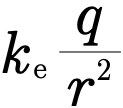
This creates an induced charge on the inside of the shell which completely cancels out the field due to the charge placed at the center. In order to determine the magnitude of this charge we must use Gauss’s Law. Since we know we must have zero field the enclosed charge must be zero. Therefore
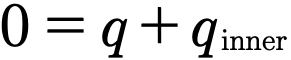
and
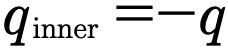
Once we are outside the spherical shell the field should return to normal so that the charge enclosed by Gauss’s Law should be the inner charge by itself. That consideration leads to the following

So that
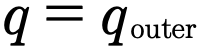
The charge density of the inside surface is given by

Similarly the outside surface charge distribution is given by

Finally the potential of the conductor can be found by using Gauss’s Law. If we choose a radius which is between r and R then we will find that the enclosed charge is given by

Therefore the electric field inside the shell must be zero so that the electric potential difference is zero and the electric potential is some constant.
Interactive 1.1 Hollow Conductors
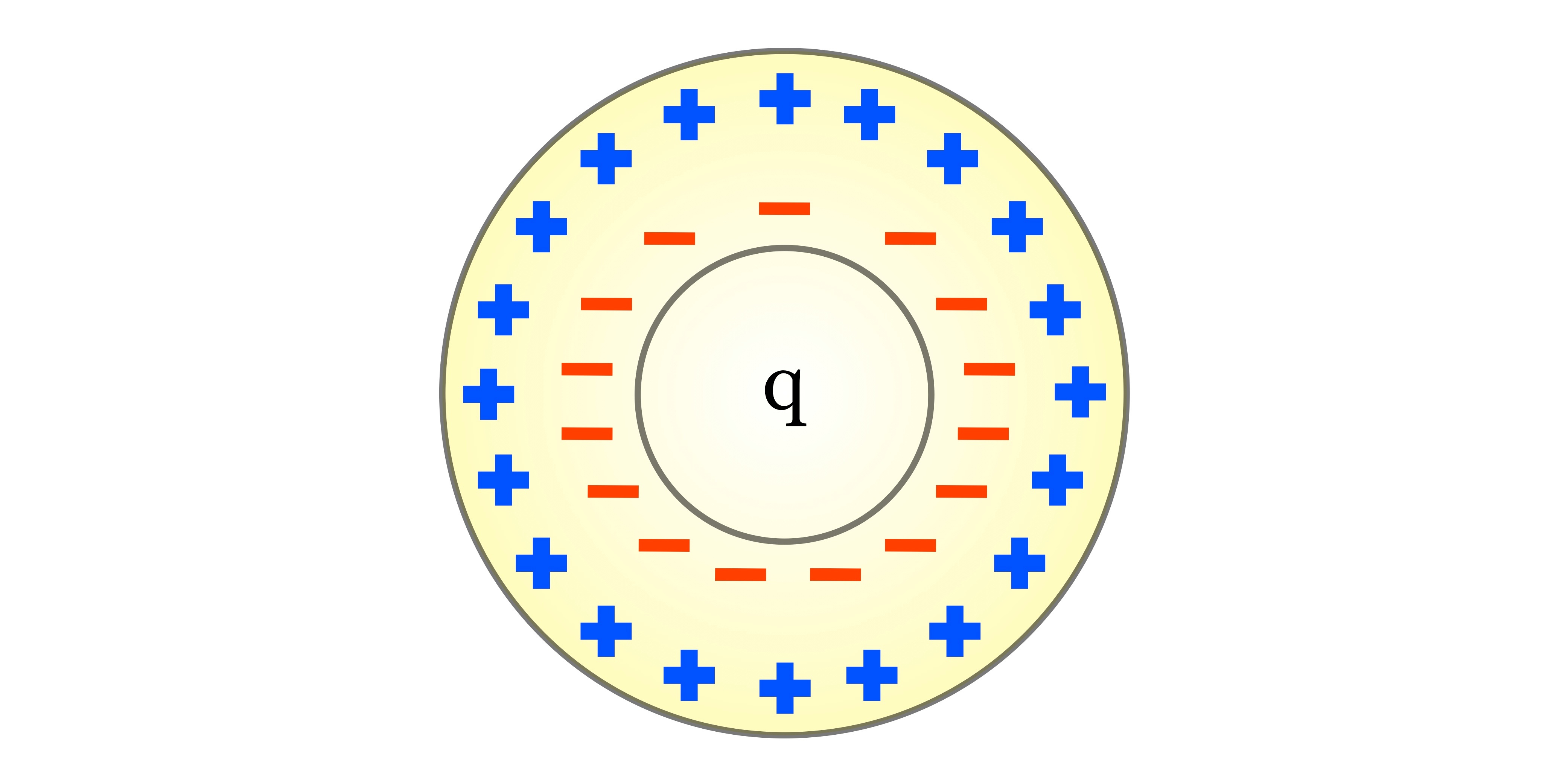
Net Positive Charge
After the electrons have moved towards the inner surface protons are left by themselves. This creates a net positive charge on the outer surface of the conductor.
The Middle Charge
A charge is placed in the middle of a hollow spherical conductor. In this demonstration we assume the charge to be positive.
Moving Electrons
Electrons are attracted to the middle positive charge so that they begin to pile up on the inner surface of the hollow conductor until they balance out the electric field
Example 3.1.2
A neutral infinite conducting slab is perpendicular to an applied uniform field E₀ in +x. Find its induced surface charge densities.
Authored clarification: Electrostatic equilibrium; no net slab charge; faces are normal to x.
In this scenario it is useful to recall the definition of the electric field of an infinite plate.
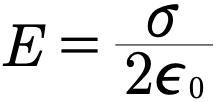
In this scenario we know that the electric field created by the induced charges inside the plate will cancel out the external electric field. Since charges will pile on top of the surfaces of our plate we consider each surface as an infinitely thin plate.
Since we have two oppositely charged infinite plates the field in between them will be two times the field of a single infinite plate with the desired charge distribution σ. The electric field produced by the plates is therefore given by
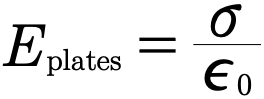
Since we know that the field inside in total must be zero the external and plates field must equal each other so that
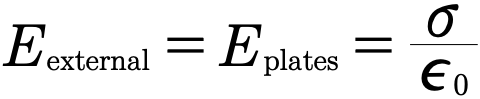
which allows of to determine the magnitude of each plates charge distribution

The second class of materials we will discuss is the insulator. An insulator is a material which inhibits the movement of electric charge. A perfect insulator is then a material which completely inhibits the free movement of electric charge.
The most well known type of insulator is probably rubber but plastics and ceramics are also commonly used as well as a wealth of other synthetic material. The most common is probably simple the gases in the air we breathe. Insulators are probably most well known for their uses in protection from electrocution but they are also extremely important in electronic applications to ensure that wires do not touch and short circuit causing device malfunction and a fire hazard.
As a final note we need to realize that although we have these two classes of materials materials rest on a continuum between inductive and insulating capabilities. Typically those materials which insulate well are called insulators and materials which conduct well are called conductors but a conductor will typically insulate to some very small degree and a insulator will conduct to some very small degree.
Reviewed worked examples
These authored derivations are paired with the original example identities. Added assumptions are stated.
Optional Gaussian-flux and potential-integral methods for conductor equilibrium. Prerequisites: charge conservation, spherical symmetry and radial integration. This preserved source example makes no AP coverage claim.
Example 3.1.1 · reviewed solution
A neutral isolated conducting spherical shell has inner radius a and outer radius b, with a point charge q at its center. Find its surface charges, densities and potential.
Authored clarification: Neutrality and isolation are explicit added conditions needed for the source’s outer-charge result.
Use zero field in conductor material.
A Gaussian surface within metal encloses zero net charge, so Qᵢₙ=−q.
Conserve the shell’s total charge.
Integrate exterior field to the shell.
Check
The metal potential is constant and generally nonzero.
Example 3.1.2 · reviewed solution
A neutral infinite conducting slab is perpendicular to an applied uniform field E₀ in +x. Find its induced surface charge densities.
Authored clarification: Electrostatic equilibrium; no net slab charge; faces are normal to x.
Equilibrium requires zero field in metal.
The induced field must be −E₀ x̂.
Opposite infinite sheets produce σ/ε₀ between them.
Assign signs to cancel the applied field.
Left face is negative and right face is positive.
Check
Existing charge redistributes; the induced sheets preserve neutrality.
Glossary and deeper reading · 6 refreshers
These editorial refreshers supplement the reading. Definitions and examples are added guidance; original source wording and recorded answers remain in their original context.
-
Electrical conductor
An electrical conductor contains charge carriers that can move through the material. In electrostatic equilibrium, mobile charges redistribute until the electric field within the conducting material is zero. For example, excess charge on an isolated metal object resides on its surface after the charges settle.
-
Electric charge
Electric charge is a conserved property that determines electric interactions. It can be positive or negative and is measured in coulombs; ordinary net charges arise from an imbalance of charged particles. For example, transferring electrons between initially neutral objects leaves one negatively charged and the other positively charged.
-
Electrostatic equilibrium
Electrostatic equilibrium is a condition in which the charge distribution has settled and there is no sustained motion of free charges. Within the material of an ideal conductor, the electric field is zero and the connected conductor is at one potential. For example, charges on a metal surface rearrange until any tangential surface field that would drive them has vanished.
-
Electric field
An electric field assigns the electric force per unit positive test charge to each location. The field is produced by the sources and is a vector, while the force on a negative charge points opposite the field. For example, the electric field between ideal parallel capacitor plates can accelerate an electron opposite the field arrows.
-
Magnetic flux
Magnetic flux measures the magnetic field’s perpendicular contribution through a chosen surface. For a uniform field and flat surface it depends on field strength, area, and the angle to the area normal, and it is measured in webers. For example, rotating a loop from face-on to edge-on to a uniform field reduces its flux magnitude toward zero.
-
Gauss’s law
Gauss’s law relates net electric flux through a closed surface to the net charge enclosed by that surface. The law always holds in its applicable electromagnetic model, while using it to calculate a field simply requires sufficient symmetry. For example, a charge outside a closed surface contributes zero net electric flux through the whole surface even though its field can be nonzero on parts of it.