The Electric Potential and Potential Energy
Original source retained for reference; this draft does not establish AP coverage.
Original author draft. Original wording and recorded answer states are preserved without claiming reviewed scientific correctness or AP alignment.
Physics 2 original textbook · Chapter 2
Section 1 Overview
Section 1
The Electric Potential and Potential Energy
Let’s revisit a situation we have thought of in the past. Consider a lone charged particle stuck in space. If we were to try and stick some other charged particle near it we would have to do work on the second particle in order to move it near the stationary charged particle. The instant we let moving particle go after pushing it near our stationary particle it would fly out eventually reaching some kinetic energy equal to the work we put into moving it near the stationary particle.
Let’s throw some math onto this scenario. The work needed to moving something with a force F is given by
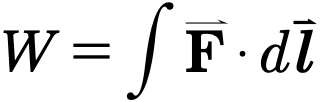
For quasistatic motion with no change in kinetic energy and only the electric and applied forces relevant, and . More generally, .
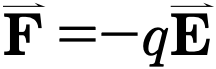
In other (mathematical) words we get for the work done on the moving particle that

Since we are bringing the proton in from some arbitrary point o which we call the reference point to some point b near the charged particle the boundaries would then read
Interactive 1.1 Electric Potential Energy
The Electric Field
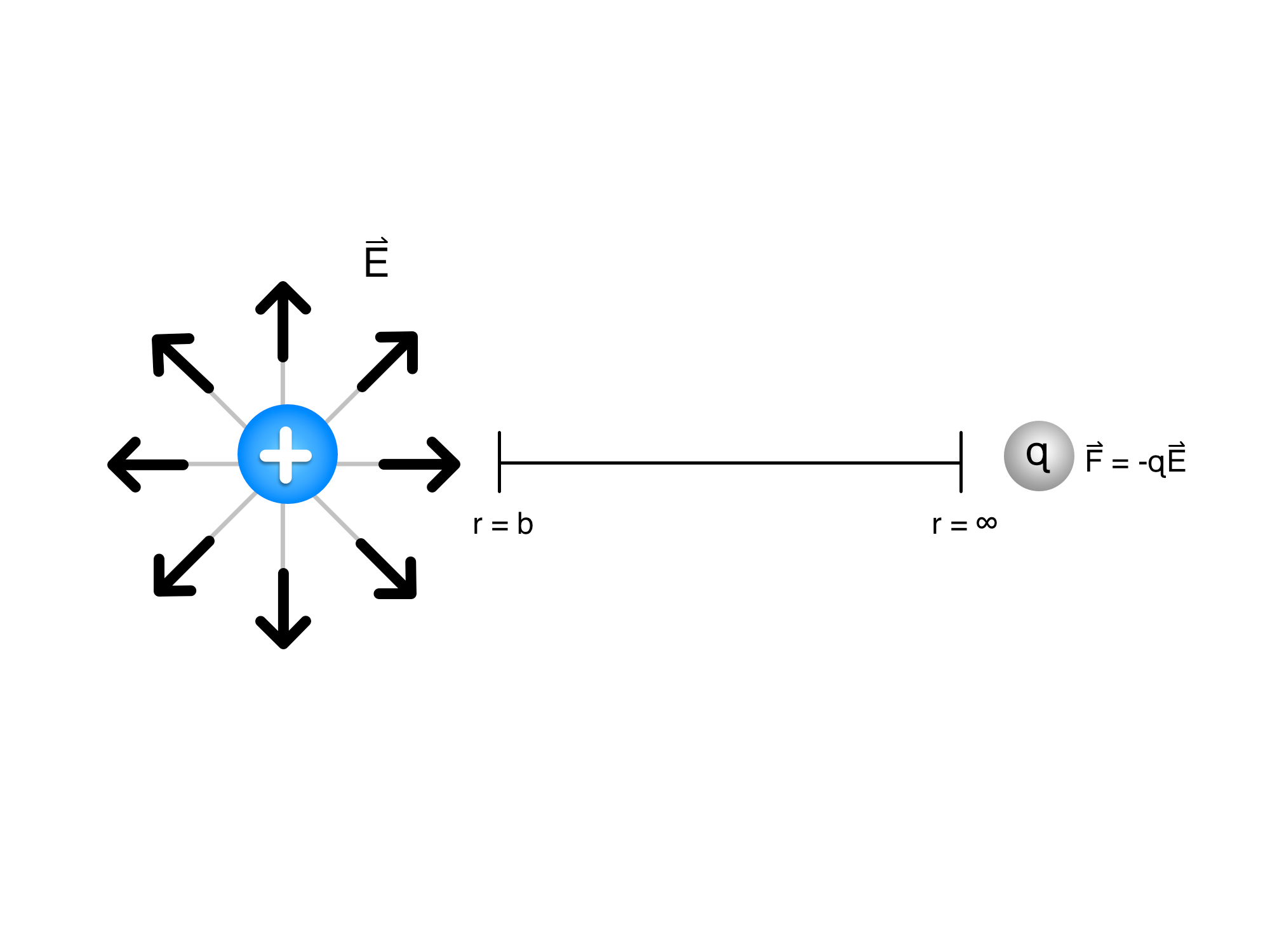
The electric field in this system is created by this positive particle. We denote it as E because this argument applies to any electric field.
Work Done
External work is the integral of the applied force along the path. For quasistatic motion, with no kinetic-energy change and no other work, it equals the change in electric potential energy. Otherwise use .
Force Applied to q
Under quasistatic conditions the applied force balances the electric force, . Its required direction depends on the sign of q and the path; moving a positive charge toward a positive source requires inward applied force.
Archived original widget · contains the source error
The electric field in this system is created by this positive particle. We denote it as E because this argument applies to any electric field.
Work as you may recall is given by the integral of the force with respect to x over a given distance. The work we put into this system is the potential energy. Using the force we apply on q we can then get an expression for the potential energy a system involving an electric field.
Moving the particle of charge q towards the positive particle requires us to apply a force opposite of the force the electric field from the positive particle applies to q. Since the force caused by the positive particle on the charge q is given by qE the force we must apply in moving q towards the positive particle is -qE.
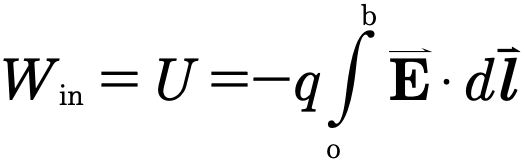
The above expression gives us the electric potential energy of the proton which we will designate with a U. In the above we can also pick out a new quantity to define which will soon be useful. The expression
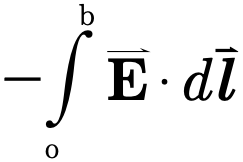
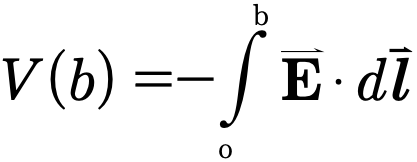
is called the electric potential. The electric potential at some arbitrary point b given the reference point o is often written
Example 2.1.1
Optional calculus derivation of the point-charge potential. Prerequisites: a radial integral and the reference V(∞)=0; the point-charge result can also be used directly. This preserved source example makes no AP coverage claim.
Find potential and energy for bringing charge q from infinity to distance r from a stationary charge q.
Authored clarification: V(∞)=0; quasistatic motion for external-work interpretation.
We will begin by finding the electric potential since to find the electric potential energy of our moving charge all that is needed is to multiply the electric potential by the charge.
The electric potential for some electric field with a reference point an infinite distance away is given by
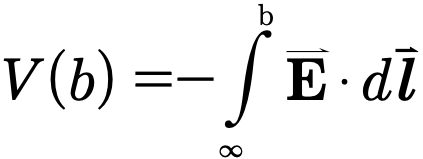
In this case the electric field is given by the stationary charge. As we have discussed the electric field created by a point charge is given by
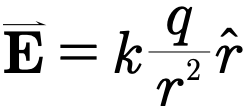
To simplify the math we will have our path be a straight line between our reference point and the point b. Doing so makes our path the radius making it parallel with the electric field of our point charge allowing us to simplify our integral.
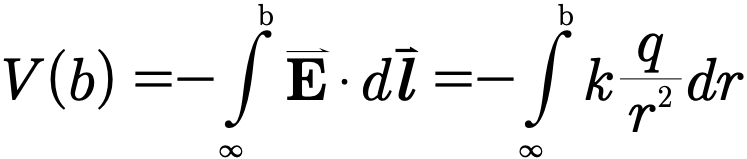
Now all that’s left is to do the integration.

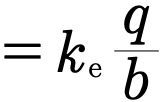
The electric potential for a point charge is then
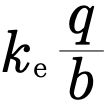
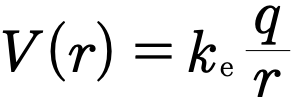
If we wish we can go ahead and change that b for an r to put it in the form it is commonly shown in.
The potential energy of a charge in this potential is then given by
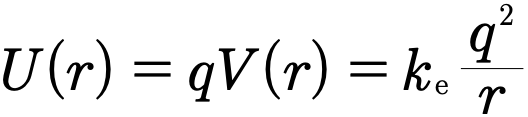
The electric potential we found in the previous example
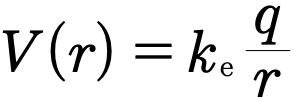
is the standard definition for the electric potential of a point charge a distance r away from the charge. Like the electric field the electric potential obeys the superposition principle so that if you have multiple charged particles in the vicinity of one another to determine the potential at some point around them you simply add the electric potentials due to each of the individual particles at that point.
Example 2.1.2
Two equal charges q are at (−a,0) and (+a,0), a=2 m. Find V(x,y).
Authored clarification: V(∞)=0 and coordinates are metres.
Let’s analyze this problem one charge at a time. The charge at (-2, 0) creates a potential according to the equation
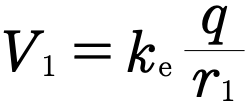
Taking r to be the distance from the particle to some arbitrary point on the grid we see that

Since the distance must take into account the small shift from the origin.
Similarly we may define a potential for the second particle
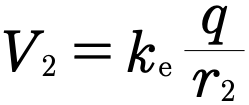
For the same reasons r may be defined by

Substituting in the corresponding r’s we can get the potential due to each particle separately.
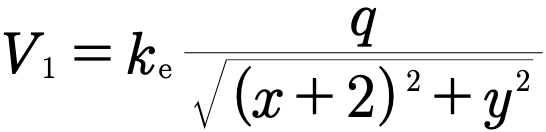
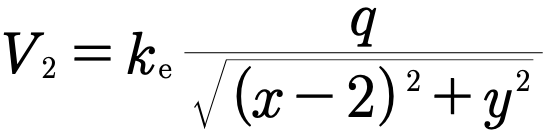
Now we invoke the superposition principle which allows us to sum the electric potentials due to each particle to get the total electric potential over the entire grid.

The potential itself isn’t much use except for ease of calculation of the electric field which we will discuss later but there is a quantity we can define which is easily measurable when experimenting. This is the voltage or potential difference between two points.
Using our definition of the electric potential we can mathematically define the voltage between points b and a.

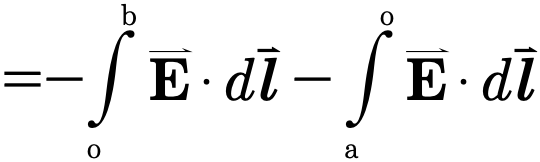
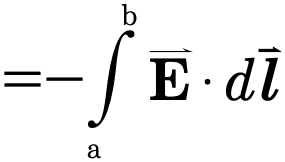
This value gives us what is commonly read off a voltmeter, something which will be discussed later in our section on circuits.
Interactive 1.2 The Potential Difference
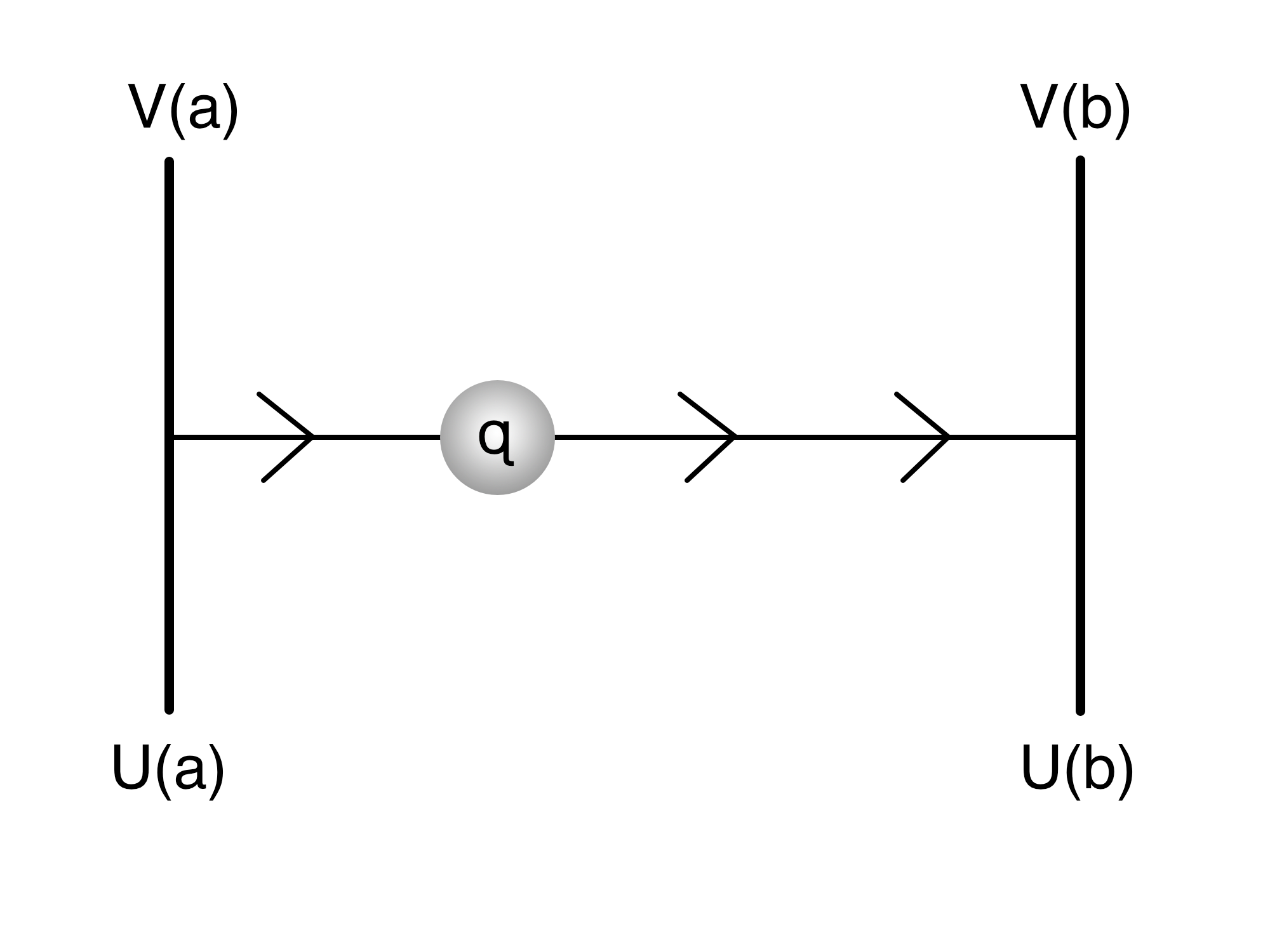
V and U linked
If you look back at the integral you see that U and V are just scalar multiple of one another. As a result as soon as you know V you also know U and can determine energy required or released in any movement of a charge.
The Charge
The charge here is dragged from the left to the right between two point a and b. Although a straight line is depicted it really doesn’t matter what path is taken since the voltage is path independent.

Example 2.1.3
A charge q moves from (0,1) to (2,3) in potential V=Axy+Bx−C. Find ΔU.
Authored clarification: Coordinates and coefficients have compatible units.

What is the potential energy associated with this move if the particle has charge q?
In this problem we are asked for the potential energy needed to move the particle from (0, 1) to (2, 3). As mentioned the change in potential energy is nothing more than the potential difference multiplied by the charge. Since we are given the charge outright this reduces the problem to a simple exercise in finding the potential difference.
At the point (2, 3) the potential is given by

At the point (0, 1) the potential is given by

The potential difference is nothing but these subtracted from one another


Finally the difference in potential energy is given by

Review 1.1 Section 1 Review
This review preserves the author’s recorded prompts, choices, and answer states. Corrected items have separate reviewed explanations and keys; unchanged draft keys are marked unreviewed. Unfinished items are not scored.
Original question 1
With V(∞)=0, is the potential at every finite point away from one isolated positive point charge positive?
Yes
No
Reviewed answer and reasoning
A
V=kQ/r>0 for Q>0. An added reference constant would change this sign statement, so the reference is essential.
This reviewed version states the assumptions or convention needed for one determinate answer. The archived source prompt and key are retained.
Archived original question and recorded key · contains the source error
A positive charge will produce a negative electric potential
True
False
Original recorded key: B
Original question 2
Moving a positive and negative charge together results in a decrease of potential energy.
True
False
Reviewed answer and reasoning
A
Opposite point charges have negative pair U=kq1q2/r; bringing them closer decreases U.
The independent semantic audit confirms this source prompt and recorded key under its stated conditions.
Archived original question and recorded key · contains the source error
Moving a positive and negative charge together results in a decrease of potential energy.
True
False
Original recorded key: A
Original question 3
With V(∞)=0, can three strictly positive point charges have zero potential at a finite point away from the charges?
No
Yes
Reviewed answer and reasoning
A
Every finite term kqᵢ/rᵢ is positive, so their scalar sum is positive.
Authored correction or explicit assumptions; this reviewed key is separate from the archived original recorded states.
Archived original question and recorded key · contains the source error
Three positive charges are placed on a grid. Is there any place where the electric potential is zero?
Yes
No
Need more information
Original recorded key: A
Original question 4
Infinite parallel nonconducting sheets with surface densities −σ and +σ are separated by d. For σ>0, what is V₊−V₋?
0
Reviewed answer and reasoning
A
Between the sheets E has magnitude σ/ε₀ and points from positive to negative potential. Integrate .
Authored correction or explicit assumptions; this reviewed key is separate from the archived original recorded states.
Archived original question and recorded key · contains the source error
Two infinite oppositely charged plates (-Q and Q) are separated by a distance d. What is the potential difference between them?
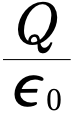
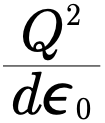
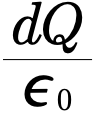
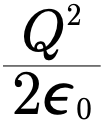
None of the above
Original recorded key: C
Original question 5
A test charge q moves from the negative sheet to the positive sheet in the preceding uniform-field setup. What is ΔU?
0
Reviewed answer and reasoning
A
Use with the stated start and end points.
Authored correction or explicit assumptions; this reviewed key is separate from the archived original recorded states.
Archived original question and recorded key · contains the source error
What is the potential energy difference associated with moving a charge q from one plate to another.
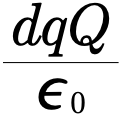
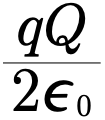
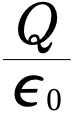
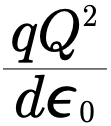
None of the above
Original recorded key: A
Original question 6
Is there a cow level?
Yes
No
Moooo!
Archived original question and recorded key · contains the source error
Is there a cow level?
Yes
No
Moooo!
Original recorded key: C
Unscored source item · Cow-level joke has no scientific answer; preserve as archival material and mark unscored.
Reviewed worked examples
These authored derivations are paired with the original example identities. Added assumptions are stated.
Optional calculus derivation of the point-charge potential. Prerequisites: a radial integral and the reference V(∞)=0; the point-charge result can also be used directly. This preserved source example makes no AP coverage claim.
Example 2.1.1 · reviewed solution
Find potential and energy for bringing charge q from infinity to distance r from a stationary charge q.
Authored clarification: V(∞)=0; quasistatic motion for external-work interpretation.
Use the stationary charge’s field.
Integrate to obtain potential.
Multiply by test charge.
Check
Like charges require positive quasistatic external work.
Example 2.1.2 · reviewed solution
Two equal charges q are at (−a,0) and (+a,0), a=2 m. Find V(x,y).
Authored clarification: V(∞)=0 and coordinates are metres.
Find each distance.
Potential is scalar.
Add kq/r from each charge.
Write the result.
Check
For large distance it approaches the potential of total charge 2q.
Example 2.1.3 · reviewed solution
A charge q moves from (0,1) to (2,3) in potential V=Axy+Bx−C. Find ΔU.
Authored clarification: Coordinates and coefficients have compatible units.
Evaluate start.
Evaluate end.
Subtract and multiply by signed q.
Check
The arbitrary additive constant C cancels.
Glossary and deeper reading · 6 refreshers
These editorial refreshers supplement the reading. Definitions and examples are added guidance; original source wording and recorded answers remain in their original context.
-
Electric potential
Electric potential is electric potential energy per unit charge relative to a chosen reference. It is a scalar measured in volts and can be positive, negative, or zero even where the electric field is nonzero. For example, contributions from equal positive and negative source charges can cancel the potential at a point without canceling their field vectors.
-
Potential energy
Potential energy describes energy associated with the configuration of interacting parts of a system. Its numerical zero is a chosen reference, while differences in potential energy determine physical energy changes. For example, separating Earth and a ball changes their gravitational potential energy even though the energy belongs to their interaction.
-
Kinetic energy
Kinetic energy is energy associated with motion relative to a chosen reference frame. For a nonrelativistic translating object it is one half of its mass times speed squared. For example, doubling a cart’s speed quadruples its translational kinetic energy when its mass stays fixed.
-
Mechanical work
Mechanical work is energy transferred by a force through displacement of its point of application. For a constant force on a particle, it depends on the force component along the particle’s displacement, and it can be positive, negative, or zero. For example, a magnetic force perpendicular to a particle’s displacement does zero work on that particle.
-
Force
A force describes an interaction that can change an object’s momentum. It is a vector measured in newtons, so both size and direction matter when forces are added. For example, a rope can pull a cart while the floor exerts friction in another direction.
-
Electric potential energy
Electric potential energy is energy associated with the configuration of interacting charges. Its value depends on the chosen reference, and a charge pair is counted once when calculating a system’s total pair energy. For example, bringing two positive point charges closer requires positive external work in a slow controlled approach.