Magnets and Magnetic Fields
Original source retained for reference; this draft does not establish AP coverage.
Original author draft. Original wording and recorded answer states are preserved without claiming reviewed scientific correctness or AP alignment.
Physics 2 original textbook · Chapter 5
Section Overview
Section 1
Magnets and Magnetic Fields
Almost without doubt you have probably come into contact with magnets. They are ubiquitous across the world and although they weren’t as commonly used when they were first discovered, humans have known of them for an extremely long time. The first recorded instances of magnets began with the greeks. They encountered a naturally occurring substance which we now call magnetite which exhibited novel effects when placed next to other pieces of magnetite.
These effects were magnetic phenomena which we have come to be extremely familiar with. Now we can readily create and magnetize materials to use. The horseshoe magnet is probably the most iconic but for ease of visualization we will start our study of magnetism with the bar magnet, a straight bar usually colored one half red and one half white.
A bar magnet is what we call a permanent magnet, an object which requires no constant external magnetic field to stay magnetized. Permanent magnets are made from ferromagnetic materials. A ferromagnetic material is a material which, when exposed to an external magnetic field, will align itself with that field. In contrast to a ferromagnetic material there are also diamagnetic materials which, when exposed to a magnetic field, oppose it.
Gallery 1.1 Magnets

The ubiquitous bar magnet is pictured above. We have colored the north pole red and south pole blue.
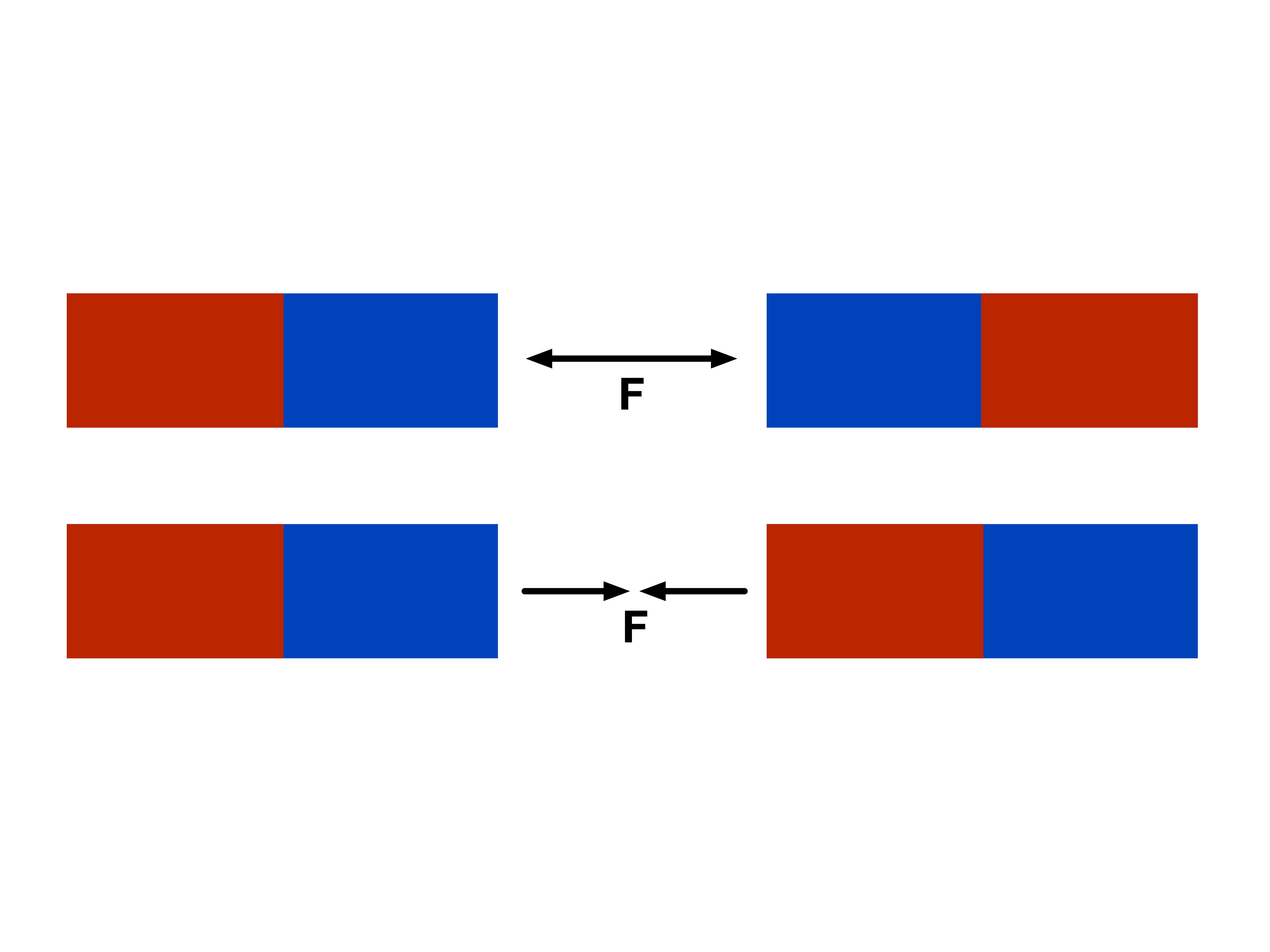
When like poles are placed near one another they repel. When opposite poles are placed together they attract.
Much in the style of electric charges. If the bar magnets attracted one another we would say that we had touched together opposite ends. Conversely if the bar magnets repelled each other we would say that the ends were the same end. Typically these different ends are labeled by convention as north and south.
To describe these effects we again make use of the vector field. Like the electric field, a magnetic field can be created where every point in space is assigned a direction and magnitude detailing magnetic effects in the region. In turn, the field can help describe what will happen when another magnetized object is placed inside the field. As with the electric field we will visually demonstrate the magnetic field using field lines.
Magnetic field lines form closed loops: outside a bar magnet they go from north to south, and inside from south to north. They do not begin or end at the poles.
In the depicted end-to-end arrangement, facing unlike poles attract and facing like poles repel. Field-line alignment alone is not a universal criterion for magnetic attraction.
Using our convention this can be checked. When field lines align, opposite poles will be facing each other and when field lines oppose like poles will be facing each other leading to repulsion.
As a final note: the letter B is used to denote the magnetic field. The units of B are the Tesla (denoted by a T) or the Gauss (denoted by a G). These two units are essentially equivalent, they differ only by their magnitudes since

Gallery 1.2 Field Lines of a Bar Magnet
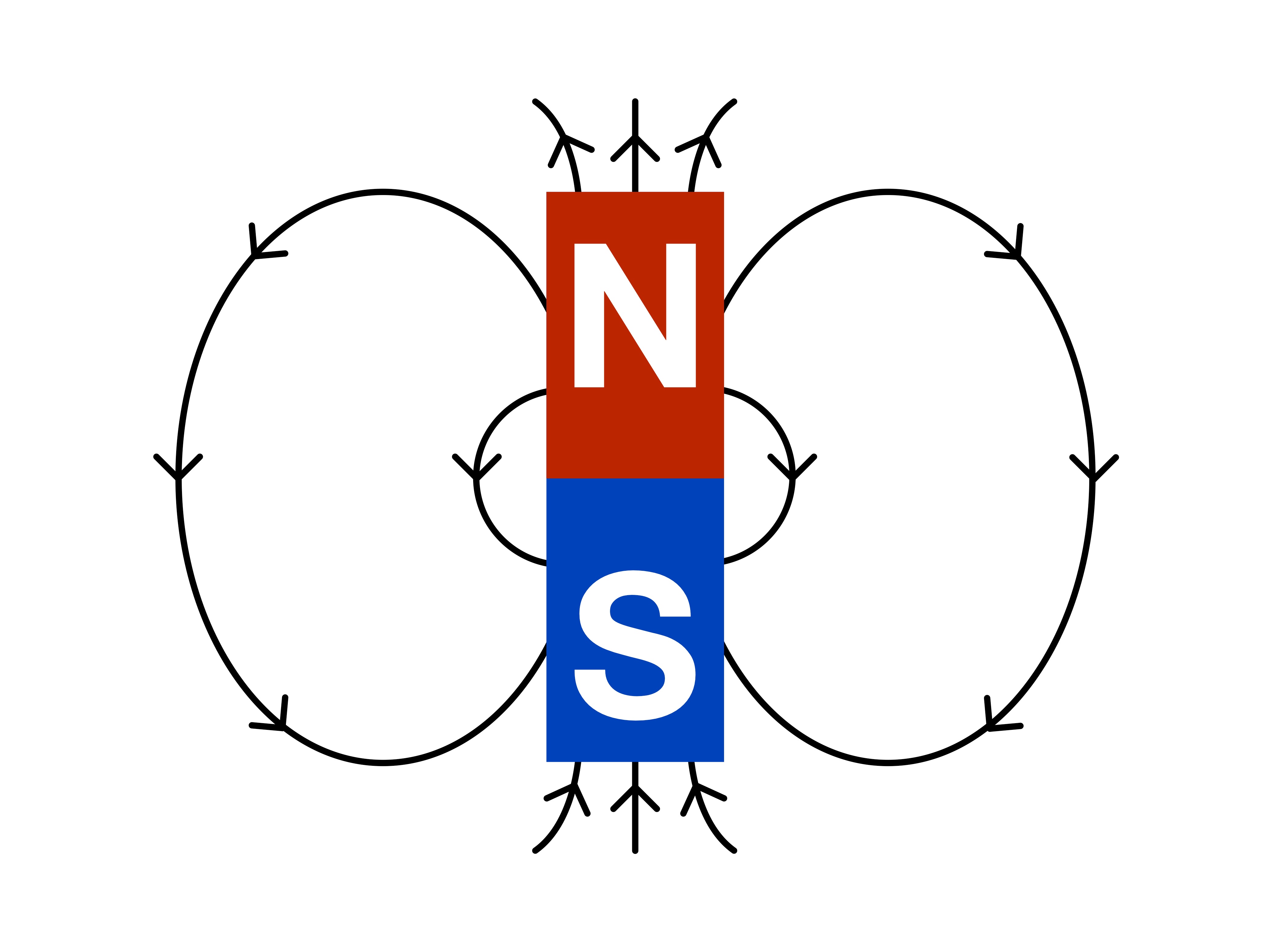
Like with the electric field the magnetic field can be described in terms of field lines. The field lines of the bar magnetic are pictured above.
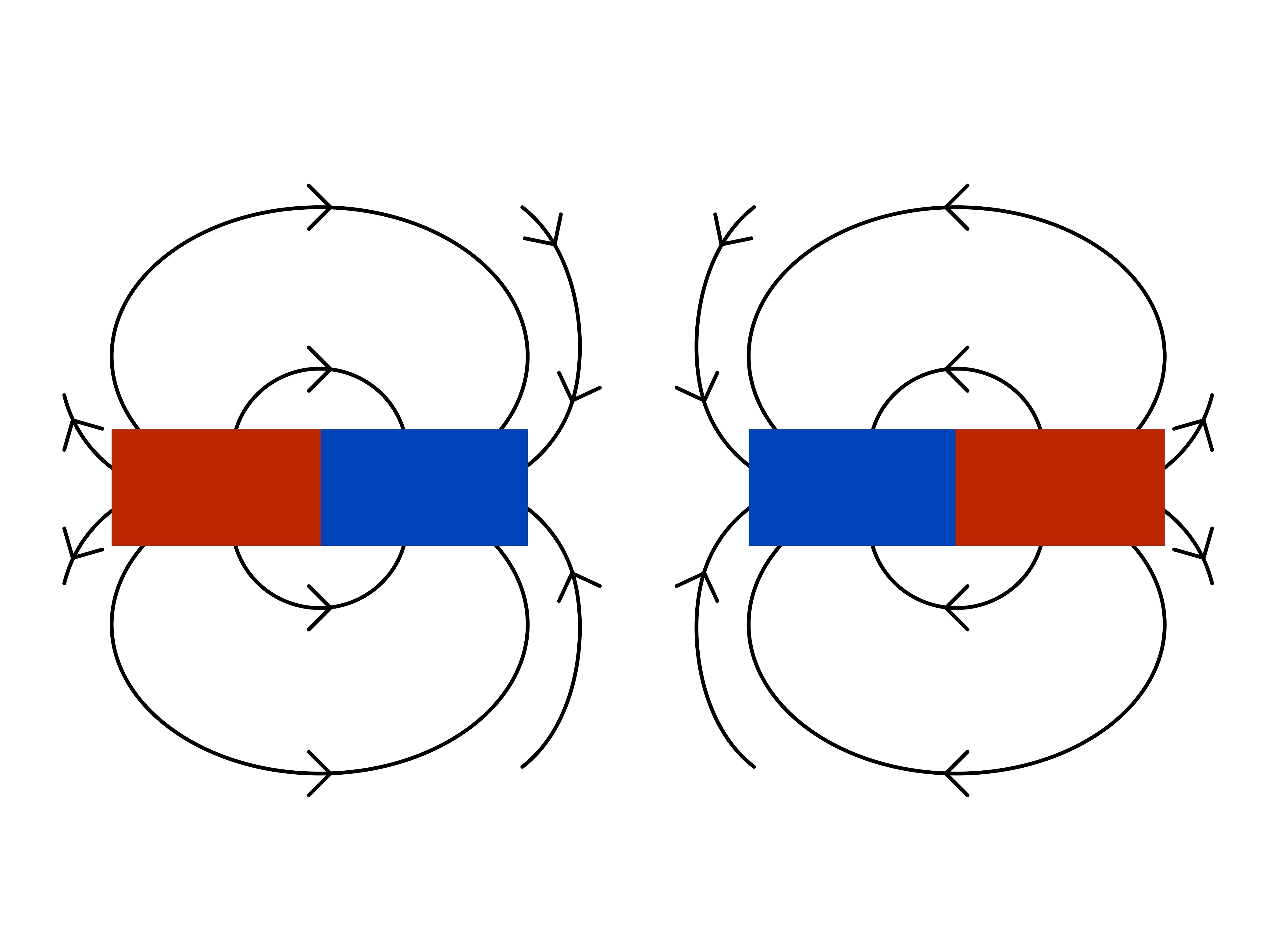
When like poles are placed next to one another field lines repel.
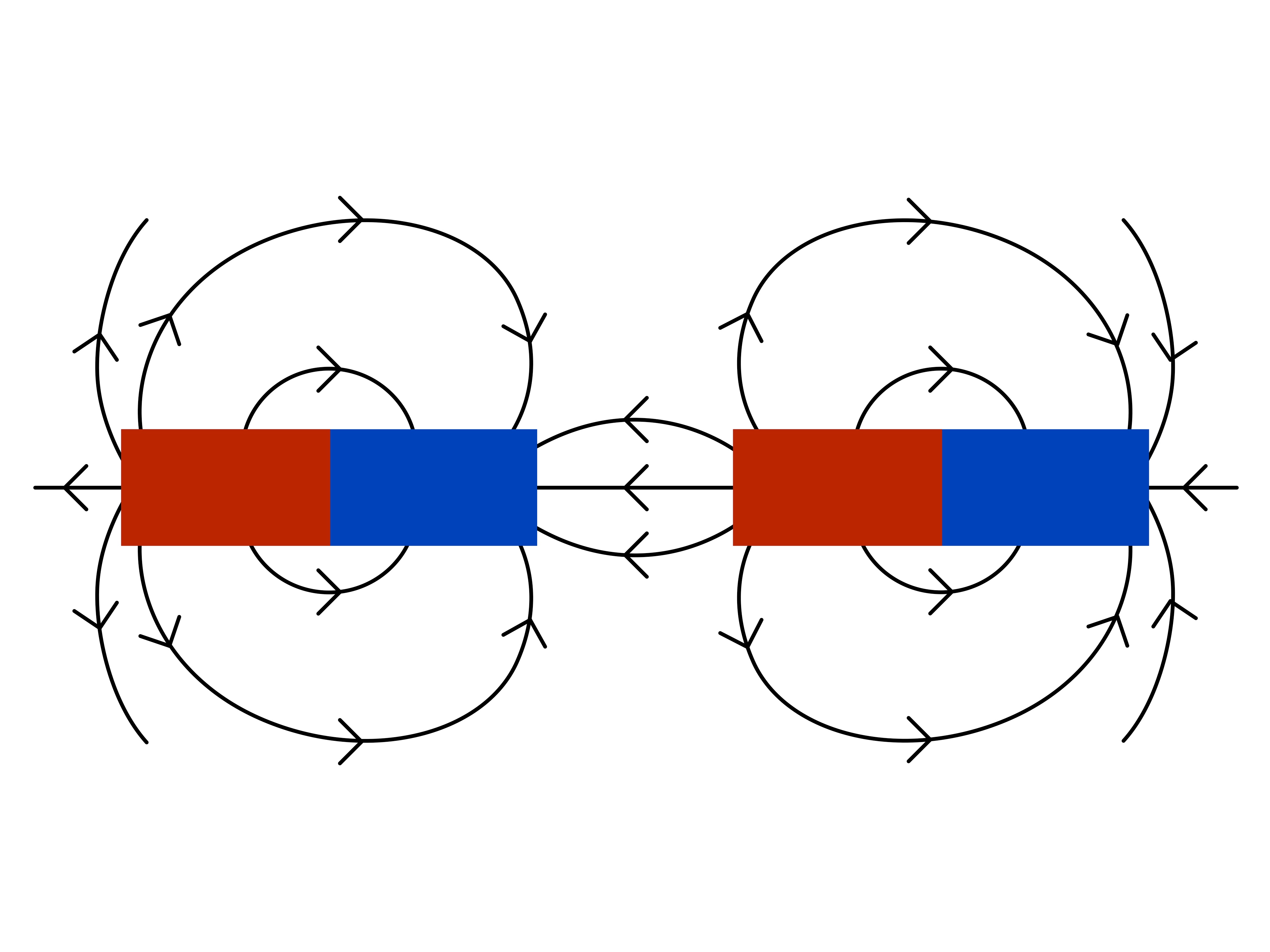
When opposite poles are placed next to one another the field lines of a magnet are aligned.
Before we begin working with the meat of magnetic phenomena, let’s go over a small amount of necessary mathematics. There is a certain vector operation called the cross product that we will be using extensively in this chapter.
If we let

and
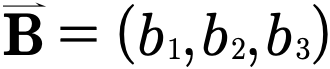
Then the cross product between A and B is given by

where the vector C is defined as
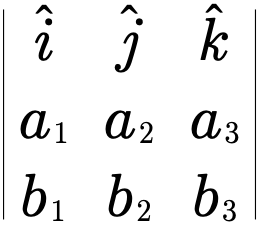
Where the bars represent the determinant of the given matrix. The magnitude of the resultant vector is given by

Where A and B are the vector as defined in the cross product and θ is the smallest angle between A and B.
To determine what C is we must calculate the given determinant using some method. One method will be shown in an example but there are others.
Example 5.1.1
Optional vector-mathematics supplement. Prerequisites: three-dimensional components and a determinant for the cross product. This preserved source example makes no AP coverage claim.
For A=(1,2,1) and B=(3,3,1), find A×B.
Authored clarification: Right-handed Cartesian coordinates.
Reviewed worked solution:
Compute x component.
Compute y component.
Compute z component.
Answer:
Check: The result has zero dot product with A and with B.
Reviewed worked examples
These authored derivations are paired with the original example identities. Added assumptions are stated.
Optional vector-mathematics supplement. Prerequisites: three-dimensional components and a determinant for the cross product. This preserved source example makes no AP coverage claim.
Example 5.1.1 · reviewed solution
For A=(1,2,1) and B=(3,3,1), find A×B.
Authored clarification: Right-handed Cartesian coordinates.
Compute x component.
Compute y component.
Compute z component.
Check
The result has zero dot product with A and with B.
Glossary and deeper reading · 10 refreshers
These editorial refreshers supplement the reading. Definitions and examples are added guidance; original source wording and recorded answers remain in their original context.
-
Magnetic field
A magnetic field assigns a vector direction and strength to each location and predicts interactions with moving charges, currents, and magnetic materials. Its strength is measured in teslas, and the force on a moving charge need not point along the field. For example, a compass aligns with the local field while a moving charge can be deflected perpendicular to it.
-
Ferromagnetism
Ferromagnetism is a strong collective magnetic response associated with aligned domains. Some ferromagnetic materials can retain substantial magnetization after an applied field is removed. For example, iron can become a permanent magnet when enough domain orientations remain aligned.
-
Diamagnetism
Diamagnetism is an induced magnetic response opposing an applied magnetic field. All materials have a diamagnetic contribution, but stronger magnetic responses can hide it in the net behavior. For example, a material described as diamagnetic has a net response weakly opposed to the applied field.
-
Electric charge
Electric charge is a conserved property that determines electric interactions. It can be positive or negative and is measured in coulombs; ordinary net charges arise from an imbalance of charged particles. For example, transferring electrons between initially neutral objects leaves one negatively charged and the other positively charged.
-
Vector
A vector is a quantity with a magnitude and a direction, represented by an arrow or by components along chosen axes. Vectors add by adding corresponding components rather than simply adding their magnitudes. For example, an eastward displacement followed by a northward displacement produces a resultant pointing northeast. The zero vector has zero magnitude and no unique direction.
-
Electric field
An electric field assigns the electric force per unit positive test charge to each location. The field is produced by the sources and is a vector, while the force on a negative charge points opposite the field. For example, the electric field between ideal parallel capacitor plates can accelerate an electron opposite the field arrows.
-
Field line
A field line is a drawn curve whose tangent shows the local direction of a vector field. Closer spacing conventionally represents greater field strength, and lines are a representation rather than physical threads. For example, electric field lines point away from a positive point charge and toward a negative one.
-
Magnitude
Magnitude is the nonnegative size of a vector quantity. It does not specify direction, and it differs from a signed component. For example, a westward velocity can have a negative x component while its speed, the velocity magnitude, stays positive.
-
Cross product
A cross product combines two vectors to form a vector perpendicular to both. Its magnitude depends on both magnitudes and the sine of their included angle, while reversing input order reverses its direction. For example, a force whose line of action passes through the pivot gives zero torque cross product about that pivot.
-
Resultant vector
A resultant vector is the vector sum of two or more vectors. Its components are the sums of the corresponding components of the vectors being combined. For example, two equal forces in opposite directions have a zero resultant even though both forces are present.