Charges in Magnetic Fields
Original source retained for reference; this draft does not establish AP coverage.
Original author draft. Original wording and recorded answer states are preserved without claiming reviewed scientific correctness or AP alignment.
Physics 2 original textbook · Chapter 5
Section Overview
For motion perpendicular to a uniform magnetic field, the force magnitude is and the nonrelativistic circular radius is . A parallel velocity component produces helical motion.
Charges in Magnetic Fields
Suppose we somehow induced a uniform magnetic field and then we shot a charged object through it. What would you expect to happen? It is perfectly conceivable that the object would move straight through the field without any interference, and it does in certain circumstances, but what is truly interesting is that in other circumstances the path of the charged object will actually curve.
Since this object is changing it’s path we know that there must be some force acting on it and after careful experimentation we can figure out exactly what equation describes this force. Unlike gravitation this force does not depend upon the mass of the object but instead on the objects charge, the objects velocity, and the orientation of the magnetic field which the object is placed in. If we use B to denote the magnetic field, let v be the velocity of the object, and use Q as the quantity of charge that the object has then the force F on that object is given by

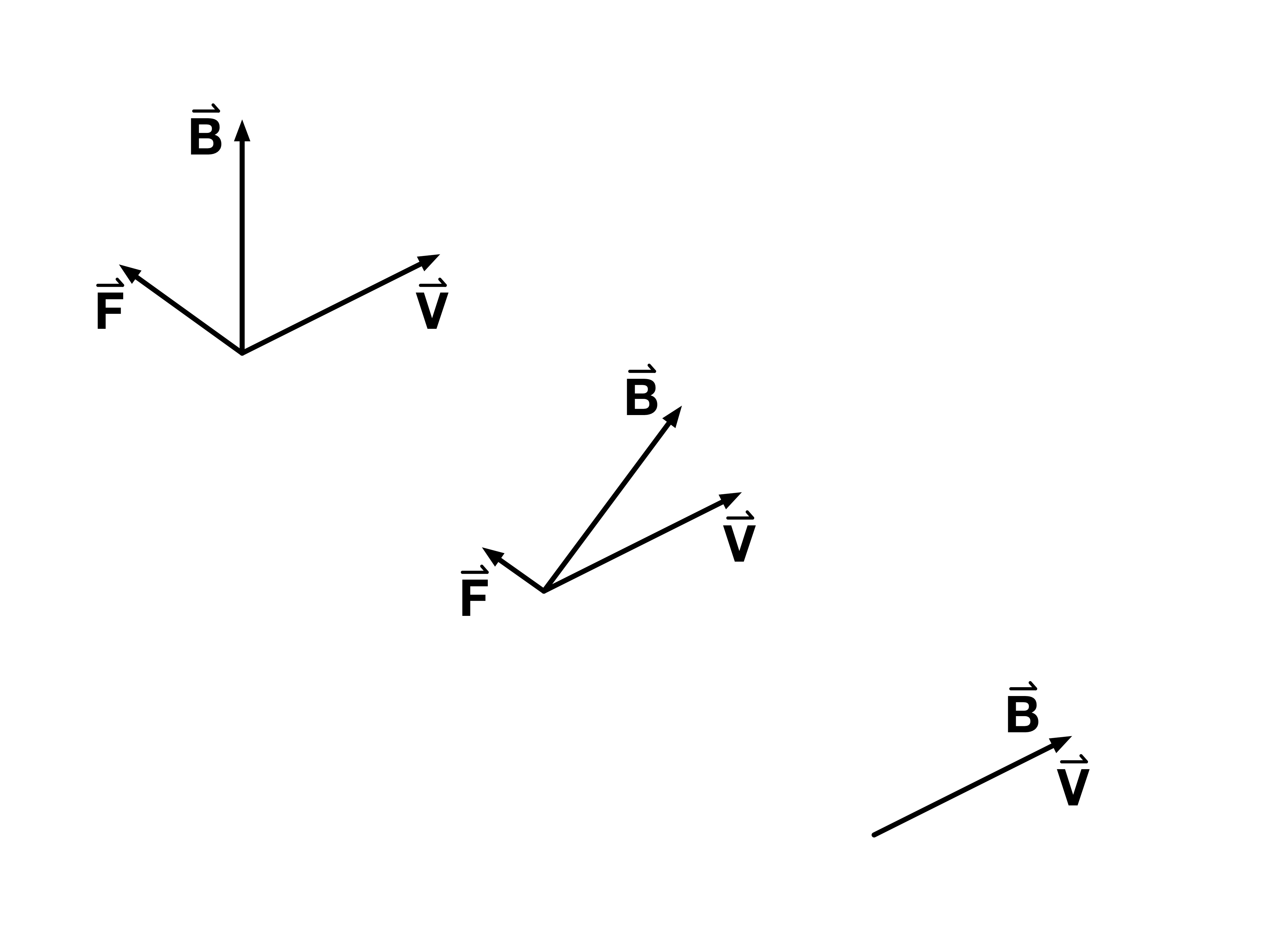
Interactive 1.1 What the Cross Product means
Parallel
Once the magnetic field and the particles velocity are parallel (or anti-parallel) there ceases to be a force.
Closing the Gap
Once the velocity of the particle and the magnetic field cease to be perpendicular the magnitude of force on the particle begins to decrease.
Perpendicular Vectors
When the magnetic field and velocity are perpendicular the force on a moving charged particle is the strongest.
Example 5.2.1
Optional arbitrary-angle particle-force extension. For positive v and b, the stated velocity makes a 45° angle with the field. Prerequisites: vector components and a cross product; AP quantitative particle-force tasks are limited to 0°, 90° and 180°. This preserved source example makes no AP coverage claim.
A particle of charge Q has v=(0,v,v) in B=(0,b,0). Find instantaneous force.
Authored clarification: No electric force is specified.
This problem requires nothing more from us than to use our magnetic force law to calculate the force on the particle using the given parameters and our understanding of the mathematics involved.
The first thing we must do is setup the necessary matrix. For our problem we get that
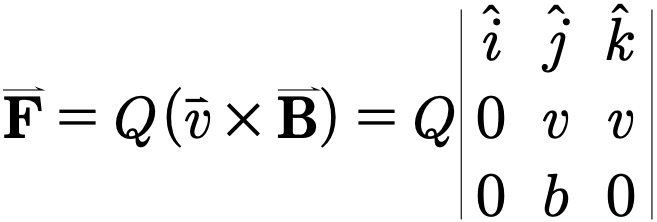
Using an augmented matrix to calculate the determinant we get the required result

Gallery 1.3 Charges in a Magnetic Field
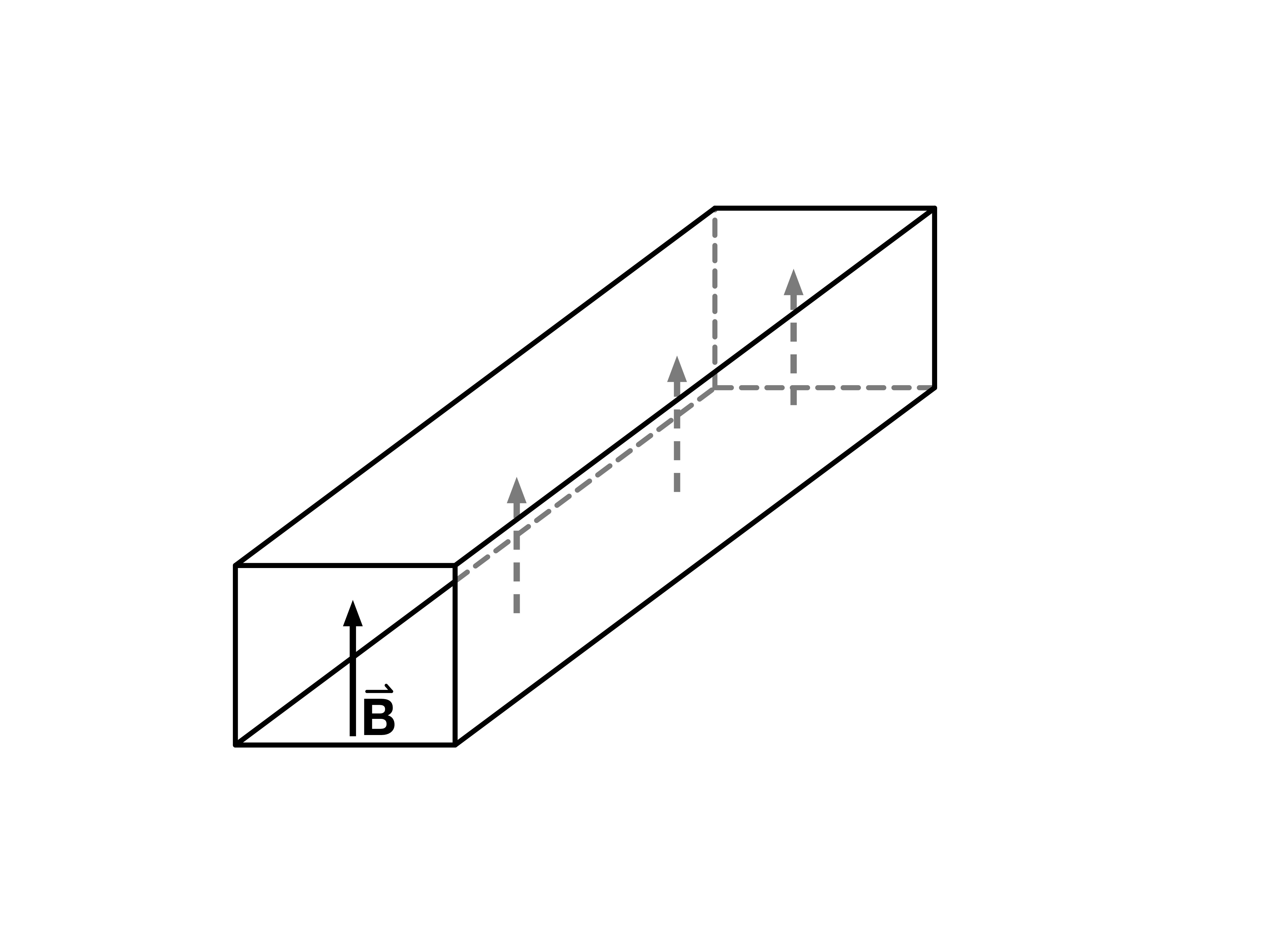
A rectangular tube is permeated by a magnetic field pointing upwards.
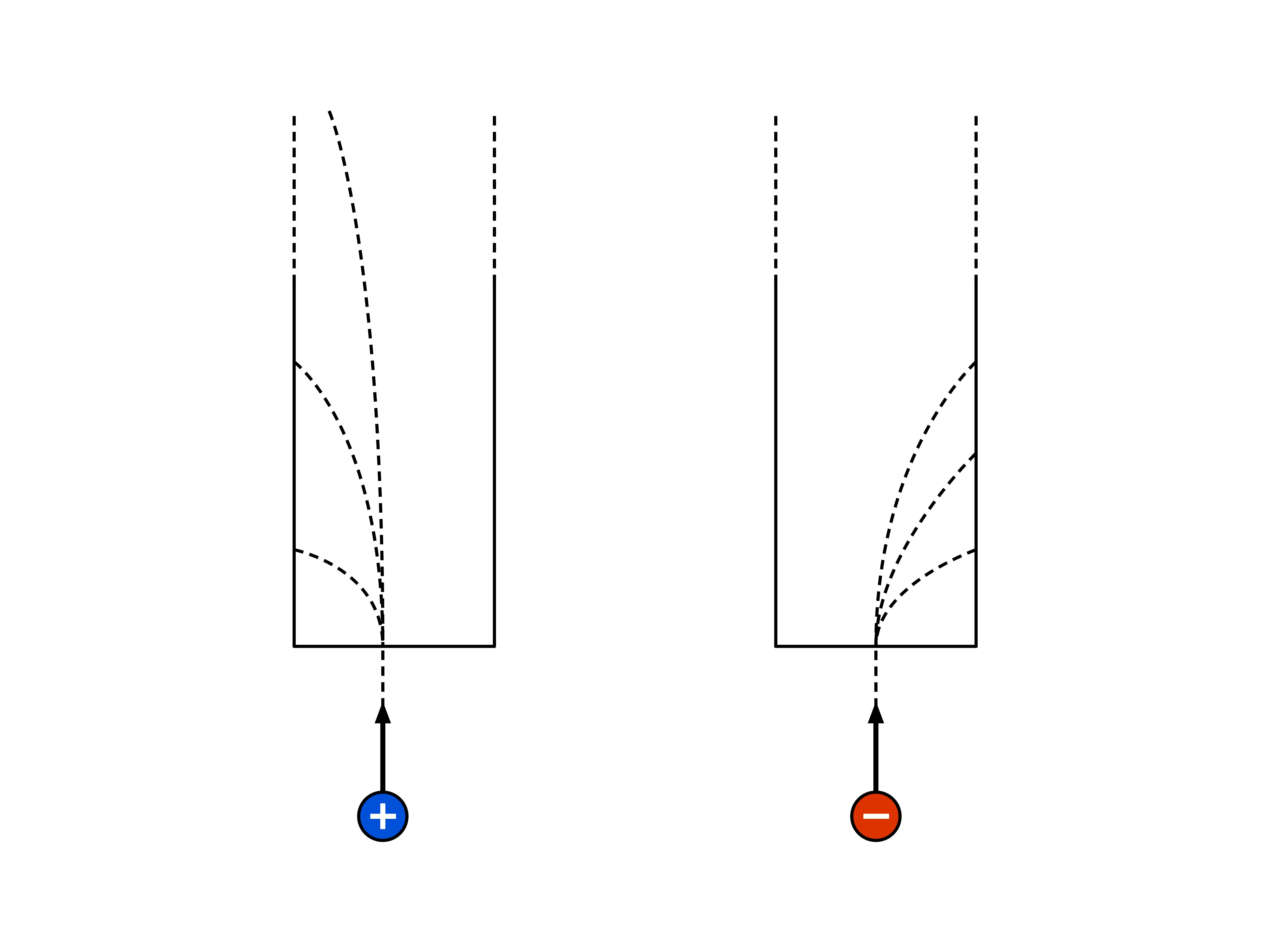
As charges particles move into box depending upon their charge they are either pulled to the left of right by the magnetic field. How far forward they get before hitting the side depends on their mass and velocity.
Using this idea it is possible to create a charge selector using only a magnetic field. We start by creating some type of rectangular tube and inside induce a uniform magnetic field which points in a single direction and is perpendicular to one side of the tube. When charged particles are shot through the tube they will be deflected one of two ways depending upon the orientation of the magnetic field and the charge of the particle.
Interactive 1.2 Cyclotron Motion
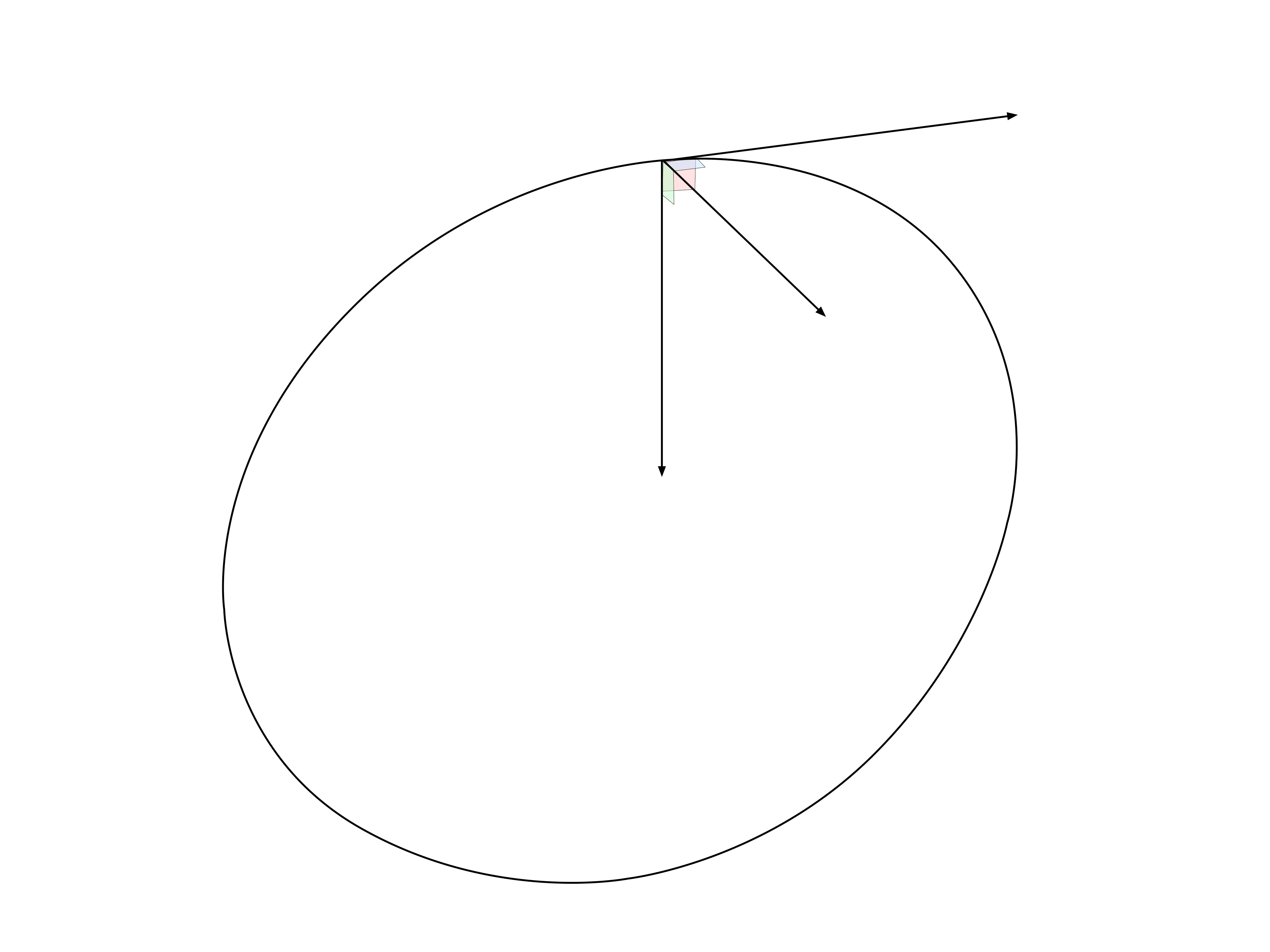
The Magnetic Field
The magnetic field here points perpendicular to the plane of the circle.
The Magnetic Force
As the particle moves along the circular path the magnetic force remains pointing toward the center of the circle. As a result it is a centripetal acceleration which forces the particle into circular motion.
The Velocity
THe magnitude of the particles velocity stays fixed. THe direction of this velocity does move though as a result of the magnetic field.
Using newtons laws and realizing that the force and velocity vectors of our particle at separated by 90 degrees we get that
Which becomes
after making the appropriate substitutions for a realizing that it is a centripetal acceleration.
Example 5.2.2
A proton and electron have equal speeds perpendicular to the same uniform B. Compare their circular radii.
Authored clarification: Nonrelativistic speeds and no other forces.
Reviewed worked solution:
Equate force magnitude to centripetal requirement.
Solve for radius.
Use equal speed and equal charge magnitudes.
Answer: The proton radius is about 1836 times the electron radius; their turn directions are opposite.
Check: Radius must be positive for both signs of charge.

Reviewed worked examples
These authored derivations are paired with the original example identities. Added assumptions are stated.
Optional arbitrary-angle particle-force extension. For positive v and b, the stated velocity makes a 45° angle with the field. Prerequisites: vector components and a cross product; AP quantitative particle-force tasks are limited to 0°, 90° and 180°. This preserved source example makes no AP coverage claim.
Example 5.2.1 · reviewed solution
A particle of charge Q has v=(0,v,v) in B=(0,b,0). Find instantaneous force.
Authored clarification: No electric force is specified.
Use magnetic force law.
Compute the only nonzero cross-product component.
Multiply by signed charge.
Check
F·v=0, so magnetic force does no work.
Example 5.2.2 · reviewed solution
A proton and electron have equal speeds perpendicular to the same uniform B. Compare their circular radii.
Authored clarification: Nonrelativistic speeds and no other forces.
Equate force magnitude to centripetal requirement.
Solve for radius.
Use equal speed and equal charge magnitudes.
The proton radius is about 1836 times the electron radius; their turn directions are opposite.
Check
Radius must be positive for both signs of charge.
Glossary and deeper reading · 4 refreshers
These editorial refreshers supplement the reading. Definitions and examples are added guidance; original source wording and recorded answers remain in their original context.
-
Magnetic field
A magnetic field assigns a vector direction and strength to each location and predicts interactions with moving charges, currents, and magnetic materials. Its strength is measured in teslas, and the force on a moving charge need not point along the field. For example, a compass aligns with the local field while a moving charge can be deflected perpendicular to it.
-
Force
A force describes an interaction that can change an object’s momentum. It is a vector measured in newtons, so both size and direction matter when forces are added. For example, a rope can pull a cart while the floor exerts friction in another direction.
-
Electric charge
Electric charge is a conserved property that determines electric interactions. It can be positive or negative and is measured in coulombs; ordinary net charges arise from an imbalance of charged particles. For example, transferring electrons between initially neutral objects leaves one negatively charged and the other positively charged.
-
Velocity
Velocity describes how position changes with time and includes direction. Instantaneous velocity describes one moment, while average velocity is displacement divided by elapsed time. For example, a car turning a corner can change velocity while maintaining the same speed.